
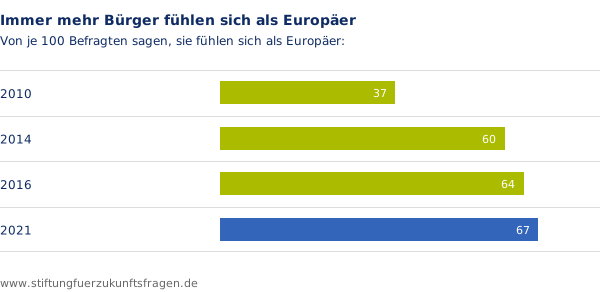
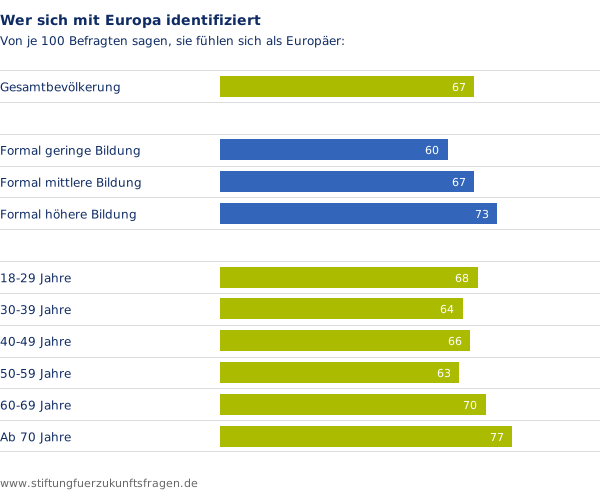
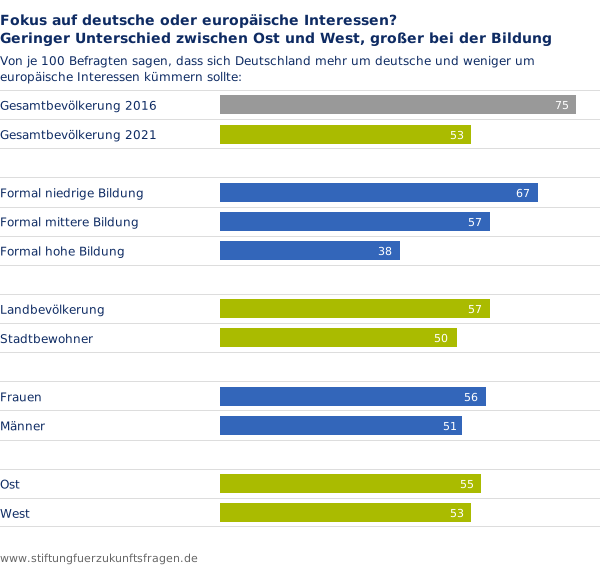
Currently, two out of three Germans feel European. But this wasn't always the case. During the euro and financial crisis, less than two out of five Germans agreed with this statement. The current coronavirus pandemic, therefore, has not had a negative impact on this fundamental sense of European identity. Quite the contrary, in fact, because parallel to the growing personal feeling of belonging to Europe, the desire within the population for Germany to focus more on German and less on European interests has fallen by 22 percentage points in the last five years.
These figures are encouraging, because a key prerequisite for the success of the European Community lies in the emotional connection people have with their continent. However, the image of the European Union often remains vague, and its strengths are not easily grasped. For many citizens, the EU seems abstract, lacking in substance, and bureaucratic.
An even more positive perspective on Europe could be achieved if the potential for positive identification were already recognized as inherent in the citizen and built upon. The identity of each individual is not immutable or a biological given, but is shaped and influenced by socialization, group affiliation, and social roles.
Differentiation from others is also an important social behavior for developing self-awareness. This differentiation, however, does not imply rejection or devaluation of others. It fosters engagement, exchange, and the experience of commonalities and differences. Important spaces for this engagement include family and friends, as well as institutions such as schools, universities, and businesses. A continuous exchange of experiences leads to greater self-knowledge and a more complex identity, one that does not exist in a single form but adapts in diverse ways to the respective social demands. After all, one is not only a father or mother, a doctor or caregiver, a Spaniard or a Finn, but also a daughter or son, a neighbor, a friend, and a European.
Therefore, a forward-looking approach would be to create better institutional frameworks that strengthen a positive emotional connection to Europe, allowing every citizen to flourish. This could include, for example, improved transparency and clarification of structural processes, more intensive communication of successful decisions, concepts, and agreements, visible joint action in openness and solidarity, and greater participation from civil society. If more societal forces – from politics and business to science and culture, and the general public – collaborate on this, a strong European identity could and would develop.
The goal of "More Europe" is undoubtedly one of the most important societal issues of the future, and therefore must be addressed with foresight and responsible future-oriented thinking in order to seize the opportunities and minimize the risks. Europe is now far more than just a guarantor of peace. The EU ensures consumer protection, jobs, fair competition, security, and environmental protection. It enables all Europeans to live and work anywhere within the EU and, with its shared values, offers the world a benchmark for human rights, democracy, social cohesion, and equal opportunities. It is therefore more urgent than ever to shape Europe's role in the world and its future positively through creative, innovative, and forward-looking solutions.
 EN
EN  DE
DE