
Data as table
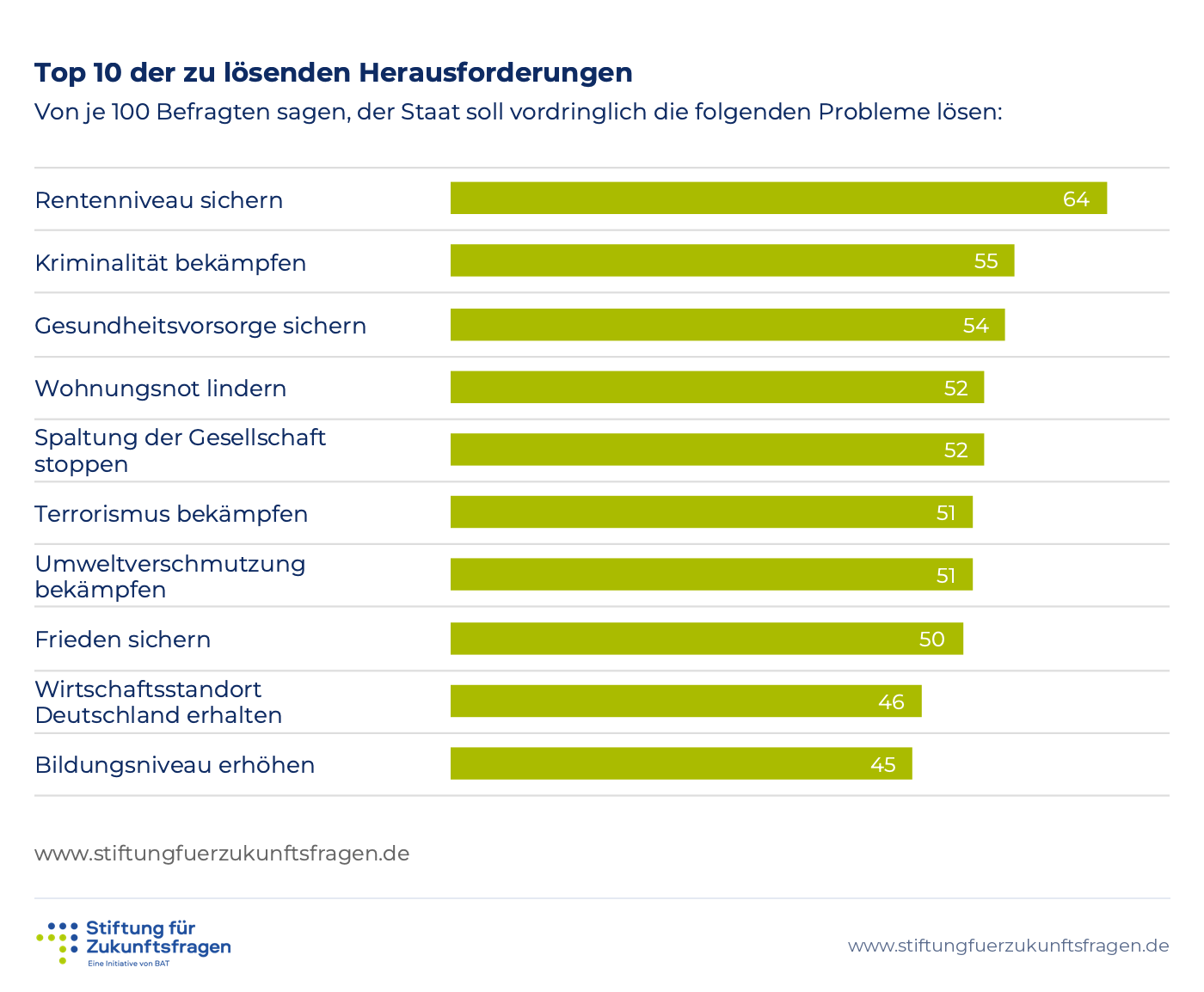
| Securing pension levels | 64 |
| Fighting crime | 55 |
| Ensure healthcare | 54 |
| Alleviating the housing shortage | 52 |
| Stop the division of society | 52 |
| Combat terrorism | 51 |
| Combat environmental pollution | 51 |
| Securing peace | 50 |
| Maintaining Germany's economic position | 46 |
| Raise the level of education | 45 |
In politics, especially during election campaigns, many important topics are always discussed, from tax reforms to investments in environmental protection to shares for the pension fund. But what do German citizens see as the most important task of a government in 2021? Which problems do the German population believe must be addressed and solved as a matter of urgency?
The BAT Foundation for Future Issues asked itself this question and surveyed 3,000 people aged 18 and over. A special feature of the study is the long-term comparison from 1989 to 2021.
The population has concrete ideas about which challenges should be prioritized in the future. Securing pensions is at the top of the list as the state's most important future project. Combating crime and ensuring healthcare follow closely behind – hardly surprising in times of Covid. A majority also cites current challenges such as alleviating the housing shortage and halting societal division.
A central theme of the election campaign and public debate of recent years, stopping climate change, follows somewhat behind in sixth place in the ranking. Other pressing problems, from the public's perspective, are raising the level of education and combating unemployment.
Data as table
| 1989 | 2021 | |
|---|---|---|
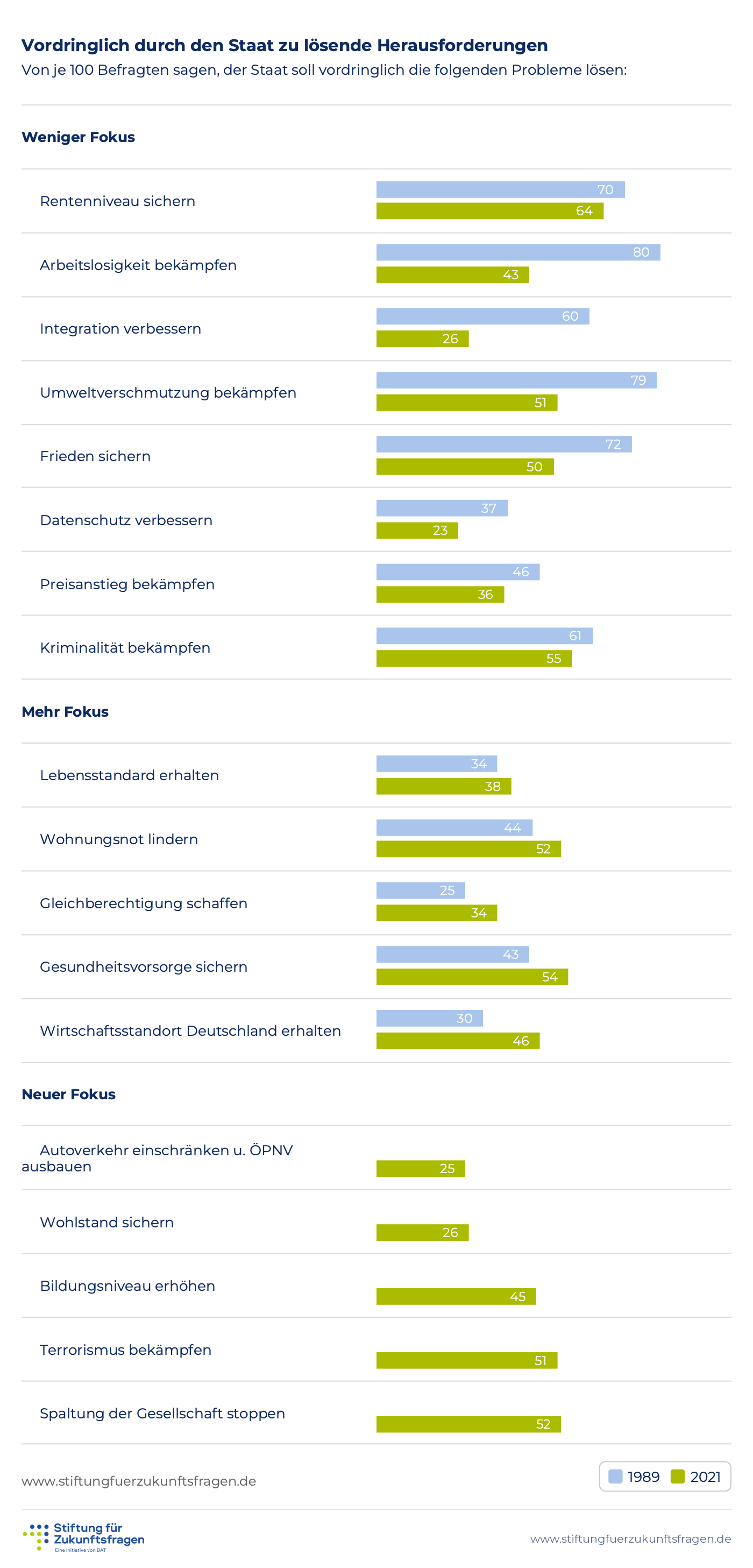
| Securing pension levels | 70 | 64 |
| Combating unemployment | 80 | 43 |
| Improve integration | 60 | 26 |
| Combat environmental pollution | 79 | 51 |
| Securing peace | 72 | 50 |
| Improve data protection | 37 | 23 |
| Combating price increases | 46 | 36 |
| Fighting crime | 61 | 55 |
| 1989 | 2021 | |
|---|---|---|
| Maintain standard of living | 34 | 38 |
| Alleviating the housing shortage | 44 | 52 |
| Creating equality | 25 | 34 |
| Ensure healthcare | 43 | 54 |
| Maintaining Germany's economic position | 30 | 46 |
| 1989 | 2021 | |
|---|---|---|
| Restrict car traffic and expand public transport | 0 | 25 |
| Securing prosperity | 0 | 26 |
| Raise the level of education | 0 | 45 |
| Combat terrorism | 0 | 51 |
| Stop the division of society | 0 | 52 |
Time comparison 1989 vs. 2021: Challenges are changing
A special feature of the study is the long-term comparison over 32 years. Within a generation, some challenges gain greater prominence, while others are seen as less relevant. For example, citizens desire... Significantly more efforts are needed to secure Germany's position as a business location.. While in 1989 less than one in three people identified this challenge, today it's almost one in two. Citizens are also increasingly demanding that politicians ensure greater equality, affordable housing, and the maintenance of living standards.
In contrast, the significance of unemployment, as well as the desire for improved integration, has roughly halved. At the height of the debate about forest dieback, four out of five citizens also felt... Combating environmental pollution as a particularly important topic. In contrast, in the era of Fridays for Future, it's "only" every second person. It should also be noted that within the age groups... Older citizens attach more importance to the issue than 18- to 29-year-olds..
Also surprising is the declining importance of data protection. While 37 percent emphasized this challenge shortly after the census in the late 1980s, the figure is currently only 23 percent. The current concern about rising prices must also be viewed realistically. This concern was also higher in the past, despite the currently higher inflation rate.
Several people were included in the survey. new challenges facing our society. The division of society, like the fight against terrorism, is one of the problems of our time that must be solved primarily through political means.
Improved education in Germany could be a potential solution to numerous challenges. Accordingly, almost half of German citizens are calling for a stronger emphasis on education policy in our country.