

Data as table
| Total population 2011 | 21 |
| Total population 2021 | 47 |
| Women | 45 |
| Men | 49 |
| rural population | 49 |
| urban population | 50 |
| Low earners | 46 |
| High earners | 50 |
Germany is becoming more child-friendly
Costs are the main argument against having your own offspring
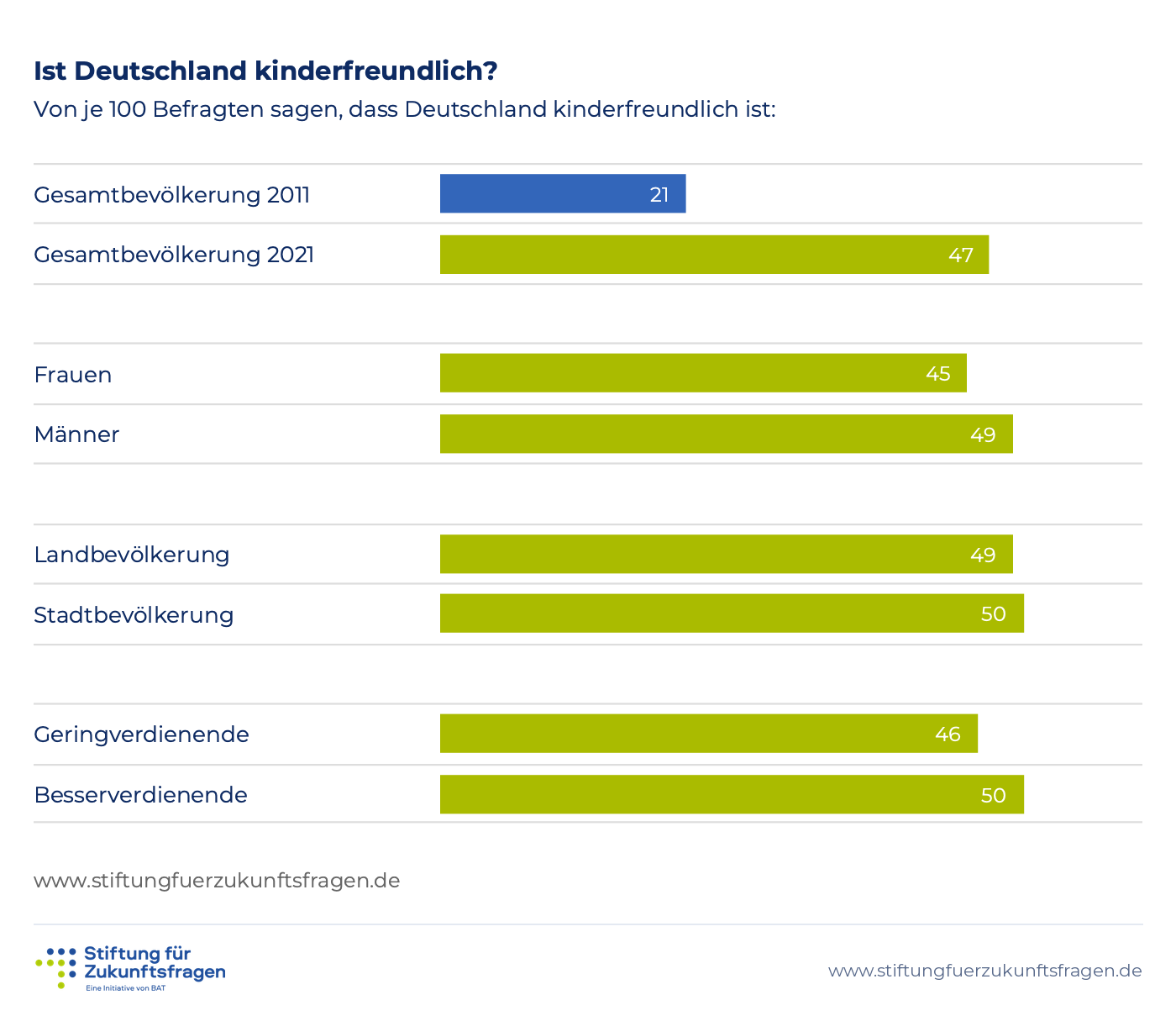
Germany is divided when it comes to child friendliness. Almost every second German citizen (47%) currently considers our country to be child-friendly - a slight majority do not (yet) see it that way. Compared to 2011, however, the figure has more than doubled, which is also reflected in the number of births, among other things. In 2020, a total of 773,200 children were born in Germany, compared to almost 100,000 fewer ten years earlier (677,947).
The differences within the population are relatively small. Men are more child-friendly than women, and residents of large cities and higher earners also rate the situation more positively than average, whereas rural residents and low earners are the most critical.
Data as table
| 2021 | 2011 | |
|---|---|---|
| Because children cost money and not everyone can afford or wants to. | 52 | 59 |
| For them, a professional career is more important than starting a family. | 47 | 52 |
| It's difficult to combine a career with family life. | 47 | 49 |
| They want to remain free and independent. | 45 | 61 |
| Because the state and societal conditions for families are not good. | 45 | 47 |
| Worry that their children will not be able to lead a safe and carefree life in the future. | 43 | 47 |
| Because the right partner is missing. | 33 | 40 |
| Because the right time to have children cannot be found. | 20 | 24 |
| Because children do not represent a fulfilling purpose in life for them. | 18 | 21 |
| They fear that their child would grow up with only one parent. | 17 | 20 |
Children cost money
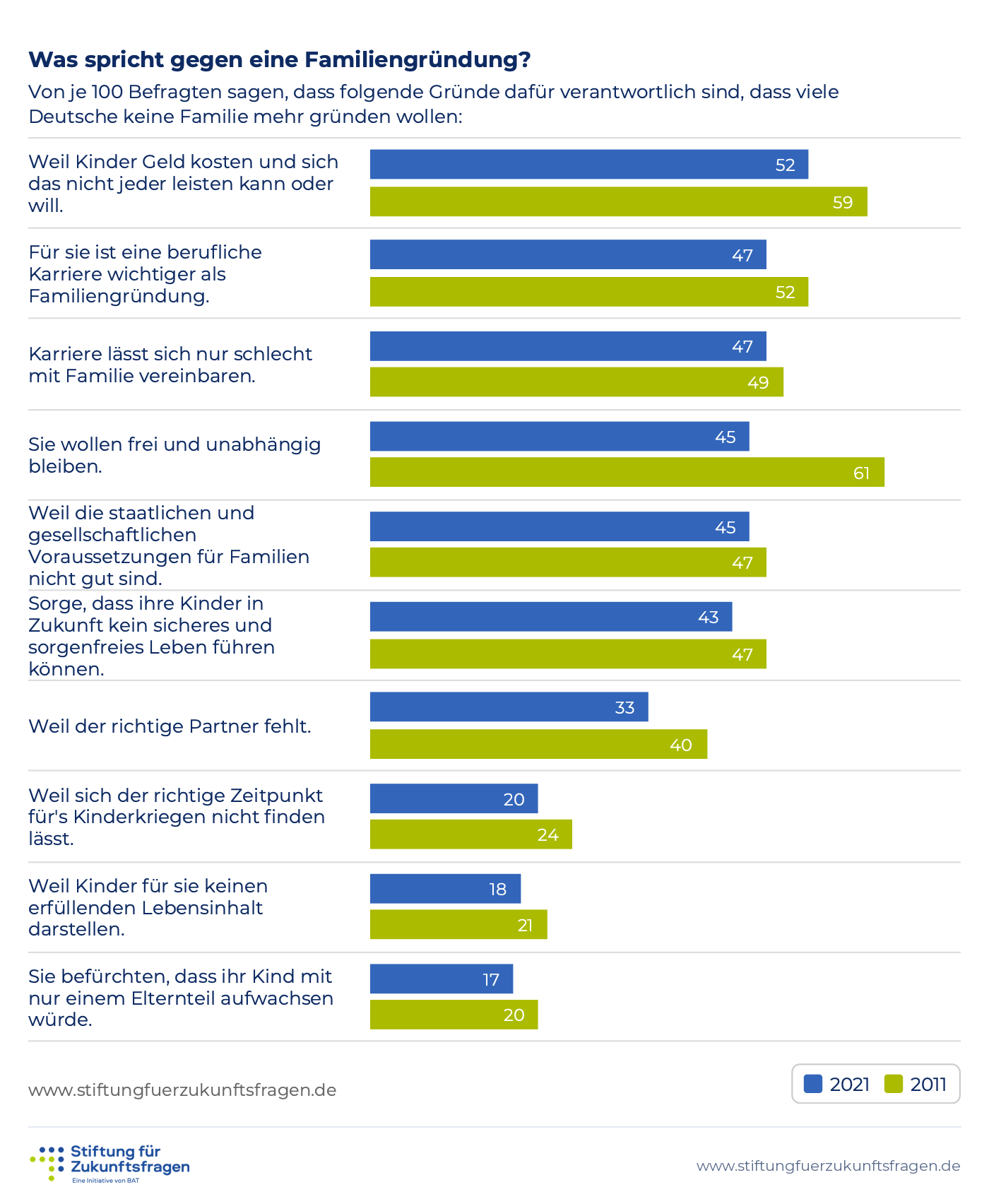
The reasons against having children remain numerous, but are shifting. Ten years ago, 61 per cent cited concerns about having to give up their own freedom as the main argument against having children, but this figure is now "only" 45 per cent.
The most frequently cited reason against having children is currently money, at 52 per cent: children cause costs that not everyone can or wants to afford.
On the positive side, it is noticeable that all arguments have decreased in a 10-year comparison and that Germans cite fewer reasons against having children overall.
Women miss the right partner
The differences between the sexes remain significant. For men, their own freedom and professional career continue to be significantly more important than for women. They are also less likely to see having children as a fulfilling purpose in life.
Women, on the other hand, lack the right partner and state requirements for having children and are much more likely to worry about the future of their offspring.
Outlook: Fear remains high, but is diminishing overall
Fear remains the main reason for not having children: fear of not having enough money; fear of neglecting one's career; fear of having to restrict oneself; fear of not being able to balance family and work; fear of choosing the wrong time or partner, and fear of not getting enough support or fear of divorce.
The often-cited German Angst therefore remains correspondingly high. At the same time, however, it is decreasing in all areas and rightly so. More and more companies are offering childcare facilities, flexible working time models or part-time management.
The state supports families with numerous funding and support measures. Thanks to greater acceptance and childcare options, there is less need to choose between children and a career or personal freedom and constant parental duties.
Digital dating sites also make it easier to find the right partner, and worries about getting pregnant at the wrong time are reduced by better opportunities to get pregnant later (the age of a woman's first child increases by around 1 year per decade).
And even the fear of divorce is continuously decreasing in parallel with the falling number of divorces (2010: 187,640; 2020: 149,010), while the number of marriages is increasing (2010: 187,027; 2020: 373,300). The probability of getting divorced therefore fell from 50 per cent to 36 per cent.
All in all, there is an increasingly strong argument in favour of having children and a renaissance of the family is emerging. It is therefore not surprising that 84 per cent of Germans consider children and family to be a particularly important part of their quality of life.