
Current research, 283
6 March 2019
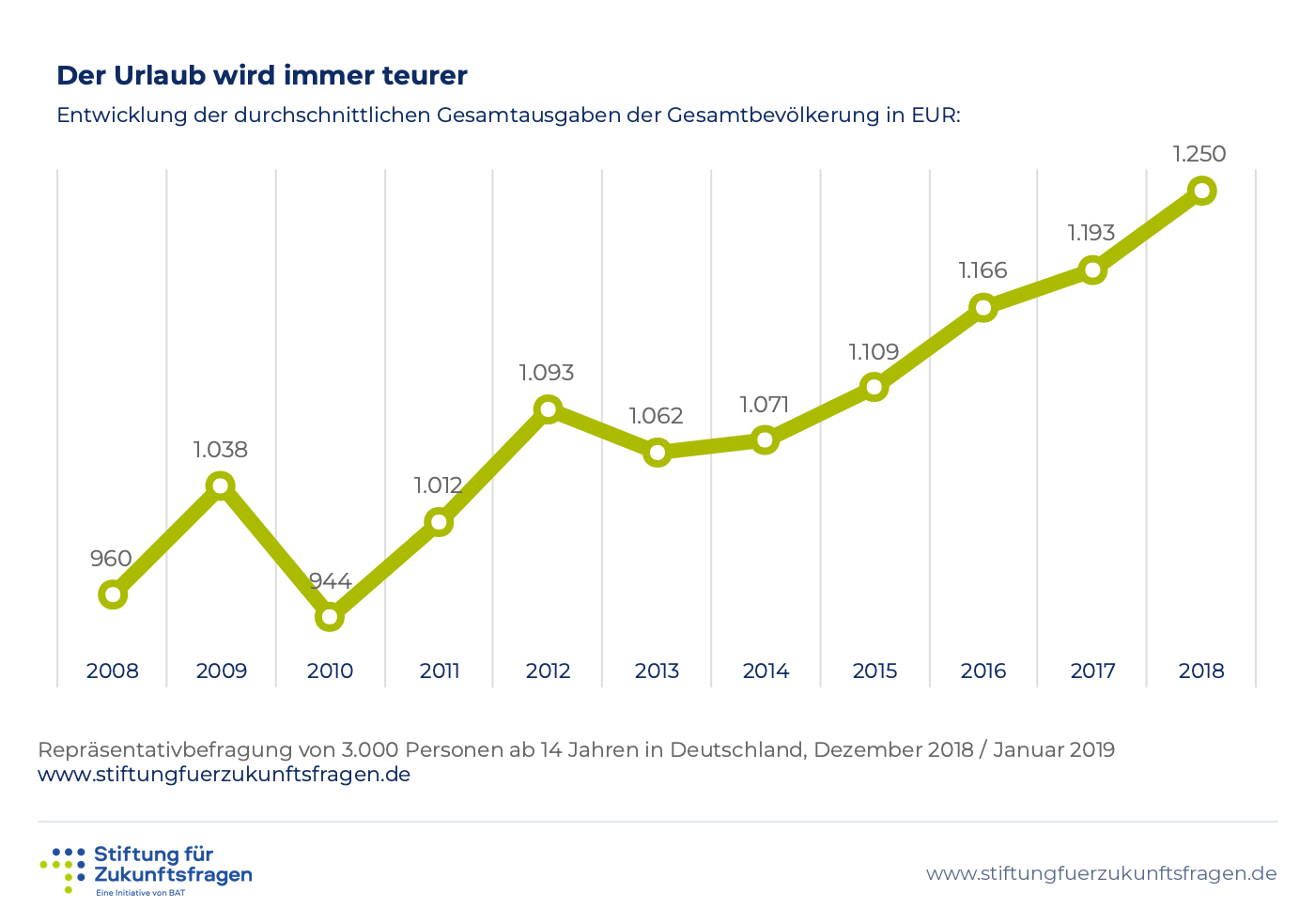
Data as table
| 2008 | 960 |
| 2009 | 1.038 |
| 2010 | 944 |
| 2011 | 1.012 |
| 2012 | 1.093 |
| 2013 | 1.062 |
| 2014 | 1.071 |
| 2015 | 1.109 |
| 2016 | 1.166 |
| 2017 | 1.193 |
| 2018 | 1.250 |
Germans spend an average of €98 per day on their main vacation. That amounts to a total of €1,250 per person. This figure includes not only travel, accommodation, and food costs, but also all other vacation expenses – from excursions and souvenirs to tips. Compared to ten years ago, spending has increased by almost €300 (2008: €960). These are the findings of the independent BAT Foundation for Future Issues, which conducted representative personal interviews with over 3,000 German citizens about their vacation spending.
„"People are cutting back on vacations last. They would rather restrict themselves in their daily lives, postpone purchases, or save less than spend the summer at home."“, "That's according to the foundation's scientific director, Professor Dr. Ulrich Reinhardt. He explains the ever-increasing holiday costs with rising expectations and a higher proportion of air travel:" „"In the past, a long journey by car to Spain or over the Brenner Pass was a standard part of many holidays. Today, fast flight connections are preferred so that people can stay longer at their holiday destination. Once there, they want their accommodation to have as many stars as possible, and they don't want to have to worry about every penny. The prevailing principle is: I've worked, I've saved, I've earned it."“
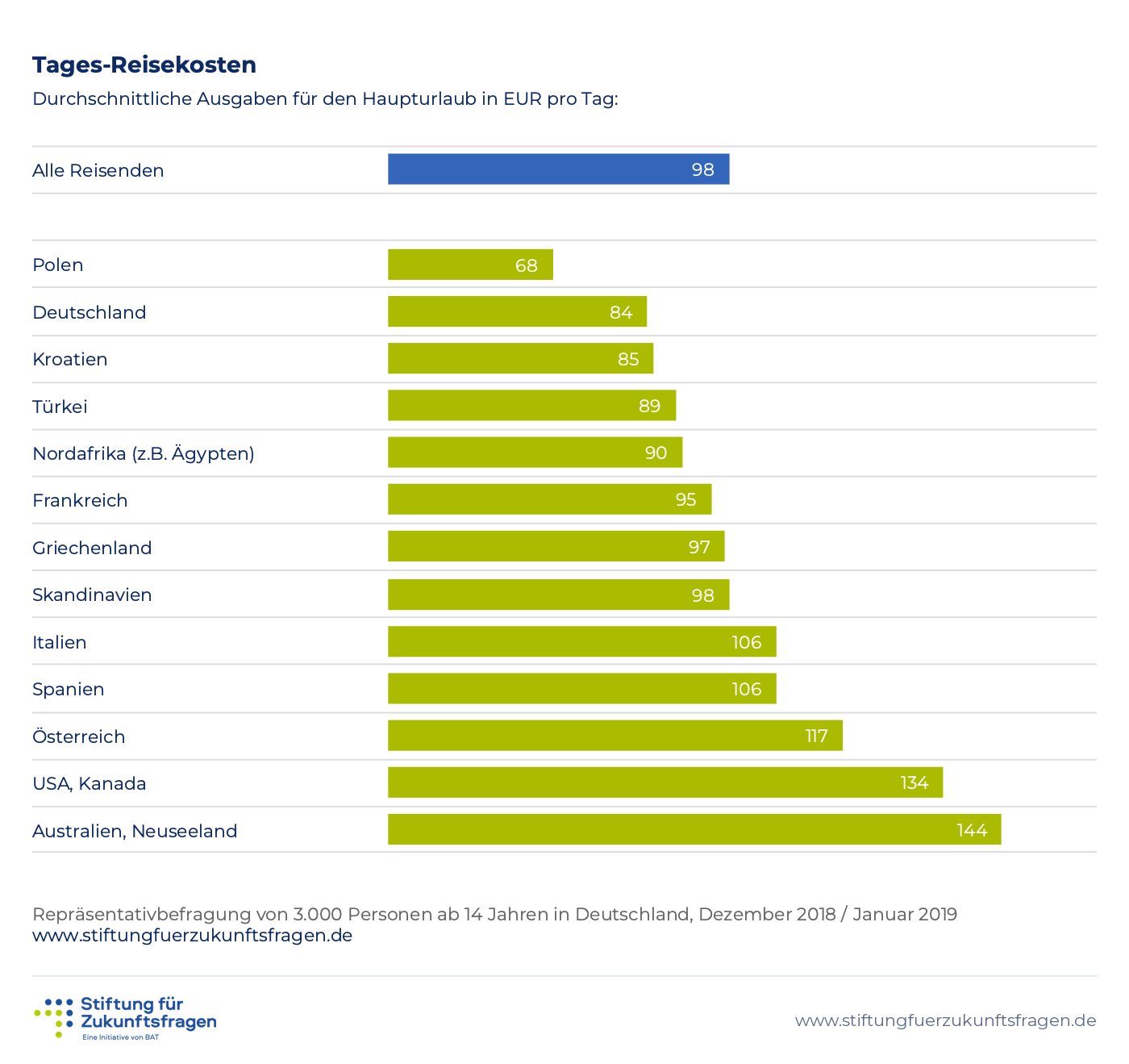
Data as table
| All travelers | 98 |
| Poland | 68 |
| Germany | 84 |
| Croatia | 85 |
| Turkey | 89 |
| North Africa (e.g. Egypt) | 90 |
| France | 95 |
| Greece | 97 |
| Scandinavia | 98 |
| Italy | 106 |
| Spain | 106 |
| Austria | 117 |
| USA, Canada | 134 |
| Australia, New Zealand | 144 |
Price plays a crucial role in choosing a travel destination. This benefits both domestic German destinations and holiday regions in Poland. The Polish Baltic Sea beaches, in particular, are attracting a growing number of budget-conscious travelers who, despite having a smaller holiday budget, still want to enjoy sun, sand, and sea. A day in Italy or Spain, on the other hand, costs significantly more. The Spanish islands, especially, have become increasingly expensive in recent years, a trend only partially attributable to higher airfares. For example, a day in the Canary Islands (125 EUR) now costs almost as much as in the USA (134 EUR).
Daily costs have also risen in Austria. There are numerous reasons for this – from the proportion of Germans who spend their main holiday skiing, which is more expensive, to the generally higher price level in the Alpine republic, and the boom in Austrian holiday resorts, where increased demand has driven up prices.
Holidays in Turkey and Egypt remain relatively inexpensive. Both destinations are trying to attract more visitors by offering good value for money. Long-haul destinations in the USA, Canada, Australia, or New Zealand are dream destinations and will likely remain so for most Germans. With daily costs of up to €144 per person, a trip to these far-flung destinations costs significantly more than most Germans are willing or able to spend.
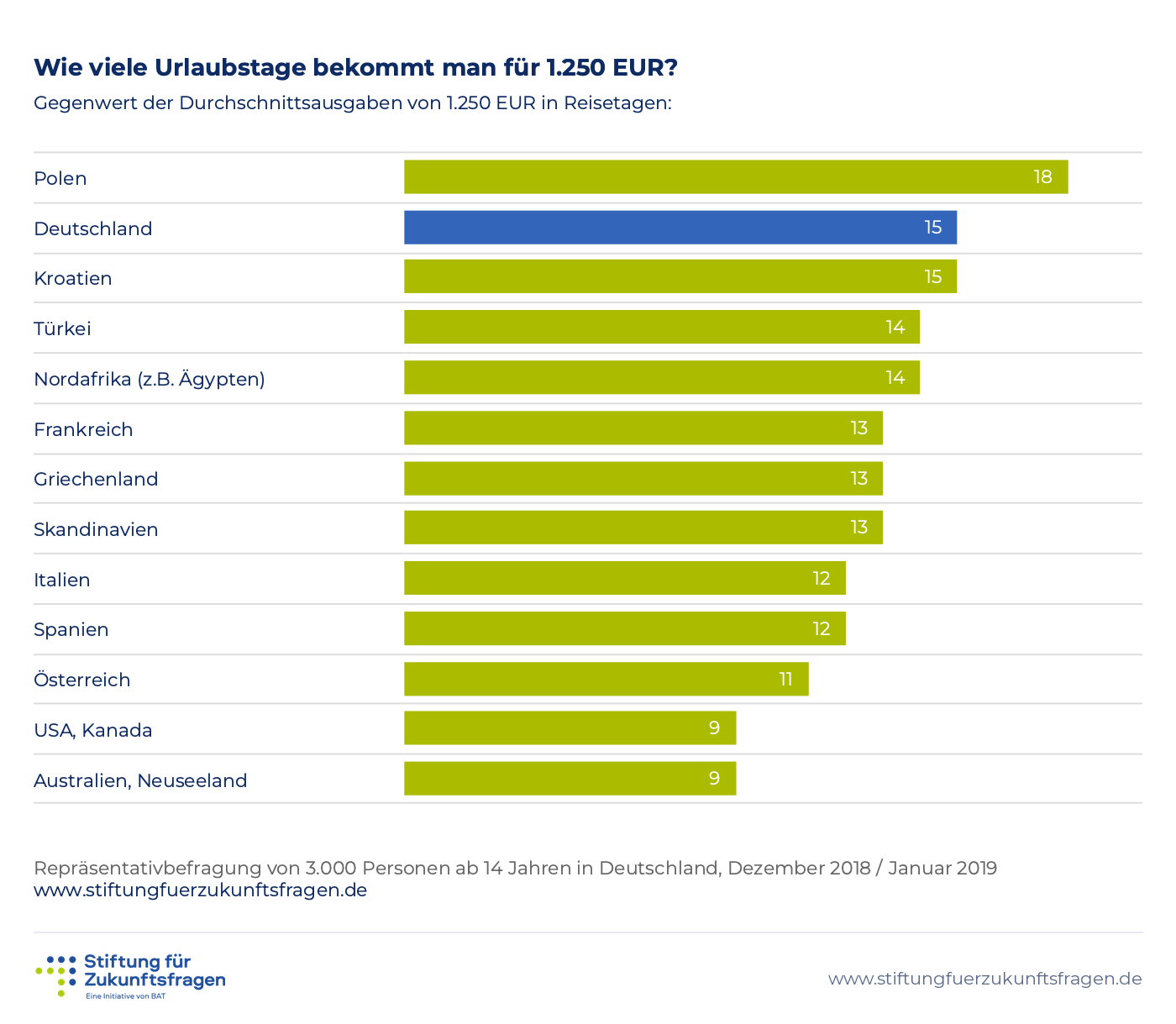
How much vacation time can you get for 1,250 euros?
Data as table
| Poland | 18 |
| Germany | 15 |
| Croatia | 15 |
| Turkey | 14 |
| North Africa (e.g. Egypt) | 14 |
| France | 13 |
| Greece | 13 |
| Scandinavia | 13 |
| Italy | 12 |
| Spain | 12 |
| Austria | 11 |
| USA, Canada | 9 |
| Australia, New Zealand | 9 |
Every German citizen needs to carefully consider what they want from their vacation: Is the destination the main focus, or is it the travel itself? Because it's possible to calculate relatively accurately how many vacation days you get for the average €1,250 spent at different destinations.
You could only stay in North America or Australia for nine days. In North Africa, on the other hand, you could stay for around 14 days, and within Germany, even more than two weeks would be possible. Anyone wanting to travel even longer should consider a holiday in Poland. There, you could spend over 18 days for €1,250.
Young adults spend the least – childless couples the most.
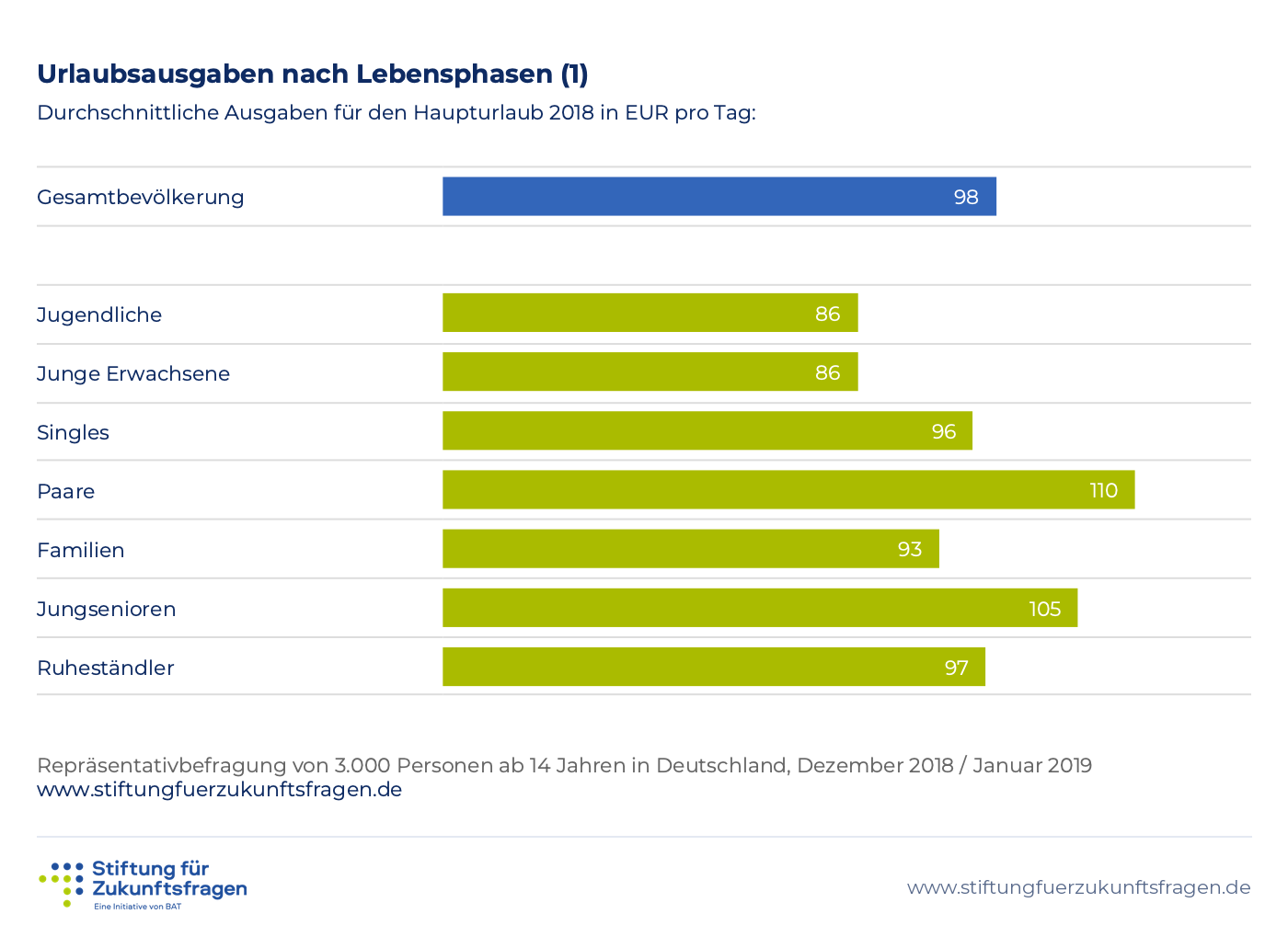
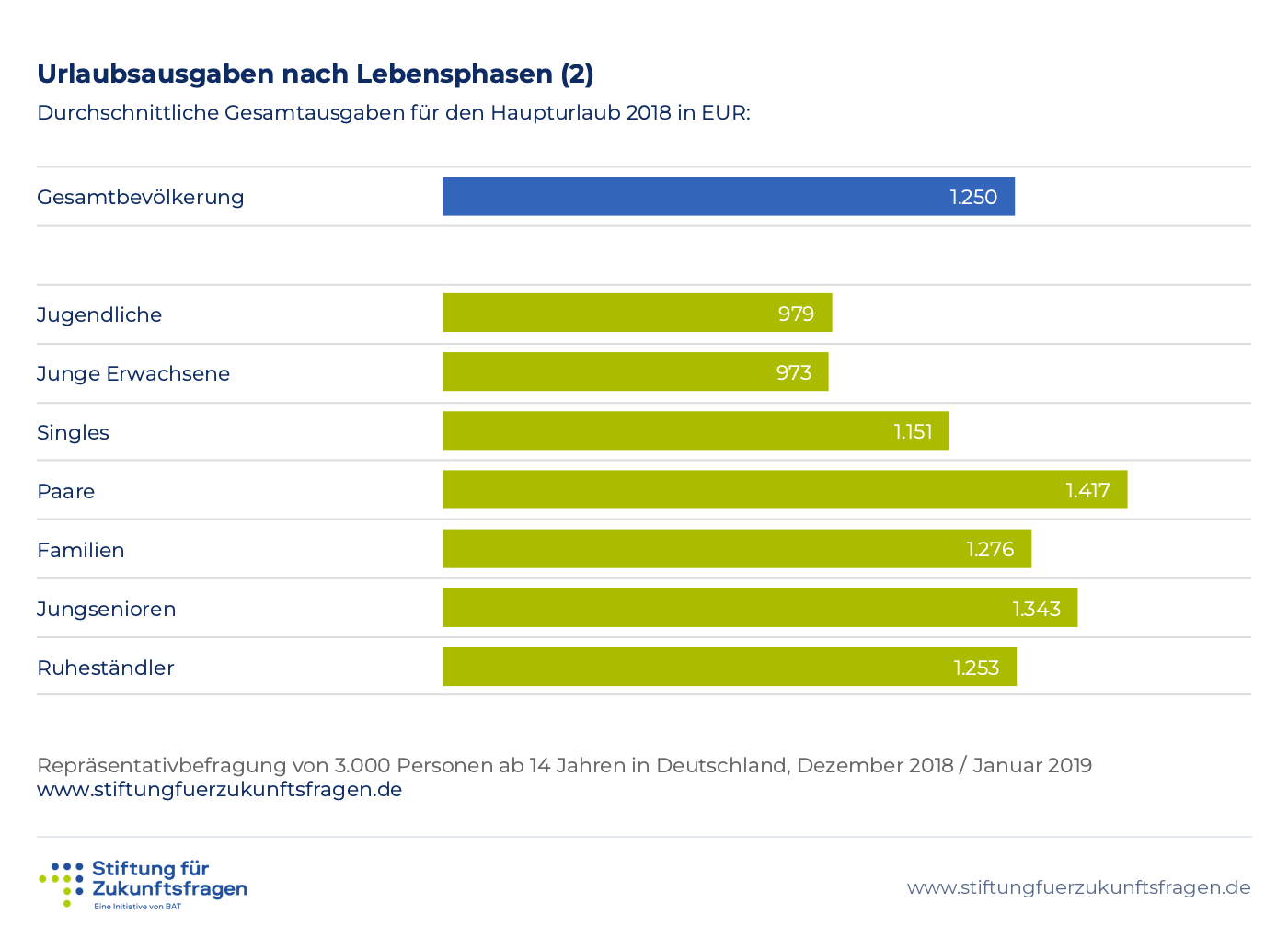
Those with more money available also spend more. This equation also applies to vacations. Teenagers and young adults spend the least on their main vacation, at under €1,000. Singles, on the other hand, have a slightly higher vacation budget (€1,151). A family of four, however, spends over €5,000.
Childless couples spend the most on their vacation (1,417 EUR), but young retirees (1,343 EUR) and pensioners (1,253 EUR) also spend above average. People in rural areas travel more economically, managing with "only" 1,056 EUR. City dwellers travel considerably more expensively (1,308 EUR), which can be explained by the high proportion of air travel.
There are also significant differences between high earners and low earners: While households with a monthly income of less than 1,500 euros have an average holiday budget of 893 euros, this is significantly higher at 1,493 euros for households with a monthly income of more than 3,500 euros.
Data as table
| Total population | 98 |
| Teenagers | 86 |
| Young adults | 86 |
| Singles | 96 |
| Couples | 110 |
| Families | 93 |
| Young seniors | 105 |
| Retirees | 97 |
Data as table
| Total population | 1.250 |
| Teenagers | 979 |
| Young adults | 973 |
| Singles | 1.151 |
| Couples | 1.417 |
| Families | 1.276 |
| Young seniors | 1.343 |
| Retirees | 1.253 |