
The coronavirus pandemic continues to shape travel behaviour in 2021. But what do people think about the future of tourism? What expectations, wishes and goals do they have? Who do they want to travel with? And what kind of holiday do they personally find interesting? What will the holiday world of tomorrow look like and what will holidaymakers really want in the future? Culture or scenery? Relaxation or adventure? Long-distance or city breaks?
The non-profit BAT Foundation for Future Studies investigated these and other questions in its latest special edition of the tourism analysis and conducted a representative survey of over 2,000 German citizens aged 18 and over in June 2021.
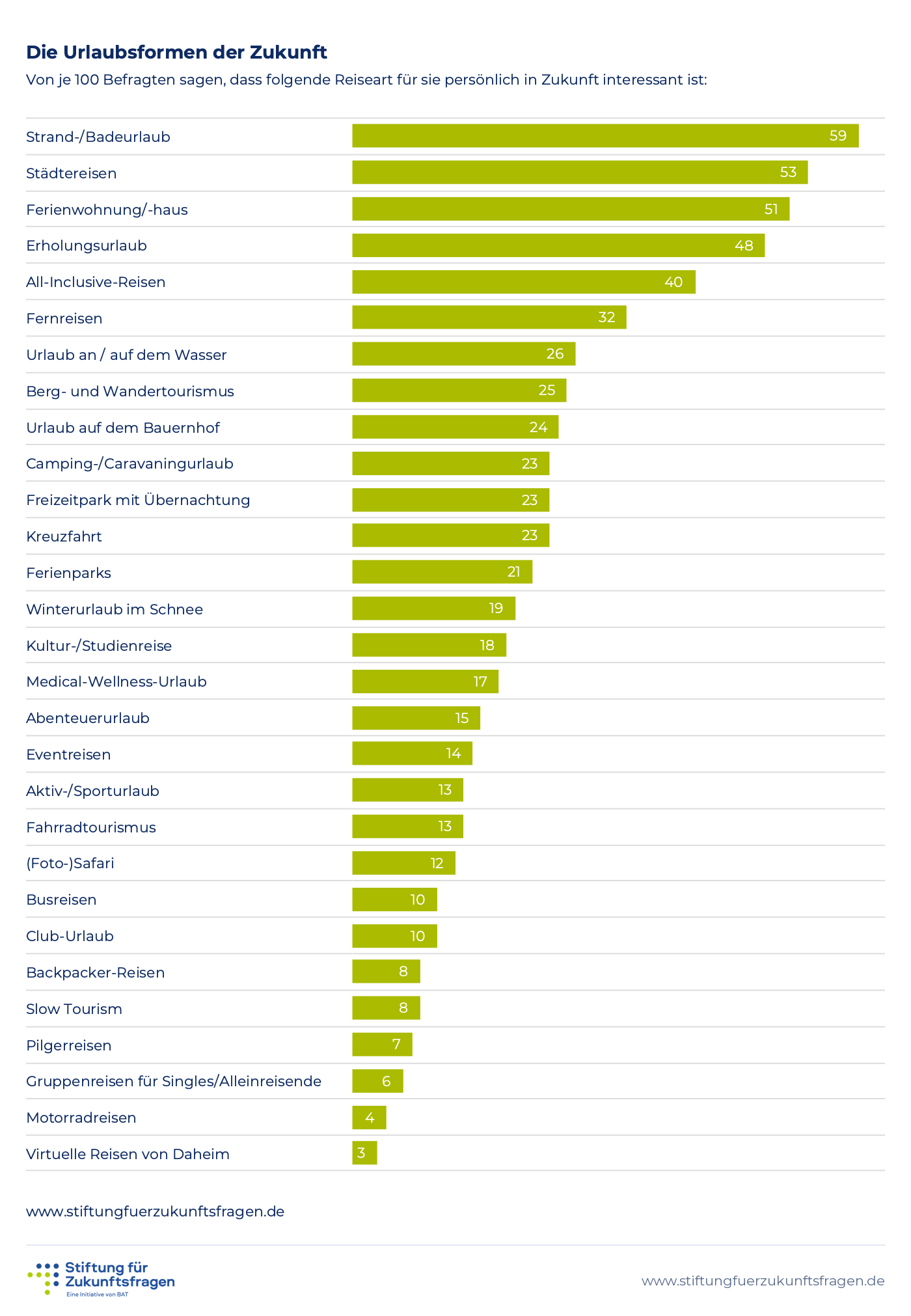
The holidays of the future: Beach. City. House
1st place: Beach and beach holidays
People come from the water and so they are always drawn back to it, at least on holiday. Accordingly, almost three out of five German citizens want to spend their holidays on the beach in the future. Holidays on the beach are not only associated with sun and warmth, but also with relaxation, the opportunity to do sports, seeing and being seen, a relaxed atmosphere and spending time in nature.
2nd place: City breaks
Whether at home or abroad, in large cities or in the countryside: almost every city rightly (also) relies on tourism. The metropolises remain popular, but smaller cities will also benefit from city tourism. Even today, the 80 German cities with more than 100,000 inhabitants account for „only“ around a third of all overnight stays. And while the metropolises outdo each other with cultural highlights and mega events, the smaller towns focus on authenticity and atmosphere, cosiness and slowing down.
3rd place: Holiday home/apartment
51 per cent of Germans dream of having their own home while on holiday. Guesthouses and hotels are increasingly feeling the competition from providers of holiday flats and houses. Thanks to online platforms, the offer is comprehensive, attractive and can be booked individually, regardless of whether it's a Spartan mountain hut or a flat in Times Square; everything is just a mouse click away. It also conveys a sense of authenticity when you „live like a local“ and can immerse yourself in the culture through the type of accommodation.
4th place: Recreational holiday
Even if holidays are no longer exclusively for relaxation these days, people's desire to find peace and quiet remains. Almost one in two people want to avoid stress and the hustle and bustle of everyday life, but instead want to unwind and recharge their batteries. A relaxing holiday is peace and quiet and personal leisure at the same time.
Place 5: All-inclusive
Two out of five German citizens want the all-round carefree package. The advantages are clear: you know what costs you will incur before you start your trip and don't have to do any calculations while on holiday. You can take advantage of all the offers without regret and without having to think about whether you really need to. This is particularly attractive compared to package holidays, which often incur an additional 30 per cent in costs.
Data as table
| Beach/swimming holiday | 59 |
| City breaks | 53 |
| Holiday apartment/house | 51 |
| Relaxing holiday | 48 |
| All-inclusive trips | 40 |
| Long-distance travel | 32 |
| Holiday on/by the water | 26 |
| Mountain and hiking tourism | 25 |
| Farm holiday | 24 |
| Camping/caravanning holiday | 23 |
| Theme park with overnight stay | 23 |
| cruise | 23 |
| Holiday parks | 21 |
| Winter holiday in the snow | 19 |
| Cultural/study trip | 18 |
| Medical wellness holiday | 17 |
| Adventure holiday | 15 |
| Event trips | 14 |
| Active/sports holiday | 13 |
| Cycling tourism | 13 |
| (Photo) safari | 12 |
| Bus tours | 10 |
| Club holiday | 10 |
| Backpacker travel | 8 |
| Slow Tourism | 8 |
| Pilgrimages | 7 |
| Group tours for singles/solo travelers | 6 |
| Motorcycle tours | 4 |
| Virtual travel from home | 3 |
Other types of holiday
Lots of interest (20-40 per cent)
From cruises to long-distance travel, from holidays in the mountains to holidays on the water, from camping trips to stays in holiday parks - numerous types of holiday are attracting a wide range of interest. Within the space of a decade, there has been a particular increase in the desire for a leisure park with overnight accommodation (+16 percentage points), farm holidays (+15 PP) and hiking tourism (+13 PP).
Some interest (under 20 per cent)
The potential of winter and sports holidays, cultural and study trips, wellness and event trips, cycling and coach holidays as well as (photo) safaris and adventure trips should be considered very carefully. Although they are all only of interest to a small proportion of the population, they can certainly be of economic importance. For example, 19 per cent of over-18s are interested in a holiday in the snow - that's over 12 million potential guests.
Little interest (less than 10 per cent)
Germans are not interested in travelling virtually from home. Pilgrimages, motorbike tours, group trips for singles, slow tourism, backpacker trips and club holidays are not even of interest to one in ten Germans in the future.
Data as table
| 2021 | 2007 | |
|---|---|---|
| The future belongs to safe regions | 89 | 69 |
| Intact nature and high environmental quality are important | 57 | 64 |
| 2021 | 2007 | |
|---|---|---|
| Always new travel destinations | 46 | 42 |
| Decide spontaneously where to go | 38 | 33 |
| Only to places where not everyone has been before. | 32 | 32 |
| Just a short stay, then onward travels | 25 | 19 |
| 2021 | 2007 | |
|---|---|---|
| Holidays with the whole family | 77 | 76 |
| Preferably alone | 24 | 12 |
| 2021 | 2007 | |
|---|---|---|
| Enjoy luxury and comfort | 43 | 38 |
| Getting to know foreign cultures and people* | 73 | 0 |
| Relaxation and not having to worry about anything* | 56 | 0 |
The holiday world of tomorrow
Travelling conditions: Safety increases, environmental protection decreases
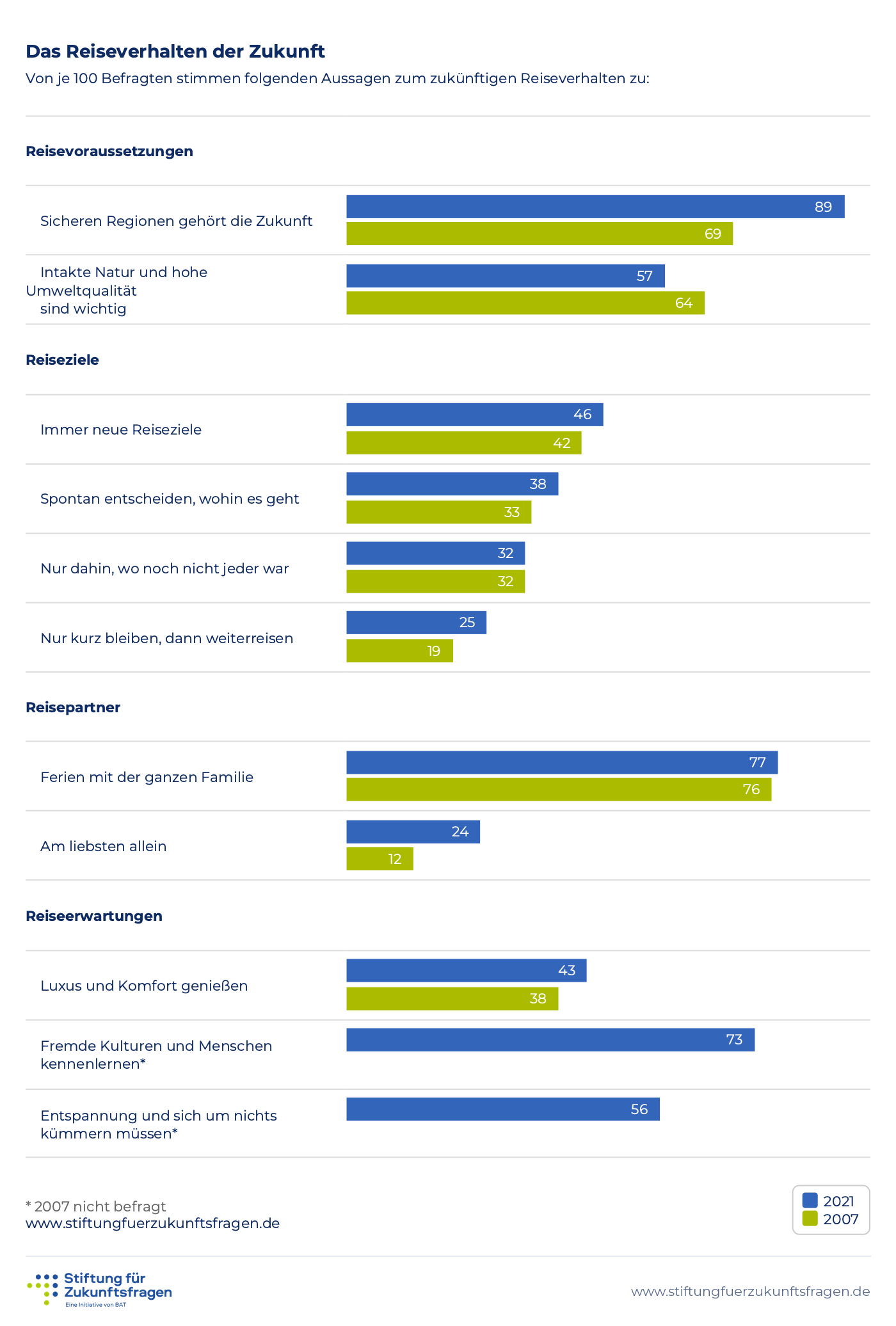
The future belongs to safe travel destinations - almost 9 out of 10 German citizens are convinced of this. Pandemics, terrorist attacks and natural disasters have left their mark. And no matter what precautionary and safety measures are taken, uncertainty when travelling has increased.
The importance of safety has risen by ten percentage points in each of the last two decades. Accordingly, more and more holidaymakers are looking for - at least perceived - safe holiday destinations. This will boost domestic tourism and go hand in hand with challenges in numerous foreign holiday destinations. Even tempting special offers, breathtaking nature and great hospitality will not be enough as long as there is a feeling of insecurity.
There were high hopes that sustainability and environmental aspects of travelling after coronavirus would become more important. However, despite increasing environmental awareness in everyday life, there is no evidence of such behaviour on holiday. There are therefore no signs of a fundamental change in behaviour or attitudes.
On the contrary: year-on-year, the expectation that holiday destinations with controlled environmental quality, intact nature and clean landscapes will be more important in the future is actually decreasing.
„Air travel destinations remain too attractive, the longing for sun, beach and sea is too great and foreign countries and cultures are too interesting for the majority of travellers to want to do without them“, says Scientific Director Professor Dr Ulrich Reinhardt.
Travel destinations: Anywhere and anytime
In future, too, many holidaymakers will want one thing above all else on holiday: to discover something new. A change of scenery or a contrast to everyday life remains a core reason for travelling - and the trend is rising. For example, 38 per cent only want to decide spontaneously where they are going shortly before the start of their holiday - and for one in four people, a holiday means travelling, so they only want to stay in one place for a short time and then move on.
And despite ever-increasing travelling experience, almost half of Germans want to discover a new destination every year. Uniqueness and differentiation from others remain important in this context. Every third person is attracted by unusual destinations that not everyone has been to.
Reinhardt: „On the one hand, a kind of modern nomadism is emerging. The younger generation in particular wants as much flexibility and variety as possible, just like in everyday life. On the other hand, many German citizens are longing for consistency and familiarity. The world of travel therefore remains divided, and the demands placed on providers are correspondingly individual and varied.“
Travelling partners: together or alone?
For more than three out of four Germans, holidays mean one thing above all else: a great holiday with the whole family. There is widespread agreement within the population, with only singles expressing slightly less interest with 65 per cent still in agreement. For one in four people, however, holidays cannot be lonely enough and they prefer to travel alone.
A year-on-year comparison shows a mixed picture. While the proportion of family holidaymakers remains constant, the proportion of those who prefer to travel alone has doubled.
Travelling expectations: Change of scenery and relaxation
Getting to know foreign cultures and people - this is what almost three quarters of Germans hope to experience on holiday. In a 5-year comparison, significantly more travellers want to experience authenticity when travelling, with this playing a particularly important role for women, city dwellers and the formally higher educated.
Not having to worry about anything on site and simply relaxing - this remains a key expectation of the holiday season for the majority of Germans. In a 5-year comparison, approval decreases slightly, but remains at a high level. There is little evidence of differences within the population. The only exceptions are housewives and househusbands, who, at 77 per cent, signal significantly more approval and want to forget the stresses of everyday life.
Being looked after, enjoying luxury and comfort and feeling like a king: for 43 per cent of Germans, this is what holidays should look like in the future. A long-term year-on-year comparison shows the increasing importance of this travel expectation.
Reinhardt: „Holidays should be better than everyday life. People want to leave stress, pressure, hectic and obligations behind and instead experience well-being, individuality and comfort. The future is therefore increasingly characterised by competition on quality rather than price.“