

Expectations for the future - Issue 02A
13 January 2021
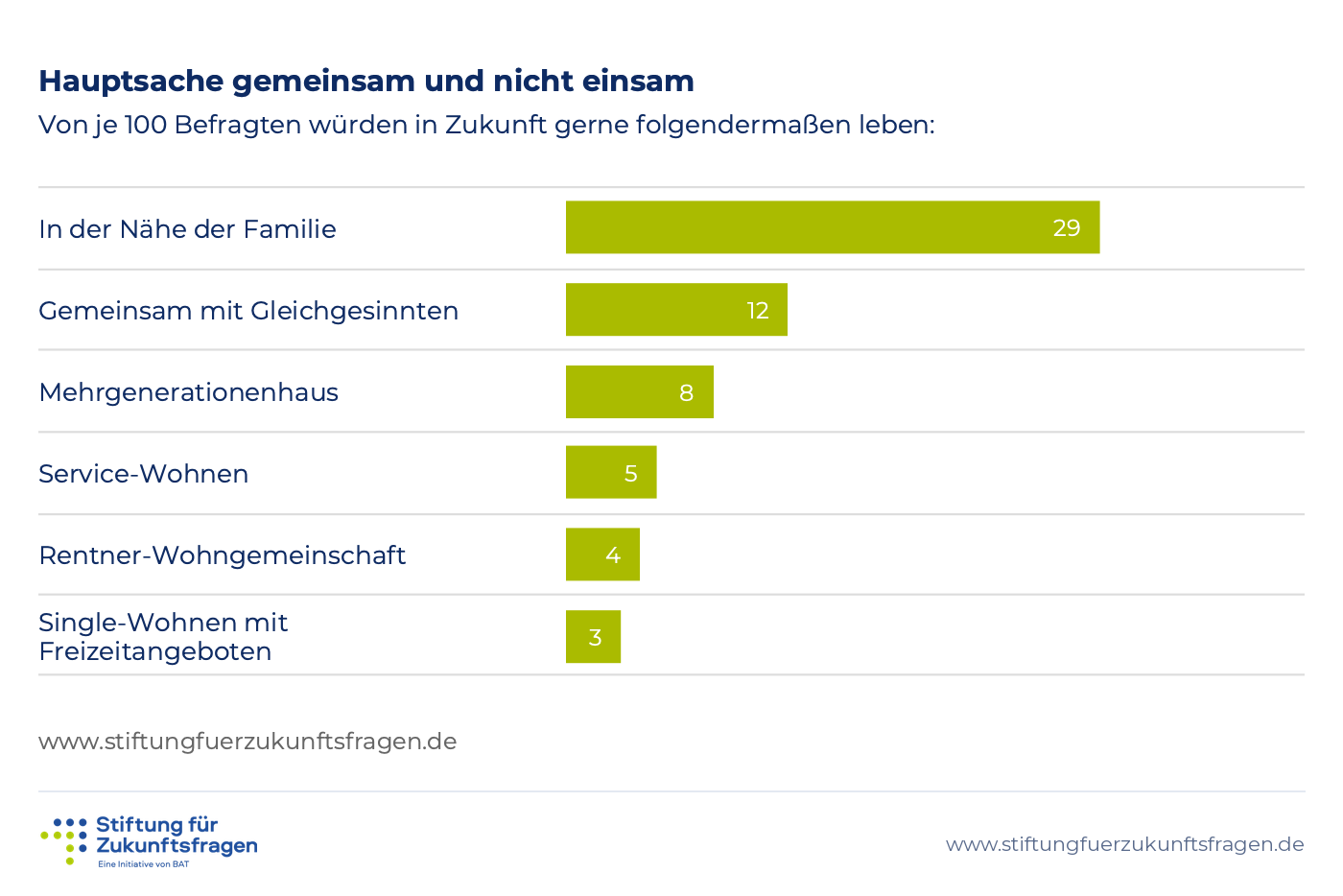
The main thing is to live together and not alone: Who Germans want to live with
Data as table
| Near the family | 29 |
| Together with like-minded people | 12 |
| multigenerational house | 8 |
| Assisted living | 5 |
| Retirement community | 4 |
| Single living with leisure activities | 3 |
Where do Germans want to live in the future? In a metropolis, in a city, or perhaps in the countryside? One thing is certain: regardless of gender or income, there is a desire to escape the city. Roughly one in four Germans would like to live in the countryside, and almost as many in a small town or a city with fewer than 100,000 inhabitants. In contrast, not even one in ten is enthusiastic about living in a metropolis. However, there are significant regional differences: almost twice as many East Germans as West Germans (151 to 81) are interested in living in a city with more than 500,000 inhabitants.
Generally speaking, most citizens are only partially willing to relocate. For example, 84 percent of rural residents want to continue living far from the city, and less than 1 percent can imagine living in a large city or metropolis. Similarly, two-thirds of residents of small and medium-sized towns want to grow old in a similarly sized neighborhood. And those who are considering a move tend to prefer the countryside to the city. Only residents of large cities show a slightly higher willingness to relocate, but even then, the majority do not want to change their location.
Outlook
In Germany, there are approximately 230 inhabitants per square kilometer. A good three-quarters live in cities and metropolitan areas, while only 15 percent live in municipalities with fewer than 5,000 inhabitants. Almost all forecasts predict a further increase in rural depopulation, and massive migration is forecast, particularly from structurally weak regions in the east.
However, these predictions do not necessarily reflect the needs of the population. A growing number of citizens can imagine a future life outside of major cities. As a first step, the commuter belts around the cities are benefiting from this trend. Their popularity has increased by around 50 percent compared to the last ten years.