How will - and above all - how do Germans want to work in the future? What opportunities and risks are associated with future developments in the world of work? What framework conditions will characterise working life in the future? The latest publication from the BAT Foundation for Future Studies, „Brave new world of work? What's coming, what's staying, what's going?“ provides well-founded answers. On more than 300 pages, representative surveys of the German population's opinions are interpreted from a futurological perspective, generational differences are highlighted and a look is taken at the working world of tomorrow.
Confidence instead of fear of the future
Today, fear of change is the main factor influencing the way broad sections of the population think about the future. Many people look to the future with concern and scepticism, yearn for more stability, particularly in their working lives, and in some cases have considerable reservations about increasing mechanisation, digitalisation, automation, liberalisation and globalisation. The fear of missing the boat, having to face new competitors, perhaps even losing one's job and thus having to accept restrictions in the standard of living and quality of life are not uncommon.
A better working world is certainly realistic - if the framework conditions negotiated between employers and employees are adapted to the challenges of the 21st century and the principles for organising a humane working life are taken into account. With this in mind, the outlook for future changes must not only focus on the dangers and risks, but must also confidently point out the many opportunities and potentials.
For example, 84% of the population see great potential for future economic growth in the further development of technologies for information, communication and automation, and 59% expect digitalisation to improve working conditions. Three quarters of the population also expect to see significantly more women in technical and scientific professions in the future and 85 per cent are certain that the working world of the future will require not only specialist knowledge but also skills such as time management, critical faculties and the ability to work in a team. The majority (57%) would also welcome government support for family-friendly companies in order to help reconcile work and family life.
Data as table
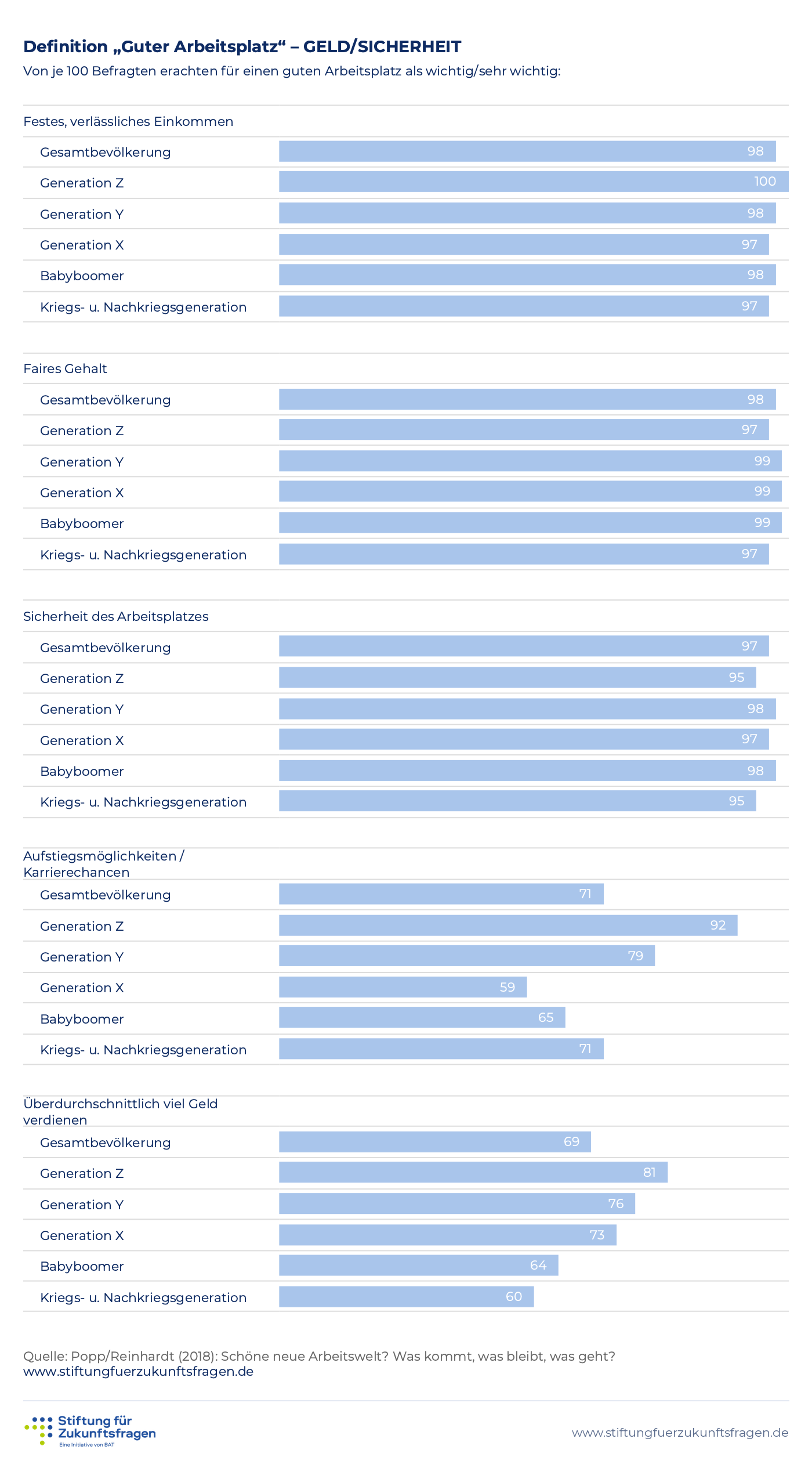
Definition of "Good Job" – MONEY/SECURITY: Fixed, reliable income — Out of every 100 respondents, the following are considered important/very important for a good job:
Total population
98
Generation Z
100
Generation Y
98
Generation X
97
Baby boomers
98
War and post-war generation
97
Definition of "Good Workplace" – MONEY/SECURITY: Fair salary — Out of every 100 respondents, the following are considered important/very important for a good workplace:
Total population
98
Generation Z
97
Generation Y
99
Generation X
99
Baby boomers
99
War and post-war generation
97
Definition of "Good Workplace" – MONEY/SECURITY: Job security — Out of every 100 respondents, the following are considered important/very important for a good workplace:
Total population
97
Generation Z
95
Generation Y
98
Generation X
97
Baby boomers
98
War and post-war generation
95
Definition of "Good Workplace" – MONEY/SECURITY: Advancement opportunities / career prospects — Out of every 100 respondents, the following are considered important/very important for a good workplace:
Total population
71
Generation Z
92
Generation Y
79
Generation X
59
Baby boomers
65
War and post-war generation
71
Definition of "Good Workplace" – MONEY/SECURITY: Earning above-average income — Out of every 100 respondents, the following are considered important/very important for a good workplace:
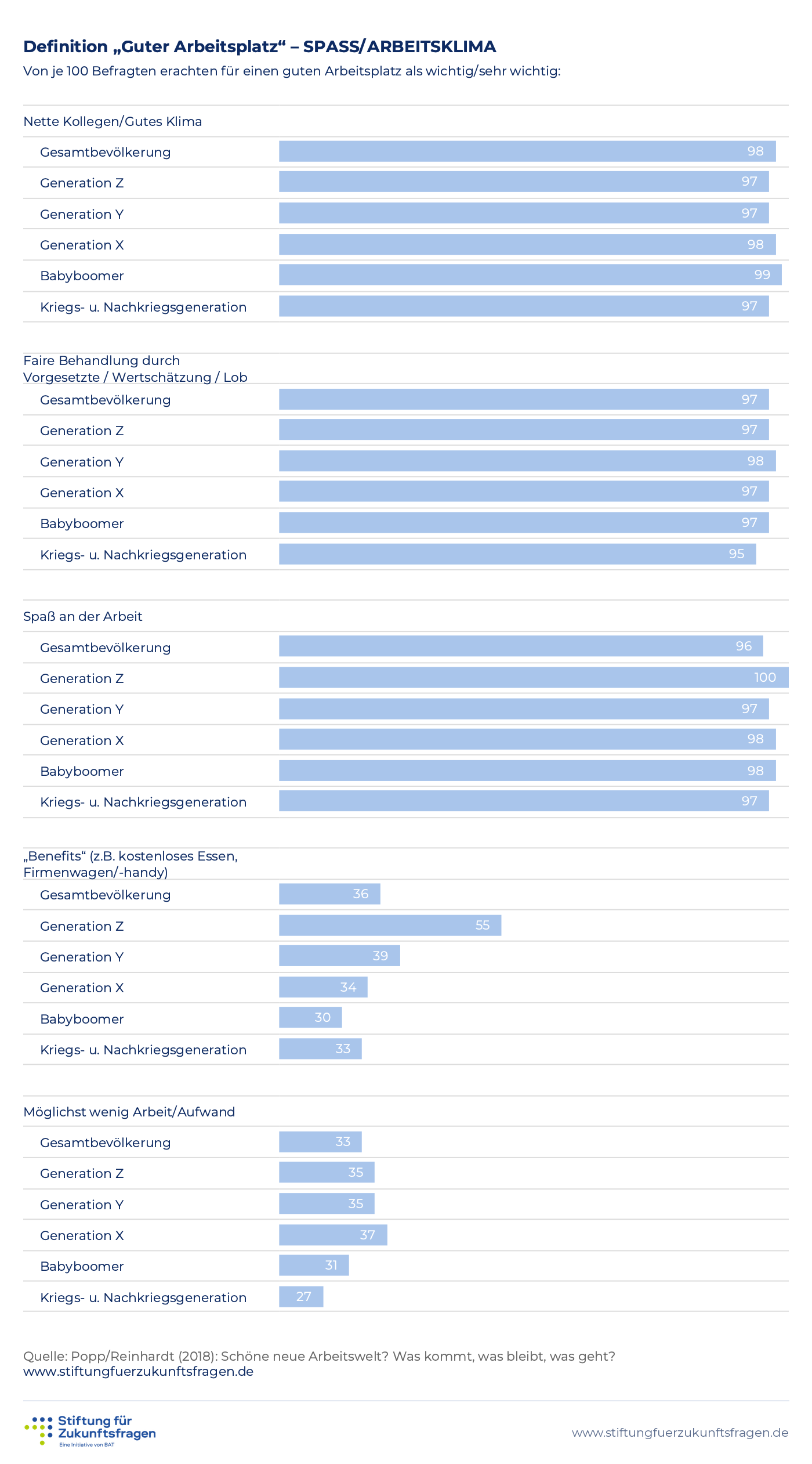
Definition of "Good Workplace" – FUN/WORK ENVIRONMENT: Nice colleagues/Good atmosphere — Out of 100 respondents, the following are considered important/very important for a good workplace:
Total population
98
Generation Z
97
Generation Y
97
Generation X
98
Baby boomers
99
War and post-war generation
97
Definition of "Good Workplace" – FUN/WORK ENVIRONMENT: Fair treatment by superiors / appreciation / praise — Out of every 100 respondents, the following are considered important/very important for a good workplace:
Total population
97
Generation Z
97
Generation Y
98
Generation X
97
Baby boomers
97
War and post-war generation
95
Definition of "Good Workplace" – FUN/WORK CLIMATE: Enjoyment of work — Out of every 100 respondents, the following are considered important/very important for a good workplace:
Total population
96
Generation Z
100
Generation Y
97
Generation X
98
Baby boomers
98
War and post-war generation
97
Definition of "Good Workplace" – FUN/WORK ENVIRONMENT: "Benefits" (e.g., free food, company car/mobile phone) — Of every 100 respondents, the following are considered important/very important for a good workplace:
Total population
36
Generation Z
55
Generation Y
39
Generation X
34
Baby boomers
30
War and post-war generation
33
Definition of a "good workplace" – FUN/WORK ENVIRONMENT: As little work/effort as possible — Out of every 100 respondents, the following are considered important/very important for a good workplace:
In contrast to the past, the evaluation of job quality no longer focusses on an above-average salary, but on security in a double sense. This includes both job security and the security of receiving a fair and regular salary. A high income, on the other hand, is gradually losing importance. The population is certain that money alone does not guarantee a high level of happiness in the world of work. A good working atmosphere, fun, appreciation from the employer and a fulfilling, meaningful job are becoming increasingly important.
For example, having fun at work is rated almost as important as protection against dismissal and fair pay. On the other hand, the classic extras of the past for performance and promotion have clearly lost importance. Only 36 per cent of the population still associate a good job with a company mobile phone or company car.
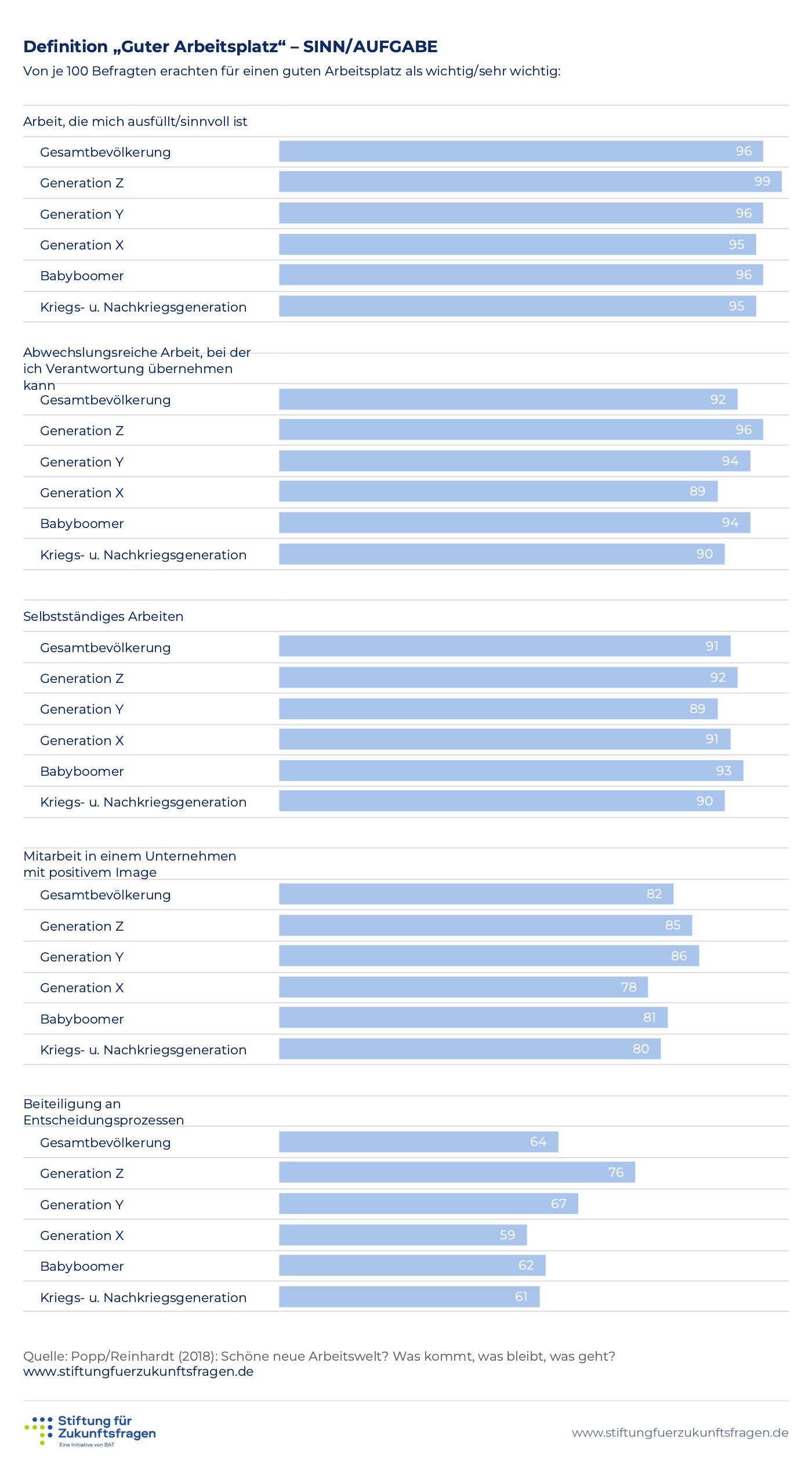
There are major differences between the younger and older generations in the areas of „meaningful tasks“, „career opportunities“, „flexible working hours“ and „participation in decision-making processes“. The younger generation in particular shows an above-average interest in being involved in decision-making processes and taking on responsibility. „Working to rule“ does not meet their expectations. While three quarters of Generation Z (born 1996-2009) would like to be directly involved in decision-making processes, only around two thirds of older employees want this. In general, the approval rate of the younger generation is higher than that of the population as a whole for numerous questions. On the one hand, this reflects Generation Z's comprehensively high expectations of their future working world, but on the other hand it also reflects their inexperience in the world of work.
There is a broad consensus among the population regarding the willingness to put in some effort during working hours. Only one in three respondents still equates a good job with as little effort as possible. In contrast, almost everyone wants a fulfilling job that is varied and that they can organise independently. They are also quite prepared to take on (more) responsibility for this.
Brave new world of work? What's coming, what's staying, what's going?
The future will bring a new world of work, that's for sure. But will it really be better? Digitalisation in particular will lead to extensive innovations, which will mean that many things that are rigid and inflexible will have to go. The values of Generations Z and App - some of which differ greatly from those of the Baby Boomer and Y generations or even the war and post-war generations - will also increasingly characterise everyday working life. The importance of people and their needs in the world of work is also becoming ever more important. It can therefore be stated: A brave new world of work is entirely realistic if people continue to take centre stage!
Data as table
Definition of "Good Workplace" – MEANING/TASK: Work that fulfills me/is meaningful — Of every 100 respondents, the following are considered important/very important for a good workplace:
Total population
96
Generation Z
99
Generation Y
96
Generation X
95
Baby boomers
96
War and post-war generation
95
Definition of "Good Workplace" – PURPOSE/TASK: Varied work where I can take on responsibility — Of every 100 respondents, the following are considered important/very important for a good workplace:
Total population
92
Generation Z
96
Generation Y
94
Generation X
89
Baby boomers
94
War and post-war generation
90
Definition of "Good Workplace" – PURPOSE/TASK: Independent work — Out of every 100 respondents, the following are considered important/very important for a good workplace:
Total population
91
Generation Z
92
Generation Y
89
Generation X
91
Baby boomers
93
War and post-war generation
90
Definition of "Good Workplace" – PURPOSE/TASK: Working in a company with a positive image — Out of every 100 respondents, the following are considered important/very important for a good workplace:
Total population
82
Generation Z
85
Generation Y
86
Generation X
78
Baby boomers
81
War and post-war generation
80
Definition of "Good Workplace" – PURPOSE/TASK: Participation in decision-making processes — Out of every 100 respondents, the following are considered important/very important for a good workplace:
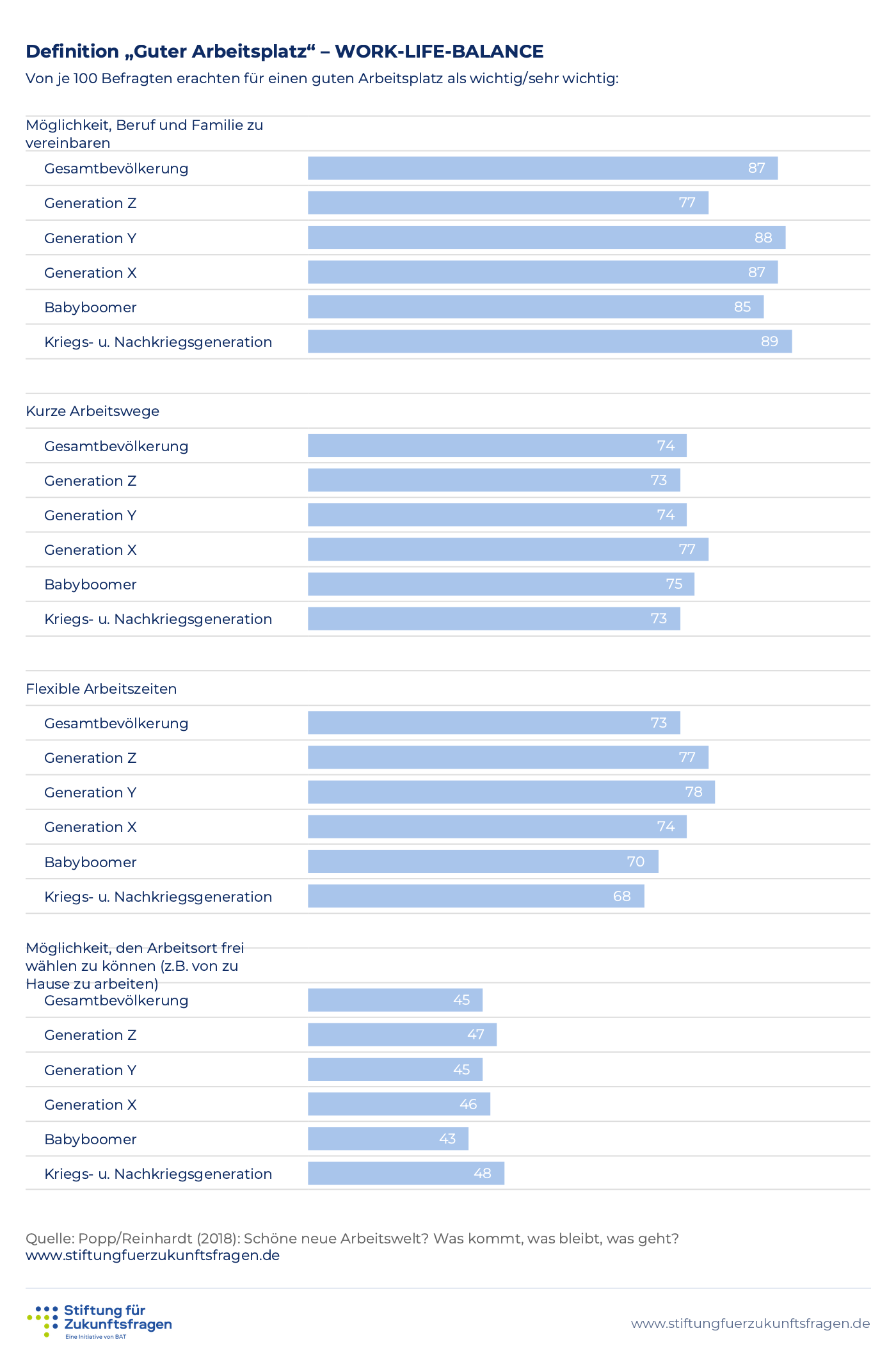
Definition of "Good Workplace" – WORK-LIFE BALANCE: The ability to reconcile work and family life — Of every 100 respondents, the following are considered important/very important for a good workplace:
Total population
87
Generation Z
77
Generation Y
88
Generation X
87
Baby boomers
85
War and post-war generation
89
Definition of "Good Workplace" – WORK-LIFE BALANCE: Short commutes — Of every 100 respondents, the following are considered important/very important for a good workplace:
Total population
74
Generation Z
73
Generation Y
74
Generation X
77
Baby boomers
75
War and post-war generation
73
Definition of "Good Workplace" – WORK-LIFE BALANCE: Flexible working hours — Of every 100 respondents, the following are considered important/very important for a good workplace:
Total population
73
Generation Z
77
Generation Y
78
Generation X
74
Baby boomers
70
War and post-war generation
68
Definition of "Good Workplace" – WORK-LIFE BALANCE: The ability to freely choose one's place of work (e.g., to work from home) — Of every 100 respondents, the following are considered important/very important for a good workplace: