

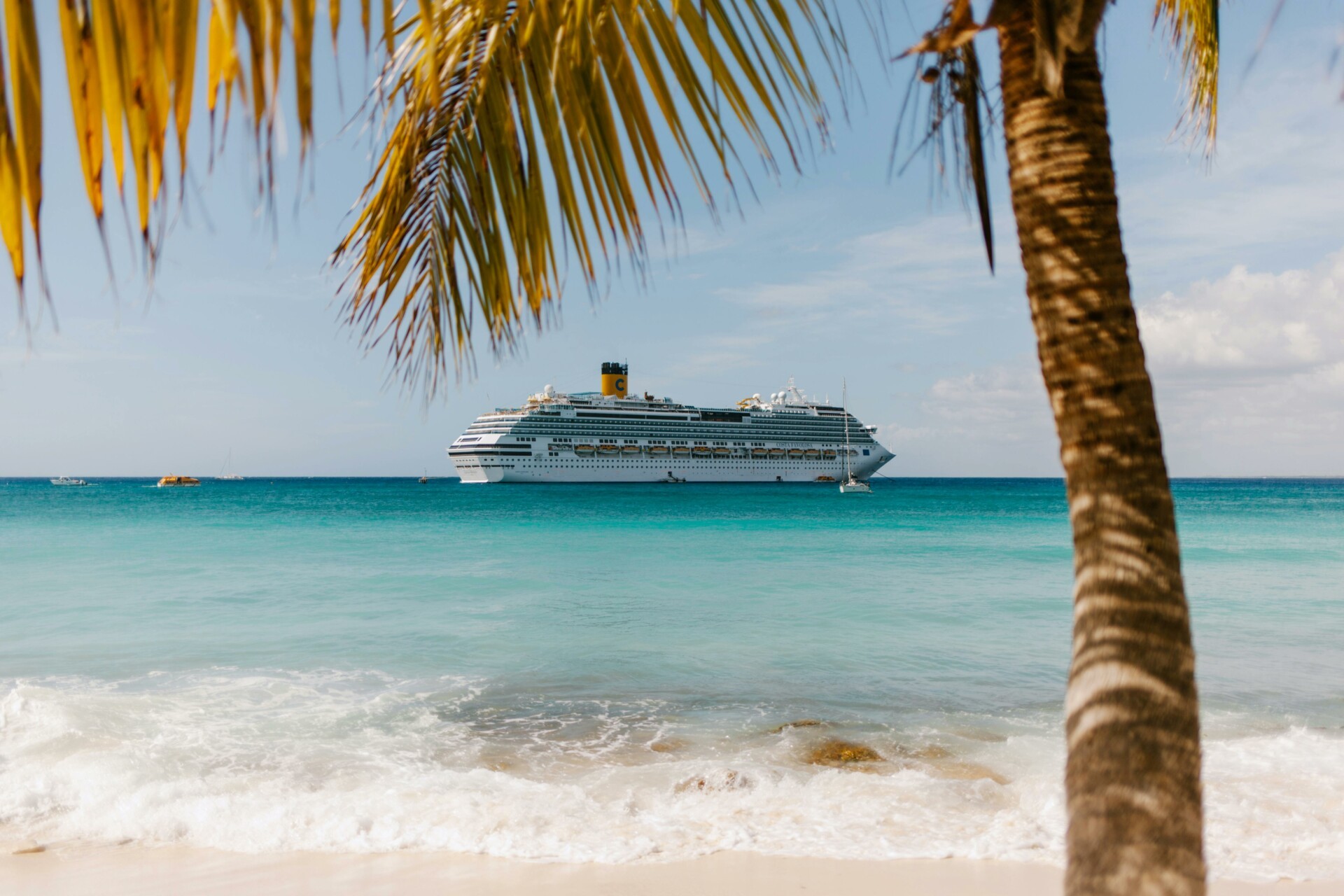
Cruises have become a standard vacation option for many Germans, according to the latest study by the BAT Foundation for Future Issues. In a representative survey, over 3,000 citizens aged 18 and over were asked about their experiences, motivations, and future expectations regarding cruise vacations.
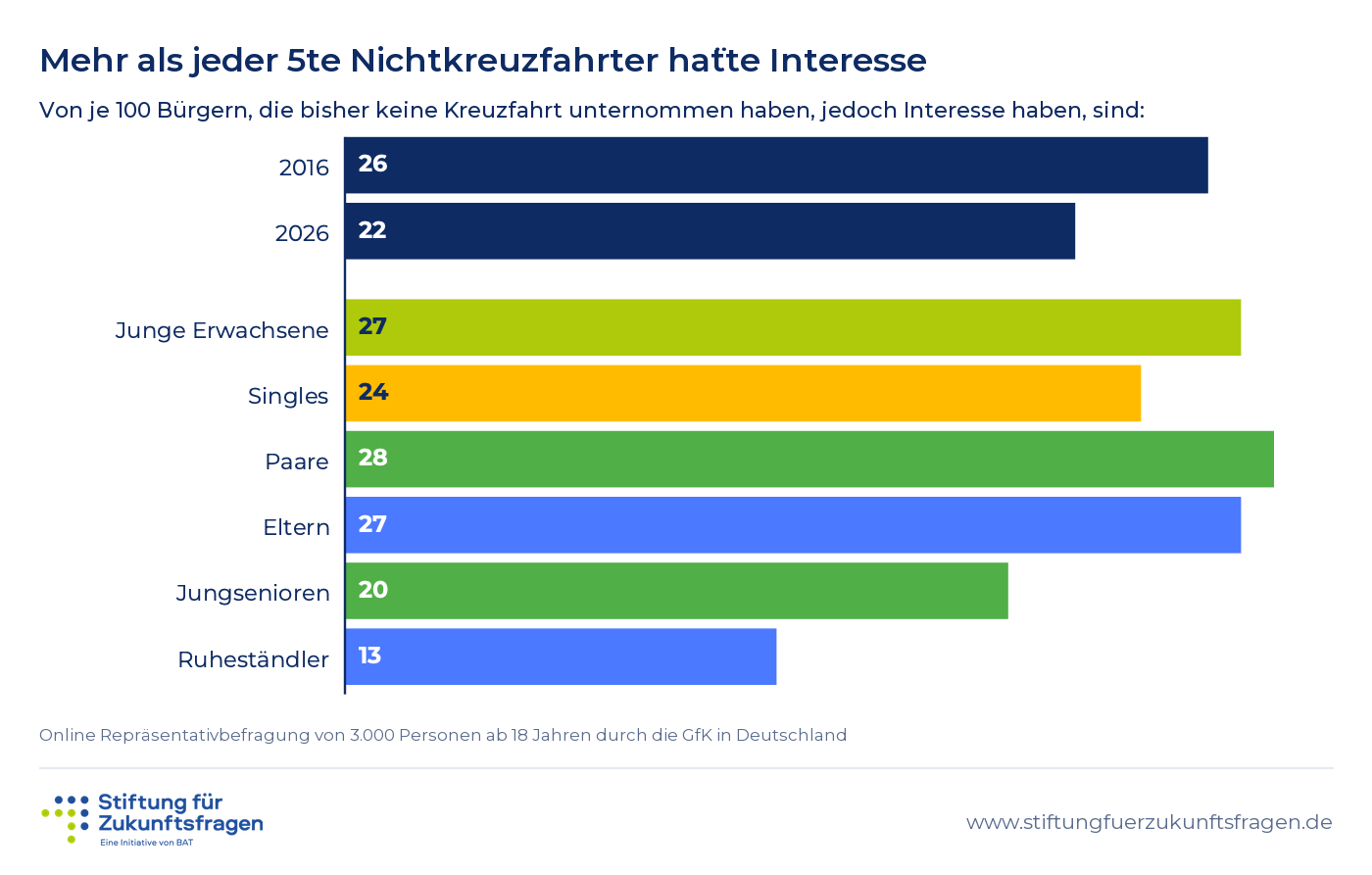
More than one in five non-cruise passengers would be interested Out of every 100 citizens who have not yet taken a cruise but are interested, the following are:Data as table
2016 26 2026 22 Young adults 27 Singles 24 Couples 28 Parents 27 Young seniors 20 Retirees 13
Key findings at a glance
- 28 percent of German citizens have already taken at least one cruise – ten years ago this figure was only 13 percent.
- 22 percent are interested in trying a cruise for the first time.
- 85 percent of guests find cruises relaxing, and 90 percent emphasize the opportunity to visit several countries in a short time.
- 59 percent cite overtourism and overcrowded cities as a key challenge.
- 81 percent see an important future opportunity in routes with less well-known ports – even if iconic highlights are omitted.
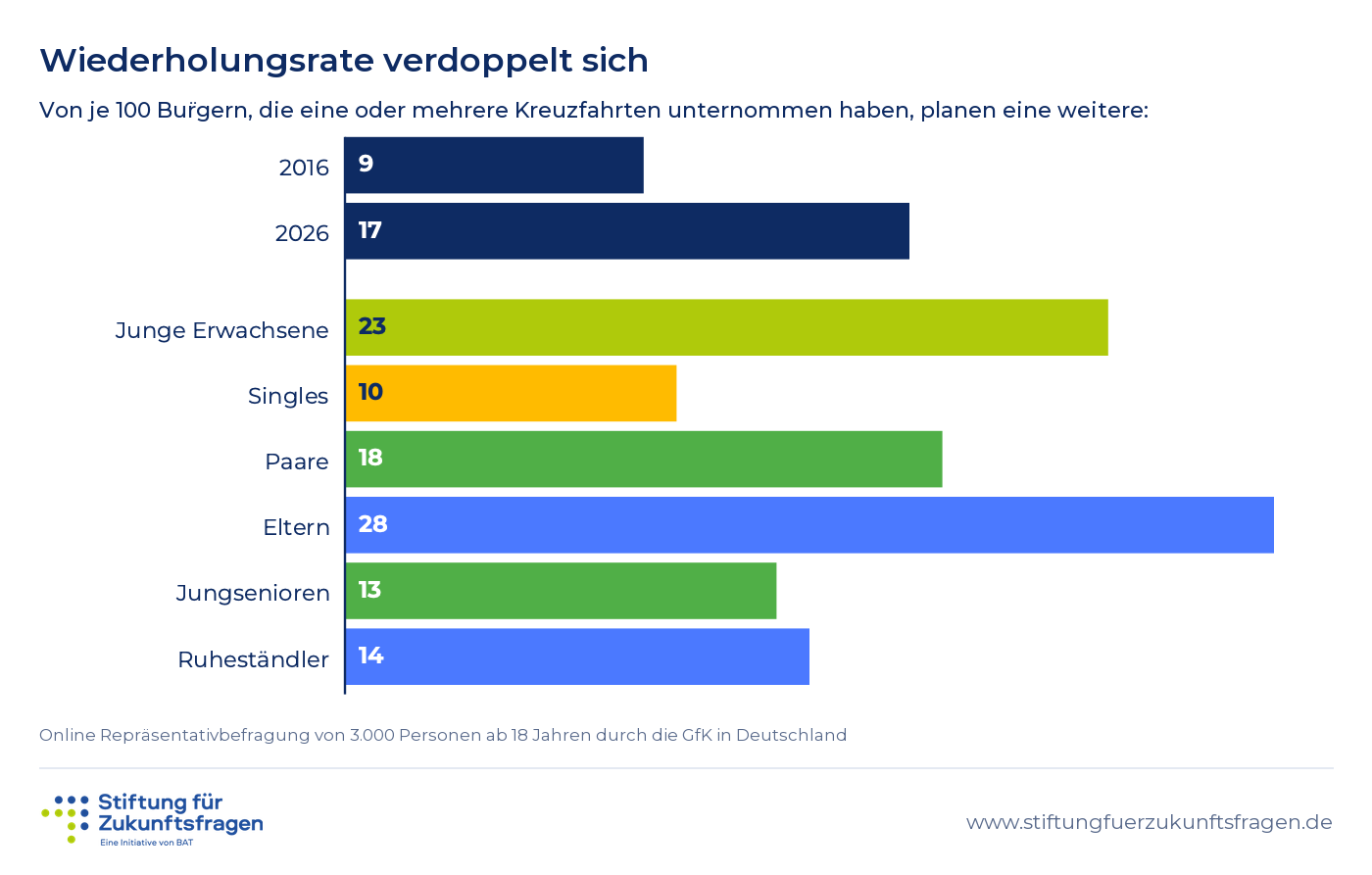
The repetition rate doubles. For every 100 citizens who have taken one or more cruises, plan another one:Data as table
2016 9 2026 17 Young adults 23 Singles 10 Couples 18 Parents 28 Young seniors 13 Retirees 14
Boom with a stable demand base
The cruise industry is no longer a niche market, but a successful model that has grown over many years. This is reflected in rising passenger numbers and ever-new record figures. The high rate of repeat business is particularly striking: those who have been on board once often permanently integrate this type of travel into their vacation repertoire.
At the same time, the number of potential first-time cruisers remains high. Almost a quarter of the population can currently imagine taking their first cruise. This provides additional impetus for further growth in demand. The combination of a stable base of regular customers and curious newcomers forms a solid foundation for a consistently high booking level.
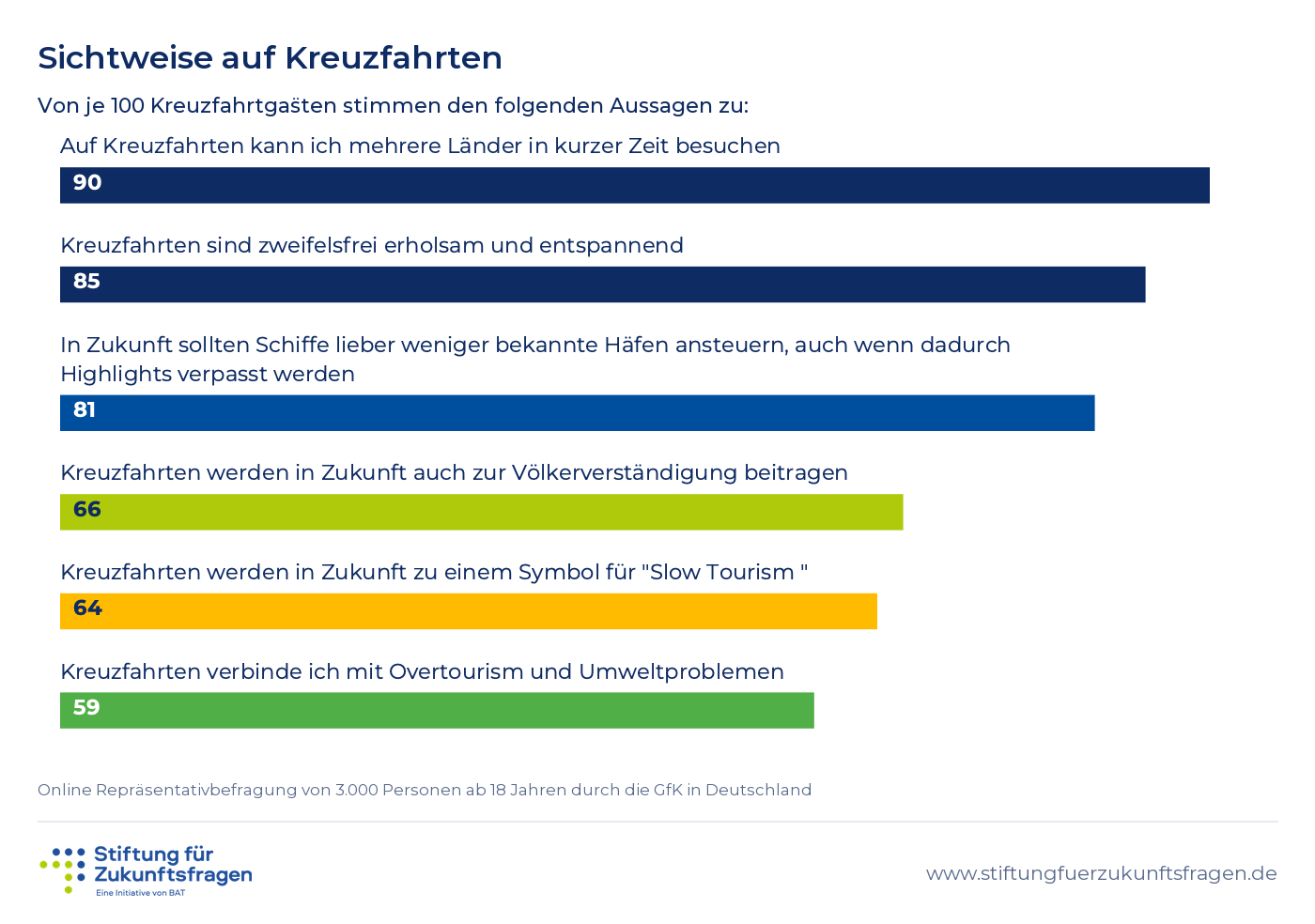
Perspective on cruises
Out of every 100 cruise passengers, the following statements are agreed with:
Data as table
| On cruises I can visit several countries in a short time. | 90 |
| Cruises are undoubtedly restful and relaxing. | 85 |
| In the future, ships should preferably head for less well-known ports, even if this means missing out on some highlights. | 81 |
| Cruises will also contribute to international understanding in the future. | 66 |
| Cruises will become a symbol of "slow tourism" in the future." | 64 |
| I associate cruises with overtourism and environmental problems. | 59 |
Why cruises are so attractive
A key reason for their success lies in the unique combination of core vacation motives. Cruises offer relaxation and adventure in a compact format. The vast majority of passengers find the trip very relaxing – due in part to comfortable accommodations, clearly organized itineraries, and the opportunity to escape from everyday life without extensive planning. Rest periods, service offerings, and a structured daily schedule make it easier for many guests to unwind – a central motivation for any vacation.
At the same time, the experiential aspect plays an important role: nine out of ten respondents highlight the opportunity to visit several countries in a short time. The trip is thus perceived as a succession of different impressions.
„Cruises serve a dual purpose, offering a rare combination of comfort and daily changing insights into different cities and cultures for adventure-seeking guests. Added to this is a high degree of safety, which makes this offering particularly attractive in turbulent times,“ said the foundation’s scientific director, Professor Dr. Ulrich Reinhardt.
The downside: Overtourism in port cities
Despite high levels of satisfaction, the industry also faces challenges. Three out of five respondents see overcrowded city centers and overtourism as a key problem associated with cruises. From the guests' perspective, this creates additional congestion in already busy locations. This can negatively impact their well-being and the overall quality of their stay.
This is particularly evident in popular port cities like Barcelona, Venice, or Dubrovnik. Crowds are already high there, and when several ships dock simultaneously, traffic flow, infrastructure, and local services come under additional pressure.
New routes as a solution approach
Many guests, however, also see concrete solutions. Four out of five respondents are open to visiting lesser-known ports more often in the future – even if this means missing out on well-known highlights. For them, the focus is not on quickly "ticking off" iconic places, but on the quality of the travel experience. The quality of the stay and a slower pace of life are gaining in importance.
This results in a clear strategic approach for shipping companies: routes can be deliberately streamlined by giving greater consideration to smaller cities, alternative regions, and ports that have been visited less frequently. Such destinations often offer more opportunities for interaction, shorter waiting times, and an overall more relaxed travel pace.
Future scenario: Cruises in balance
Prof. Ulrich Reinhardt: „If one extrapolates current attitudes to the coming years, on the one hand, much points to a continued boom in cruises, but on the other hand, the demand on shipping companies to face challenges and find solutions becomes clear.“
Routes that include more medium-sized and smaller destinations can better distribute visitor flows and relieve pressure on both tourists and locals. At the same time, new regions gain access to tourism revenue without immediately reaching capacity limits.
„This creates an offering for travelers that combines relaxation, adventure, and respect for local structures. Comfort and variety are maintained, but complemented by a stronger focus on the quality of the stay. Cruises thus have the opportunity to evolve from a purely growth-oriented model to a more balanced form of travel,“ said Reinhardt.
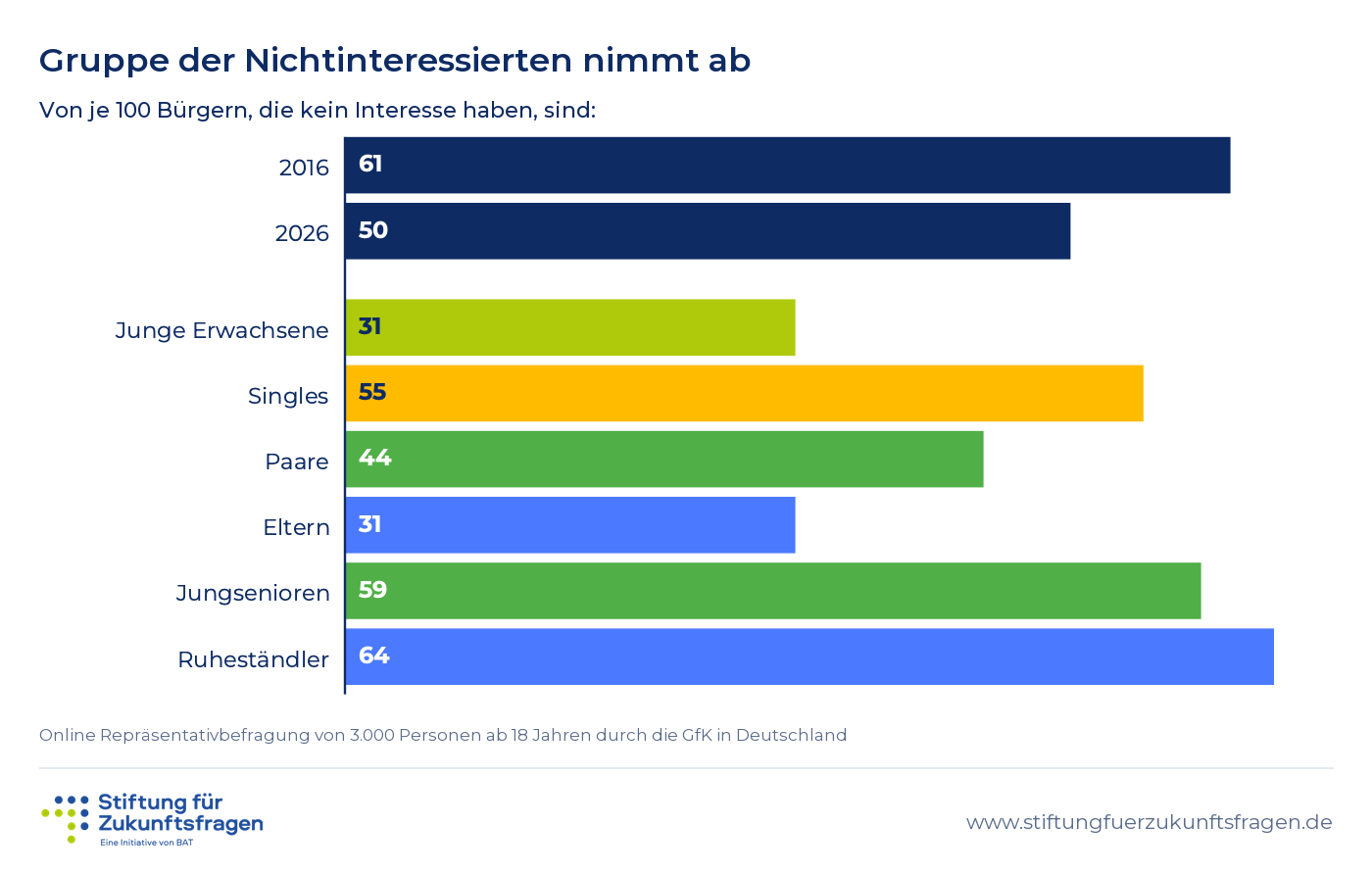
The group of those who are not interested is decreasing.
Out of every 100 citizens who have no interest, the following percentages are:
Data as table
| 2016 | 61 |
| 2026 | 50 |
| Young adults | 31 |
| Singles | 55 |
| Couples | 44 |
| Parents | 31 |
| Young seniors | 59 |
| Retirees | 64 |