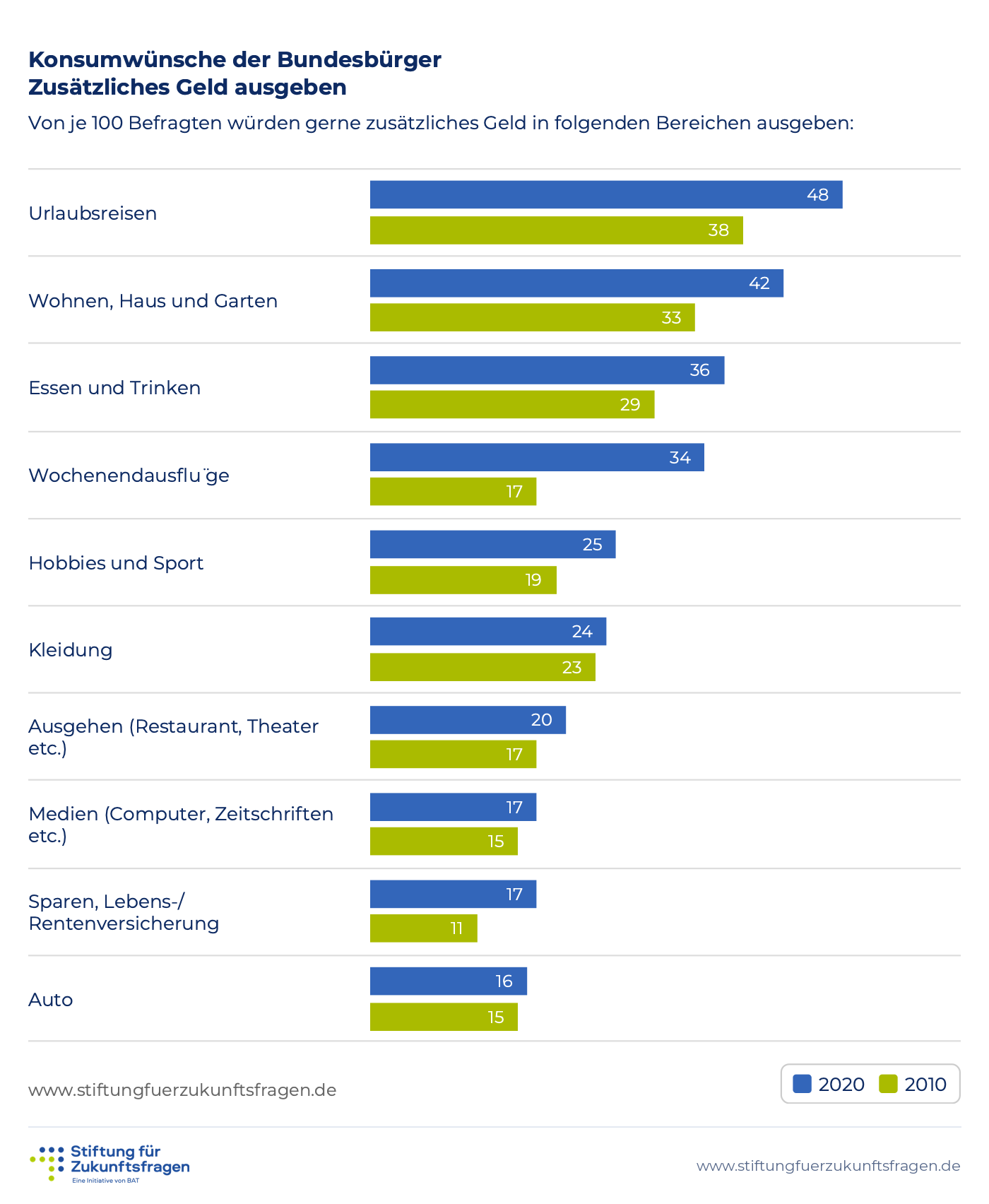


What would Germans most like to spend their money on? If they had an unexpected windfall, almost half of them would go on holiday first and foremost. Finally get away from it all, realise that long-awaited dream trip or perhaps spend a little longer at their holiday destination. A third would also like to take (more) weekend trips, in line with the motto „short, near, far“. This desire has increased the most in a 10-year comparison and has even doubled.
40 per cent of Germans would also improve their own home or garden or perhaps even move into a larger flat. And around one in three would invest more in food and drink with a higher income - be it for higher quality, speciality or healthier food.
Data as table
| 2020 | 2010 | |
|---|---|---|
| Holiday trips | 48 | 38 |
| Living, house and garden | 42 | 33 |
| Food and Drink | 36 | 29 |
| weekend trips | 34 | 17 |
| Hobbies and sports | 25 | 19 |
| Clothing | 24 | 23 |
| Going out (restaurant, theatre, etc.) | 20 | 17 |
| Media (computers, magazines, etc.) | 17 | 15 |
| Savings, life/pension insurance | 17 | 11 |
| car | 16 | 15 |
For all consumer wishes, it is striking how great the differences are within the population. Women are much more likely to invest additional money in the latest fashion (+12 percentage points) and men would spend additional money on media (+10 PP), cars (+8 PP) and hobbies (+6 PP). Higher earners would go on holiday more often (+20 PP) and improve their home (+17 PP), whereas lower earners are undecided in this regard and are twice as likely to say „I don't know what for“ (+8 PP).
The differences in age are also striking: the generation under 30 would spend more money in every area than the generation over 60, for example to go to the cinema or a bar significantly more often, buy more clothes and shoes, pursue a hobby or own the latest smartphone. The middle generation would primarily go on more weekend trips and invest in food and drink. Similar to those on low incomes, older Germans are not sure what they would do with extra money (+8 PP compared to 18-29-year-olds).
A 10-year comparison shows an increased need for more financial resources in all areas, especially for travelling. The average holiday costs are currently around 1,208 euros per person, i.e. around 5,000 euros for a family of four. However, in addition to travel and accommodation costs, this also includes all additional expenses - from souvenirs and beach chairs to ice cream for the children. But consumer wishes are also increasing for the home, excursions and hobbies. Only media, cars and clothing have changed only minimally.
Savings contracts as well as life and pension insurance policies have seen strong growth. Pension uncertainty and concerns about their own financial situation in old age are too great, meaning that 18-29 year olds in particular want to make more provisions in this area than they did 10 years ago (2020: 25%, 2010: 12%).
Outlook
Most German citizens would like to consume more. Consumer desires are too great and the offers are too tempting. The vast majority of Germans would therefore invest additional financial resources directly in order to leave their own living environment or make it more beautiful, to indulge in a hobby, to realise a long-standing dream or to improve their own quality of life.
A fundamental end to the consumer society is therefore not on the horizon. However, the question remains as to whether consumer goods will have to be owned in the future - or whether utilisation will be sufficient and take centre stage. The possibility of temporarily borrowing products could therefore be an option for saving resources while at the same time enjoying the consumer offer.