

Current research, 298
10 November 2022
Climate change, pandemic, war - Many citizens have the feeling that they are living in times of continuing crisis. The global crises therefore not only pose challenges for political and economic leaders, but are also a burden for many citizens. This is the conclusion of the latest survey conducted by the non-profit BAT Foundation for Future Studies, for which a representative sample of 2,000 German citizens was questioned.
Core results
- Almost two thirds are stressed by the uncertain future
- With regard to the imposition of the pandemic, citizens are not only suffering from the health risks: Almost half of them complain about restrictions in their everyday lives, particularly with regard to their leisure activities
- For almost one in three people, the fear of infection leads to a change in leisure behaviour
Our uncertain future is stressing almost two-thirds
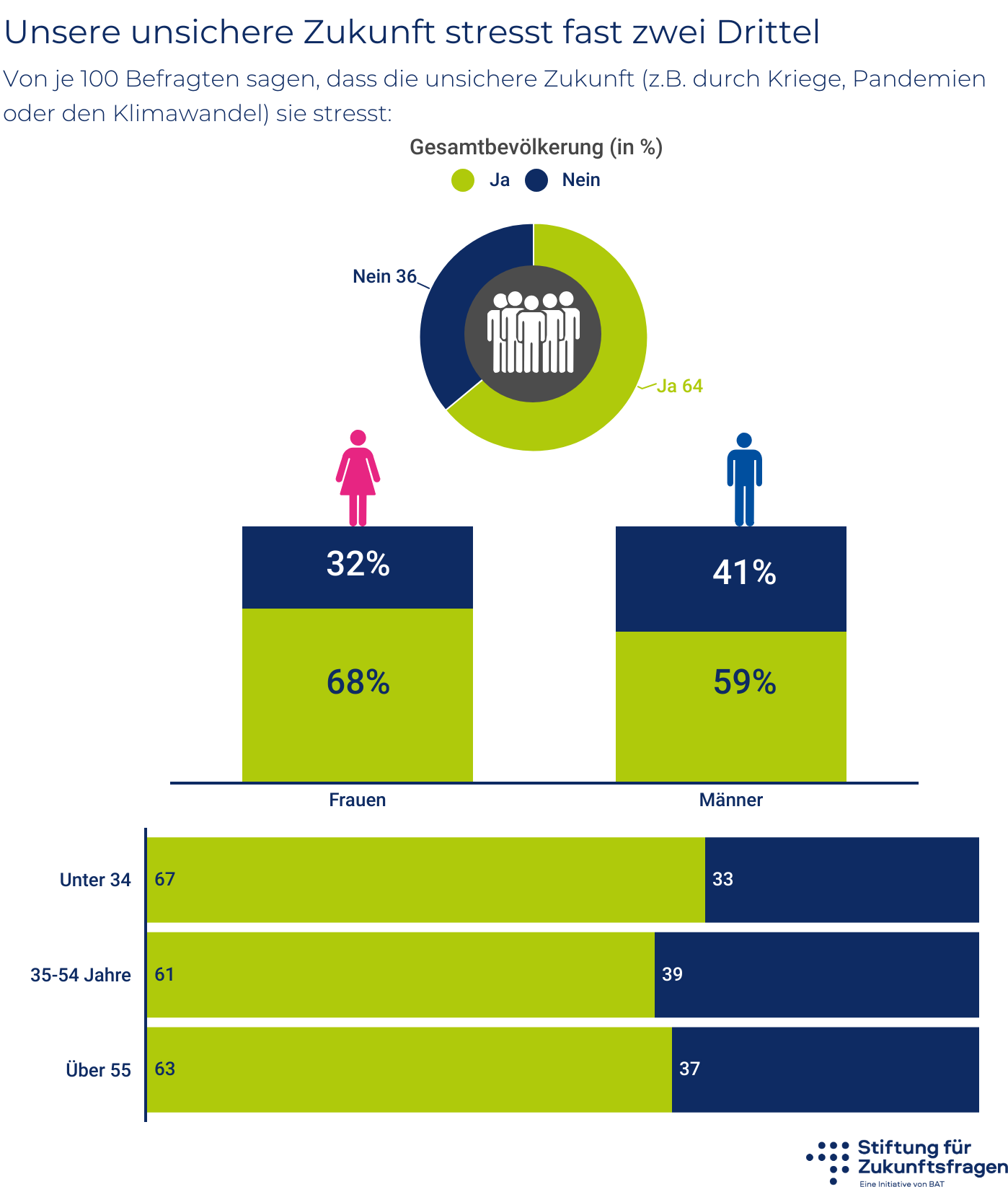
Out of every 100 respondents, they say that the uncertain future (e.g., due to wars, pandemics, or climate change) stresses them:
Total population (in %)
Data as table
| Yes | No | |
|---|---|---|
| Women | 68 | 32 |
| Men | 59 | 41 |
| Total population | |
|---|---|
| Yes | 64 |
| No | 36 |
| Yes | No | |
|---|---|---|
| Under 34 | 67 | 33 |
| 35-54 years | 61 | 39 |
| Over 55 | 63 | 37 |
For the Scientific Director of the Foundation, Professor Dr Ulrich Reinhardt climate change, wars and pandemic events represent both indirect and direct changes to everyday life that many associate with uncertainty, withdrawal and stress. There are recognisable nuances here. Climate change is seen as an urgent, global problem that does not (yet) affect everyday life. Reports of extreme weather events are making people more and more aware of the issue, but have not yet had a lasting effect on practical behaviour. The stress factor is therefore more likely to be located on a theoretical, intellectual level.
War conflicts are perceived as more stressful the closer the geographical border to them, the more frequently they are reported on in the media and the more individual restrictions are associated with them. The war in Ukraine shows these characteristics in terms of financial worries, security concerns and - particularly among the older population - stressful memories. In conjunction with a growing sense of far-reaching challenges (e.g. increasing division in society, radicalisation of subgroups, excessive demands or a dwindling basic consensus), they increasingly intensify the feeling of stress.
A narrow majority no longer feels any restrictions due to Corona.
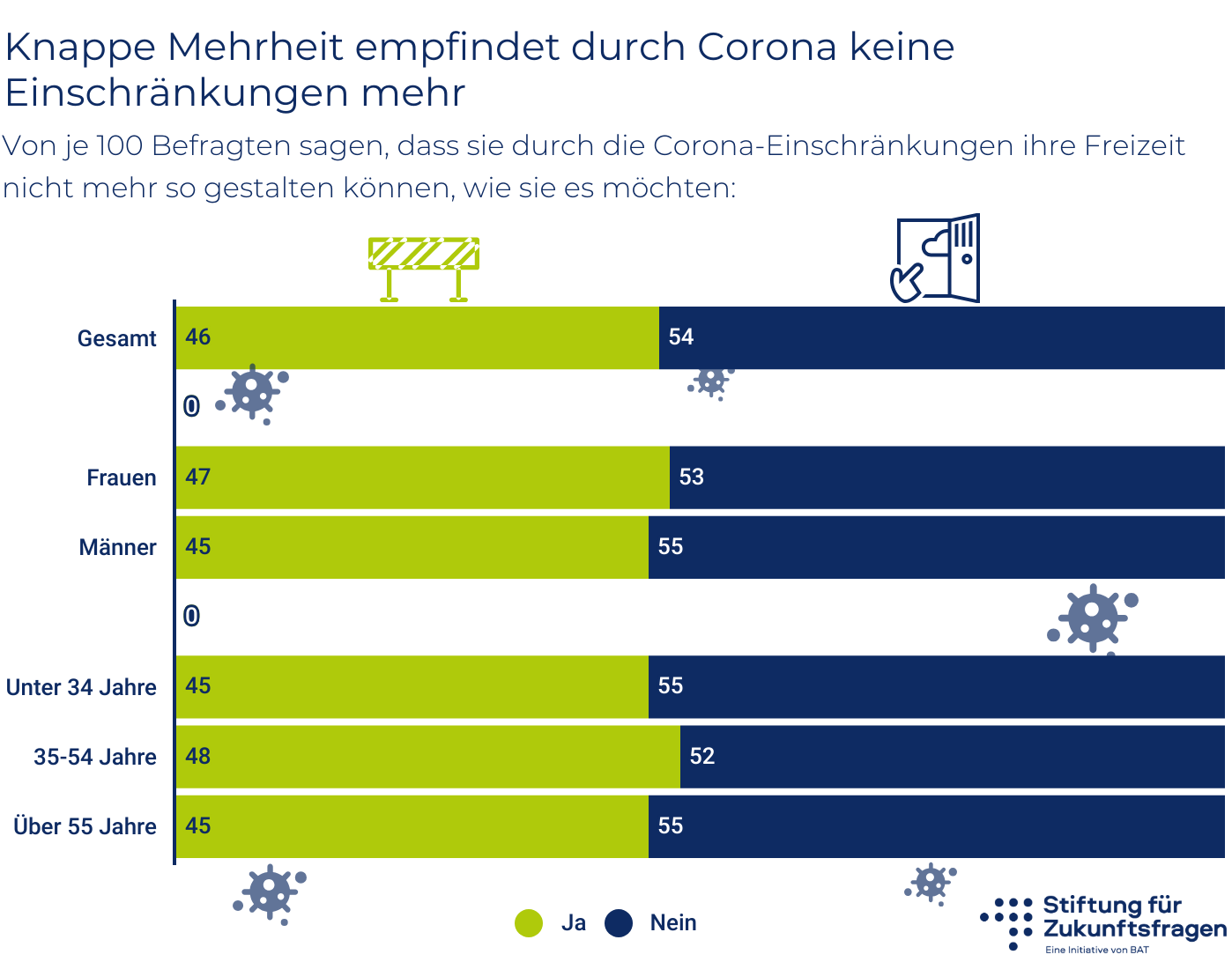
Of every 100 respondents, 100 say that due to the Corona restrictions they can no longer spend their free time as they would like:
Data as table
| Yes | No | |
|---|---|---|
| Total | 46 | 54 |
| Women | 47 | 53 |
| Men | 45 | 55 |
| Under 34 years | 45 | 55 |
| 35-54 years | 48 | 52 |
| Over 55 years | 45 | 55 |
The pandemic has a particular impact on individual well-being, as it is associated with direct restrictions and changes. Almost one in two people state that they are unable to carry out their usual leisure activities. This is due to both external and internal factors: external factors include new regulations, bans, a reduced range of organised and open leisure activities or additional financial costs. Internal motives include, above all, the fear of infection, which for a third of respondents leads to modified leisure behaviour, new prioritisation or frustration about restrictions.
Two-thirds are no longer afraid of a coronavirus infection.
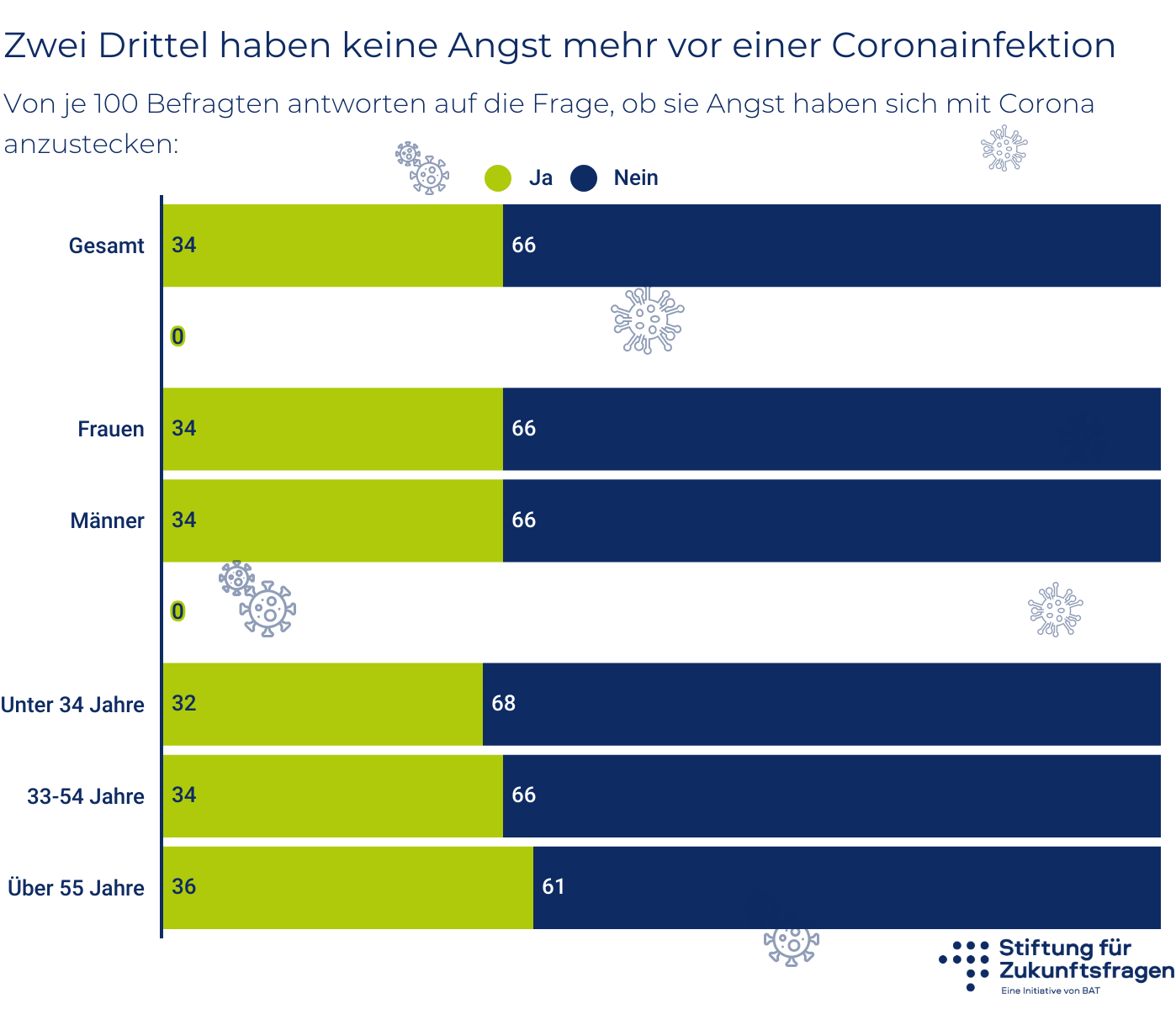
Out of every 100 respondents, the following answers were given to the question of whether they are afraid of becoming infected with Corona:
Data as table
| Yes | No | |
|---|---|---|
| Total | 34 | 66 |
| Women | 34 | 66 |
| Men | 34 | 66 |
| Under 34 years | 32 | 68 |
| 33-54 years | 34 | 66 |
| Over 55 years | 36 | 61 |
Despite all the challenges and negative figures, Reinhardt also emphasises the positive aspects of the study: „A third do not consider the current challenges and crises to be a burden or have found ways and means of dealing with them. Half of the population has adapted to the circumstances and continues to lead (or is once again leading) a carefree and active leisure life. And two thirds are no longer afraid of infection“.