

Chart of the week, 2025-KW40
2 October 2025
What will become of us?
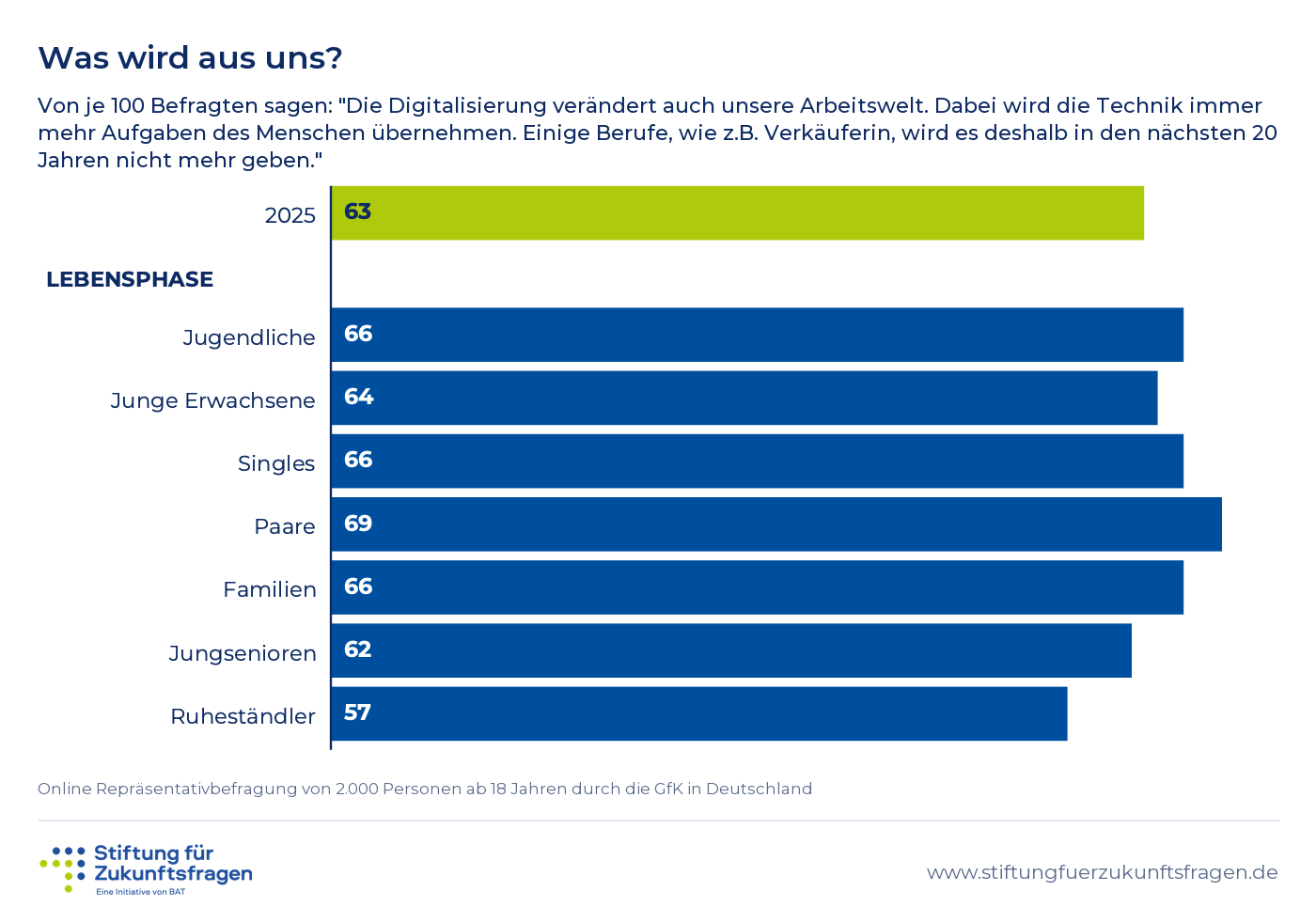
Of every 100 respondents, one said: "Digitalization is also changing our working world. Technology will increasingly take over more and more tasks from humans. Some professions, such as sales assistant, will therefore no longer exist in the next 20 years.""
Data as table
| 2025 | 63 |
| LIFE PHASE | |
|---|---|
| Teenagers | 66 |
| Young adults | 64 |
| Singles | 66 |
| Couples | 69 |
| Families | 66 |
| Young seniors | 62 |
| Retirees | 57 |
Result
Digitalisation is fundamentally changing the world of work - and is viewed with mixed feelings by the majority of the population. 63 per cent of Germans assume that technological developments will influence all professional fields in the long term. At the same time, there is uncertainty about the extent to which their own job will be affected. Concerns about the loss of jobs due to automation contrast with hopes for new career opportunities. Between fascination with progress and fear of displacement, an area of tension is emerging that is shaping the future of gainful employment.
Reasons
Not all professions are affected by digitalisation to the same extent. Activities with a high potential for automation, such as in accounting or logistics, are changing more than personalised professions, for example in the skilled trades, catering or culture. Opportunities arise in particular where new occupational fields are created - as AI trainers or data ethicists. In addition to technical skills, social and adaptive skills are becoming increasingly important. The ability to continuously acquire new knowledge and deal with change is becoming a key prerequisite for long-term employability. Learning is less about acquiring facts and more about the ongoing process of personal development.
Forecast
The future of work is not a race between man and machine, but an interplay between the two. While technology takes on monotonous and repetitive tasks, humans can concentrate on creative, empathetic and strategic activities. Job profiles are becoming more flexible, transitions between permanent employment and self-employment more fluid. The desire for self-determination and a better work-life balance will continue to grow. At the same time, the risk of a digital divide is growing - education and training will therefore become key tasks for society in order to enable participation for all.