

Chart of the Week, 2025-Week 48
November 27, 2025

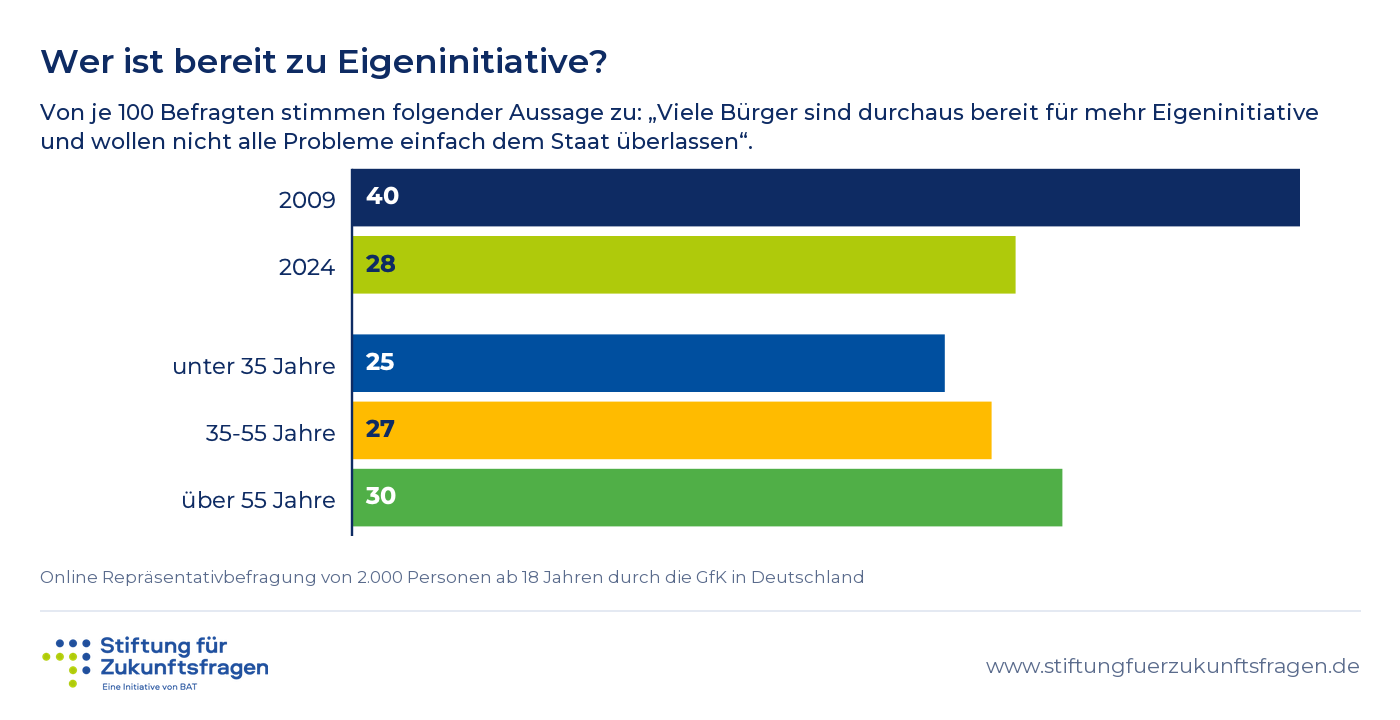
Who is willing to take initiative?
Out of every 100 respondents, the following statement was agreed with: "Many citizens are quite willing to take more initiative and do not want to simply leave all problems to the state.".
Data as table
| 2009 | 40 |
| 2024 | 28 |
| under 35 years | 25 |
| 35-55 years | 27 |
| over 55 years | 30 |
Result
The willingness of German citizens to take social initiative is increasingly viewed with skepticism. Currently, only 28 percent agree with the statement that many people are willing to take action themselves instead of leaving problems to the state.. Compared to 2009, when 40 percent held this view, this is a significant decline.. This reveals a blatant discrepancy between the perception of others and the assessment of oneself. While trust in public initiatives is declining, parallel data shows that 90 percent of respondents take personal responsibility for their actions.. More than half are even convinced that they bear more responsibility than their fellow human beings.. The self-image („I do a lot“) thus stands in stark contrast to the external image („The others do little“).
Reasons
The primary cause of this perception gap is a psychological distortion. People tend to evaluate their own behavior more favorably and positively than the actions of others.. One's own commitment is evident, while the activities of others often remain invisible or are perceived as insufficient.. This effect is amplified by evolutionary and media mechanisms. The human brain is programmed to perceive risks, problems, and negative events more intensely, as this was historically vital for survival.. In today's media landscape, this leads to grievances and scandals being discussed more frequently than positive examples of civic engagement.. When the focus is primarily on negative headlines, the impression is reinforced that there is a widespread lack of civic spirit and responsibility, even if the reality is more nuanced..
Forecast
To break the negative cycle of mistrust and calls for state solutions, a change of perspective will be necessary in the future.. Trust in society's ability to act grows not through appeals, but through lived reality and visibility.. It can be assumed that shared experiences and encounters – for example in voluntary work, in clubs or in the neighborhood – will gain in importance in order to correct the image of the „inactive other“.. When successes are shared and personal initiative is experienced as rewarding and effective, the individual's motivation to see themselves as part of a responsible community increases.. The challenge of the coming years will be to bring these positive narratives more to the forefront in order to close the gap between perception and reality..