

Core results
- Highest travel frequency in 20 years
- Approximately one in two German citizens undertook two or more trips.
- The trip duration remains constant at just under 13 days.
- Long-distance trips take twice as long as domestic holidays.
- Holiday spending reaches new record high
- Greece and Spain are significantly more expensive than Türkiye and Croatia.
- More than one in three people spend their vacation in their own country.
- Italy and France can gain ground.
- North America more popular than last year
- More than two-thirds are already sitting on packed suitcases.
- Travel plans for 2026 are largely finalized.
Despite economic pressures, social conflicts, and a tense general mood, the frequency of travel continues to increase, and more money is being spent than ever before. This is shown by the 42nd German Tourism Analysis conducted by the non-profit BAT Foundation for Future Issues. In the representative survey, over 3,000 citizens aged 18 and over were asked about their travel habits and plans in December 2025 and January 2026.
Travelling frequency
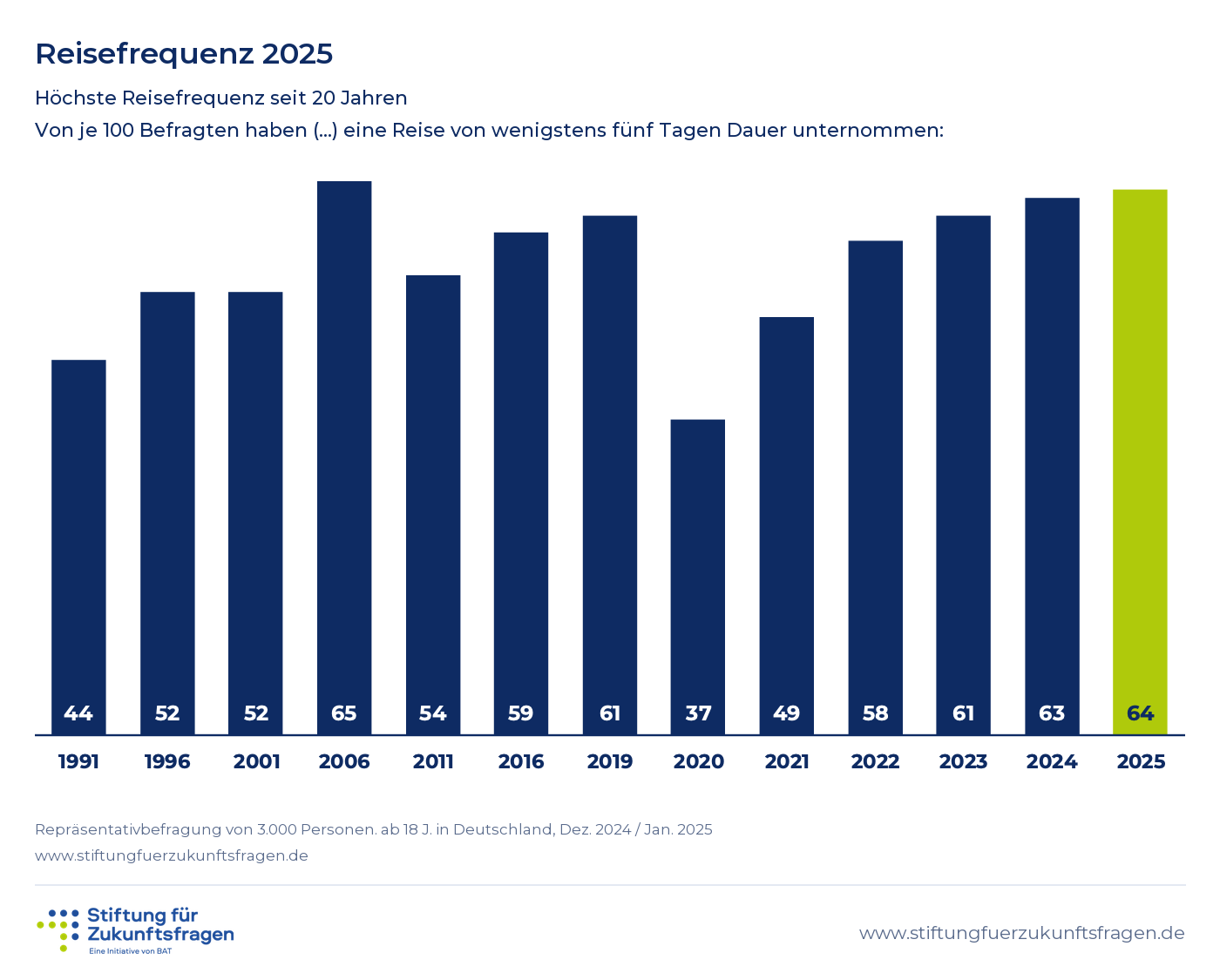
In 2025, almost two-thirds of German citizens (64 %) took at least one trip lasting five days. Only in 2006 was a higher figure recorded. At the same time, the number of multiple trips also continued to rise. Almost half of all citizens (44 %) packed their bags and traveled several times. Ten years earlier, this was true for only 15 percent of Germans.
Travel frequency increased with income: Almost four times as many higher earners (63 %) as lower earners (17 %) traveled multiple times.
„"The strategy 'the more often, the better' has proven to be an effective way of coping with the increasing pace and acceleration of everyday life. People consciously take these breaks as a counterpoint to professional pressures and global uncertainties. Vacations function as a kind of last refuge of self-determination, which is the last thing people cut back on, even when money is tight."‚, according to the scientific director of the foundation, Professor Dr. Ulrich Reinhardt.
Travel frequency 2025
Highest travel frequency in 20 years
Of every 100 respondents, (...) undertook a trip lasting at least five days:
Data as table
| 1991 | 44 |
| 1996 | 52 |
| 2001 | 52 |
| 2006 | 65 |
| 2011 | 54 |
| 2016 | 59 |
| 2019 | 61 |
| 2020 | 37 |
| 2021 | 49 |
| 2022 | 58 |
| 2023 | 61 |
| 2024 | 63 |
| 2025 | 64 |
Trip duration
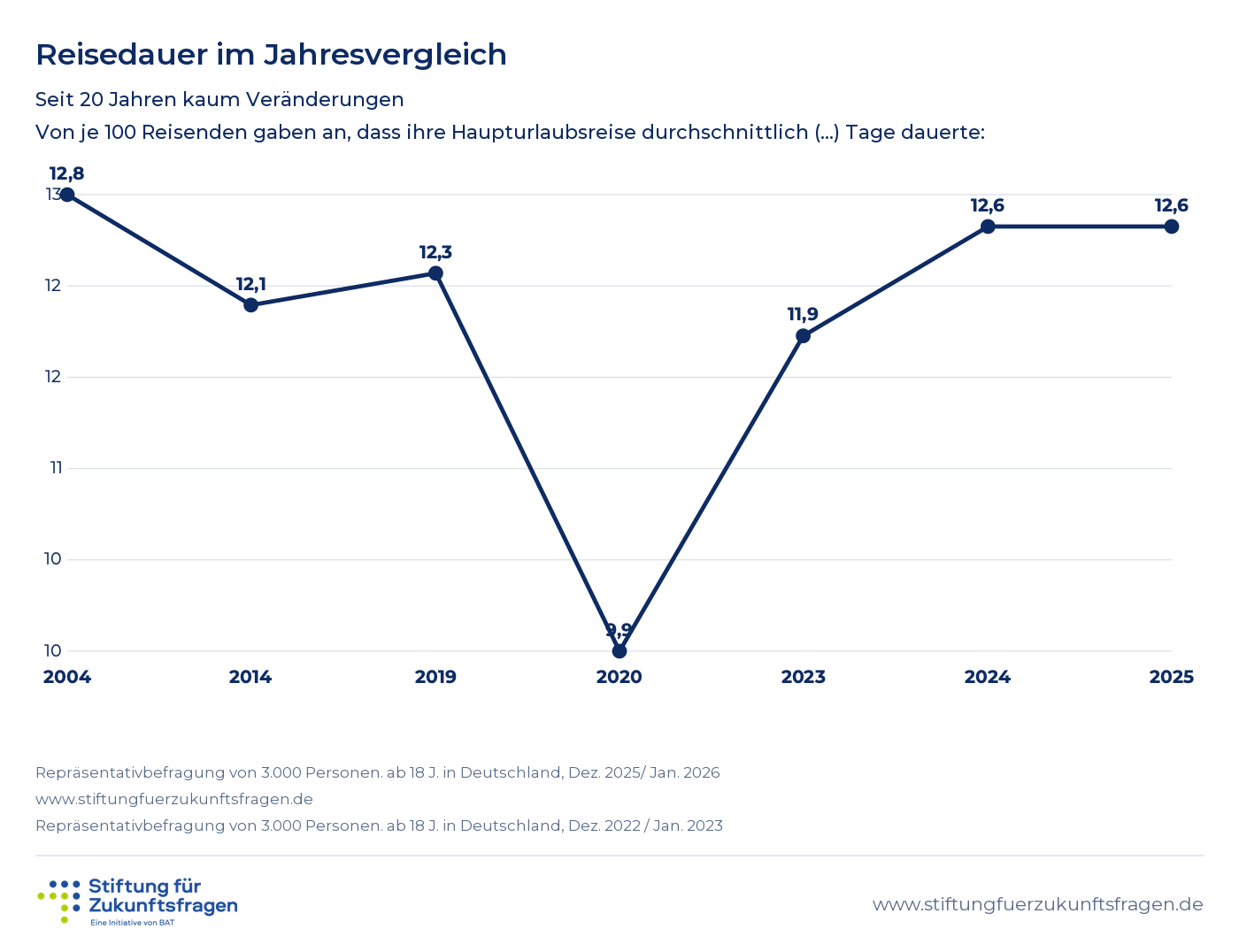
The average vacation duration in 2025 remained at the previous year's level of just under 13 days. Looking at trends over more than two decades reveals the largely consistent length of trips. Only in the first year of the COVID-19 pandemic did deviations occur due to the exceptional circumstances. Apart from this exceptional situation, the duration of trips has proven quite stable over the years.
Significant differences emerge depending on the chosen destination: domestic trips remain well below average, while long-distance travel involves considerably longer vacation times. Within Europe, the duration of trips is generally similar – with two exceptions: Turkey is almost four days above average, while in Austria it is even below the German average.
The reasons for longer stays in Turkey can be explained by the low daily costs and the relatively long journey. In Austria, vacation durations are shorter primarily because the country is a classic short-break destination for many travelers – offering minimal organizational effort, cultural proximity, and a highly reliable infrastructure. Furthermore, the functional use of the destination plays a role: Austria is often chosen specifically for individual activities (e.g., hiking, wellness, skiing), but not for extended relaxing vacations or to experience new things.
Reinhardt: „"Overall, a clear pattern can be observed, whereby with increasing spatial distance not only does the organizational effort of the trip increase, but also the desire for intensive relaxation, a sustainable break from everyday life and a greater exploitation of the travel experience."“
Travel duration compared to previous years
Hardly any changes in 20 years
Of every 100 travelers, one indicated that their main holiday trip lasted an average of (...) days:
Data as table
| 2004 | 12,8 |
| 2014 | 12,1 |
| 2019 | 12,3 |
| 2020 | 9,9 |
| 2023 | 11,9 |
| 2024 | 12,6 |
| 2025 | 12,6 |
Travelling expenses
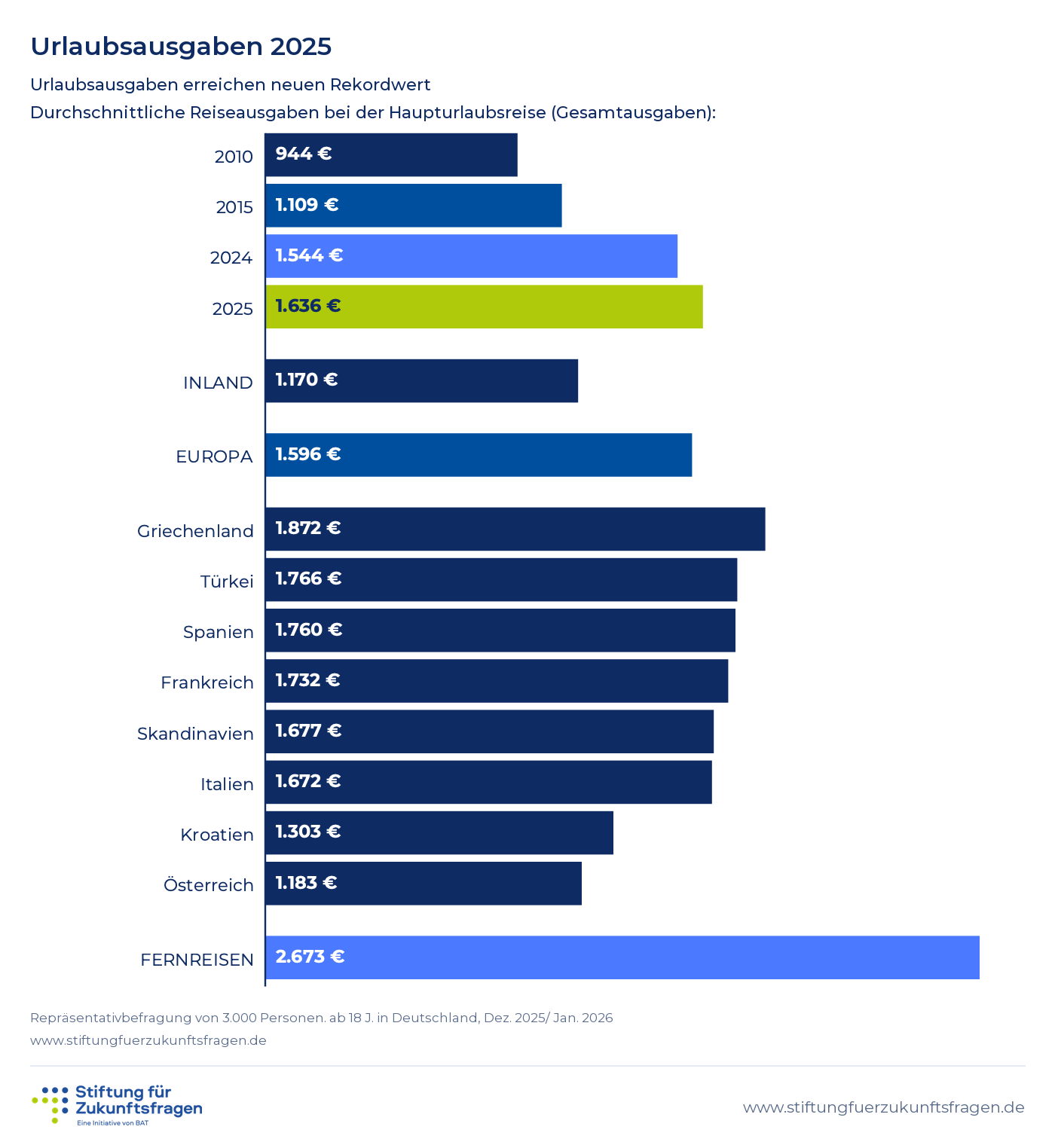
Average holiday costs in 2025 amounted to €1,636 per person, almost €100 higher than the previous year. Ten years earlier, travelers spent more than €500 less on their main holiday (2015: €1,109).
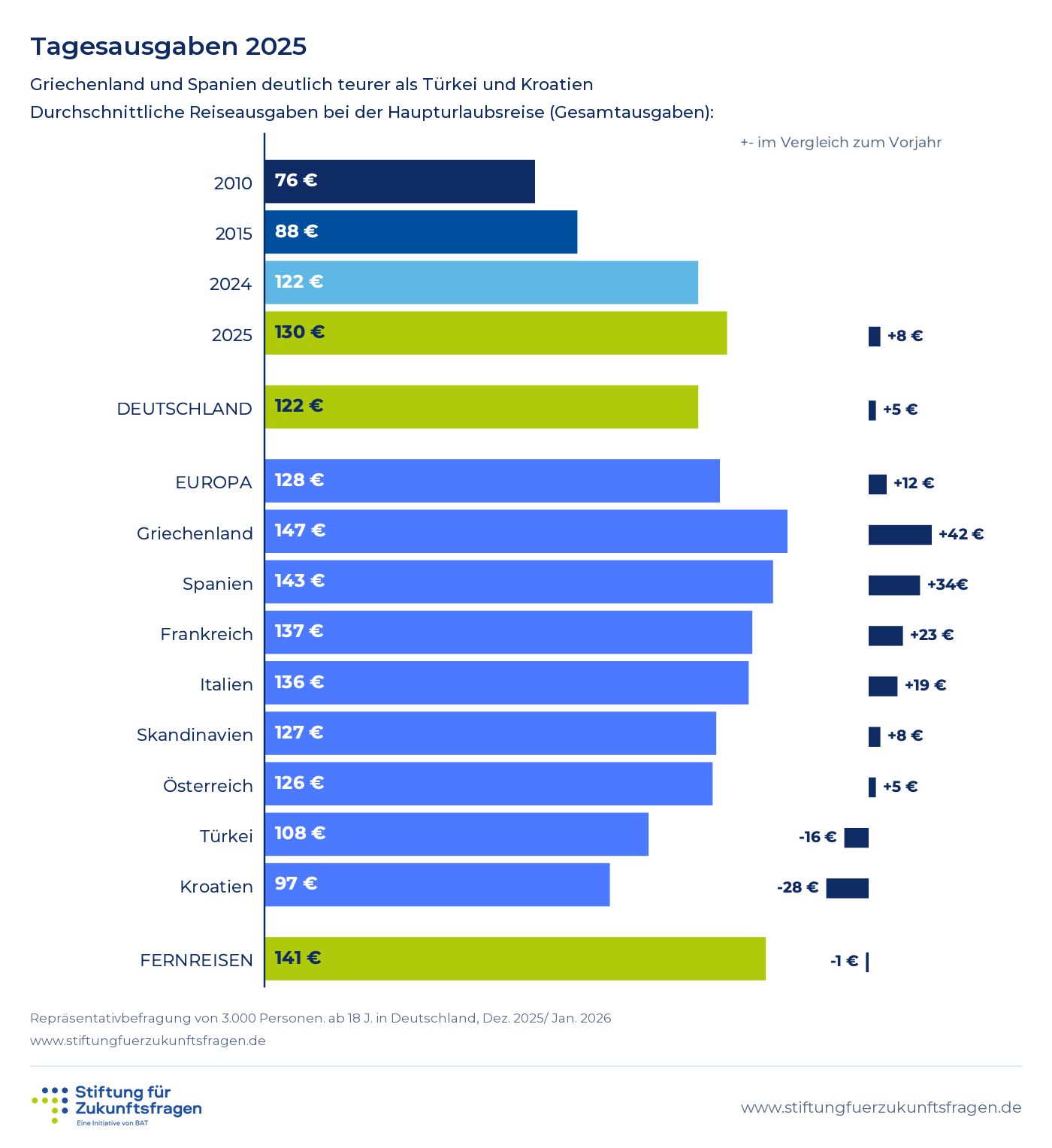
Daily costs also reached a new high of €130 per person per day. However, costs varied considerably depending on the destination. Greece (€147) and Spain (€143) were the most expensive – even more so than long-haul trips. In both countries, prices rose significantly year-on-year, which can be partly explained by increased airfares. Turkey and Croatia, on the other hand, were considerably cheaper, and both also saw year-on-year price reductions.
Holiday expenses 2025
Holiday spending reaches new record high
Average travel expenses for the main holiday trip (total expenses):
Data as table
| Year | Amount | |
|---|---|---|
| Total | 2010 | 944 € |
| Total | 2015 | 1.109 € |
| Total | 2024 | 1.544 € |
| Total | 2025 | 1.636 € |
| INLAND | 2025 | 1.170 € |
| EUROPE | 2025 | 1.596 € |
| Greece | 2025 | 1.872 € |
| Turkey | 2025 | 1.766 € |
| Spain | 2025 | 1.760 € |
| France | 2025 | 1.732 € |
| Scandinavia | 2025 | 1.677 € |
| Italy | 2025 | 1.672 € |
| Croatia | 2025 | 1.303 € |
| Austria | 2025 | 1.183 € |
| LONG-DISTANCE TRAVEL | 2025 | 2.673 € |
Daily spending 2025
Greece and Spain are significantly more expensive than Türkiye and Croatia.
Average travel expenses for the main holiday trip (total expenses):
Data as table
| +/- compared to the previous year | ||
|---|---|---|
| 2010 | 76 € | |
| 2015 | 88 € | |
| 2024 | 122 € | |
| 2025 | 130 € | +8 € |
| GERMANY | 122 € | +5 € |
| EUROPE | 128 € | +12 € |
| Greece | 147 € | +42 € |
| Spain | 143 € | +34€ |
| France | 137 € | +23 € |
| Italy | 136 € | +19 € |
| Scandinavia | 127 € | +8 € |
| Austria | 126 € | +5 € |
| Turkey | 108 € | -16 € |
| Croatia | 97 € | -28 € |
| LONG-DISTANCE TRAVEL | 141 € | -1 € |
Domestic destinations
In 2025, Germany remained the most popular destination for German citizens, accounting for 35 percent of all holiday trips. Bavarian holiday regions slightly extended their lead and are now clearly ahead of holiday destinations in the north of the country. Baden-Württemberg, the winner of the previous 2024 travel season, suffered a significant decline in popularity among Germans and was chosen as the primary travel destination by fewer travelers. Numerous holiday destinations in the remaining eleven federal states gained ground, continuing the diversification of domestic travel destinations.
Reinhardt: „"Domestic tourism in Germany is not a given, and every region must constantly develop to remain attractive. Those who rest on their past laurels will quickly be left behind by more innovative destinations."“
European destinations
Spain maintained its position as the most popular destination for Germans' main holidays, with over nine percent of the vote. Italy consolidated its second place and, like France, gained market share.
The reasons for these gains can only be partially explained by good accessibility (by car). More decisive was the renaissance of Dolce Vita and Savoir-vivre – that is, the conscious return to classic values of enjoyment in a complex world. Many travelers were looking for destinations that offered a reliable mix of slowing down, culinary delights, a certain lifestyle, coziness, cultural proximity, and authenticity. Italy and France embody precisely this longing – beyond mere sun and sand.
Long-distance destinations
Long-haul travel destinations saw an overall upward trend. More than one in six trips (17) took place outside Europe. Compared to ten years ago, this represents a significant increase of more than 50 percent (2015: 11). Destinations in North Africa were among the winners in the past travel season. Fueled by an attractive price-performance ratio, fewer safety concerns, and numerous natural and cultural highlights, countries like Morocco, Tunisia, and Egypt were able to satisfy the wanderlust of many Germans.
North America also saw an increase. This rise occurred regardless of media coverage of the USA. The change of government and the associated discussions thus had no negative impact on the travel behavior of German tourists. The United States was and remains a highly attractive destination, and the vastness of the country, the myth of the American Way of Life, and iconic landscapes exert their influence irrespective of all political issues.
Travelling intentions
Germans' love of travel remains resilient to external crises in 2026. Whether economic pressures, geopolitical tensions, or social uncertainties – the desire for a vacation retains its central role in everyday life for Germans. Accordingly, two-thirds are already certain they will take at least one trip this year. Compared to ten years ago, fewer respondents are uncertain and know well in advance whether or not they will travel this year.
Regarding destinations, one in five plans to spend their vacation outside of Europe – more than ever before. Germany will be visited slightly less often than last year, whereas Mediterranean destinations can expect a large number of German guests.
Professor Reinhardt: „"Planning certainty is high, and the anticipation of holidays is already an important emotional outlet during the dark winter months. Citizens want to and will travel in 2026, spending the best weeks of the year amidst a mix of local pride and wanderlust."“