

Caring for relatives
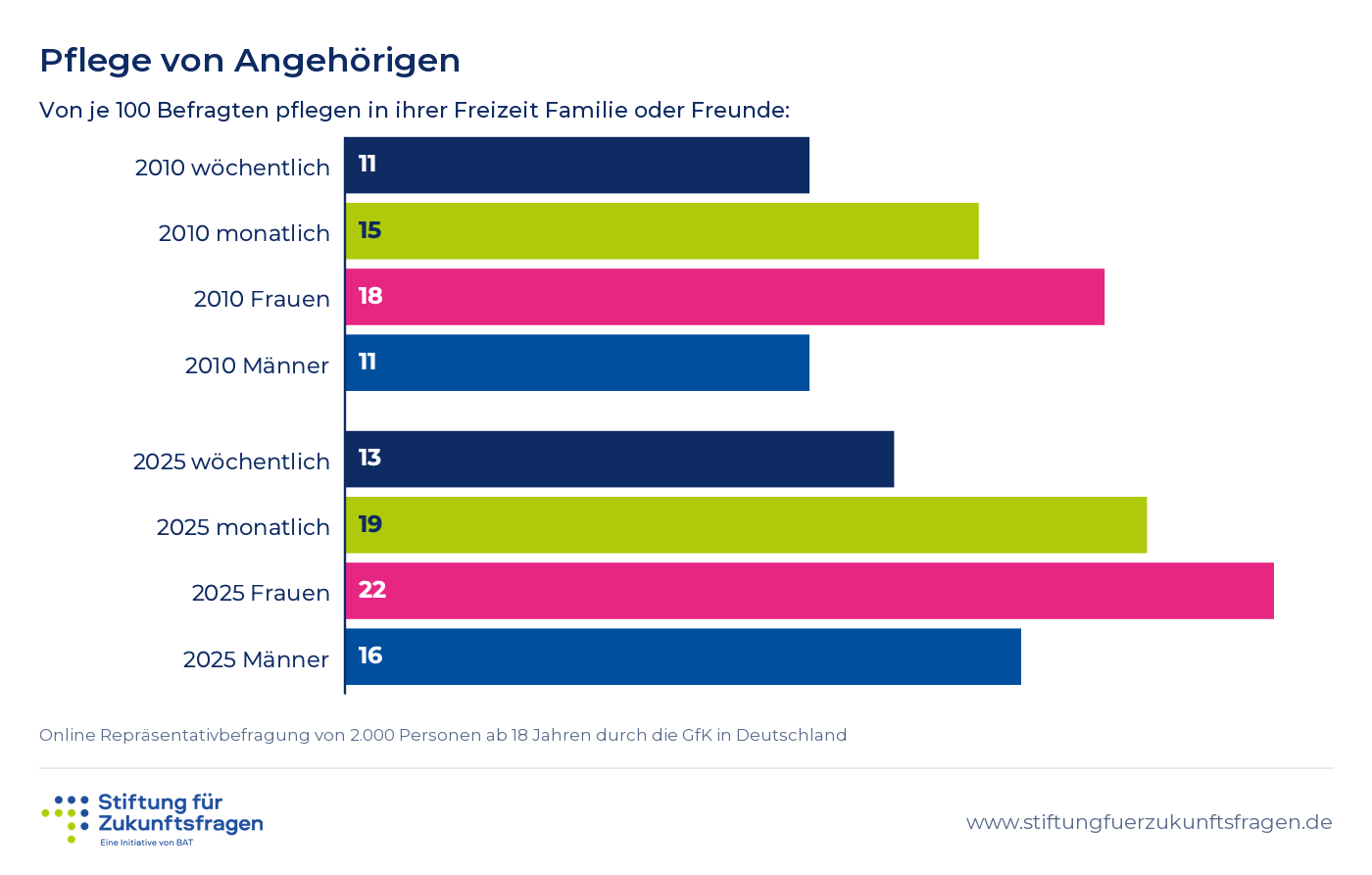
Out of every 100 respondents, those who spend their free time caring for family or friends:
Data as table
| 2010 weekly | 11 |
| 2010 monthly | 15 |
| 2010 Women | 18 |
| 2010 Men | 11 |
| 2025 weekly | 13 |
| 2025 monthly | 19 |
| 2025 women | 22 |
| 2025 Men | 16 |
Result
Caring for relatives is increasingly becoming a fixed pillar in the everyday lives of many German citizens. Currently, more than one in eight citizens (13 %) state that they care for a relative at least once a week.. If one considers the monthly cycle, almost one in five citizens is involved.. In comparison to 2010, there is a clear increase in private care work, which at that time was performed by 15 % (monthly) or 11 % (weekly).. Caregiving remains unequally distributed: women are significantly more involved in caring for relatives (22 %) than men (16 %).. Although men are slowly catching up compared to previous years, the main burden still falls on female citizens.. Furthermore, regional differences are evident: In rural areas, care is provided more frequently than in large cities, which is due to closer family structures, but also to a lower density of professional services..
Reasons
The increase in home care is primarily due to demographic change. In an aging society with a growing number of very elderly people, the risk of chronic diseases increases, while at the same time there is a shortage of skilled workers.. This leads to a de facto privatization of care: families step in where state or institutional structures are insufficient.. The fact that women more frequently take on this task is often still due to traditional gender roles.. At the same time, private care is an enormous economic factor. If the unpaid work of family caregivers, who account for two-thirds of all care services, were monetized, this would correspond to a value of over 40 billion euros – comparable to half of the federal budget for education and research.. In rural areas, family support is often the only option, as professional service providers are lacking.. The burden on caregivers is high: The average sick leave rate in nursing professions is almost twice as high as the national average, at 39 days, highlighting the physical and psychological challenges of this work..
Forecast
Care will continue to be a central societal task in the future, but it requires new approaches to solutions. Similar to childcare, demands for tax advantages, wage replacement benefits, or the crediting of pension points for caregiving periods will gain in relevance.. It can be assumed that flexible working time models and company solutions will be crucial in reconciling work and care work.. In addition to family support, the importance of foreign skilled workers will continue to increase; their share in elderly care has already more than doubled since 2013 to 18 %. In addition, technological innovations – from organizational apps to robotics based on Japanese models – as well as new social concepts such as digital neighborhood assistance could contribute to easing the burden.. In the long term, caregiving must be transformed from an individual burden into a recognized social service.