


Which values are important
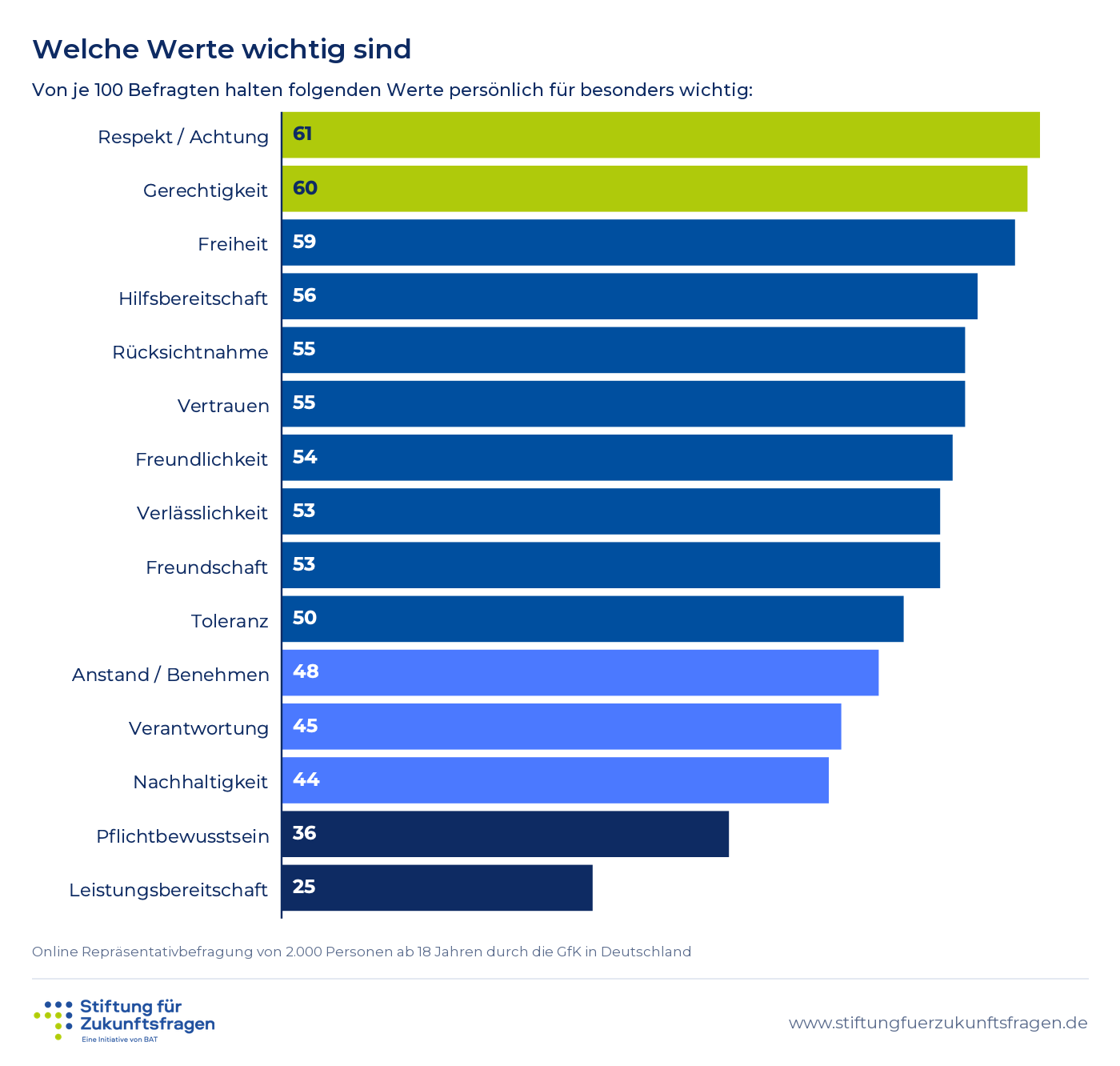
Of every 100 respondents, the following values are considered personally particularly important:
Data as table
| Respect / Consideration | 61 |
| Justice | 60 |
| Freedom | 59 |
| Helpfulness | 56 |
| thoughtfulness | 55 |
| Trust | 55 |
| friendliness | 54 |
| Reliability | 53 |
| friendship | 53 |
| Tolerance | 50 |
| Decency / Manners | 48 |
| Responsibility | 45 |
| sustainability | 44 |
| Sense of duty | 36 |
| willingness to perform | 25 |
Result
Respect, justice and freedom are among the core values of German society. These three principles epitomise the population's desire for harmonious, fair and self-determined coexistence. In addition to these core values, social virtues such as helpfulness, consideration and trust are also held in high esteem, as they illustrate the importance of interpersonal relationships in an increasingly individualised world. In addition, friendliness and reliability, friendship and tolerance are also seen as important by the majority. By contrast, traditional virtues such as a sense of duty and commitment only play a role for around a third and a quarter of the population respectively.
Reasons
The great importance of respect, justice and freedom can be explained by fundamental social needs. Respect is seen as an indispensable basis for peaceful coexistence. It creates space for mutual recognition and minimises conflicts that arise from disregard. Justice is regarded as the foundation of social stability, as it promotes equal opportunities and reduces social inequalities. Freedom, on the other hand, remains a central ideal as it enables personal fulfilment and protects individual freedom. These three values not only reflect individual aspirations, but also the desire for an open and just society. They illustrate the striving for a balance between individuality and community.
Social virtues such as helpfulness and consideration also fulfil a central function in the social fabric. They are an expression of the need for cohesion in an increasingly complex world. Mutual support is perceived as indispensable, especially in uncertain times, in order to strengthen social bonds. Trust plays a key role here, as it enables stable relationships and strengthens cohesion.
The reduced importance of traditional values such as a sense of duty or a focus on performance can be attributed to the change in social priorities and structures. At a time when flexibility and creativity are increasingly valued, these values appear less important. A sense of duty is often associated with rigid rules, inflexibility and hierarchies, which are perceived as a hindrance in modern, dynamic living and working environments. Performance orientation, on the other hand, is often caught between personal fulfilment and social pressure, which makes it less attractive. In addition, many work processes have changed, relativising traditional notions of hard work and discipline. Instead, values such as helpfulness, decency and responsibility are also important in a professional context.
Forecast
Respect, justice and freedom will remain central points of reference for society in the future. It will be important to strike a balance between individual freedom and collective responsibility in order to fulfil the needs of the individual on the one hand and to enable a just society as a whole on the other. In this context, trust and consideration are becoming increasingly important in order to overcome challenges such as social divisions or global crises.
Digitalisation will have an increasing influence on the development of values. While technological advances create new opportunities for networking, they can also put a strain on traditional interpersonal relationships. It will be crucial to shape digital opportunities in such a way that they promote social cohesion instead of jeopardising it.