

Chart of the Week, 2025-Week 47
November 20, 2025

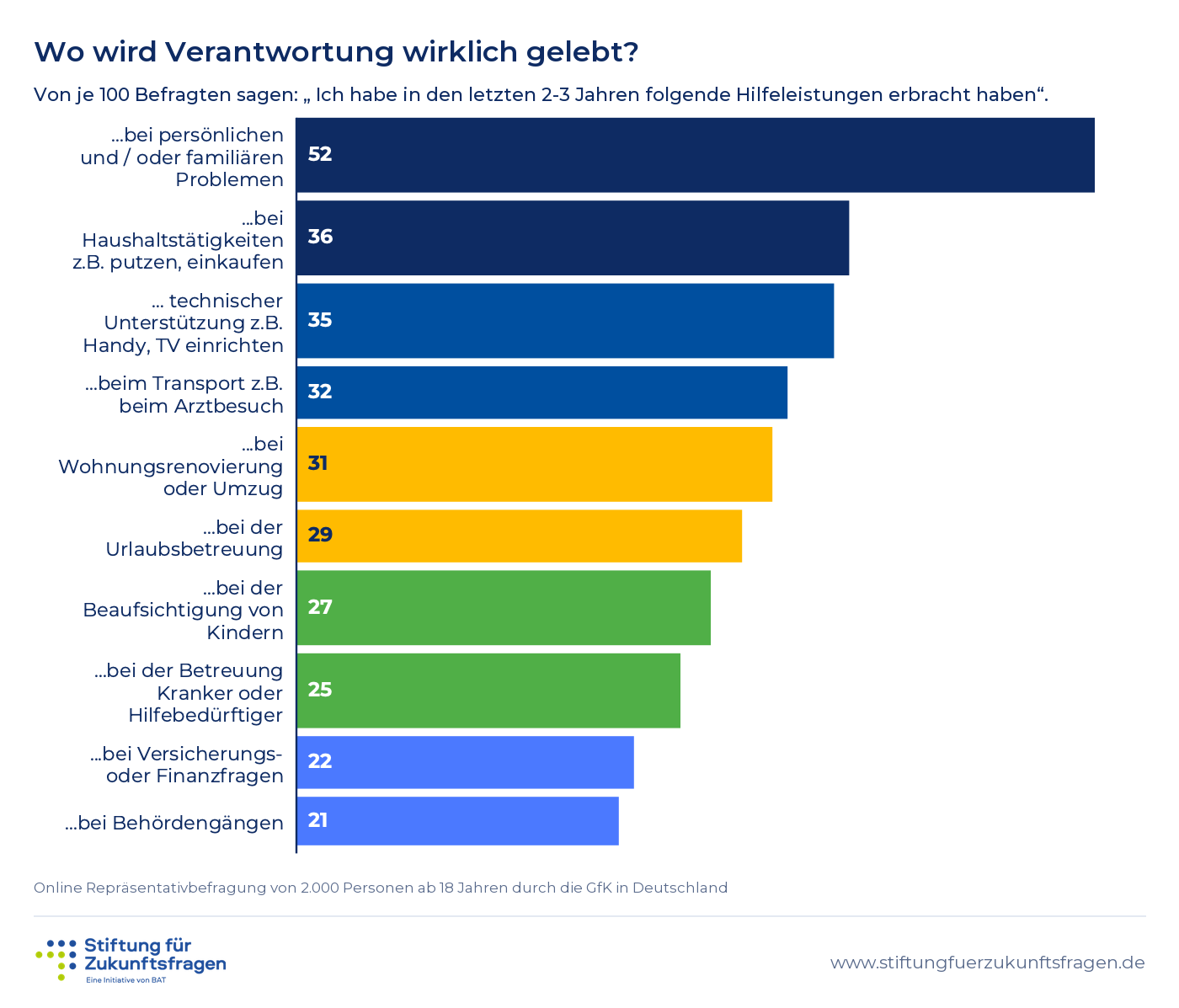
Where is responsibility truly practiced?
Out of every 100 respondents, the following answers were given: "I have provided the following assistance in the last 2-3 years.".
Data as table
| ...in case of personal and/or family problems | 52 |
| ...for household chores, e.g., cleaning, shopping | 36 |
| … technical support, e.g., setting up mobile phones and TVs | 35 |
| ...during transport, e.g., for a doctor's visit | 32 |
| ...during apartment renovations or moving | 31 |
| ...during holiday childcare | 29 |
| ...when supervising children | 27 |
| ...in the care of the sick or those in need of assistance | 25 |
| ...in insurance or financial matters | 22 |
| ...during visits to government offices | 21 |
Result
Taking responsibility in everyday life is a normal part of daily life for many German citizens. 52 percent The population indicated that they had primarily been involved in or provided assistance within their personal and family circles over the past two to three years. This often involved everyday support – such as listening, being available, or practical help with household chores.
The willingness to share responsibility has also increased in other areas: for example, with practical help, technical questions, or support with financial and bureaucratic matters. Only in childcare and renovation work are the numbers slightly declining – possibly a consequence of changing living conditions such as fewer people moving or falling birth rates.
Particularly noteworthy is the change in social engagement: Younger citizens are now more likely to get involved than older citizens. in social, ecological or educational projects – mostly flexible, project-based and outside of traditional club structures.
Reasons
The increasing willingness to take on responsibility reflects a growing need for social participation and community engagement. At the same time, the forms of engagement have changed. Younger people, in particular, prefer short-term, effective involvement in concrete projects – for example, in the areas of the environment, education, or neighborhood – rather than long-term commitments within established structures.
The main obstacles to greater civic engagement are lack of time, work commitments, or uncertainty about one's own abilities. A lack of appreciation or concerns about making a long-term commitment also act as deterrents. Furthermore, many citizens lack concrete information about how and where they could take on responsibility.
Nevertheless, it's clear that those who volunteer regularly often benefit personally. Besides fostering a stronger sense of belonging, actively helping can even prevent isolation and burnout. In many cases, volunteering is based on reciprocity – according to the principle: those who help today can count on support tomorrow.
Forecast
Taking responsibility will remain a key element of social cohesion in the future. To encourage more people to get involved, tailored opportunities are needed – from short-term micro-engagements for working professionals to mentoring programs for older adults. Students and young adults are also looking for ways to participate that foster community while respecting their flexibility.
Digital platforms and apps can help make offers more visible and coordinate spontaneous acts of assistance. However, it's crucial that engagement remains concrete – visible, effective, and personally addressed. Only then will a sense of genuine responsibility develop – and not the risk of hiding behind the group.
Crucial for the future will be understanding responsibility not only as a duty, but also as an expression of trust, creative power, and social connection. Those who help others shape not only the present, but also the social fabric of tomorrow.