
Tourism analysis 2023
7 February 2023
Travel balance 2022: the joy of travelling instead of everyday frustration
- Travel frequency: as high as before the pandemic
- Trip duration: Germans are staying longer on site again
- Travel expenses: holiday spending at an all-time high
- Domestic destinations: Significant declines, but above pre-corona level
- European holiday destinations: Spain and Turkey win, Austria loses
- Long-haul destinations: Almost a doubling
- Travel intentions: 2023 could be a record year
- Travel destinations 2023: Those who can afford it are travelling abroad
- Special topic: How Germans keep their travel costs under control
These are the key findings of the 39th German Tourism Analysis by BAT - STIFTUNG FÜR ZUKUNFTSFRAGEN, for which a representative cross-section of the German population of over 3,000 people aged 18 and over were surveyed by GfK on their own travel behaviour in 2022, their holiday intentions for 2023 and their willingness to save for and on holiday.
Tourism analysis 2023
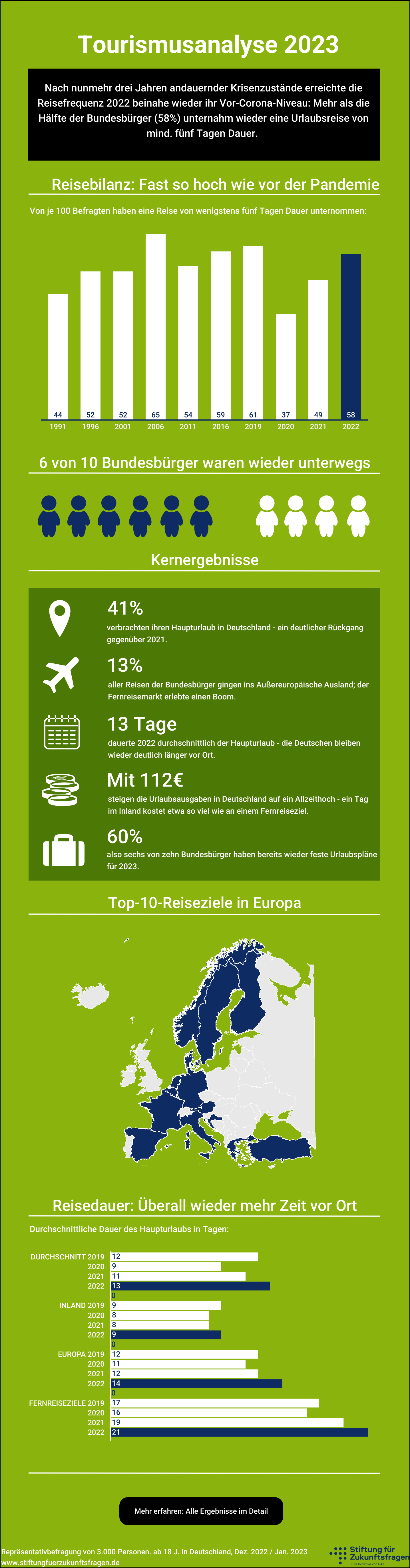
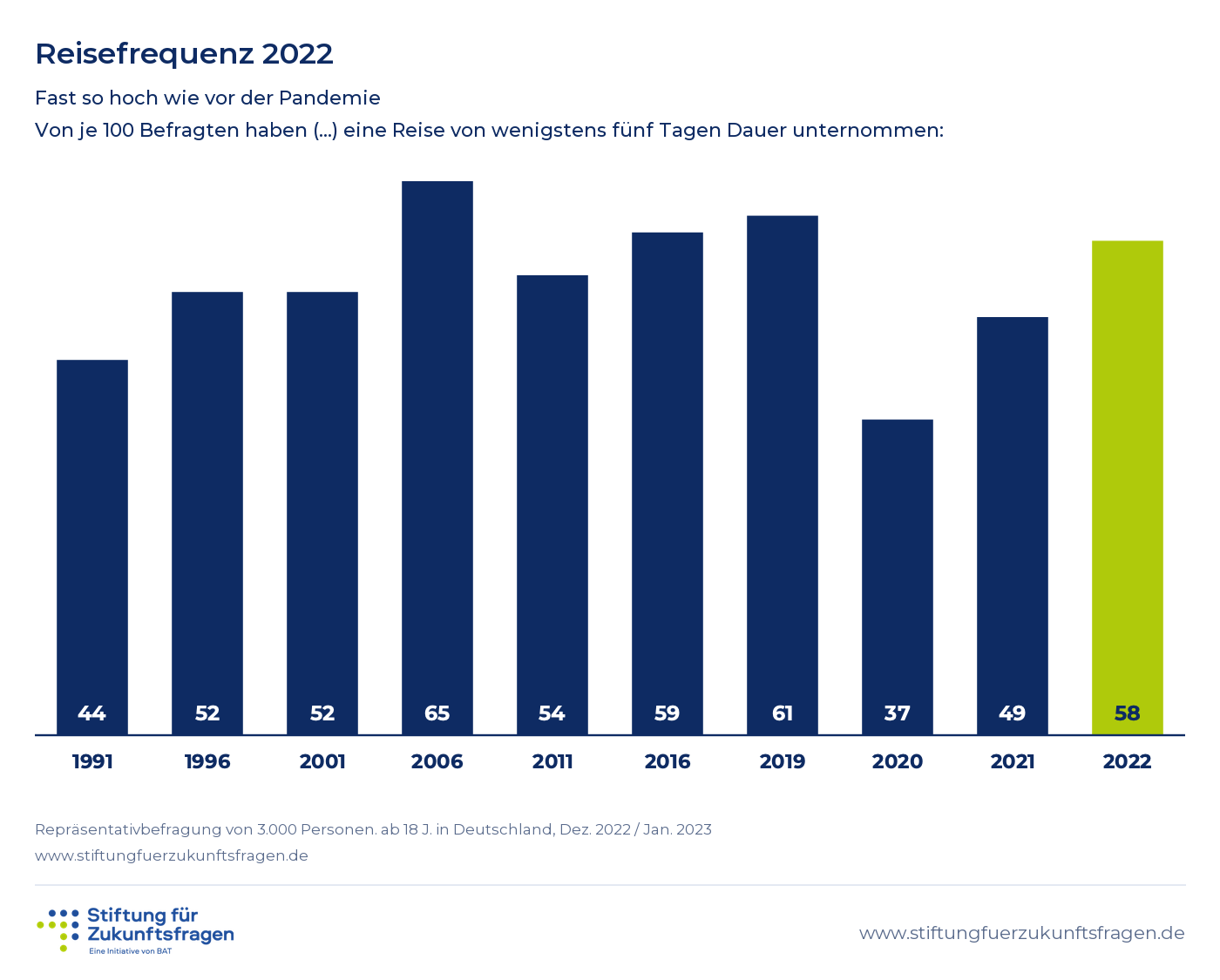
After three years of ongoing crisis, travel frequency in 2022 almost reached its pre-corona level again: More than half of German citizens (58%) undertook a holiday trip of at least five days.
Travel balance: Almost as high as before the pandemic
Out of every 100 respondents, one undertook a trip lasting at least five days:
6 out of 10 German citizens were traveling again
Core results
41% — spent their main holiday in Germany - a significant decrease compared to 2021.
13% — all trips taken by German citizens went to countries outside Europe; the long-distance travel market experienced a boom.
13 days
In 2022, the average length of the main holiday was longer - Germans are staying significantly longer again.
With €112
Holiday spending in Germany is rising to an all-time high - a day in the country costs about as much as a day at a long-distance travel destination.
60% — meaning six out of ten German citizens already have firm holiday plans for 2023.
Top 10 travel destinations in Europe
Travel duration: More time on-site everywhere again.
Average duration of main vacation in days:
Learn more: All results in detail
Data as table
| AVERAGE 2019 | 12,3 |
| 2020 | 9,9 |
| 2021 | 11,2 |
| 2022 | 13,0 |
| DOMESTIC 2019 | 9,3 |
| 2020 | 8,1 |
| 2021 | 8,6 |
| 2022 | 9,1 |
| EUROPE 2019 | 12,7 |
| 2020 | 11,0 |
| 2021 | 12,8 |
| 2022 | 14,0 |
| Long-distance travel destinations 2019 | 17,4 |
| 2020 | 16,6 |
| 2021 | 19,3 |
| 2022 | 21,0 |
| Year | Portion | |
|---|---|---|
| Total | 1991 | 44 |
| Total | 1996 | 52 |
| Total | 2001 | 52 |
| Total | 2006 | 65 |
| Total | 2011 | 54 |
| Total | 2016 | 59 |
| Total | 2019 | 61 |
| Total | 2020 | 37 |
| Total | 2021 | 49 |
| Total | 2022 | 58 |
Pandemic, energy crisis, inflation and war - in the last twelve months, numerous challenges have characterised the everyday lives of German citizens. However, after three years of ongoing crisis conditions, many Germans wanted one thing above all else in 2022: to get out of their own four walls and finally travel again! The record low from 2020 (40 %) was overcome and the travel frequency almost reached its pre-corona level again at currently 58 per cent.
Travel frequency 2022
Almost as high as before the pandemic
Of every 100 respondents, (...) undertook a trip lasting at least five days:
Data as table
| Year | Portion | |
|---|---|---|
| Total | 1991 | 44 |
| Total | 1996 | 52 |
| Total | 2001 | 52 |
| Total | 2006 | 65 |
| Total | 2011 | 54 |
| Total | 2016 | 59 |
| Total | 2019 | 61 |
| Total | 2020 | 37 |
| Total | 2021 | 49 |
| Total | 2022 | 58 |
Germans are staying longer on site again
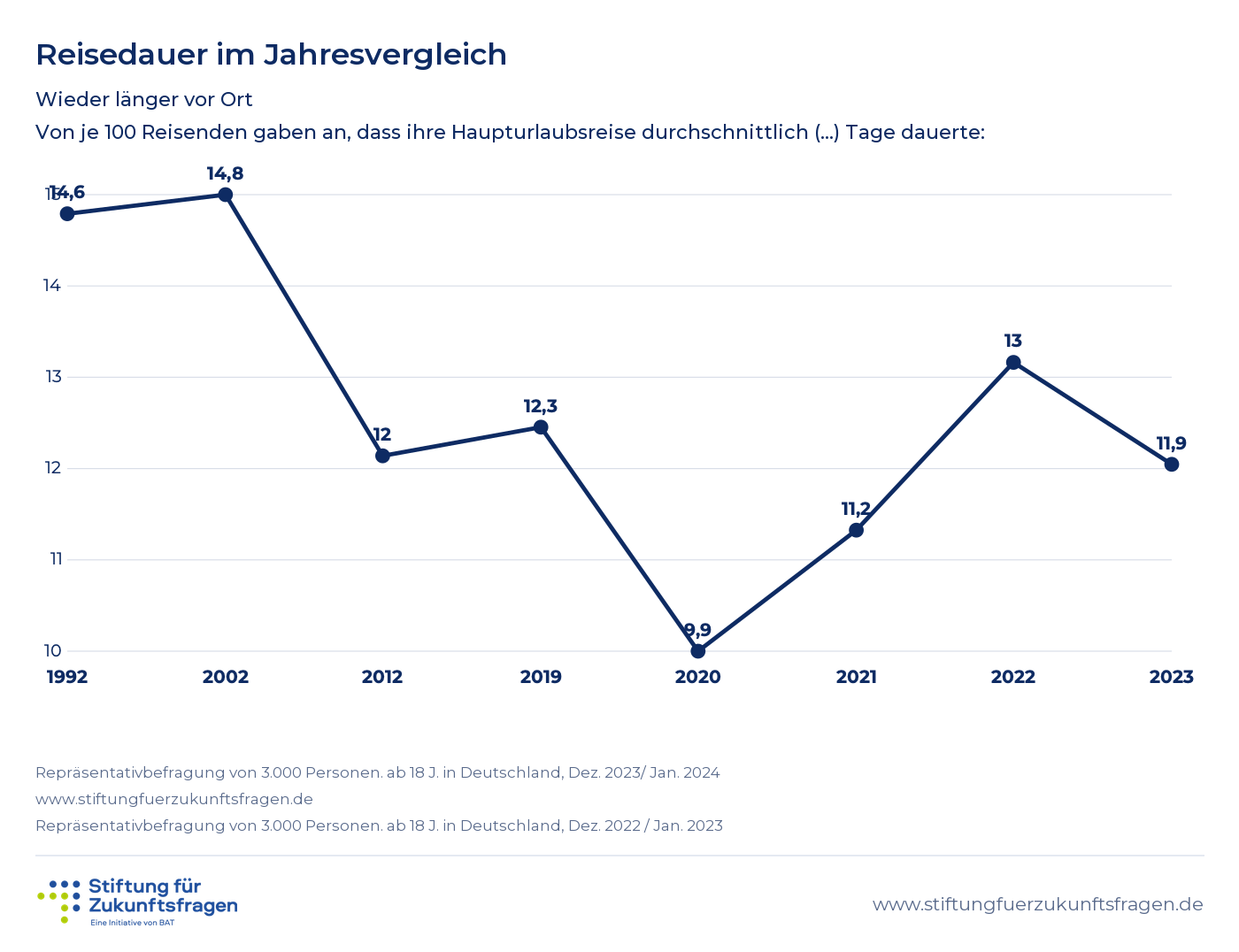
On average, German citizens spent around 13 days travelling on their main holiday in 2022, almost two days longer than in the previous year. The last time a similarly high figure was reached was in the early 2000s. A large proportion of this is undoubtedly due to the high proportion of long-distance holidays, as the equation applies: the further away the destination, the longer the stay on site. However, the desire for a longer period of relaxation - after all the restrictions and sacrifices of recent years - as well as the search for a counterbalance to everyday life and worries about current challenges are also at the centre of this trend.
It did not matter which destination was chosen - in 2022, the average number of days for domestic holidays (nine days) as well as for holidays in European (14 days) and non-European destinations (21 days) increased.
Travel duration compared to previous years
Staying longer again
Of every 100 travelers, one indicated that their main holiday trip lasted an average of (...) days:
Data as table
| 1992 | 14,6 |
| 2002 | 14,8 |
| 2012 | 12 |
| 2019 | 12,3 |
| 2020 | 9,9 |
| 2021 | 11,2 |
| 2022 | 13 |
| 2023 | 11,9 |
Holiday spending at an all-time high
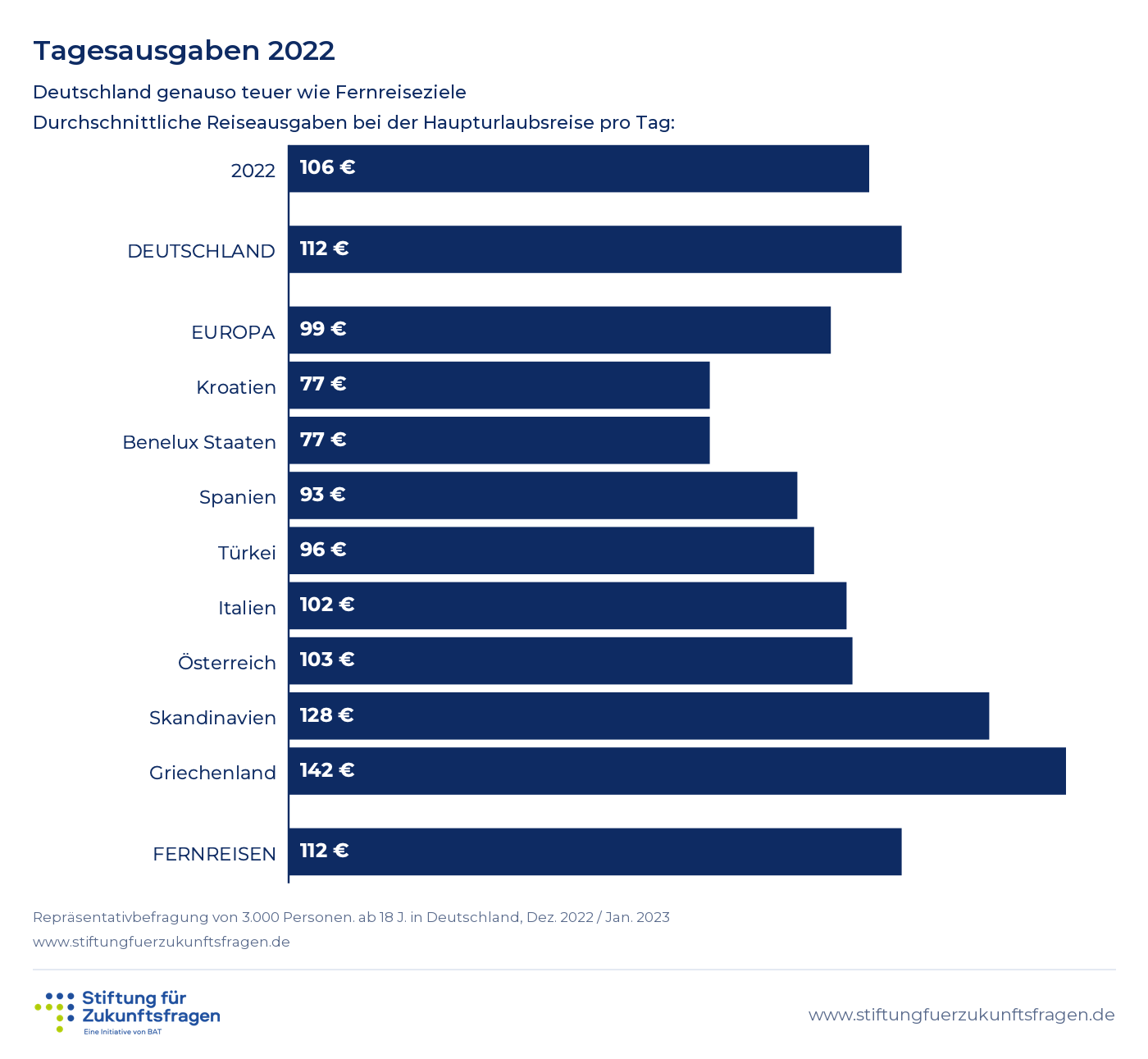
German citizens spent over €1,350 on their main holiday last year. For a family of four, this equates to just under €5,500. Compared to the previous year, expenditure increased by a good €250. One reason for this was the longer stay on site, but the daily costs also increased from €98 in 2021 to €106 in 2022.
There were major differences within the individual countries. At €77, a day's holiday in Croatia or the Benelux countries was significantly cheaper than a holiday around the Mediterranean, for example in Spain (€93), Italy (€102) or Turkey (€96). At €112, a day's holiday in Germany costs just as much as a day's holiday outside Europe, e.g. in the Caribbean, Dubai or the USA. The most expensive daily costs in 2022 were in Scandinavia (€128) and Greece (€142).
Daily expenditures 2022
Germany is just as expensive as long-distance travel destinations
Average daily travel expenses for the main holiday trip:
Data as table
| 2022 | 106€ |
| GERMANY | 112€ |
| EUROPE | 99€ |
| Croatia | 77€ |
| Benelux countries | 77€ |
| Spain | 93€ |
| Turkey | 96€ |
| Italy | 102€ |
| Austria | 103€ |
| Scandinavia | 128€ |
| Greece | 142€ |
| LONG-DISTANCE TRAVEL | 112€ |
Domestic destinations: Significant declines, but above pre-corona level
In 2022, around two fifths of all holiday trips (41%) took place in Germany, meaning that Germany remains the most popular holiday destination for German citizens. Although the proportion of domestic trips has fallen by around 10 percentage points compared to the previous year, it is still significantly higher than ten (2012: 37%) and twenty years ago (2002: 33%).
Once again, the majority of domestic travellers were drawn to the mountains and coastal regions last year. More than one in four travellers stated that they spent their holiday on the North Sea or Baltic coast, while one in five holidaymakers spent the best time of the year in Bavaria.
Domestic travel destinations comparison 2021 - 2022
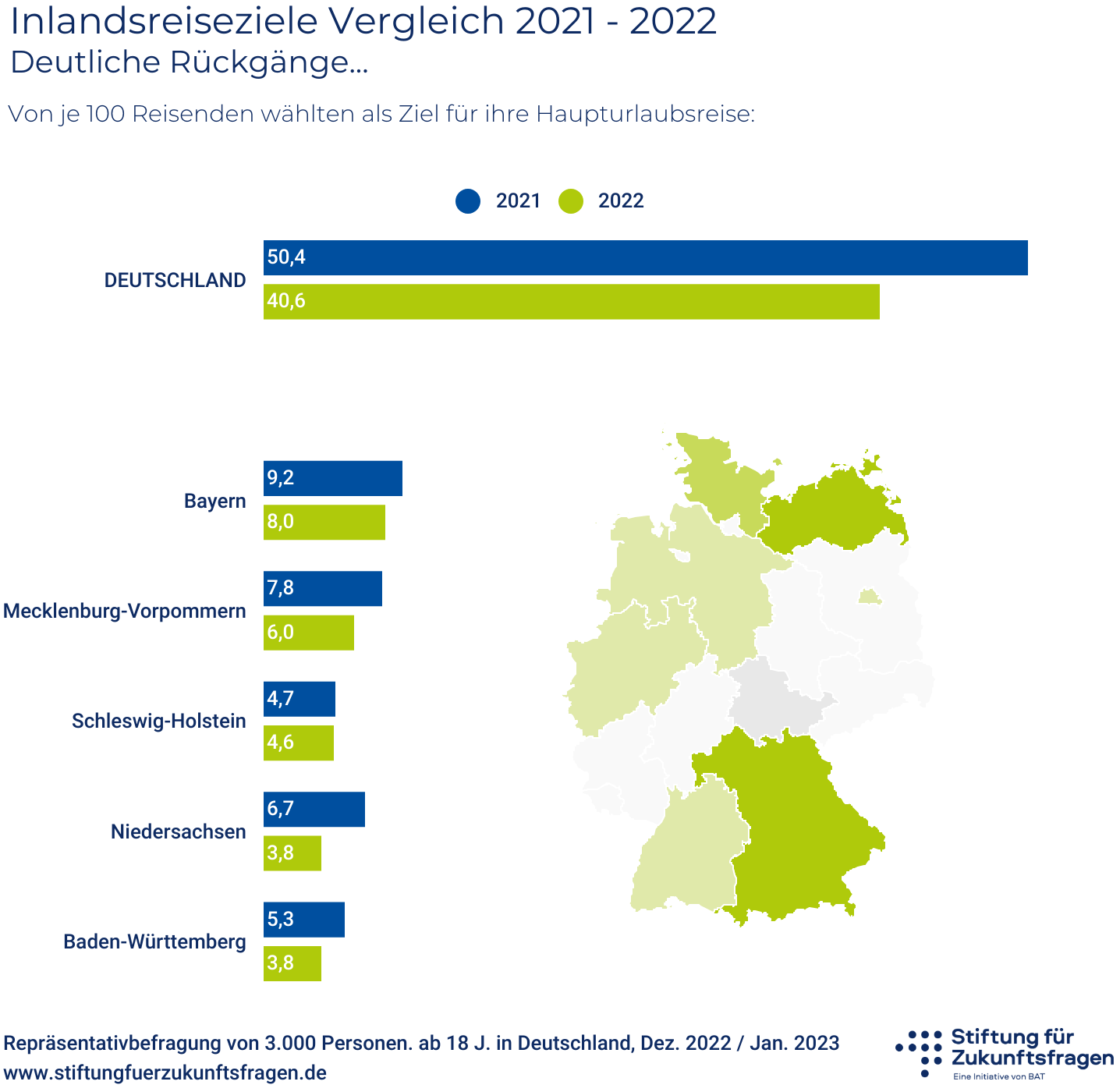
Significant declines...
Out of every 100 travelers, the following destinations were chosen for their main holiday trip:
Data as table
| 2021 | 2022 | |
|---|---|---|
| GERMANY | 50,4 | 40,6 |
| Bavaria | 9,2 | 8,0 |
| Mecklenburg-Western Pomerania | 7,8 | 6,0 |
| Schleswig-Holstein | 4,7 | 4,6 |
| Lower Saxony | 6,7 | 3,8 |
| Baden-Württemberg | 5,3 | 3,8 |
European holiday destinations: Spain, Turkey and France gain, Austria loses
Summer, sun, beach and sea - last year, many German citizens were once again drawn to the warm countries in the south of Europe. Without travel bans and with significantly fewer coronavirus restrictions and fears, the number of holidays to the Mediterranean rose accordingly. Spain (8.2%), Italy (6.5%) and Turkey (5.3%) were particularly frequently chosen as holiday destinations by German citizens, not least because of their below-average daily costs. Greece (4.2 per cent) and Scandinavia (3.9 per cent) also made it into the top 5 destinations in Europe. The loser of the 2022 travel season was Austria, which once again welcomed significantly fewer German guests. Compared to 2020 (5.7%) and 2021 (3.3%), the proportion of German holidaymakers in the Alpine republic fell to 2.8 per cent. For the first time, more Germans spent their main holiday in the Benelux countries (3.0%) than in Austria.
Long-haul destinations: Almost a doubling
After a good two years of lull in the long-haul travel segment, German citizens once again chose a holiday destination outside of Europe much more frequently. The number of long-haul trips has almost doubled compared to the previous year. While only seven per cent opted for another trip in 2021, this figure is currently back up to 13 per cent - making it the third-highest figure since reunification.
Long-haul travel destinations 2022
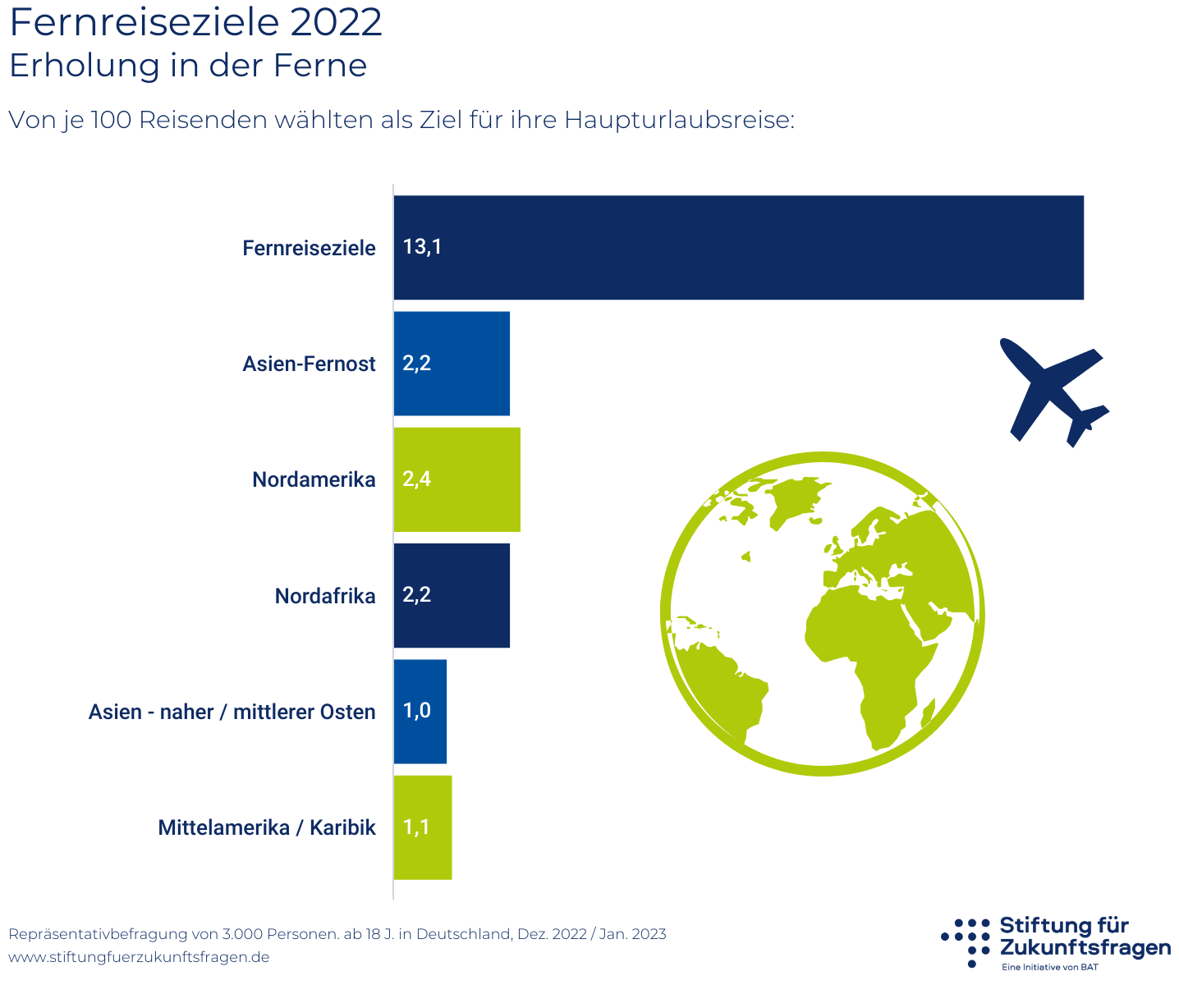
Relaxation far away
Out of every 100 travelers, the following destinations were chosen for their main holiday trip:
Data as table
| 2022 | |
|---|---|
| Long-distance destinations | 13,1 |
| Asia-Far East | 2,2 |
| North America | 2,4 |
| North Africa | 2,2 |
| Asia - Near/Middle East | 1,0 |
| Central America / Caribbean | 1,1 |
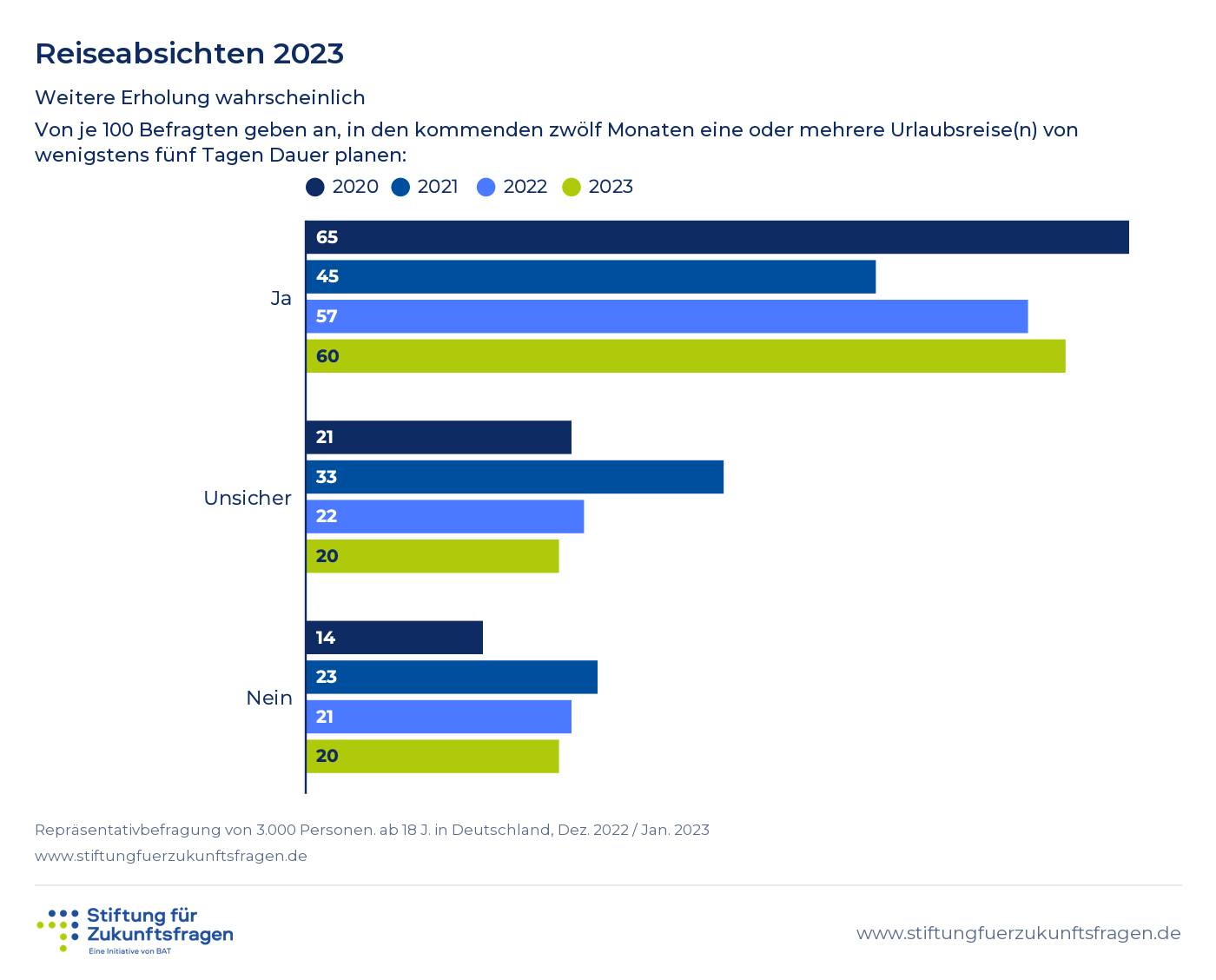
2023 could be a record year
In 2022, the intensity of travel has increased significantly compared to the previous year - and six out of ten Germans are already planning their next trip. Neither the situation in Ukraine nor the crises in their own country are dampening the majority of Germans' travel intentions. Only one in five is already certain that they do not want to or will not be able to travel this year. A fifth are also undecided and have not yet decided whether they will be travelling this year. This means that the frequency of travel in 2023 is likely to be at least at the pre-corona level, if not higher.
Travel plans 2023
Further recovery likely
Of every 100 respondents, one or more holiday trips of at least five days each are planned in the next twelve months:
Data as table
| 2020 | 2021 | 2022 | 2023 | |
|---|---|---|---|---|
| Yes | 65 | 45 | 57 | 60 |
| Unsure | 21 | 33 | 22 | 20 |
| No | 14 | 23 | 21 | 20 |
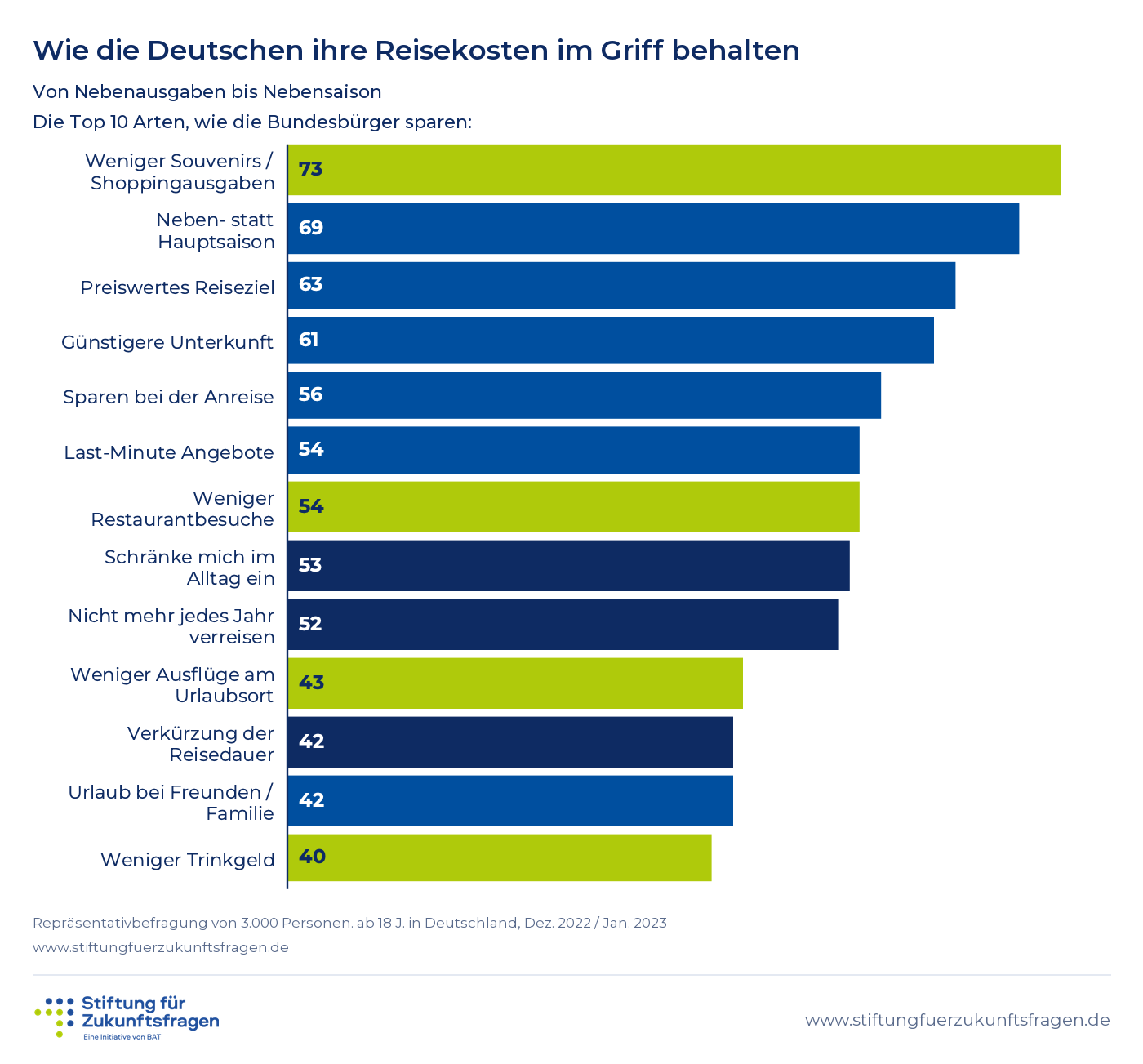
Special topic: How Germans keep their travel costs under control
Energy crisis, inflation, Ukraine war: the current news emphasises the challenges of the present. However, instead of reacting with fear, despondency and restraint, Germans are reacting pragmatically - at least when it comes to holidays: they want to be on the move and are prepared to make certain compromises to do so:
How Germans keep their travel costs under control
From incidental expenses to off-season
The top 10 ways Germans save money:
Data as table
| Fewer souvenirs / shopping expenses | 73 |
| Off-peak instead of peak season | 69 |
| Affordable travel destination | 63 |
| Cheaper accommodation | 61 |
| Save on travel expenses | 56 |
| Last-minute offers | 54 |
| Fewer restaurant visits | 54 |
| I restrict myself in everyday life | 53 |
| No more traveling every year | 52 |
| Fewer excursions at the holiday destination | 43 |
| Reduction of travel time | 42 |
| Vacation with friends/family | 42 |
| Less tip | 40 |
The Foundation's Scientific Director, Professor Dr Reinhardt, notes the outlook: "The world champion traveller is back. The holiday trip has lost none of its significance and despite all the challenges, most people want to be on the move. One basic motive for travelling is becoming even more important: the contrast to everyday life. The more stressful, worry-ridden, externally determined and monotonous everyday life is perceived to be, the greater the demands placed on holidays. A holiday promises the opposite and stands for light-heartedness, variety, relaxation, nature, time, freedom, fun, experiences and much, much more."
Survey institute GfK
Field time: December 2022 / January 2023
3,000 respondents aged 18-74 years
Online