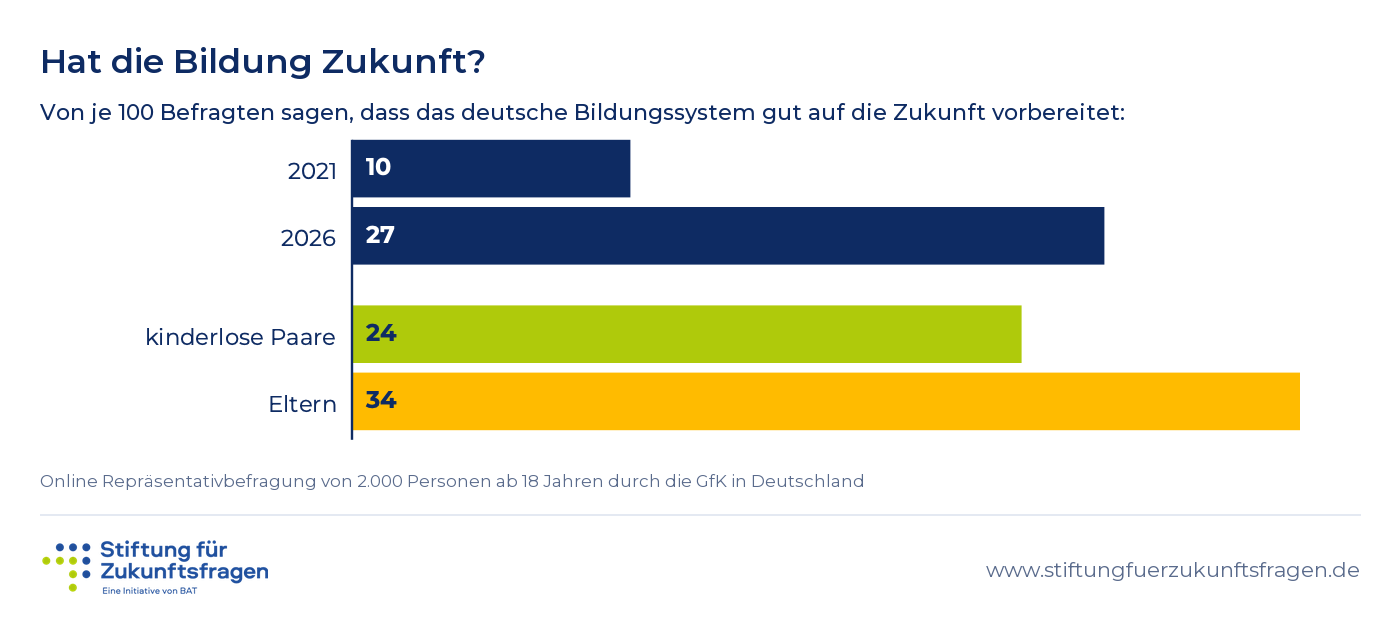


According to only about a quarter of German citizens (2026: 27%), the German education system is well prepared for the future. Even though this figure has risen significantly compared to the past (2021: 10%), a large majority of the population remains skeptical. This is the conclusion of a recent study by the BAT Foundation for Future Studies, for which 2,000 German citizens aged 18 and over were surveyed in a representative sample.
These doubts reflect the complex challenges: Today, schools are expected not only to impart professional, personal, social, and democratic skills and educate students to become independent, responsible, and socially competent individuals—as stipulated by law—but also to address societal tasks such as integration, digitalization, and mental health. Professor Dr. Ulrich Reinhardt, Scientific Director of the Foundation, therefore calls for a discussion on the fundamental question:„What will be the future role of schools?“
Does education have a future?
Out of every 100 respondents, the German education system says that it prepares well for the future:
Data as table
| 2021 | 10 |
| 2026 | 27 |
| Childless couples | 24 |
| Parents | 34 |
Basic skills are the real future skills
Discussions about the future of education often focus on terms like artificial intelligence, robotics, and digital learning software. However, it becomes clear that even the best technology is of little use if fundamental skills such as reading comprehension, writing, and arithmetic are lacking.
„"Of course we need digital competence and creativity"“says Reinhardt. „"But all of this depends on a foundation. Those who can't read well can't check sources. Those who can't do math can't interpret statistics. The real future skills are reliable basic competencies for every child. Without these foundations, all further learning remains fragmented."“.
Furthermore, the teaching of these basics is also a social issue, as inadequate school education increasingly impacts life chances, freedom and social participation.
KNOWLEDGE IN THE AGE OF AI – FROM STORAGE TO NAVIGATION SYSTEM
The constant availability of information through AI applications raises the question of what knowledge will still need to be imparted in the future. For Reinhardt, the answer is not whether one's own knowledge will become obsolete:
„"On the contrary, in order to assess whether AI-generated information is correct or belongs in a broader context, an internal knowledge framework becomes a prerequisite. Prompting without expertise often only leads to well-articulated ignorance.".
OUTLOOK: EDUCATION NEEDS ORIENTATION INSTEAD OF OVERWHELMING
The debate about the role of schools is often fueled by ever-evolving expectations. Hardly any societal problem escapes the attention of educational institutions sooner or later. However, the more tasks are assigned to schools, the greater the risk of losing sight of their core mission. And while education can achieve a great deal, it cannot compensate for all the shortcomings in other areas of society.
Therefore, redefining priorities will be crucial. School should primarily be a place where young citizens acquire reliable foundations, understand connections, develop judgment, and gain confidence for their own path in life. Reinhardt:
„"Those who understand connections and can make their own decisions will also take responsibility for themselves and others. Therefore, what will be crucial is not constantly absorbing new content, but having the courage to focus on what is essential. Not every societal development calls for a new subject, and not every challenge demands further expectations of teachers. A good school is therefore not recognized by how many tasks it undertakes, but by how reliably it fulfills its core mission. This is precisely where the foundation for equal opportunities, economic strength, and social cohesion lies."“