


STRENGTHENING TRUST, SHARING RESPONSIBILITY, LIVING COOPERATION.
HOW CITIZENS WANT TO OVERCOME CHALLENGES
Strengthening trust, sharing responsibility and practising cooperation - this is the citizens„ response to crises and challenges. Almost half of the population criticise the current communication skills of politicians and find political measures and decisions correspondingly difficult to understand. These are the findings of the latest publication “How Germany's future will succeed" by the STIFTUNG FÜR ZUKUNFTSFRAGEN. For the survey, over 3,000 people aged 18 and over were questioned on a representative basis about their attitudes.
Core results:
- Almost nine out of ten German citizens (87%) see commitment and cooperation as an essential response to crises.
- 45% of Germans criticise the mediation skills of politicians.
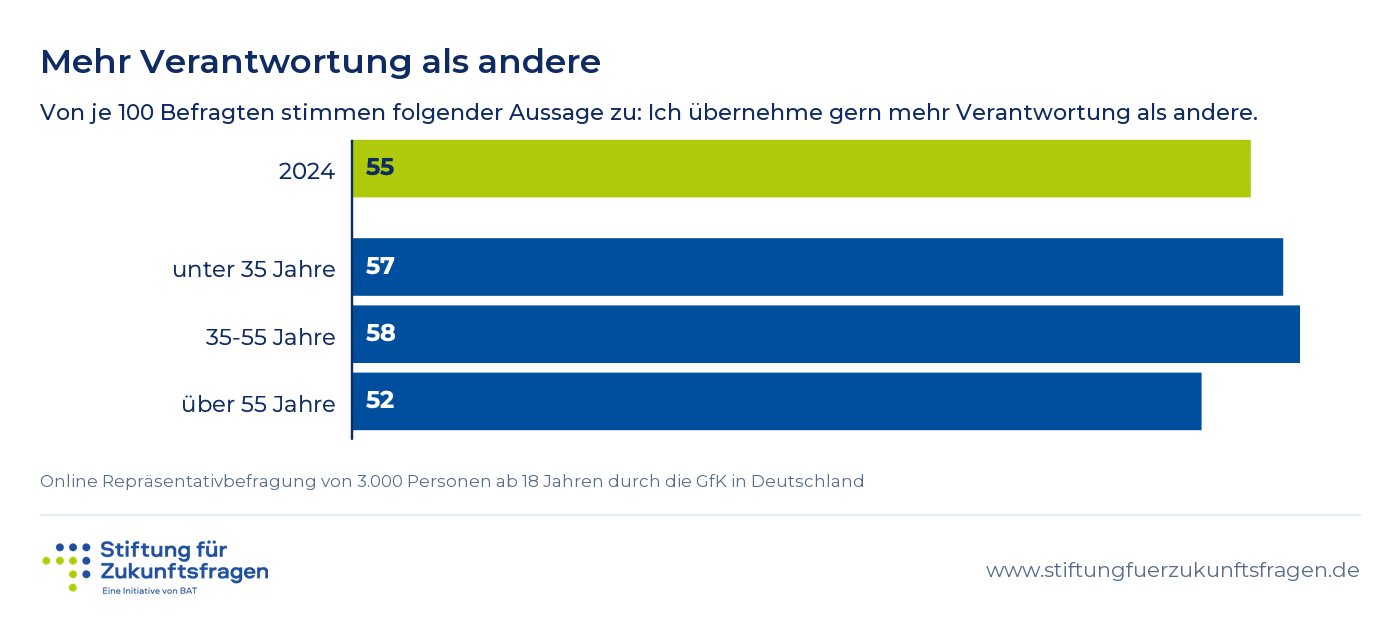
- 55% in this country are prepared to take on more responsibility than others.
OVERCOMING CRISES - LARGE MAJORITY CALLS FOR MORE COMMUNITY
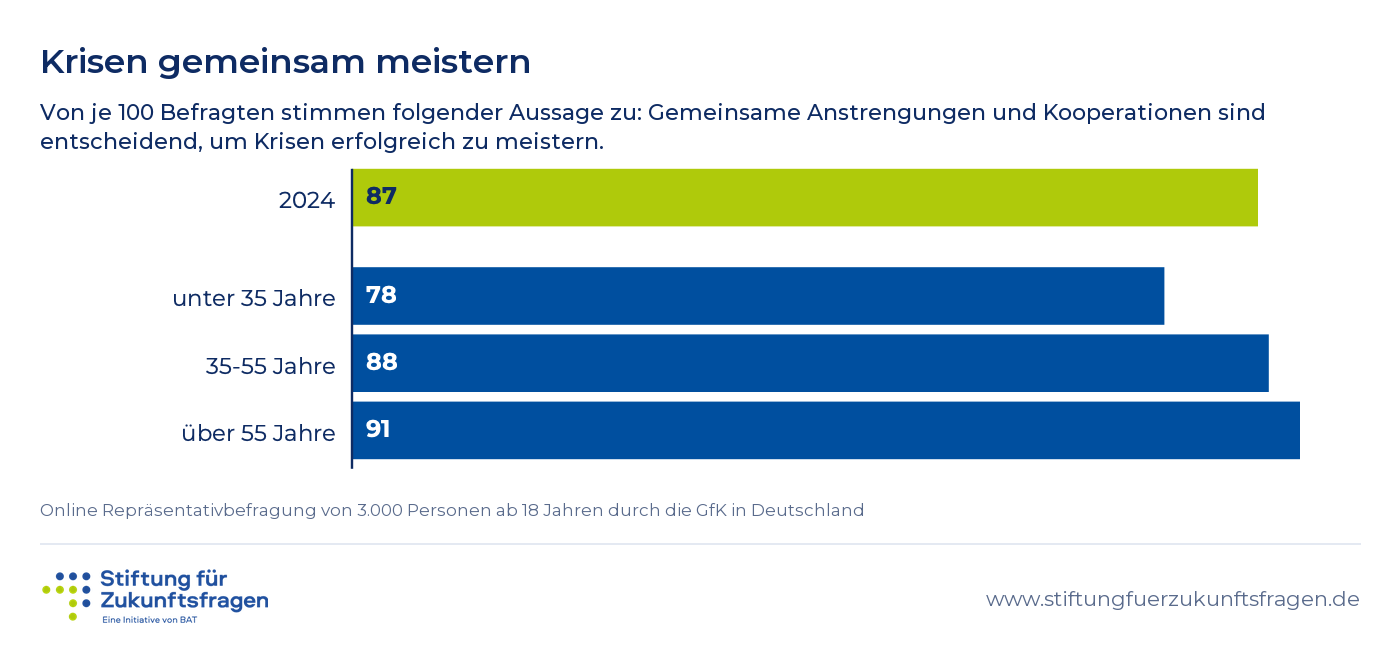
For a large majority of 87 per cent of German citizens, commitment and cooperation are the key response to crises and challenges. There is great unanimity within the population. The differences in terms of income, level of education or marital status are small.
„For the majority of citizens, it is clear that only joint efforts can effectively overcome crises“, says Prof Dr Ulrich Reinhardt, Scientific Director of the Foundation for Future Studies. „It doesn't matter whether the cooperation takes place between individuals, communities, parties, institutions or nations - what matters is a joint approach and a clear objective.”
Cooperative behaviour has far-reaching effects beyond the actual goal: It strengthens mutual trust and a sense of community, conveys solidarity and distributes responsibility among various players.
Overcoming crises together
Out of every 100 respondents, the following statement is agreed with: Joint efforts and cooperation are crucial to successfully overcoming crises.
Data as table
| 2024 | 87 |
| under 35 years | 78 |
| 35-55 years | 88 |
| over 55 years | 91 |
BETWEEN TECHNICAL LANGUAGE AND EMPTY PHRASES - CITIZENS CRITICISE POLITICAL COMMUNICATION
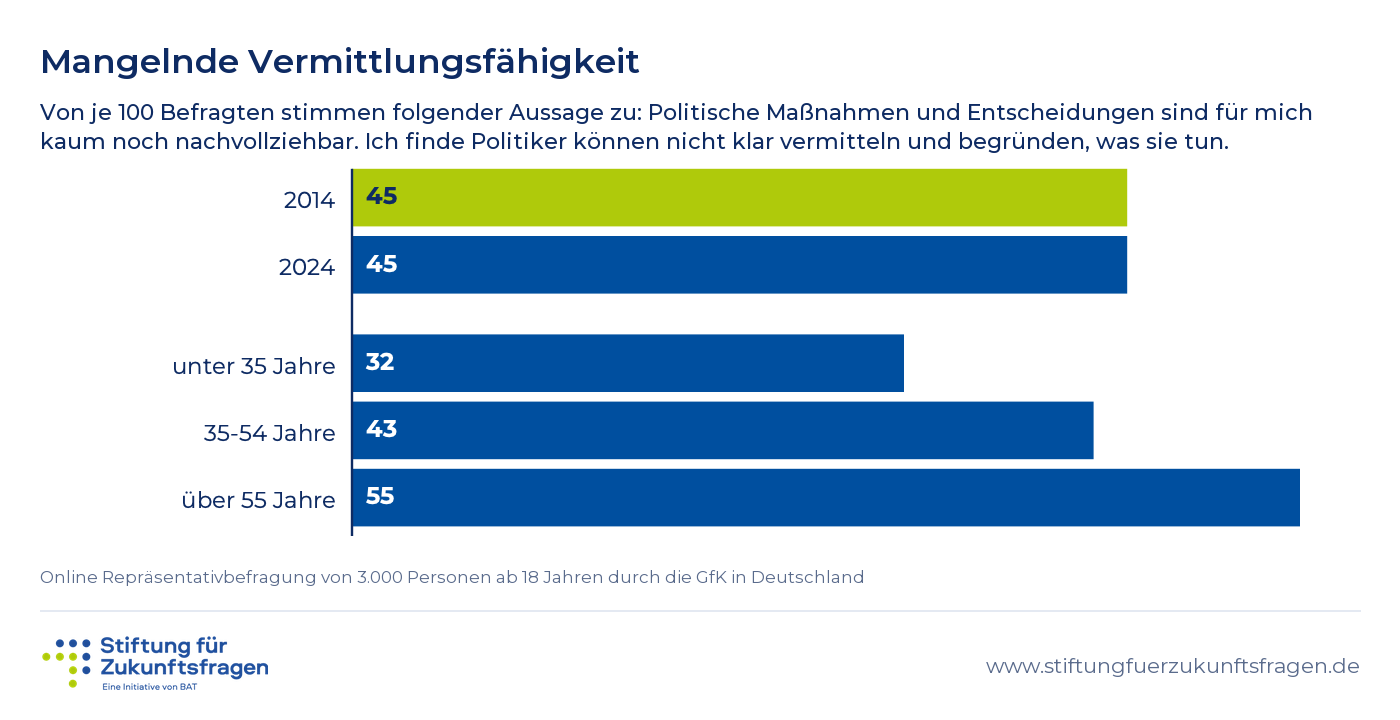
Just under half of citizens (45%) find political measures and decisions difficult to understand and criticise the communication skills of politicians.
Criticism of the ability of political actors to communicate is not a new phenomenon and has not changed in the last ten years. The difficulty of communicating political content clearly and comprehensibly is particularly evident when it comes to complex issues such as climate change, migration, digitalisation or social reforms.
One reason for this is the increasing complexity of political issues. Many decisions are closely linked to scientific, technological and international developments. Security policy, for example, is not just about national measures, but is also linked to international agreements and long-term strategies.
Another reason is the lack of empathy in political language. Citizens not only want information about political decisions, but also more understanding of their personal concerns and the realities of their lives. However, political communication often comes across as technocratic and distanced, which reinforces the impression of a detached elite. „The often typically German behaviour of politicians also fits in with this: too many appear matter-of-fact and sober, using political jargon with legal or technical formulations“says Reinhardt.
Lack of mediation skills
Out of 100 respondents, the following statement was agreed with: Political measures and decisions are hardly comprehensible to me anymore. I find that politicians cannot clearly communicate and justify what they do.
Data as table
| 2014 | 45 |
| 2024 | 45 |
| under 35 years | 32 |
| 35-54 years | 43 |
| over 55 years | 55 |
LEADING THE WAY INSTEAD OF RUNNING ALONG - MAJORITY WANT TO TAKE ON MORE RESPONSIBILITY THAN OTHERS
Taking responsibility means utilising the freedom to shape things, making courageous decisions and implementing them with confidence and determination. It means getting involved and standing up for other people, personal values, ideas or even content. Just over half of the population is prepared to take on more responsibility than others.
This individual responsibility can manifest itself in a wide variety of areas, but always has the same core: the individual makes a decision and takes responsibility for its consequences. This can relate to the family sphere, the immediate social environment, the professional field or also in a wider social context, for example by assuming political, economic or ecological responsibility.
More responsibility than others
Out of every 100 respondents, the following statement is agreed with: I am happy to take on more responsibility than others.
Data as table
| 2024 | 55 |
| under 35 years | 57 |
| 35-55 years | 58 |
| over 55 years | 52 |
OUTLOOK: THE KEY TO THE FUTURE
- The importance of commitment and Co-operation will continue to increase in the future. In the face of increasingly complex national (e.g. skills shortages, demographic change, polarisation, loss of trust) and global challenges (e.g. climate change, migration, geopolitical tensions), collaborative action remains essential. It will be crucial to develop new forms of cooperation - both at local and international level.
- Communicating political decisions will remain one of the key challenges for governments in the coming years. In order to Trust To win back the support of citizens and increase the comprehensibility of political measures, innovative approaches are required. The focus must be on an emotional appeal, a stronger link between politics and everyday realities and a reform of the political culture.
- For the future, the willingness of citizens, Responsibility The attitude of taking on responsibility plays a central role, as it makes a decisive contribution to overcoming numerous social challenges. This attitude not only promotes social cohesion, but also strengthens personal development and opens up new opportunities in professional contexts.
Reinhardt: „Only a balanced interplay of individual initiative and collective responsibility can keep a society resilient. The ability to cooperate not only determines success in overcoming current crises, but also forms the basis for a future worth living.“