



Are "bad news" really "good news"?
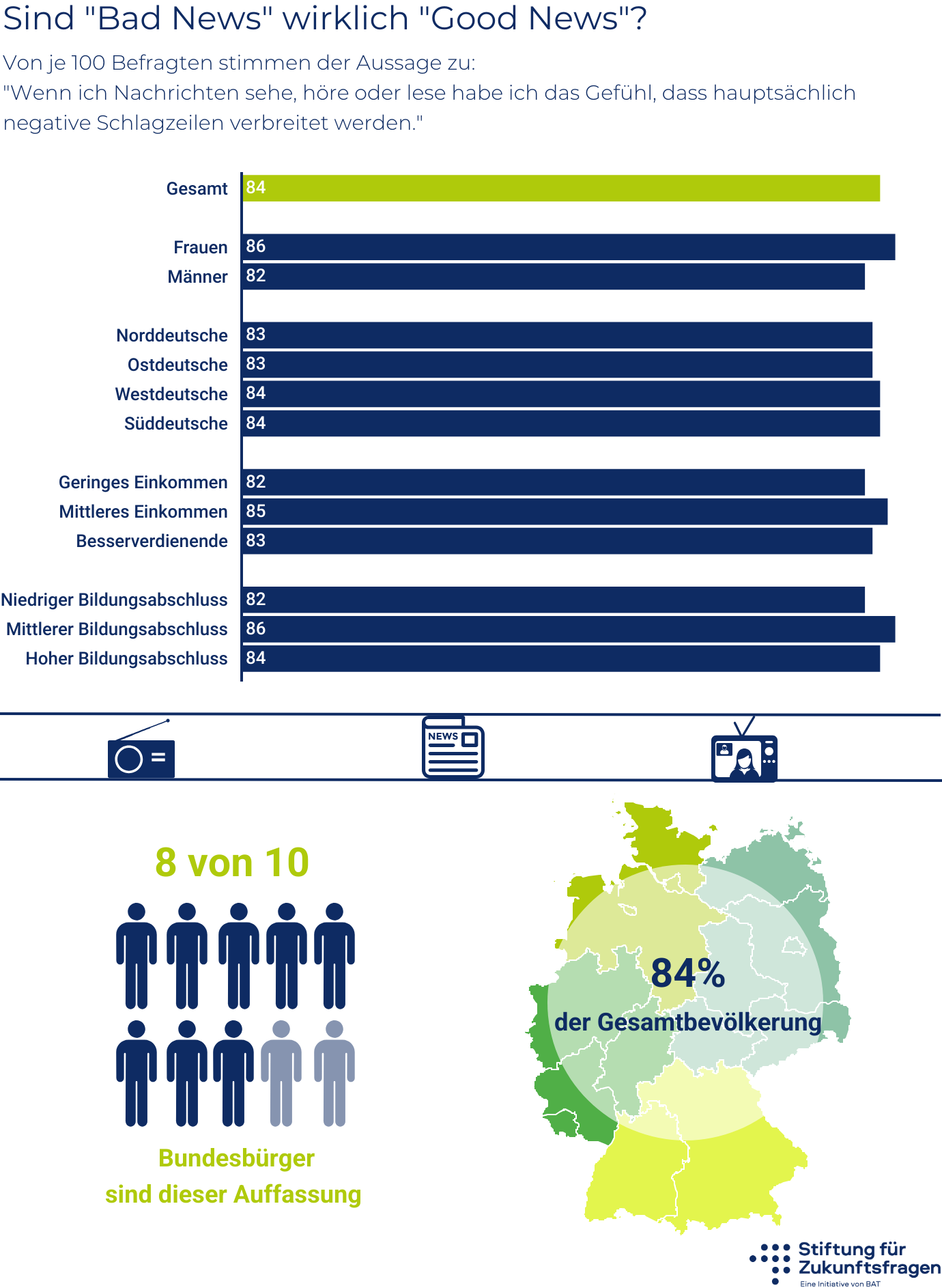
Out of every 100 respondents, the following percentage agree with the statement:
""When I see, hear or read the news, I get the feeling that mainly negative headlines are being spread.""
8 out of 10
84% — of the total population
German citizens hold this view
Data as table
| Bad News | |
|---|---|
| Total | 84 |
| Women | 86 |
| Men | 82 |
| North Germans | 83 |
| East German | 83 |
| West German | 84 |
| South German | 84 |
| Low income | 82 |
| Middle income | 85 |
| High earners | 83 |
| Low level of education | 82 |
| Intermediate school leaving certificate | 86 |
| Higher education qualification | 84 |
Result
Currently, more than eight out of ten German citizens are convinced that they see, hear or read predominantly negative headlines in the news. There is widespread agreement within the population and gender, place of residence, income or educational background do not play a role.
Reasons
"Only bad news is good news" is a well-known phrase in the media industry. According to this assumption, bad news sells better than good news and often reaches the public's attention more quickly. The content of the news is not decisive and can range from economic downturns and natural disasters to personal tragedies or misdemeanours. Although some bad news can have a positive impact (e.g. serving as a warning or encouraging action to achieve improvement), it is almost always accompanied by negative consequences. One of the most serious is the emotional toll it can take on many citizens. When most reports centre on wars, recessions, climate catastrophes, political misconduct, scandals, divisions and the like, many people feel anxious and hopeless. This is often accompanied by economic worries, which in turn leads to a higher savings rate. This can then lead to companies cutting jobs, accelerating the downward spiral. Too much bad news can also trigger a loss of trust in politicians, the media or other institutions and promote an "us versus them" mentality. This polarisation makes it more difficult to tackle problems in a constructive way.
Forecast
There have always been and will always be crises and challenges - and therefore also negative headlines. Reporting on this is important and right. However, the vast majority of the population also longs for positive news, wants to experience perspectives and enjoy successes and beautiful things. In future, newspapers, the internet, TV and radio stations will therefore also fulfil these needs. So instead of just reporting on job losses, in future we will also read about new attitudes, instead of just reporting on famine and war deaths, we will also be informed about developments and improvements and instead of just one-sidedly focussing on challenges, we will also read and hear about opportunities and possibilities.