

Current research, 297
20 September 2022
The BAT Foundation for Future Studies will present its "Leisure Time Monitor 2022" on 20 September 2022. For the study, which has been conducted since 1982, over 3,000 people between the ages of 18 and 74 were surveyed on a representative basis about their leisure behaviour and the special topic of "stress in leisure time".
Core results
The most common leisure activities of German citizens
Internet expands dominance, social media in the top 10 for the first time
Leisure activities in a 40-year comparison
Within your own four walls, instead of among people
What stresses you out in your free time
From lack of time to planning your own life
The most common leisure activities of German citizens
Internet expands dominance, social media top 10 for the first time
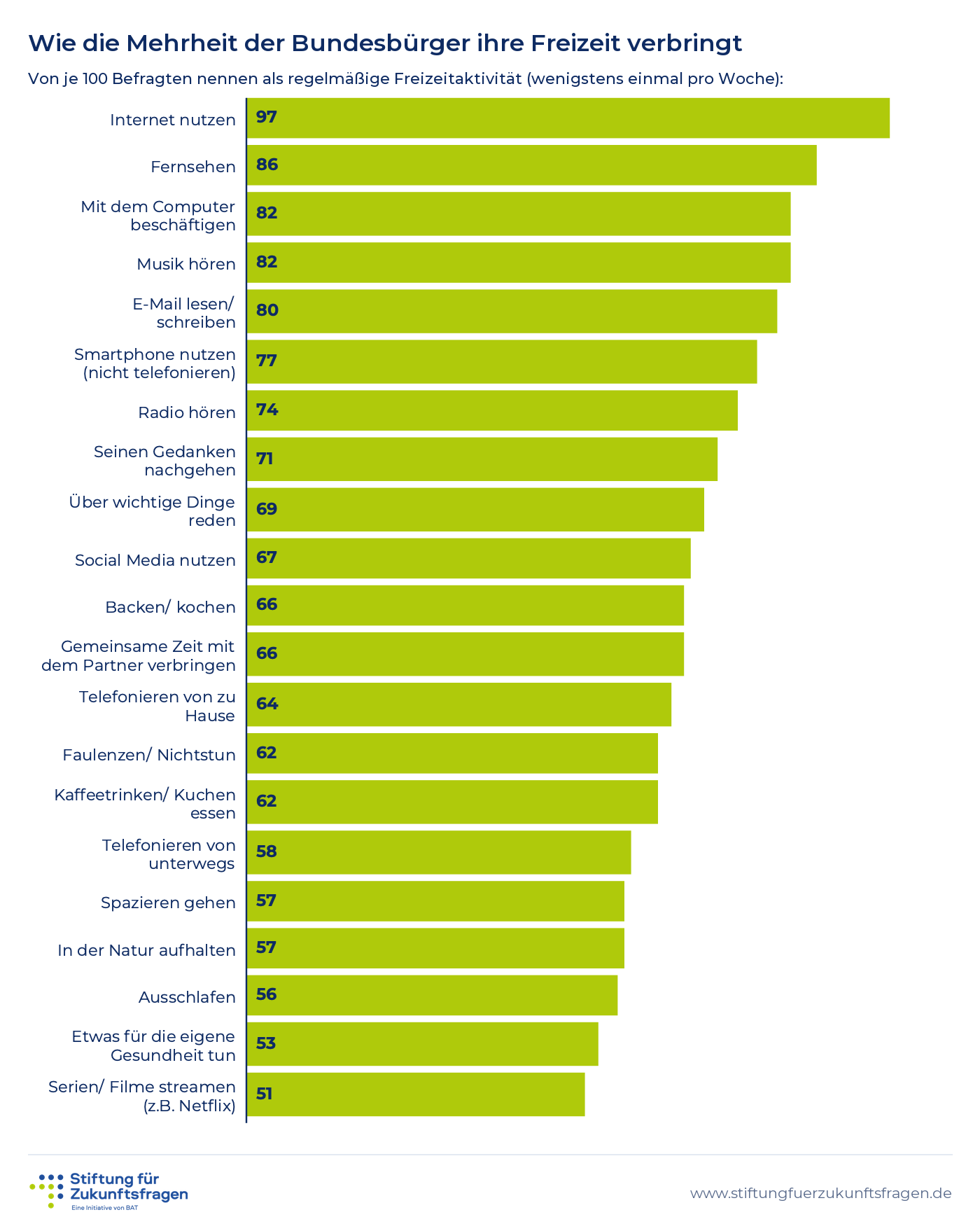
The dominance of the internet is unbroken. 97 per cent of all German citizens between the ages of 18 and 74 are regularly (i.e. at least once a week) active online. Ten years ago, this figure was only around half as many (2012: 53%). Television remains the second most popular leisure activity, followed by PC/laptop/tablet use. For the first time, social media also appeared in the top 10 most popular leisure activities: Facebook, Instagram, LinkedIn, TikTok, Snapchat or Twitter are used regularly by more than two thirds.
However, the majority of Germans are also active offline in their free time - for example, two out of three people spend time together with their partner, baking or cooking. Almost as many enjoy having a coffee in peace or simply doing nothing for once. And a majority also go for a walk or spend time in nature at least once a week.
How the majority of German citizens spend their free time
Out of every 100 respondents, the following are listed as regular leisure activities (at least once a week):
Data as table
| Using the internet | 97 |
| Television | 86 |
| Using the computer | 82 |
| Listen to music | 82 |
| Read/write email | 80 |
| Use your smartphone (not make phone calls) | 77 |
| Listen to the radio | 74 |
| to follow his thoughts | 71 |
| Talk about important things | 69 |
| Use social media | 67 |
| Baking/cooking | 66 |
| Spending time together with your partner | 66 |
| Making phone calls from home | 64 |
| Loitering/Doing nothing | 62 |
| Coffee/cake | 62 |
| Making calls on the go | 58 |
| Go for a stroll | 57 |
| Spending time in nature | 57 |
| Sleep in | 56 |
| Do something for your own health | 53 |
| Stream TV series/movies (e.g. Netflix) | 51 |
Leisure activities in a 40-year comparison
Within your own four walls, instead of among people
The Foundation for Future Studies has been investigating the leisure behaviour of German citizens for four decades. A 40-year comparison shows that only four activities were already among the most common leisure activities in 1982: Listening to music and watching television as well as pursuing one's thoughts and talking about important things. Activities such as reading the newspaper (1st place in 1982), doing something with friends (2nd place) or reading a book (9th place) are now only practised regularly by a minority. It is also clear that leisure time increasingly takes place within one's own four walls. While several activities outside the home were always among the most popular pastimes in recent decades, the ten most common activities currently take place at home. The scientific director of the Foundation for Future Studies, Professor Dr Ulrich Reinhardt, explains this as follows:
"Even though there are more and more leisure activities outside the home, this does not mean that they are being used more frequently. Leisure time is first and foremost recreational time - and this is spent at home. However, an ageing society, smaller family structures, a very attractive media offering and the current inflation and uncertainty also play a role".
Leisure stress instead of corona blues
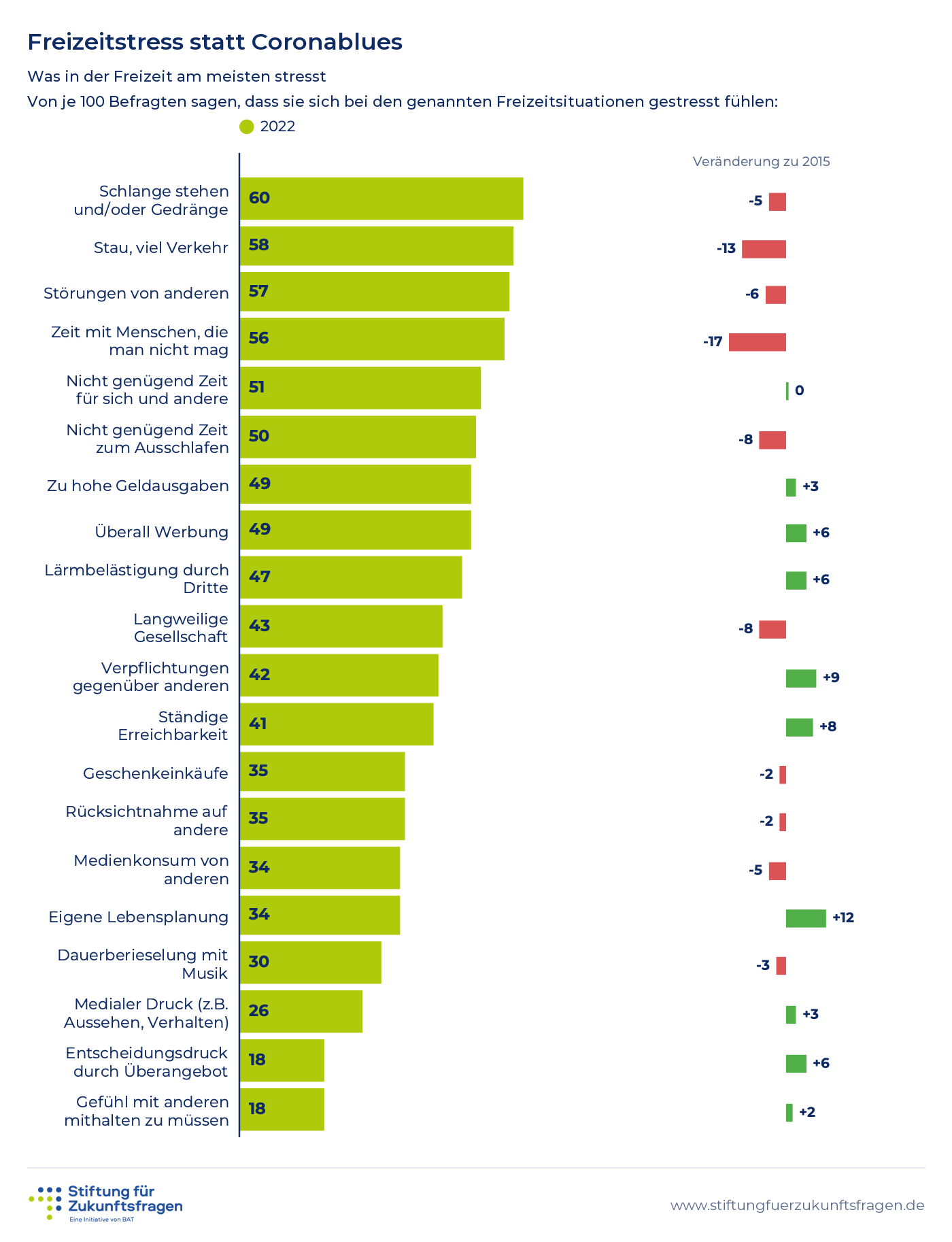
What causes the most stress in leisure time
Out of every 100 respondents, they say they feel stressed in the aforementioned leisure situations:
Data as table
| 2022 | Changes since 2015 | |
|---|---|---|
| Queuing and/or crowding | 60 | -5 |
| Traffic jam, heavy traffic | 58 | -13 |
| Disturbances from others | 57 | -6 |
| Time spent with people you don't like | 56 | -17 |
| Not enough time for oneself and others | 51 | 0 |
| Not enough time to sleep in | 50 | -8 |
| Excessive spending | 49 | 3 |
| Advertising everywhere | 49 | 6 |
| Noise pollution caused by third parties | 47 | 6 |
| Boring company | 43 | -8 |
| obligations to others | 42 | 9 |
| Constant availability | 41 | 8 |
| Gift shopping | 35 | -2 |
| Consideration for others | 35 | -2 |
| Media consumption of others | 34 | -5 |
| personal life planning | 34 | 12 |
| Constant background music | 30 | -3 |
| Media pressure (e.g., appearance, behavior) | 26 | 3 |
| Decision pressure due to oversupply | 18 | 6 |
| The feeling of having to keep up with others | 18 | 2 |
Nothing stresses Germans out more in their free time than wasting time - be it standing in a queue or in a traffic jam. But Germans are also stressed out by other people, either because they disturb them, because they have to endure the company of people they don't like or because they simply don't have enough time for themselves or others. What all these stress factors have in common is that they have decreased over time. This can be explained by the effects of the pandemic. It has led to fewer opportunities for contact, fewer offers and more individual time. Germans feel more stress than before the pandemic, mainly due to perceived obligations, constant availability and the flood of advertising on the internet, television and everyday life. However, stress levels have increased the most when it comes to personal life planning, be it in terms of career, family or self-realisation. Reinhardt:
"Caught between the expectations of others, seemingly limitless possibilities and their own needs, more and more people are feeling stressed. It is not easy to get out of this hamster wheel, which is why the risk of burnout is increasing.
On www.freizeitmonitor.de you will find many more results of this study. Feel free to take a look!
Leisure Monitor 2022:
- Germans' favourite leisure activities
- Winners and losers in a 10-year comparison
- Active and passive leisure activities in a 40-year comparison
- Long-term comparison of media use
- What stresses Germans out in their free time
- Differences in leisure activities and the perception of stress
o by gender
o according to age
o according to income