

Leisure Monitor 2021
16 September 2021
- THE MOST FREQUENT LEISURE ACTIVITIES OF FEDERAL CITIZENS: Internet takes top spot
- LEISURE ACTIVITIES BEFORE AND DURING PANDEMIA: Significantly more activities within the home
- FUN FACTORS IN LEISURE: Social activities are the most fun
- LEISURE ACTIVITY "SPENDING TIME IN NATURE": More often in the future
The most frequent leisure activities of German citizens: Internet defends top position
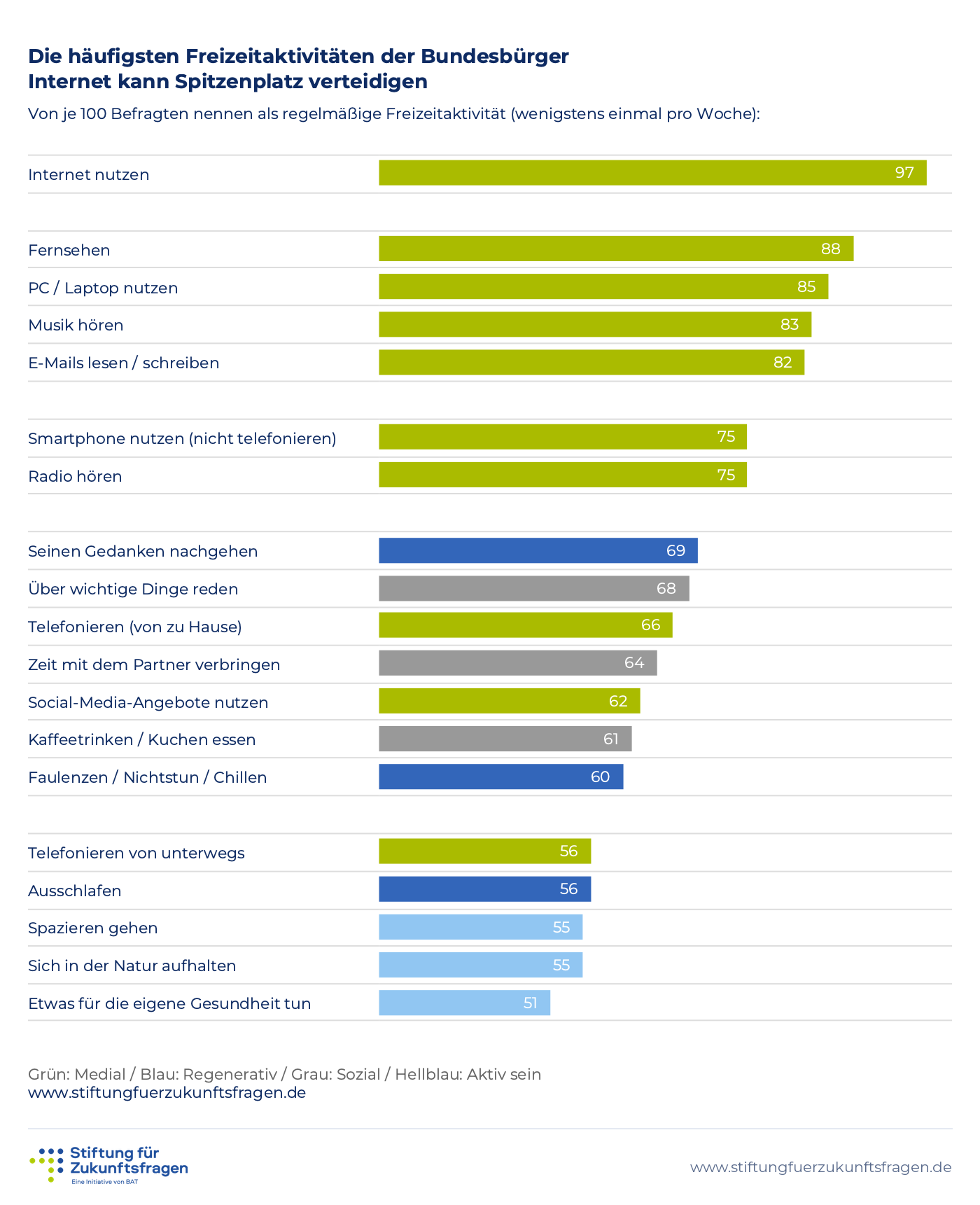
Almost exactly 30 years ago, in August 1991, the World Wide Web was introduced to the public for the first time. While in the early years it was still a gimmick for a few, it is now the most common leisure activity for German citizens: 97 per cent use the internet regularly (at least once a week).
"The appeal of the internet is unbroken. It promises knowledge, entertainment and distraction, offers (apparent) anonymity, equality and control, is almost omnipresent and fascinates almost all citizens," says Professor Dr Ulrich Reinhardt, Scientific Director of the Foundation for Future Studies.
This is followed by other media-related leisure activities such as watching TV, using the computer, listening to music, using a smartphone, making phone calls, listening to the radio or using social media services.
In addition, many Germans regularly indulge their thoughts, laze around and sleep in. Around two thirds of Germans spend their free time with friends and family, do something with their partner, talk about important things or meet up for coffee.
Activities outside the home are relatively rare. Only going for a walk, spending time in nature and doing something for their health are regularly practised by the majority of the population.
Data as table
| Using the internet | 97 |
| Television | 88 |
| Using a PC / Laptop | 85 |
| Listen to music | 83 |
| Reading / writing emails | 82 |
| Use your smartphone (not make phone calls) | 75 |
| Listen to the radio | 75 |
| to follow his thoughts | 69 |
| Talk about important things | 68 |
| Making phone calls (from home) | 66 |
| Spending time with your partner | 64 |
| Use social media services | 62 |
| Coffee / Cake | 61 |
| Lounging / Doing nothing / Chilling | 60 |
| Making calls on the go | 56 |
| Sleep in | 56 |
| Go for a stroll | 55 |
| Spending time in nature | 55 |
| Do something for your own health | 51 |
Leisure activities before and during the coronavirus pandemic: significantly more indoor activities
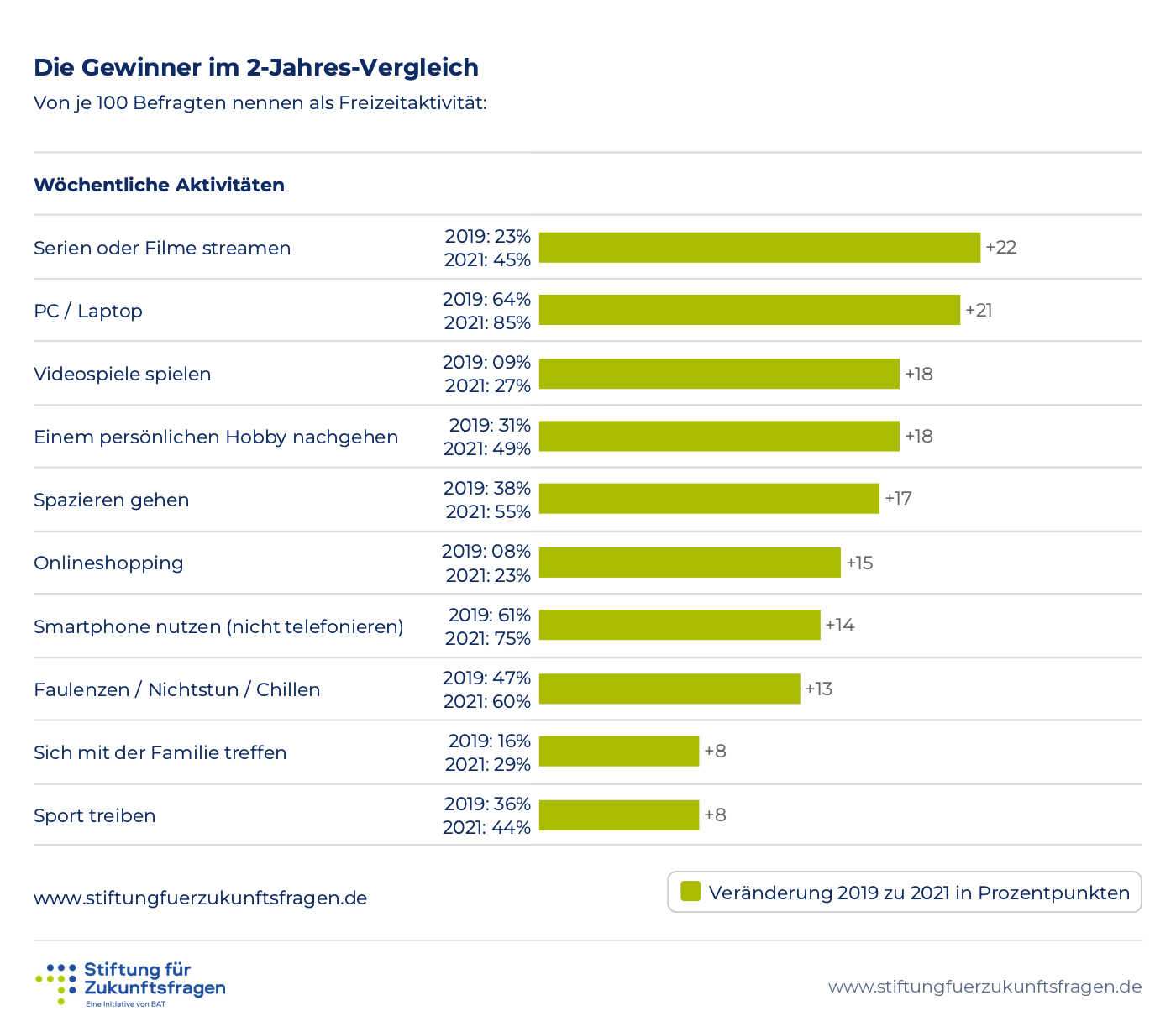
The restrictions and uncertainty caused by the coronavirus pandemic continue to influence Germans' leisure behaviour. Leisure time mainly takes place within their own four walls. Compared to the time before the pandemic (2019), activities such as watching streaming services, engaging in artistic endeavours or playing board games have doubled - video games and online shopping services are even used three times more frequently. However, people also go for walks, work in the garden or play sport much more often.
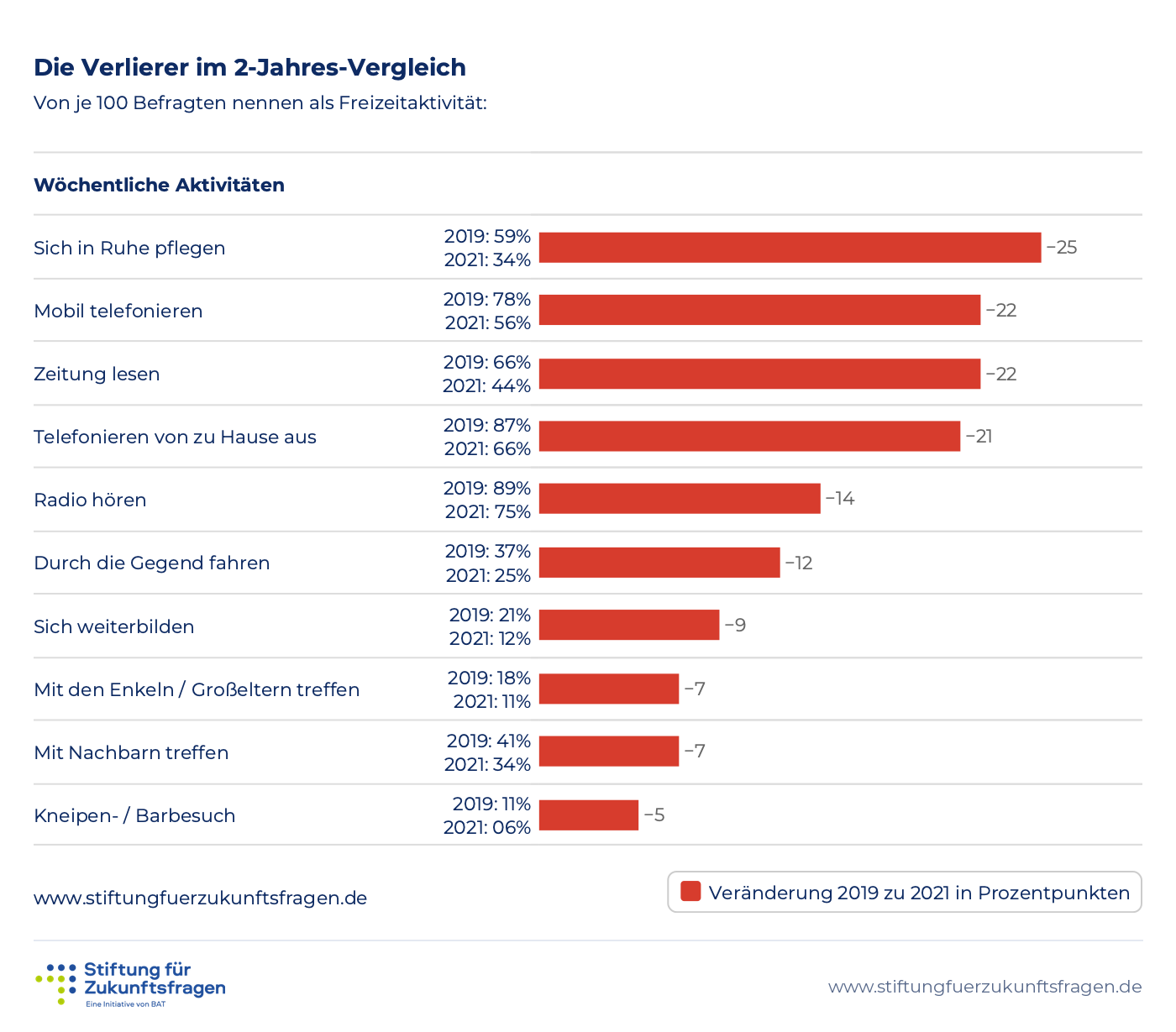
On the other hand, people are much less likely than two years ago to make phone calls, meet up with family or neighbours, spend time in clubs, at regulars' tables and at sporting events as well as attending further education courses. The biggest decline of all activities can be seen in the leisure activity "taking care of oneself in peace and quiet".
"Working from home and the closed-door scheme are reducing stress levels and physical exertion in leisure time, as well as the need to leave the house with a fresh shave and haircut. Accordingly, people are less likely to take care of themselves in peace and quiet or relax in the bathtub - because it's simply not necessary," says Prof Ulrich Reinhardt.
Data as table
| 2019 | 2021 | Change from 2019 to 2021 in percentage points | |
|---|---|---|---|
| Weekly activities | |||
| Stream series or movies | 23 | 45 | +22 |
| PC / Laptop | 64 | 85 | +21 |
| playing video games | 9 | 27 | +18 |
| Pursuing a personal hobby | 31 | 49 | +18 |
| Go for a stroll | 38 | 55 | +17 |
| online shopping | 8 | 23 | +15 |
| Use your smartphone (not make phone calls) | 61 | 75 | +14 |
| Lounging / Doing nothing / Chilling | 47 | 60 | +13 |
| Meeting with family | 16 | 29 | +13 |
| to do sports | 36 | 44 | +8 |
Data as table
| 2019 | 2021 | Change from 2019 to 2021 in percentage points | |
|---|---|---|---|
| Weekly activities | |||
| Take time to pamper yourself | 59 | 34 | -25 |
| Mobile phone calls | 78 | 56 | -22 |
| read newspaper | 66 | 44 | -22 |
| Making phone calls from home | 87 | 66 | -21 |
| Listen to the radio | 89 | 75 | -14 |
| Driving around the area | 37 | 25 | -12 |
| Further education | 21 | 12 | -9 |
| Meeting with the grandchildren / grandparents | 18 | 11 | -7 |
| Meeting with neighbors | 41 | 34 | -7 |
| Pub/bar visit | 11 | 6 | -5 |
Fun factors in leisure time: Social activities are the most fun
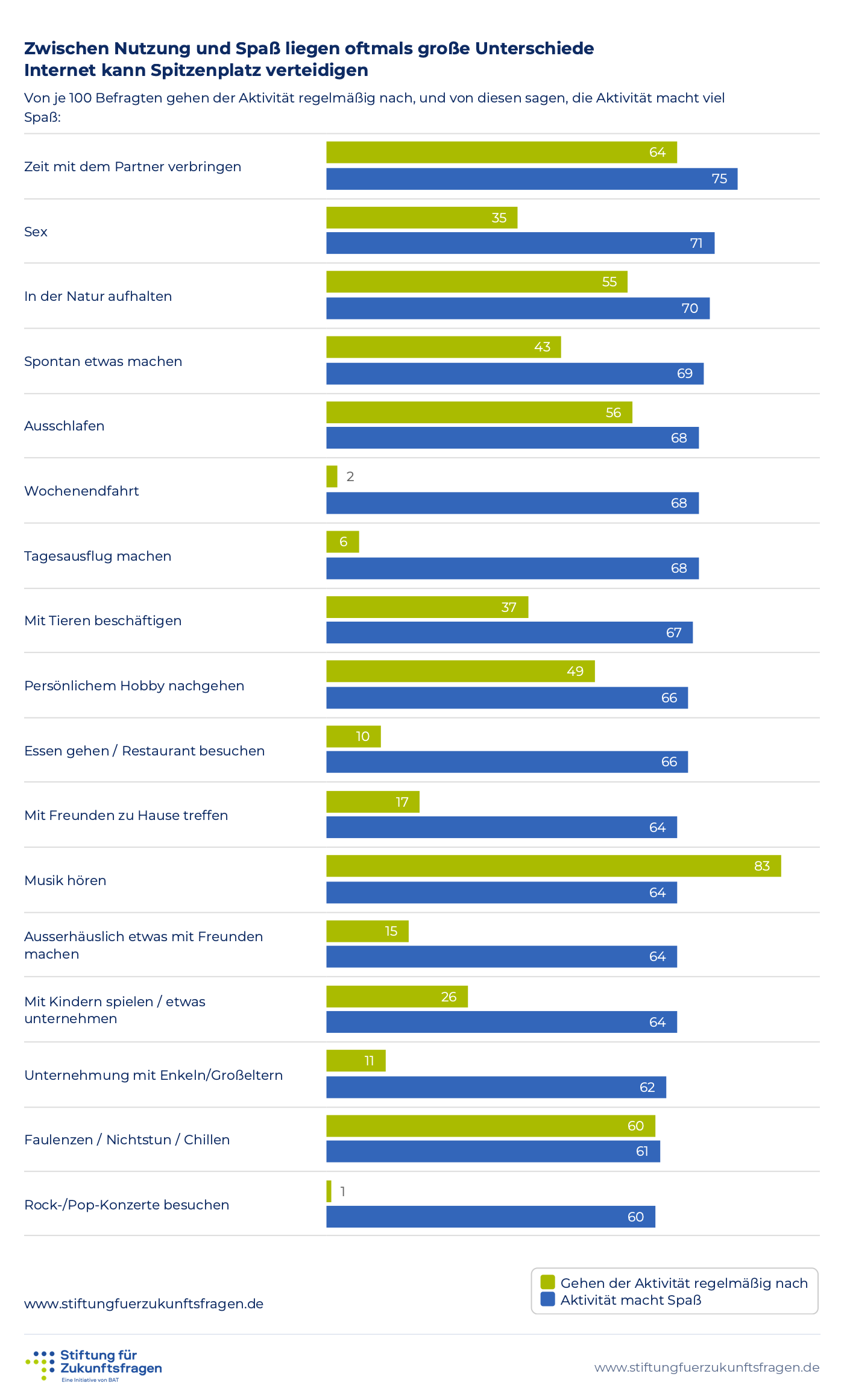
Leisure and fun are often equated in the general understanding. However, there is often a large gap between the actual leisure activity and its fun factor. Spending time with a partner or friends, spending time in nature, spontaneous activities, eating out and sleeping in or pursuing a hobby - the vast majority of Germans enjoy all of these things.
However, these activities are practised relatively rarely. Not even one in two people regularly dedicate themselves to their personal hobby or spontaneously practise something. Only around one in six meet up with friends regularly and only one in three make time for intimacy at least once a week.
Conversely, only around one in two people actually enjoy the internet, the TV programme and PC or mobile phone use. When it comes to the most common leisure activities, only listening to music scores well and is equated with fun by almost two thirds.
There are also major differences between the sexes. Men have significantly less fun making phone calls, reading books, going shopping or doing handicrafts. Women have less fun visiting amusement arcades, gyms, pubs, churches or sporting events.
A long-term comparison between 1986 and 2021 shows a decline in citizens' satisfaction with their leisure time. Whereas 35 years ago, two thirds of all leisure activities were still associated with fun by a majority of people, this figure has now fallen to just over a third of all activities.
The fun factor has increased for only six leisure activities, most strongly for spending time with animals (+25 PP), reading books (+28 PP) and going to concerts (+35 PP). Within a generation, many people have lost their enjoyment of going to the theatre (-44 PP), dancing (-42PP) and doing sport (-40PP).
Prof Ulrich Reinhardt: "A large number of leisure activities are pursued out of habit, a sense of duty or boredom, which leads to a loss of enjoyment, experience, satisfaction and a sense of well-being. Many people also don't make enough (free) time for activities with a high fun factor."
Data as table
| regularly pursue the activity | Activity is fun | |
|---|---|---|
| Spending time with your partner | 64 | 75 |
| sex | 35 | 71 |
| Spending time in nature | 55 | 70 |
| Do something spontaneously | 43 | 69 |
| Sleep in | 56 | 68 |
| weekend trip | 2 | 68 |
| Make a day trip | 6 | 68 |
| Working with animals | 37 | 67 |
| pursuing a personal hobby | 49 | 66 |
| Going out to eat / Visiting a restaurant | 10 | 66 |
| Meeting up with friends at home | 17 | 64 |
| Listen to music | 83 | 64 |
| Doing something outside the home with friends | 15 | 64 |
| Playing with children / doing something with children | 26 | 64 |
| Outing with grandchildren/grandparents | 11 | 62 |
| Lounging / Doing nothing / Chilling | 60 | 61 |
| Attend rock/pop concerts | 1 | 60 |
Leisure activity "Spending time in nature": More often in the future
More and more people in Germany are seeking a balance to sitting at home and spending time in nature. Whether on walks, jogging, cycling or hiking, whether during the week, at the weekend or on holiday, whether in the forest, by the water or in their own garden: the desire for more contact with nature in their leisure time is of central importance to many German citizens.
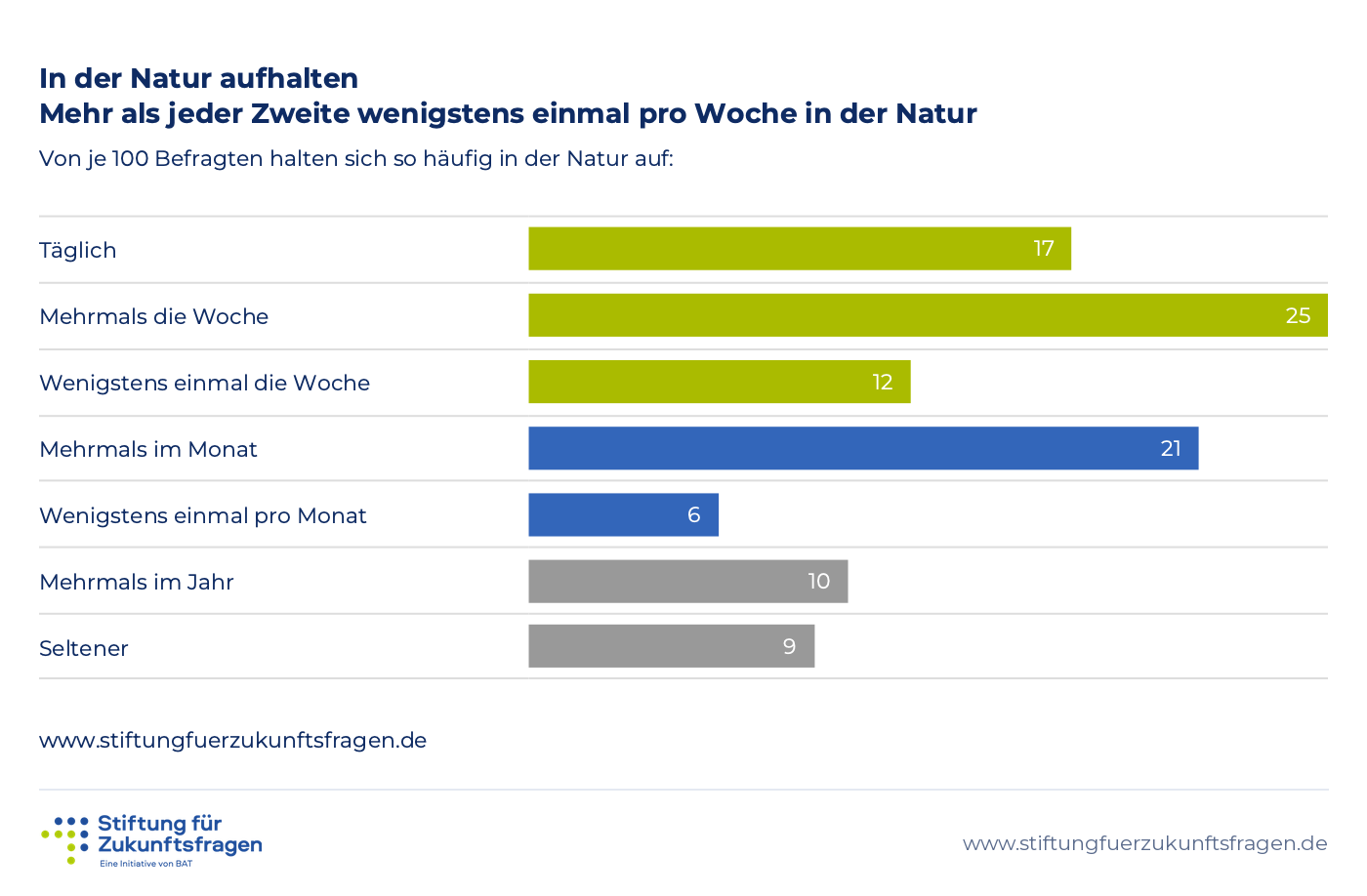
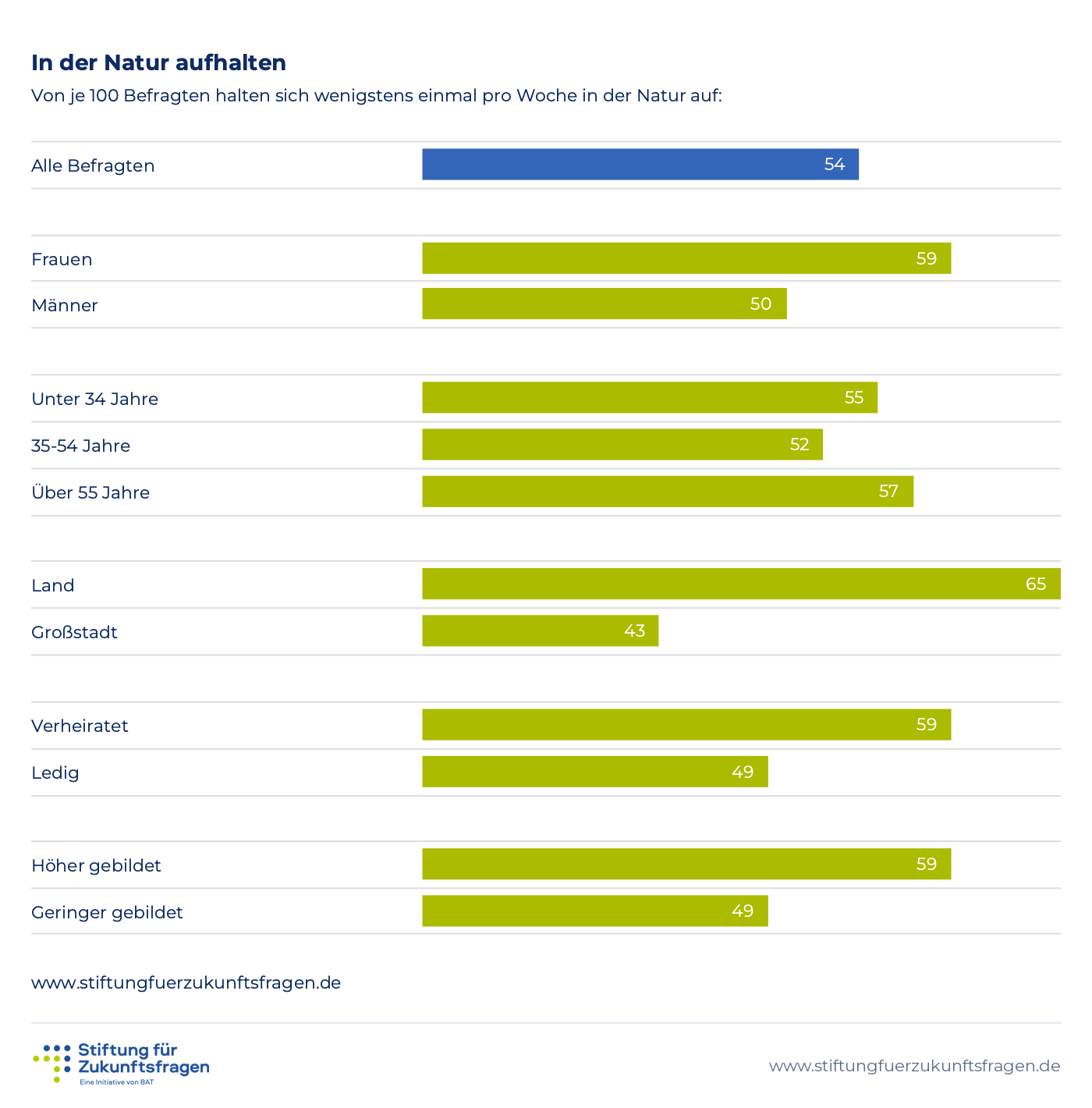
More than one in two people say they spend time in nature regularly - at least once a week. Within the population, it is mainly women, rural dwellers, couples and the formally educated who make time for this activity.
In the ranking, the fun factor of "spending time in nature" is even in third place. And when asked which activity they would like to do more often in the future, this activity also came out on top.
The reasons for the longing for nature are complex and range from the desire to slow down, the search for beauty or adventure to an even greater awareness of nature through public discussions.
"The more technical developments characterise everyday life, the greater the desire for a natural contrast. This balancing act between technology on the one hand and nature on the other will continue to have a major influence on our leisure behaviour in the future," Prof. Ulrich Reinhardt is certain.
Data as table
| Daily | 17 |
| Several times a week | 25 |
| At least once a week | 12 |
| Several times a month | 21 |
| At least once a month | 6 |
| Several times a year | 10 |
| Rare | 9 |
Data as table
| All respondents | 54 |
| Women | 59 |
| Men | 50 |
| Under 34 years | 55 |
| 35-54 years | 52 |
| Over 55 years | 57 |
| country | 65 |
| metropolis | 43 |
| Married | 59 |
| Single | 49 |
| Higher education | 59 |
| Less educated | 49 |
Data as table
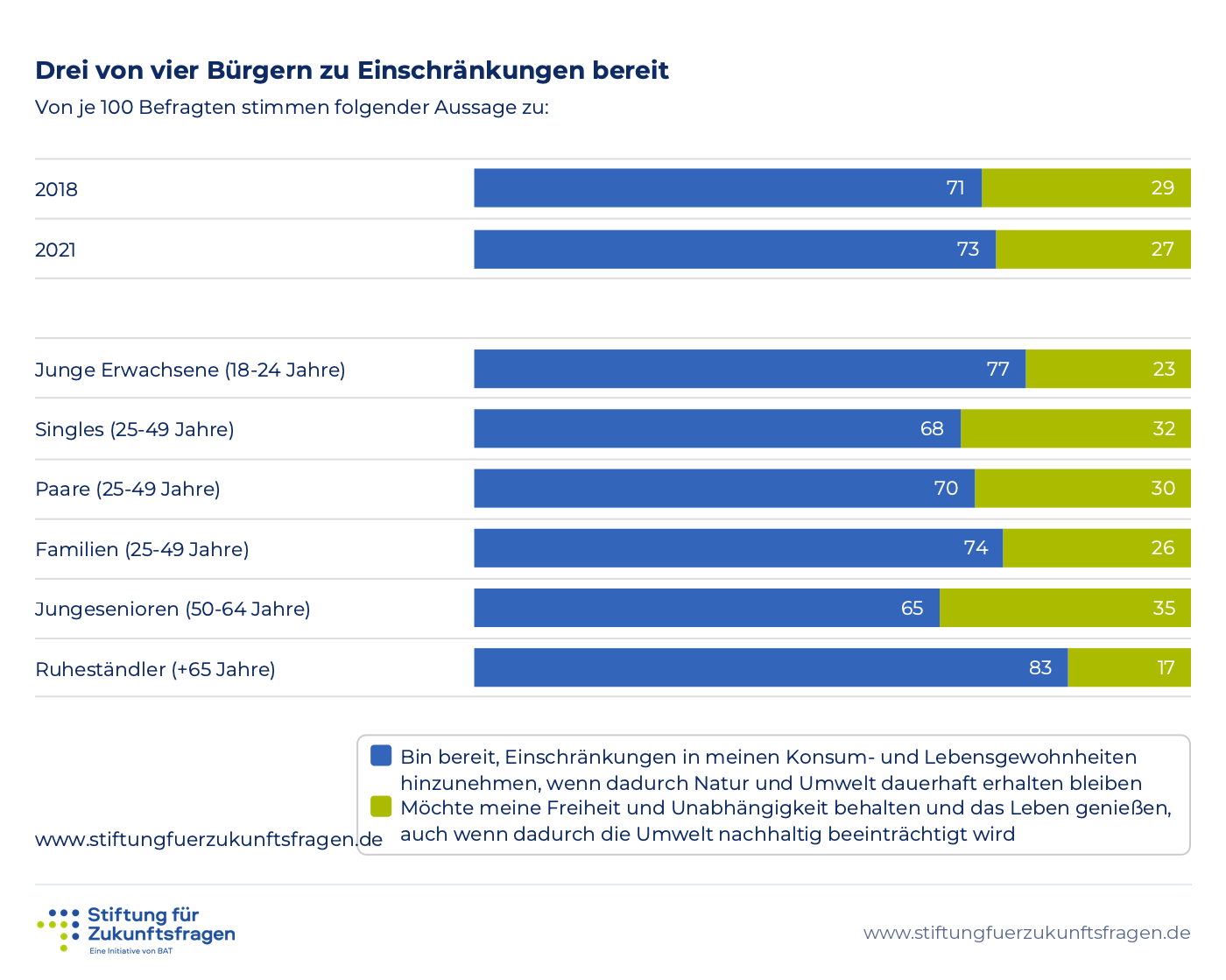
| I am prepared to accept restrictions in my consumption and lifestyle habits if this ensures the long-term preservation of nature and the environment. | I want to retain my freedom and independence and enjoy life, even if this has a lasting negative impact on the environment. | |
|---|---|---|
| 2018 | 71 | 29 |
| 2021 | 73 | 27 |
| Young adults (18-24 years) | 77 | 23 |
| Singles (25-49 years) | 68 | 32 |
| Couples (25-49 years) | 70 | 30 |
| Families (25-49 years) | 74 | 26 |
| Young seniors (50-64 years) | 65 | 35 |
| Retirees (+65 years) | 83 | 17 |
On our themed website www.freizeitmonitor.de you can now find all the results of the study in detail. You can also analyse the data interactively and individually, including the export of all graphics and charts.
Technical data of the investigation
Number and representation: Over 3,000 people aged 18 to 74 in Germany
Period of the survey: August 2021
Method: CAWI
Survey institute: Gesellschaft für Konsumforschung (GfK), Nuremberg