

Chart of the Week, 2025-Week 50
December 11, 2025

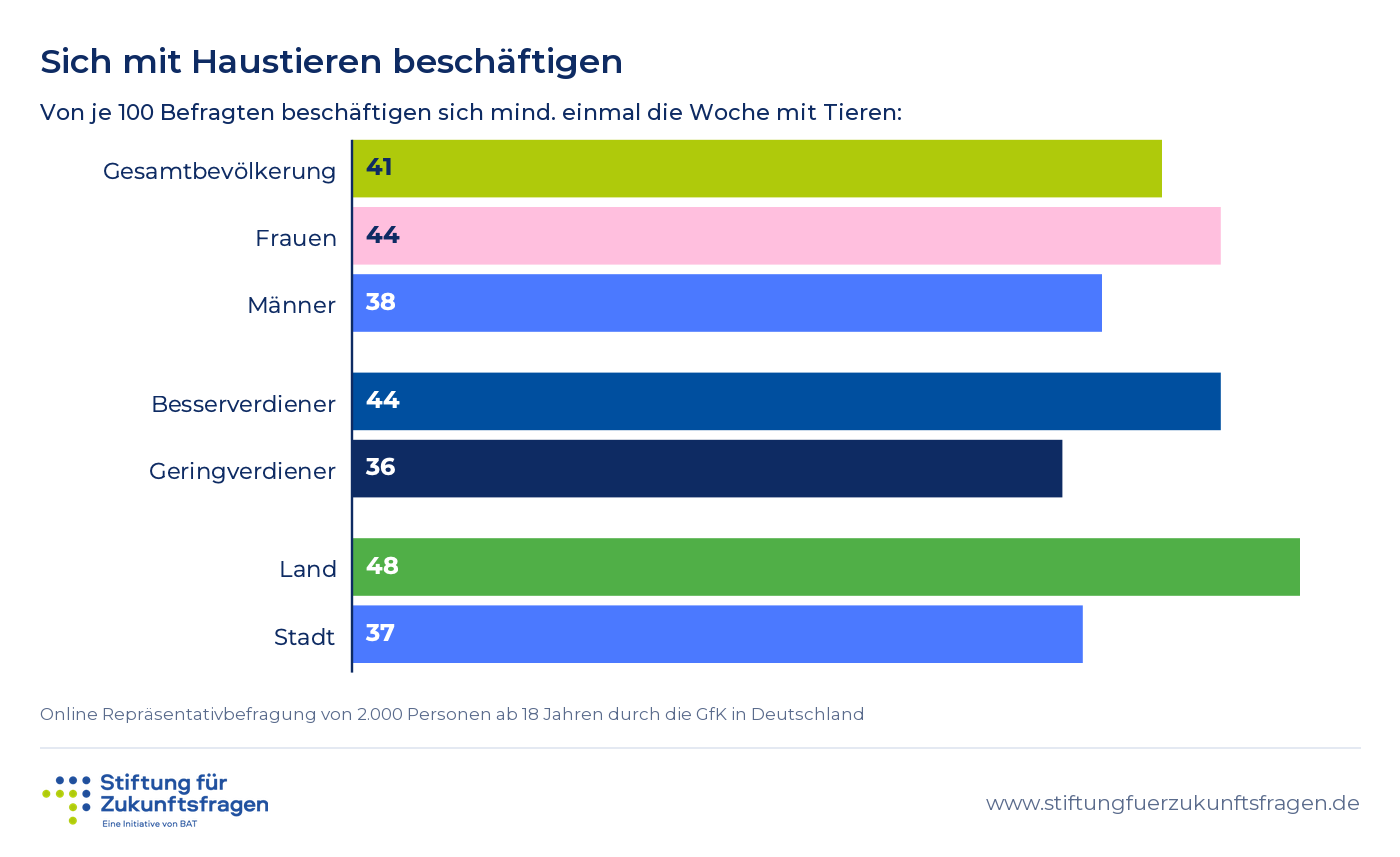
Spending time with pets
Of every 100 respondents, at least one deals with animals once a week:
Data as table
| Total population | 41 |
| Women | 44 |
| Men | 38 |
| high earners | 44 |
| low-income earners | 36 |
| country | 48 |
| City | 37 |
Result
The figures confirm that dealing with animals is very present in the everyday lives of citizens.. More than two out of five Germans say they actively engage with animals at least once a week – a remarkable number, twice as high as, for example, jogging and also higher than video games, reading books or visiting restaurants.. For many citizens, caring for animals is a central leisure activity.. Differences emerge depending on spatial conditions and gender: In smaller communities Almost every second person is involved with animals, while in large cities it's only about every third person.. Furthermore, this activity is more pronounced in women than in men..
Reasons
Pets often take on the role of an emotional anchor in many everyday situations by providing closeness, structuring the daily routine, and not judging.. Especially in single-person households, among older people, and among people with special needs, keeping animals unfolds an enormous social power.. Studies also show that regular contact with animals reduces stress hormones, stabilizes heart rate, and improves overall health.. The intense relationship between humans and animals is not a modern phenomenon, but has historical roots.. Today, pets are more likely to live in the countryside than in the city, but they are also present in urban areas and their numbers have increased there in recent years.. Families with children often use animal husbandry to teach responsibility.. For people living alone, pets serve as an important counterbalance to loneliness..
Forecast
The desire for closeness, reliability, and belonging will continue in the future, with pets playing a central role.. It can be assumed that new models of animal husbandry will develop, such as "dog sharing" already practiced today.„. This concept makes it possible to share the benefits of a bond with an animal with others, thereby learning continuous responsibility, but without bearing the burden seven days a week.. Furthermore, technological developments will significantly shape animal husbandry.. Fitness trackers for dogs that monitor movement, heart rate, calorie consumption and even sleep are already on the market.. Digitized animal husbandry, for example with automated gates or feed dispensers, as well as technical aids against birds of prey in chicken farming, are also expected to gain in importance.. Another future topic is the use of robot dogs, which are already being used in Japanese nursing homes to provide structure and as companions for people with dementia or those who are lonely.. Overall, pets are more than just companions; they reflect societal needs, provide closeness in an increasingly individualized world, and encourage the assumption of responsibility..