

Current research, 291
10 June 2021
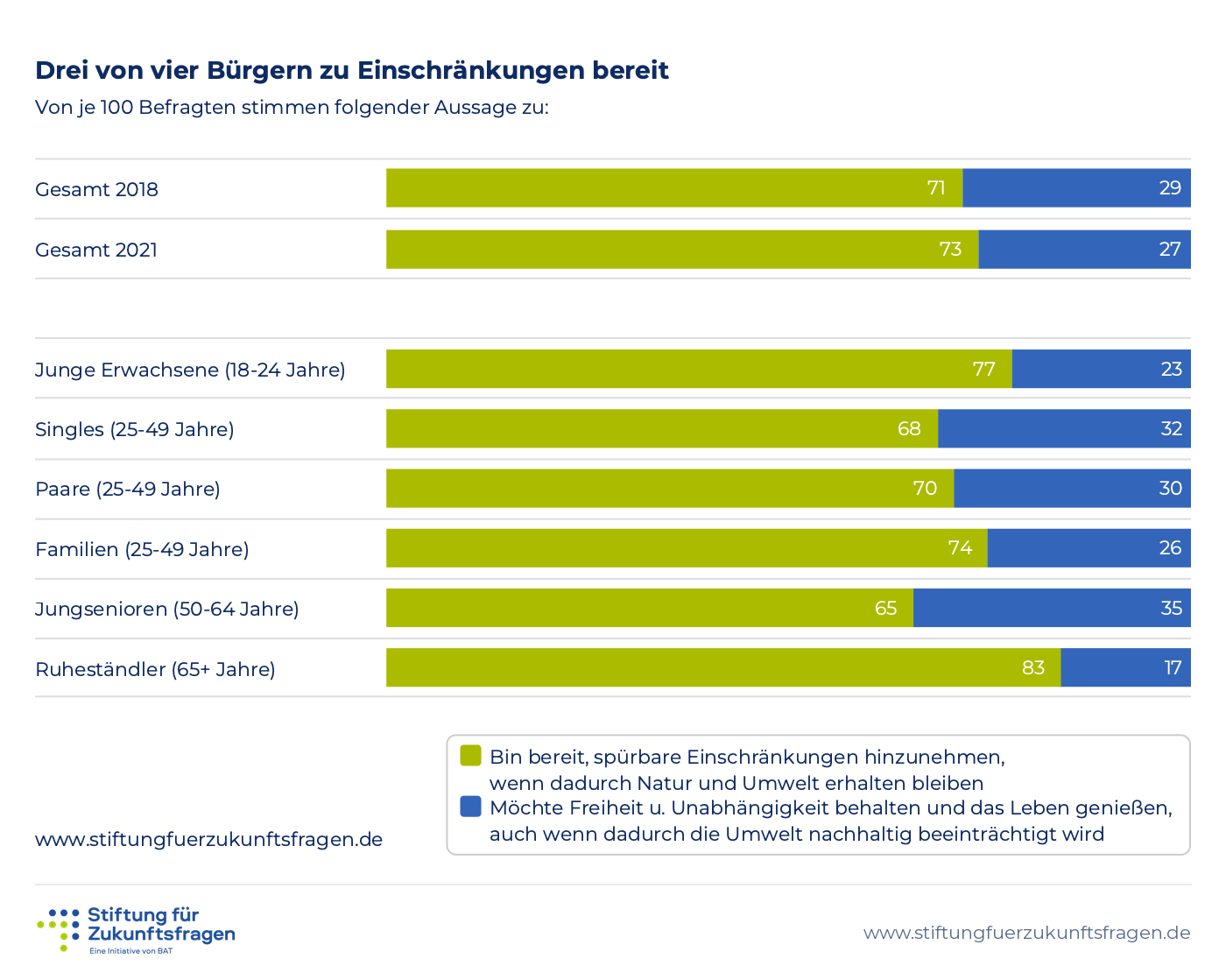
German citizens are becoming increasingly aware of the issue of climate change. Almost three out of four German citizens are currently prepared to accept noticeable restrictions in their consumption and lifestyle habits if this means that nature and the environment are preserved in the long term. Within the population, it is mainly young adults and retired people who agree with this statement. One in four citizens, on the other hand, would like to retain their freedom and independence and enjoy life, even if this has a lasting impact on the environment.
But what exactly drives Germans to adopt environmentally friendly behaviour? Is it the realisation that it is not possible without a change in behaviour, or is it a guilty conscience and social pressure? This is what the non-profit BAT Foundation for Future Studies is investigating in its latest environmental study, for which over 3,000 people aged 18 and over were surveyed on a representative basis about their environmental behaviour.
Data as table
| I am prepared to accept noticeable restrictions if this means nature and the environment are preserved. | I want to retain my freedom and independence and enjoy life, even if this has a lasting negative impact on the environment. | |
|---|---|---|
| Total 2018 | 71 | 29 |
| Total 2021 | 73 | 27 |
| Young adults (18-24 years) | 77 | 23 |
| Singles (25-49 years) | 68 | 32 |
| Couples (25-49 years) | 70 | 30 |
| Families (25-49 years) | 74 | 26 |
| Young seniors (50-64 years) | 65 | 35 |
| Retirees (65+ years) | 83 | 17 |
Climate change is no longer just an abstract topic in media reports; it has become an everyday issue. Whether shopping for food, planning holidays or making new technical purchases - more and more Germans are finding out about supply chains and ingredients, discussing alternatives, sometimes questioning their own behaviour and even changing their priorities as a result.
The assumption that we cannot afford to live ecologically is still valid, but it is becoming less so. It is no longer just about organic food, eco-friendly toys or sustainable fashion, but also about avoiding air travel, using instead of owning, recycling and upcycling, and consuming regionally instead of internationally.
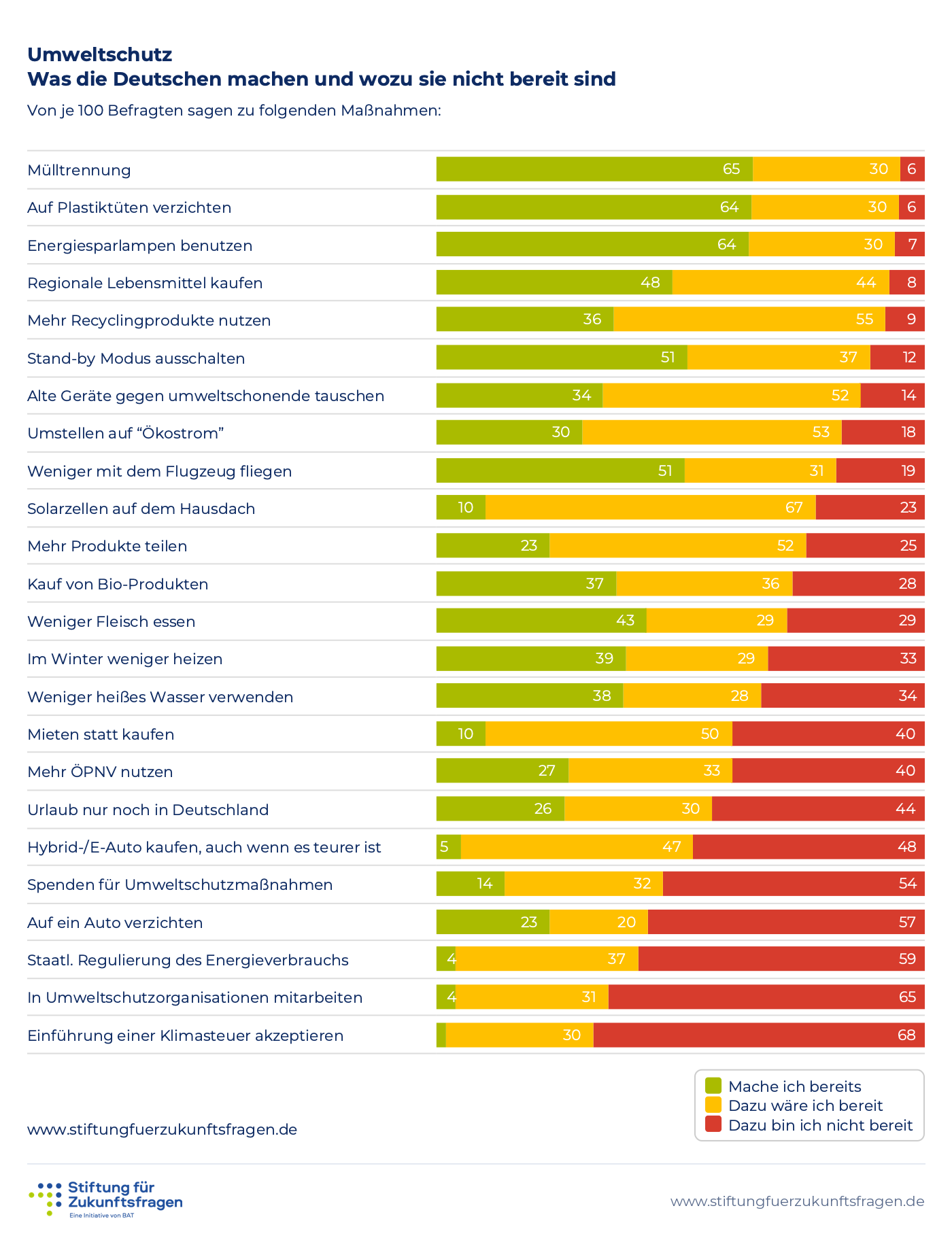
The vast majority of the population is prepared to make numerous personal restrictions or is already practising them. For example, only one in six people do not want to switch to green electricity and only one in four are not interested in the sharing economy.
Data as table
| I'm already doing that. | I would be willing to do that. | I am not prepared to do that. | |
|---|---|---|---|
| Waste separation | 65 | 30 | 6 |
| Avoid plastic bags | 64 | 30 | 6 |
| Use energy-saving light bulbs | 64 | 30 | 7 |
| Buy regional food | 48 | 44 | 8 |
| Use more recycled products | 36 | 55 | 9 |
| Turn off standby mode | 51 | 37 | 12 |
| Replace old devices with environmentally friendly ones | 34 | 52 | 14 |
| Switch to “green electricity” | 30 | 53 | 18 |
| Fly less | 51 | 31 | 19 |
| Solar panels on the roof | 10 | 67 | 23 |
| Share more products | 23 | 52 | 25 |
| Buying organic products | 37 | 36 | 28 |
| Eat less meat | 43 | 29 | 29 |
| Use less heating in winter | 39 | 29 | 33 |
| Use less hot water | 38 | 28 | 34 |
| Rent instead of buy | 10 | 50 | 40 |
| Use public transport more | 27 | 33 | 40 |
| Holidays only in Germany now | 26 | 30 | 44 |
| Buy a hybrid/electric car, even if it's more expensive. | 5 | 47 | 48 |
| Donations for environmental protection measures | 14 | 32 | 54 |
| Do without a car | 23 | 20 | 57 |
| Government regulation of energy consumption | 4 | 37 | 59 |
| Working in environmental protection organizations | 4 | 31 | 65 |
| Accept the introduction of a climate tax | 2 | 30 | 68 |
But are Germans also prepared to give up their own car on their doorstep or holidays far away? Professor Dr Ulrich Reinhardt, Scientific Director of the BAT Foundation: "People undoubtedly want to protect the environment. However, they want to do so as pragmatically as possible and without compromising their own standard of living or quality of life. For this reason, measures based on the substitution of goods are currently the most successful."
For example, the willingness to switch to green electricity, use energy-saving light bulbs or buy fair food in the supermarket is quite high, as this does not change one's own lifestyle, but gives a good feeling and also soothes the conscience.
On the other hand, not going on holiday, not owning a car outside the big city, getting actively involved in an environmental organisation in everyday life or spending more money on a climate tax and donations are measures that would have a much greater impact on one's own life, and the population is correspondingly cautious.
Reinhardt concludes: "Most German citizens are willing to help stop climate change, but the personal restrictions should be minimised. It is therefore imperative that politics, business, the media and science continue to take action to make the transition to a greener everyday life as easy as possible for the general public through framework conditions, reporting, education, innovations and concrete solutions."