

Current research, 301
5 September 2023
The BAT Foundation for Future Studies will present the "Leisure Time Monitor 2023" at an online press conference on 5 September 2023. For the survey, which has been conducted regularly since 1986, over 2,000 representatively selected citizens aged 18 and over were surveyed in July and August 2023 on over 100 different leisure activities as well as the special topic "Scope of personal (free) time".
Core results
1. THE SOFA AS THE EPICENTRE OF OUR LEISURE TIME
2. SPORT AND CULTURE ARE BOOMING - WITH ONE EXCEPTION
3. LESS FREE TIME FOR AND WITH OTHERS
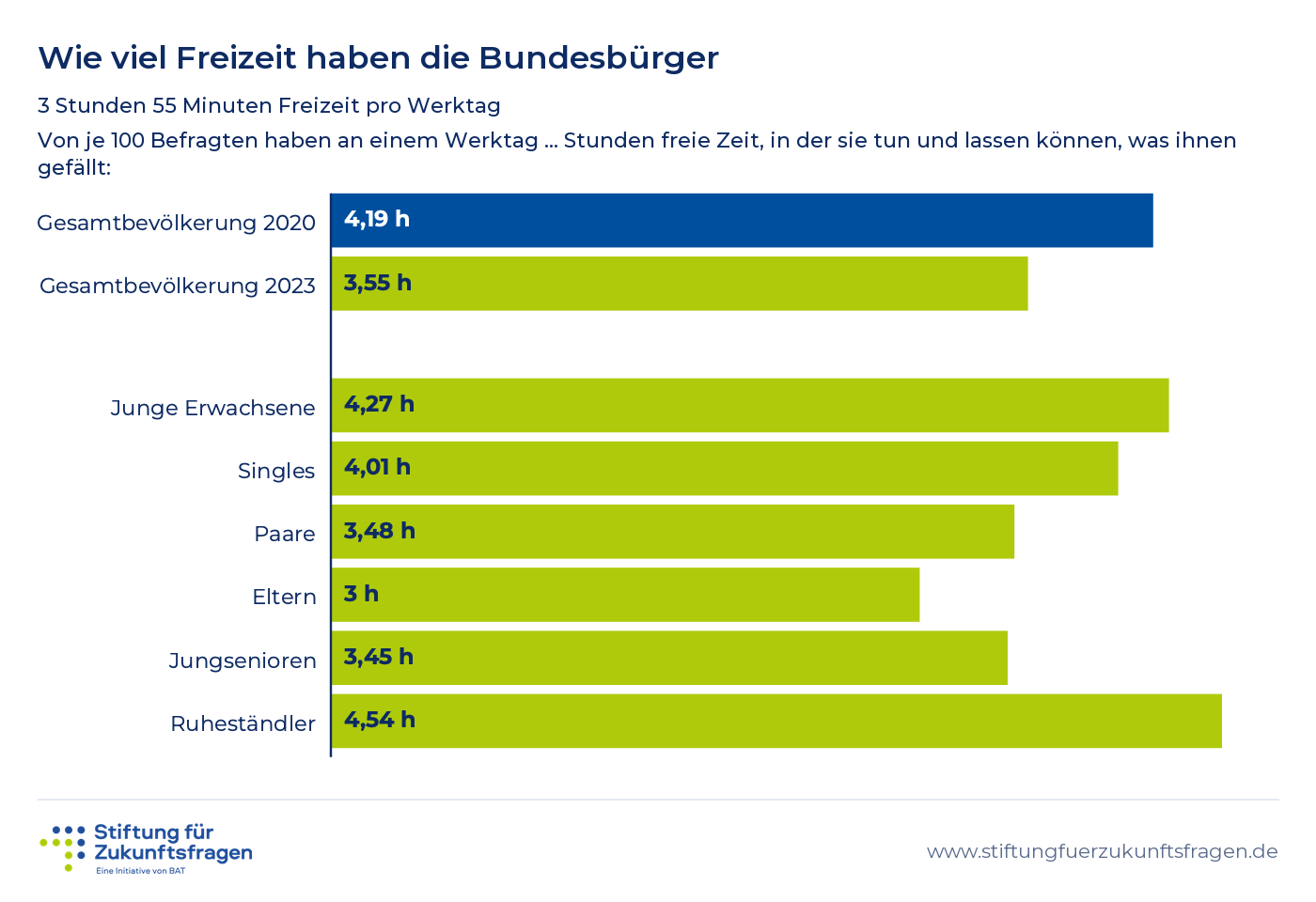
4. 3 HOURS 55 MINUTES FREE TIME PER WORKING DAY
THE SOFA AS THE EPICENTRE OF OUR LEISURE TIME
In an age characterised by constant change, fast-paced life, technological progress, but also uncertainty and worry, our homes are becoming the centre of our leisure time. People surf the internet, watch TV programmes for information, entertainment or entertainment, use social networks, make phone calls, text or stream. Their own couch is thus becoming the epicentre of modern leisure activities. The increasing use of media not only demonstrates technological progress, but also the current importance of convenience and individual needs.
But it is not only the media that make the home the favourite place for leisure activities. It also remains the favourite retreat for relaxation. Whether daydreaming or reflecting, chilling out or lazing around, people always use their own four walls. Regenerative leisure activities are no longer seen as mere inactivity, but rather as a conscious time-out and counterbalance to an increasingly hectic everyday life. The house or flat thus offers a space for slowing down and self-care. In addition, shared activities with partners, friends and family also take place in the home environment - be it cooking or games evenings, time for conversation, socialising or cosy evenings - as the home environment offers an intimate atmosphere in which relationships can be deepened and shared interests consolidated.
"In a time and world that is often characterised by external influences and a fast pace of life, the organisation of leisure time at home is becoming increasingly important - whether as a source of relaxation, personal interests and interpersonal connection"says Professor Dr Ulrich Reinhardt, Scientific Director of the BAT Foundation.
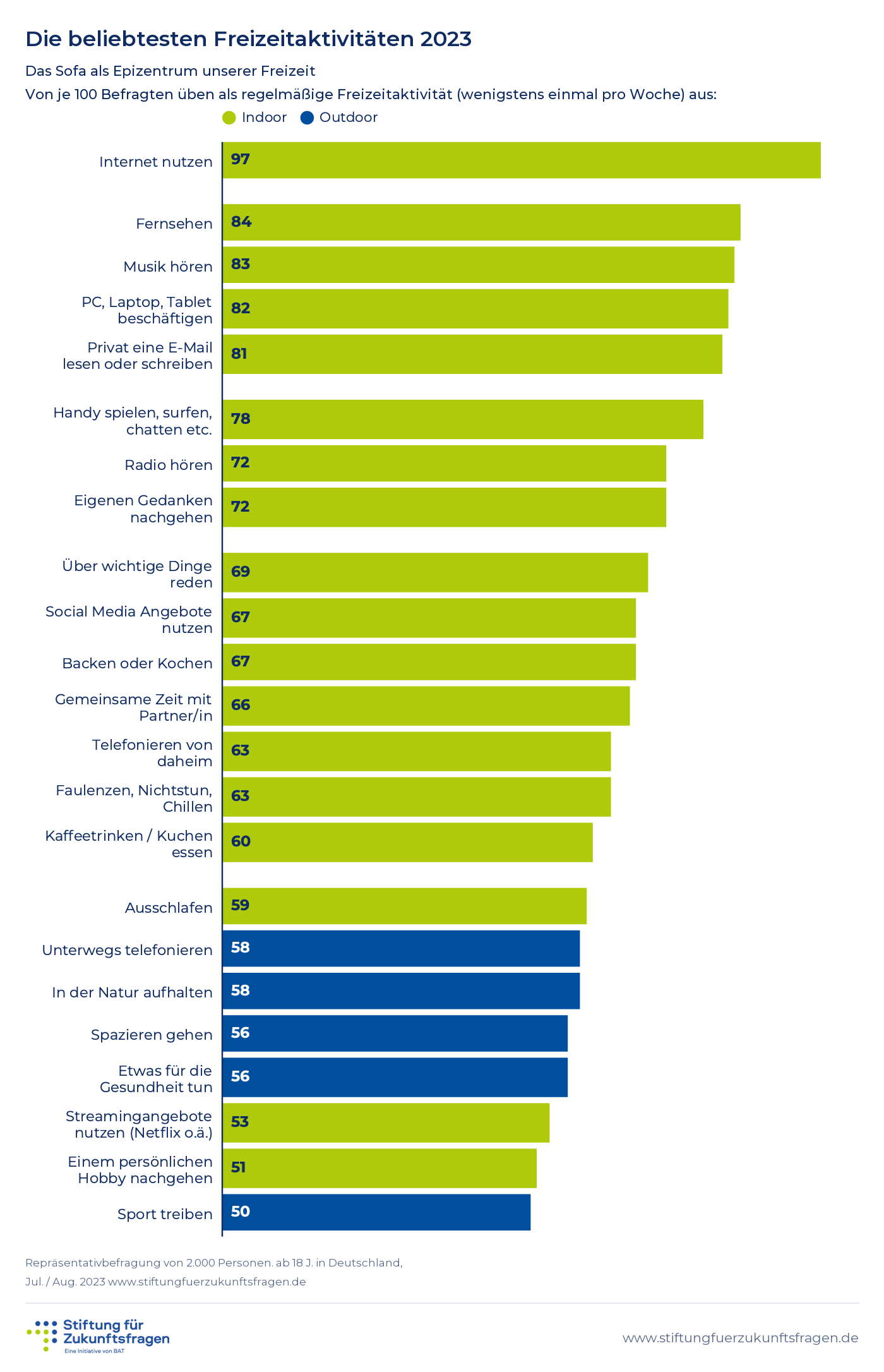
The most popular leisure activities of 2023
The sofa as the epicenter of our leisure time
Out of every 100 respondents, the following are practiced as regular leisure activities (at least once a week):
Data as table
| Using the internet | 97 |
| Television | 84 |
| Listen to music | 83 |
| PC, laptop, tablet | 82 |
| Reading or writing a private email | 81 |
| Playing games on your mobile phone, surfing the internet, chatting, etc. | 78 |
| Listen to the radio | 72 |
| to follow one's own thoughts | 72 |
| Talk about important things | 69 |
| Use social media services | 67 |
| Baking or cooking | 67 |
| Spending time together with your partner | 66 |
| Making phone calls from home | 63 |
| Loitering, doing nothing, chilling | 63 |
| Coffee / Cake | 60 |
| Sleep in | 59 |
| Making phone calls on the go | 58 |
| Spending time in nature | 58 |
| Go for a stroll | 56 |
| Do something for your health | 56 |
| Use streaming services (Netflix or similar) | 53 |
| Pursuing a personal hobby | 51 |
| to do sports | 50 |
CULTURE AND SPORT ARE BOOMING - WITH ONE EXCEPTION
From museums and concerts to cinema screenings and amusement parks - cultural leisure activities are becoming increasingly popular with many citizens, albeit at a much lower level than domestic activities. The wide range of options enables everyone to immerse themselves in different worlds and be entertained or inspired artistically, musically and intellectually. The need to catch up is certainly still playing a major role here.
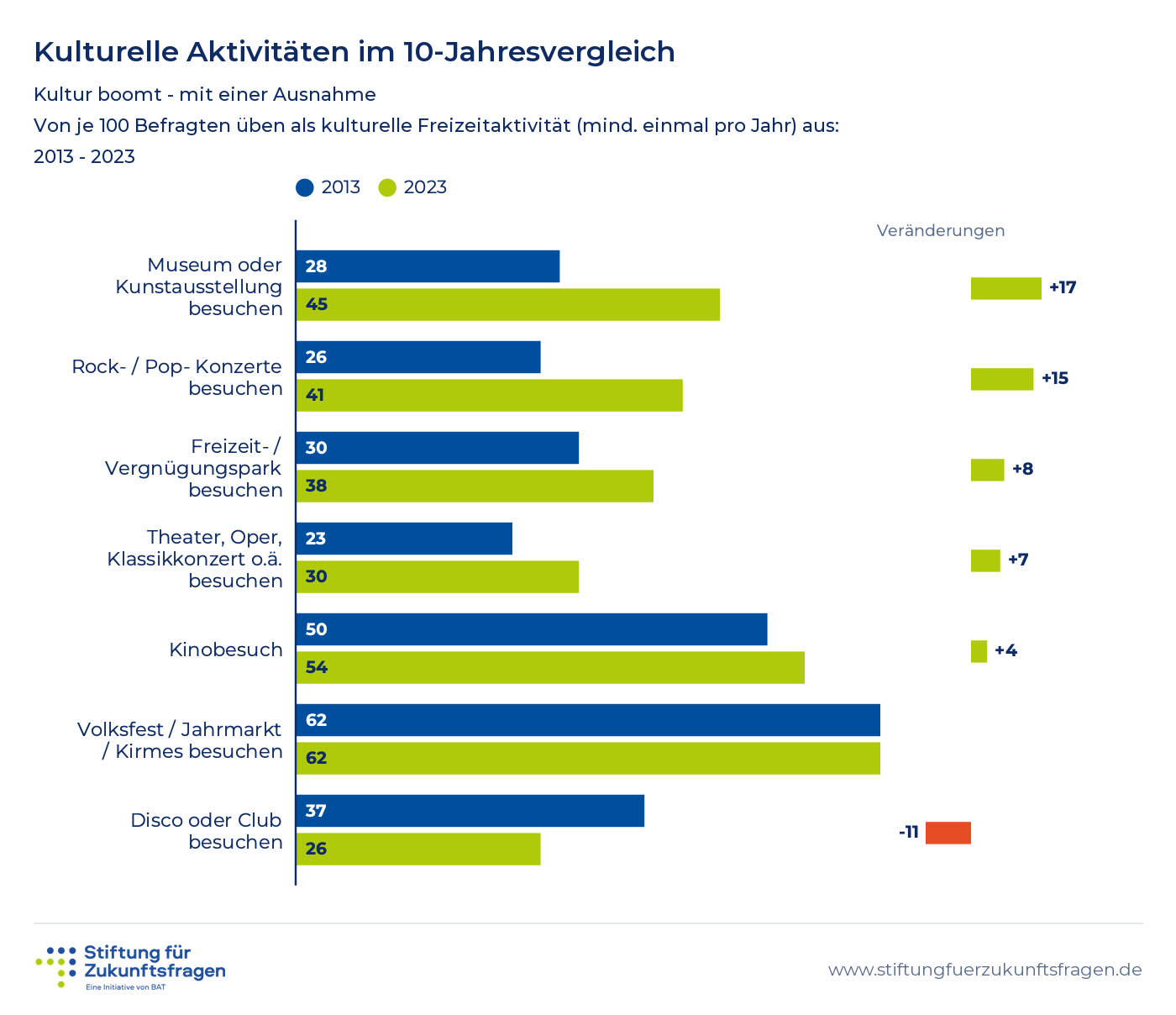
Only discos and clubs are not benefiting from the cultural boom. Once considered the epitome of nightlife and a social meeting place, dance floors are now much less frequented than they were ten years ago. There are many reasons for this, ranging from fewer offers due to closures during the pandemic to demographic changes and more popular other leisure activities.
Cultural activities in a 10-year comparison
Culture is booming – with one exception
Out of every 100 respondents, the following are practiced as cultural leisure activities (at least once a year):
2013 - 2023
Data as table
| Cultural leisure activity | 2013 | 2023 | Changes |
|---|---|---|---|
| Visit a museum or art exhibition | 28 | 45 | +17 |
| Attend rock/pop concerts | 26 | 41 | +15 |
| Visit an amusement park | 30 | 38 | +8 |
| Visit a theatre, opera, classical concert, or similar event. | 23 | 30 | +7 |
| cinema visit | 50 | 54 | +4 |
| Visit a folk festival / fair / carnival | 62 | 62 | |
| Visit a disco or club | 37 | 26 | -11 |
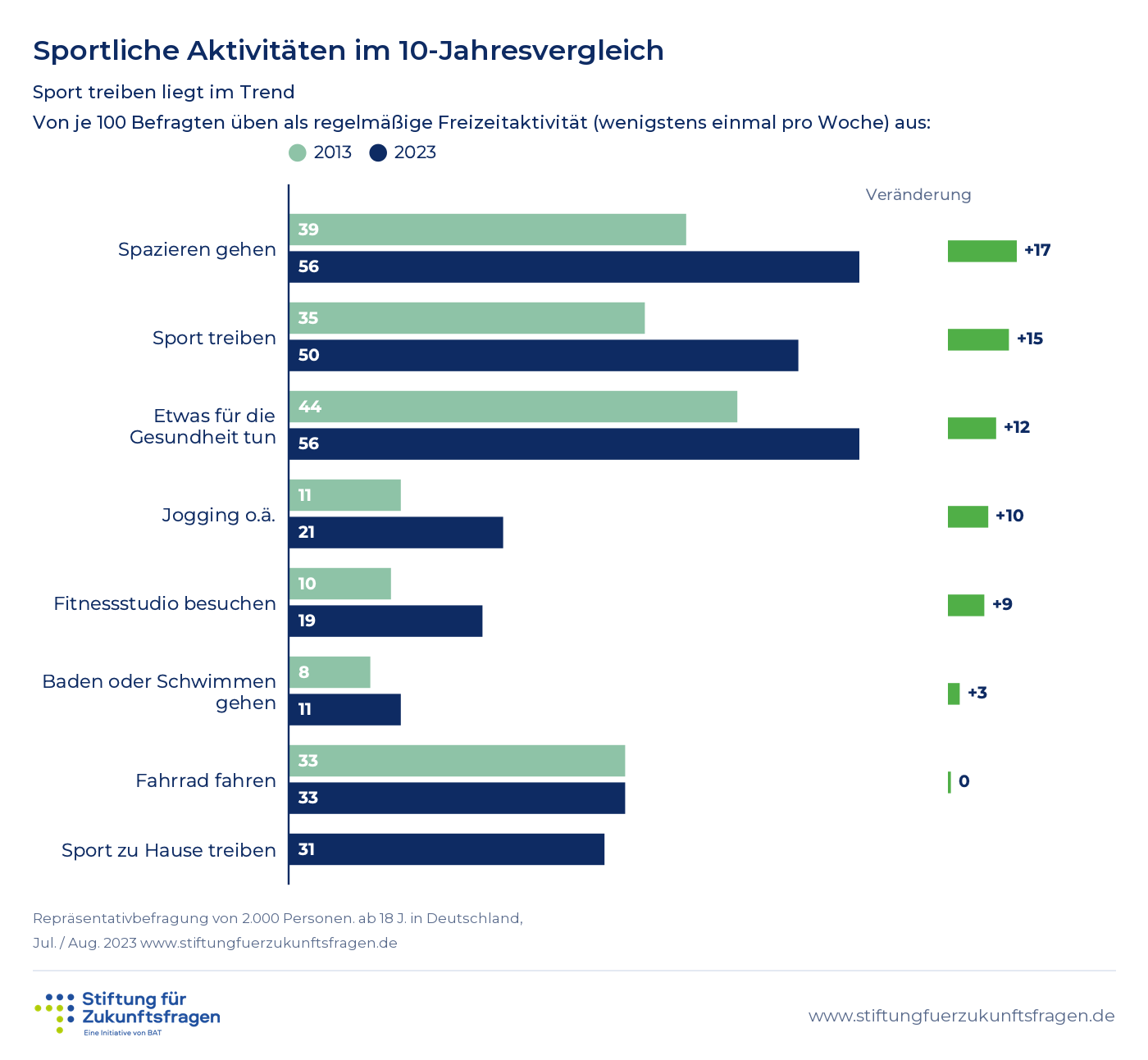
Sporting activities are also being practised much more frequently than ten years ago. Many people are lacing up their running shoes, putting on their swimming goggles or going to the gym. The enthusiasm for exercise-intensive activities is evidence of growing health awareness on the one hand, but also of an increased need for exercise and thus a balance to work and leisure time at a desk or screen on the other.
Sporting activities over the past 10 years
Playing sports is trendy
Out of every 100 respondents, the following are practiced as regular leisure activities (at least once a week):
Data as table
| 2013 | 2023 | change | |
|---|---|---|---|
| Go for a stroll | 39 | 56 | +17 |
| to do sports | 35 | 50 | +15 |
| Do something for your health | 44 | 56 | +12 |
| Jogging or similar. | 11 | 21 | +10 |
| Visit the gym | 10 | 19 | +9 |
| Going for a bath or a swim | 8 | 11 | +3 |
| ride a bike | 33 | 33 | 0 |
| Doing sports at home | - | 31 |
LESS FREE TIME FOR AND WITH OTHERS
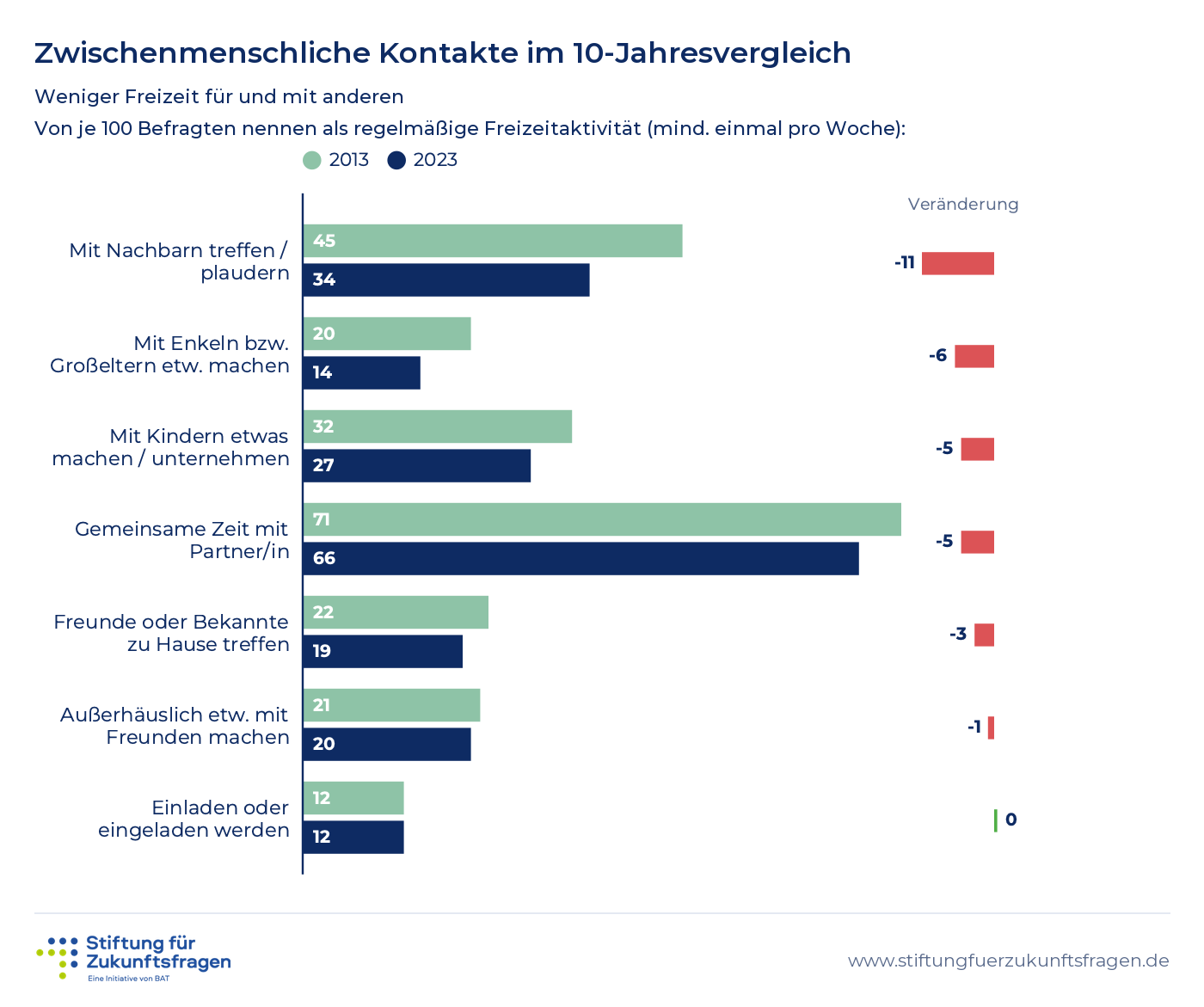
Exchanges with neighbours, joint activities with grandchildren or grandparents, activities with children, friends or acquaintances as well as sharing moments with a partner are less common compared to a decade ago. According to Reinhardt, the trend towards fewer interpersonal activities in leisure time can be attributed to various reasons:
"Modern life is characterised by an accelerated rhythm that often leaves less room for social gatherings. It may seem paradoxical that at a time when humanity is more connected than ever before, personal meetings and socialising are becoming less important. For the future, we need to find a balance between the modern pace of life and maintaining close human connections.
Interpersonal contacts in a 10-year comparison
Less free time for and with others
Out of every 100 respondents, the following are listed as regular leisure activities (at least once a week):
Data as table
| 2013 | 2023 | change | |
|---|---|---|---|
| Meeting/chatting with neighbors | 45 | 34 | -11 |
| Doing something with grandchildren or grandparents | 20 | 14 | -6 |
| Doing something with children / doing something with children | 32 | 27 | -5 |
| Spending time together with your partner | 71 | 66 | -5 |
| Meeting friends or acquaintances at home | 22 | 19 | -3 |
| Doing something outside the home with friends | 21 | 20 | -1 |
| To invite or to be invited | 12 | 12 | 0 |
3 HOURS 55 MINUTES FREE TIME PER WORKING DAY
Compared to the first year of the coronavirus pandemic, the average amount of free time people have has decreased by almost half an hour. Retired people currently have an above-average amount of free time with almost five hours, compared to just three hours per week for parents.
The change can be attributed to various factors, with less working from home being one of the main reasons. Although many companies continue to offer their employees the opportunity to spend part of their working time at home, many are also returning to the company. The corresponding travelling time to and from the offices and factory halls is "missing" from the leisure budget. The proportion of commitments has also increased again - be it shopping at the supermarket, "getting ready" in the morning or hours spent as a trainer at a club.
It is likely that the workload will continue to increase in the coming years as the economy attempts to stabilise. Significantly more free time is therefore unlikely for the time being.
How much free time do German citizens have?
3 hours 55 minutes of free time per working day
Out of every 100 respondents, they have ... hours of free time on a weekday in which they can do whatever they like:
Data as table
| Total population 2020 | 4,19 |
| Total population 2023 | 3,55 |
| Young adults | 4,27 |
| Singles | 4,01 |
| Couples | 3,48 |
| Parents | 3,00 |
| Young seniors | 3,45 |
| Retirees | 4,54 |
On www.freizeitmonitor.de you will find many more results of this study. Feel free to take a look!