

Chart of the week, 2025-KW39
25 September 2025

Between appreciation and willingness to pay
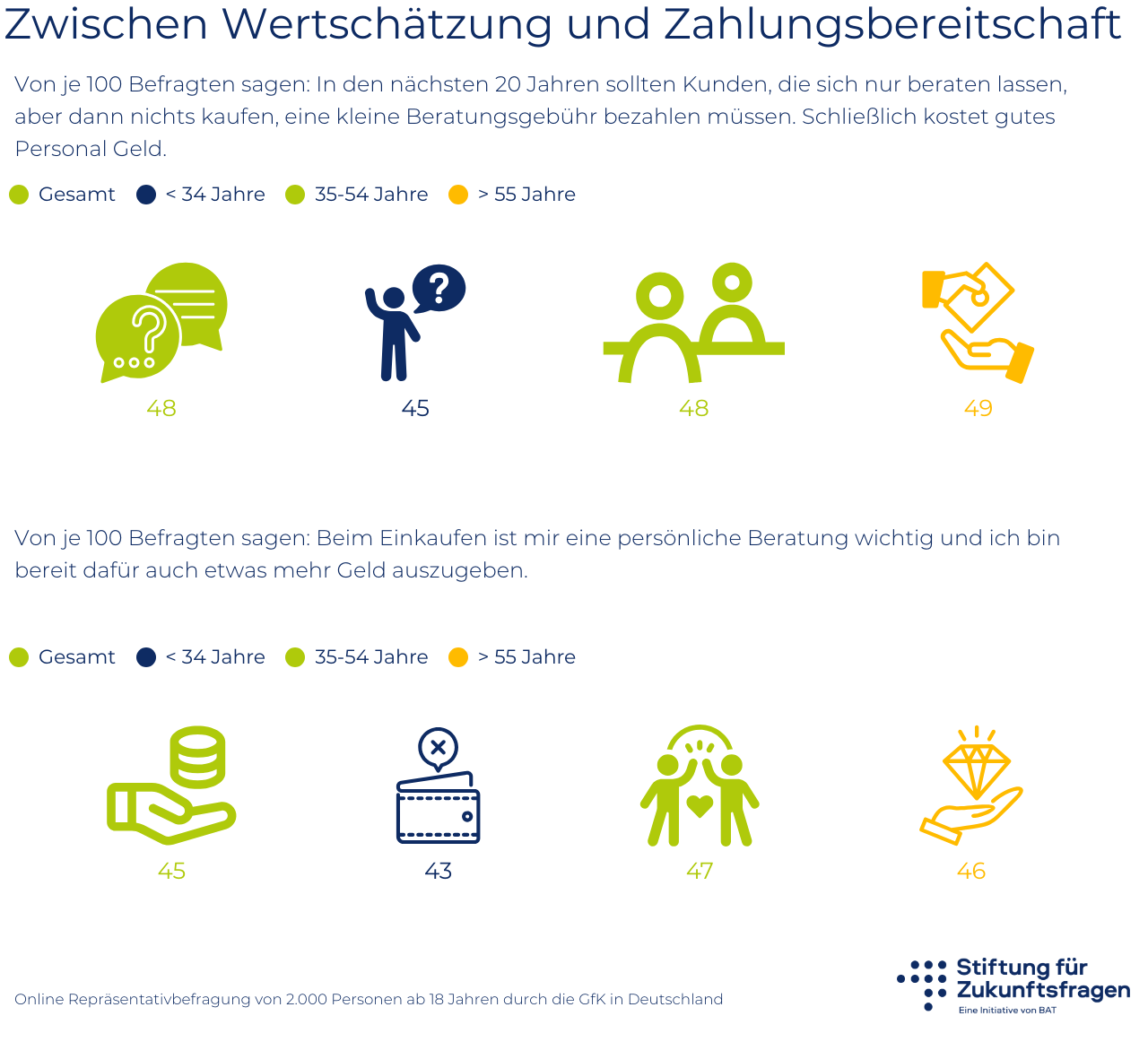
Of every 100 respondents, one in 100 said that in the next 20 years, customers who only seek advice but then don't buy anything should have to pay a small consultation fee. After all, good staff costs money.
Out of every 100 respondents, one in 100 said: Personal advice is important to me when shopping, and I am willing to spend a little more money for it.
Data as table
| Total | 48 |
| < 34 years | 45 |
| 35-54 years | 48 |
| > 55 years | 49 |
| Total | 45 |
| < 34 years | 43 |
| 35-54 years | 47 |
| > 55 years | 46 |
Result
Two key questions regarding the future of personal consultation paint a nuanced picture. While nearly half the population (49 percent in 2018, 48 percent in 2025) supports the introduction of a consultation fee, for example, when advice is sought but no purchase is made, the willingness to generally spend more money on personal consultation is declining. In 2018, three out of five respondents stated that personal consultation was important to them when shopping and that they would be willing to pay a premium for it. By 2025, this figure will be only 45 percent. This increasingly highlights the question of under what conditions consultation is still considered a worthwhile service.
Reasons
The consistent approval of consultation fees demonstrates a growing understanding of fairness in commerce. Many recognize that qualified and competent advice incurs costs. A fee is therefore increasingly seen as legitimate compensation for the service provided.
At the same time, the decline in general willingness to pay points to changing consumer habits. More and more people prefer to inform themselves, for example online, via comparison portals, reviews, or testimonials. Traditional in-person advice is losing importance, especially if it is perceived not as neutral but as purely sales-oriented. Economic reasons also play a role: Those confronted with rising prices and uncertain future prospects often cut back not on the product itself, but on the accompanying services.
Forecast
Consultation will remain a key element of customer relationships in the future, especially for products that require explanation or are complex. However, it will no longer automatically be equated with a higher price.
The idea is gaining ground that consulting should be paid for when it is independent, professionally sound, and time-consuming, regardless of whether a purchase is subsequently made. Companies are challenged to communicate the quality of their consulting services more clearly and to proactively rebuild trust. Customers expect guidance and support, but are only willing to pay if they can understand the benefits of the consulting and have a say in the outcome.