
Chart of the week, 2023-KW37
14 September 2023

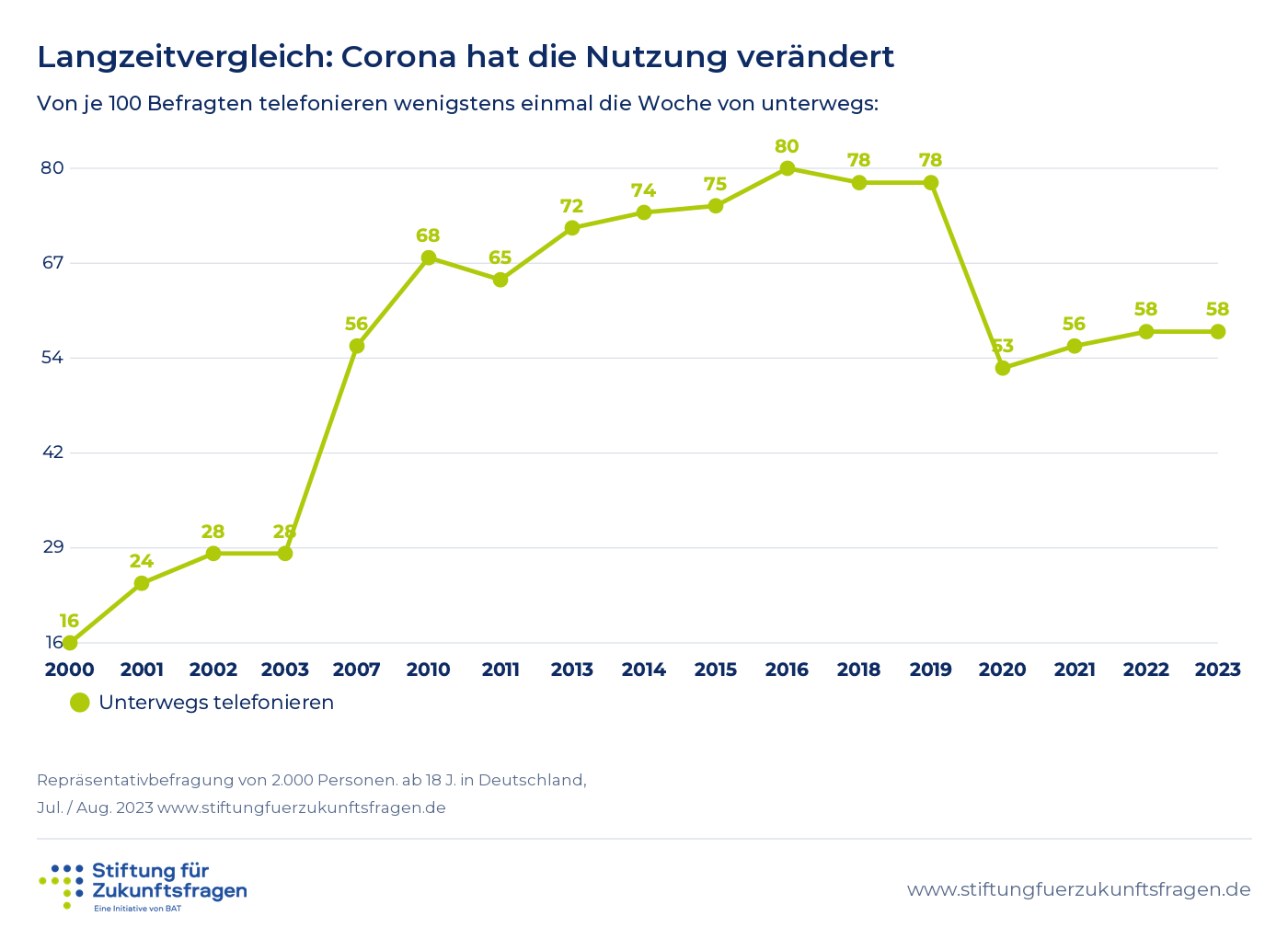
Long-term comparison: Corona has changed usage
Out of every 100 respondents, at least one phone call per week is made while traveling:
Data as table
| Making phone calls on the go | |
|---|---|
| 2000 | 16 |
| 2001 | 24 |
| 2002 | 28 |
| 2003 | 28 |
| 2007 | 56 |
| 2010 | 68 |
| 2011 | 65 |
| 2013 | 72 |
| 2014 | 74 |
| 2015 | 75 |
| 2016 | 80 |
| 2018 | 78 |
| 2019 | 78 |
| 2020 | 53 |
| 2021 | 56 |
| 2022 | 58 |
| 2023 | 58 |
Result
The use of mobile phones has seen a remarkable increase in Germany over the last two decades. As the latest results on our special page www.Freizeitmonitor.de show, almost three out of five German citizens use their smartphone regularly - i.e. at least once a week - to make calls while travelling. Compared to 2003, mobile phone use has therefore more than tripled. However, even though the mobile phone has become an indispensable companion for many citizens, the number of calls made on the move has fallen significantly over the past three years and the number of calls made on the move is currently the same as it was 15 years ago.
Reasons
During the COVID-19 pandemic, there were significant changes in people's work, leisure and communication behaviour. Lockdowns, restrictions and social distancing led to more working from home, a reduction in face-to-face contact and more in-home activities, among other things. All of these changes led to a decline in the need to use mobile phones for calls while on the move. At the same time, video calls, text messages, messenger apps and social media continued to gain in importance, replacing many a phone call.
The question of time also has a major influence. In a fast-paced world, many people appreciate the ability to send and receive messages without having to devote their full attention to them, as this allows them to pursue other activities at the same time. A phone call, on the other hand, requires full attention, usually takes longer than composing a message and can only be done on the side to a limited extent. Texting - as a form of asynchronous communication - makes it possible to maximise this time aspect. In this context, the freedom to write messages only when it is convenient also fits.
Social norms and a changed communication culture also play an important role, especially for the younger generations. Text messages are the most common form of communication, while phone calls are increasingly only made when necessary.
Forecast
Mobile phones will remain an integral part of modern life, but their use will evolve and adapt to the changing needs of citizens. Instead of their original use for making phone calls, messaging platforms such as WhatsApp, Facebook Messenger and Signal will play an increasingly important role in communication. The integration of functions such as video calls, group chats, voice messages and payment services into the apps' range of services will further increase the appeal of text messages as an all-in-one means of communication. However, traditional mobile telephony will continue to play a major role in the future and will be used by many people depending on the occasion and preference.
(You can find more on this topic on our special page www.freizeitmonitor.de)