


The opportunities of a 4-day week
The introduction of a 4-day week with full pay is the subject of intense debate in Germany. While employers, associations and political parties tend to be sceptical, almost two thirds of German citizens think it is a good idea. This is the result of a recent study by the BAT Foundation for Future Studies, for which over 2,000 German citizens aged 18 and over were surveyed.
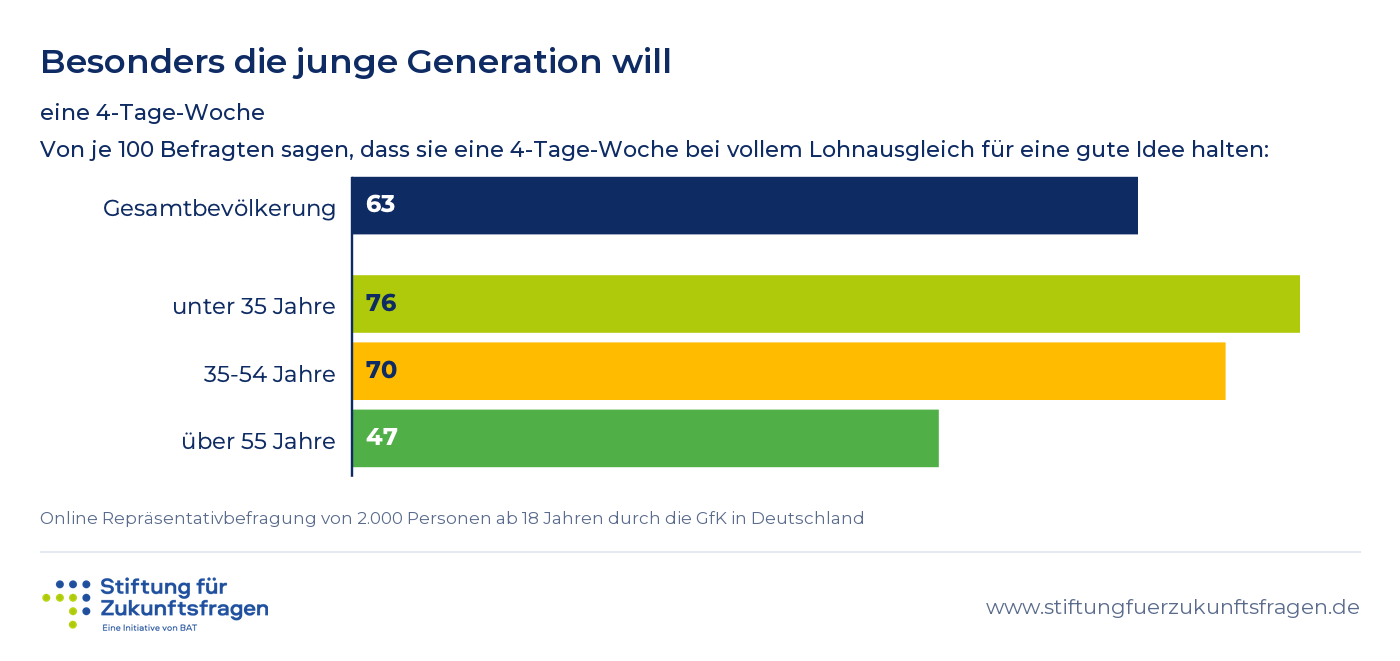
The younger generation in particular wants
a 4-day week
Of every 100 respondents, one in 100 said they consider a 4-day week with full pay compensation to be a good idea:
Data as table
| Total population | 63 |
| under 35 years | 76 |
| 35-54 years | 70 |
| over 55 years | 47 |
THE YOUNG GENERATION IN PARTICULAR WANTS A 4-DAY WEEK
What is particularly striking in the analysis is the difference in opinion between younger and older citizens. For example, three out of four under 35-year-olds are in favour of a reduction in working hours, while less than half of over 55-year-olds are in favour. The arguments in favour of introducing a 4-day week not only include advantages for employees, such as a better balance between work and private life or generally less stress in life, but also the resulting advantages for companies, such as more company loyalty, more applicants or fewer absences due to illness. Only a minority of the population shares the concern of an economic disadvantage in international competition. On the contrary, the majority expect an increase in productivity, more motivation to work and greater attractiveness for foreign skilled workers as a result of the 4-day week.
REASONS FOR THE VIEWS OF THE UNDER 35S
A key aspect for the different perspectives is the changing importance of work in modern society. The younger generation attaches more importance to a balance between work and leisure, seeks affirmation and fulfilment outside of work and wants to enjoy this time accordingly. In contrast, many older employees have experienced the 5-day week as an established norm for many years, have adapted to it and internalised it. Their professional and family obligations are often embedded in this traditional working model, which is why they are less able to imagine changes to their working hours. Technological change also plays a role. The younger generation is more familiar with digital work tools and appreciates being able to organise their job more flexibly in terms of time and location. And it should not be forgotten that the current labour market situation allows younger employees in particular to make more demands, as they are virtually being courted by companies.
FEAR OF LOSING COMPETITIVENESS
The main argument against the introduction of a 4-day week is the fear of a loss of competitiveness. Reduced working hours are equated with declining productivity. However, studies of pilot projects in England and Iceland refute this concern.
PROGNOSIS
Discussions about the introduction of the 4-day week will increase in the future. The courage and openness of politics, business and society will be of key importance here in order to take needs into account, test new models and utilise opportunities. Digitalisation, automation and mechanisation will help to carry out certain activities and processes faster and more effectively in the future. In addition, the argument of financial feasibility must be researched more comprehensively, for example to recognise the actual daily productivity. Current studies show that in Germany, an average of two hours per day is spent on non-productive activities - from private surfing, texting and telephoning to activities that have already been completed by others and are not necessary. The economic benefits should also be taken into account in the overall calculation of affordability. These range from lower medical costs and lower childcare costs to more frequent volunteering and taking on caring activities. Another important aspect is shown in the Japanese studies: A reduction in working hours can counteract the demographic trend.
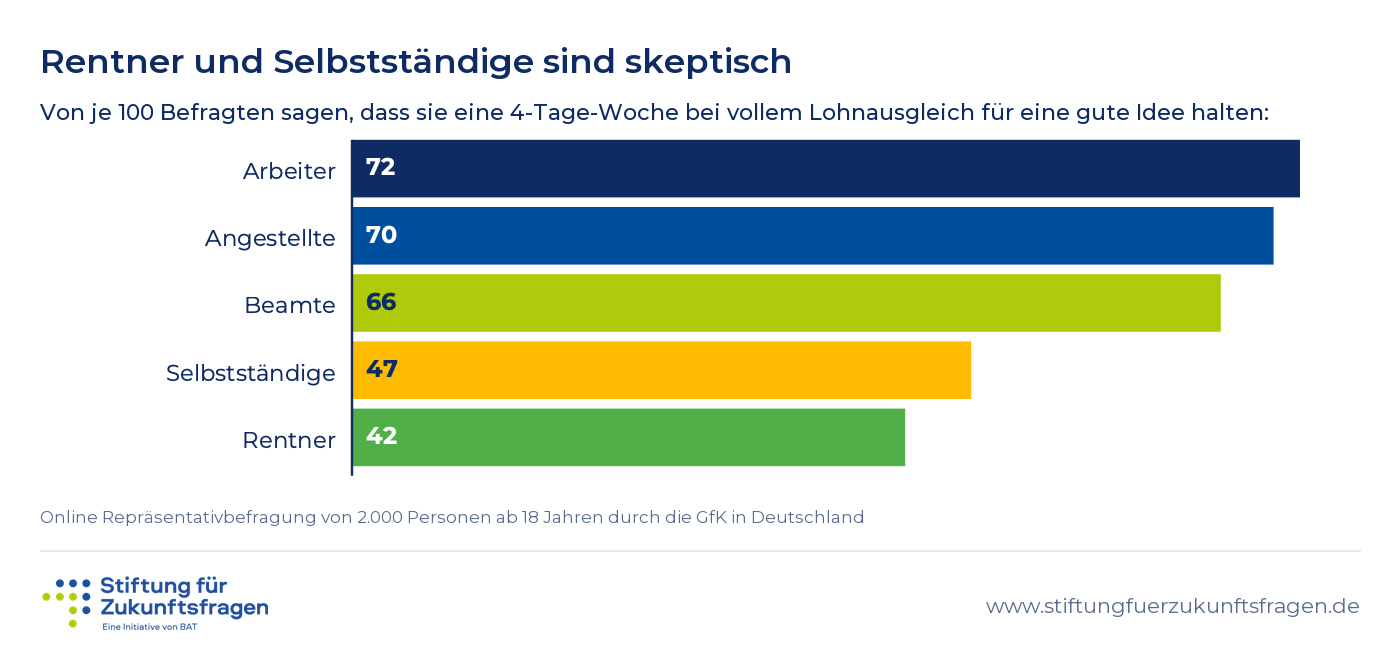
Pensioners and self-employed people are skeptical.
Of every 100 respondents, one in 100 said they consider a 4-day week with full pay compensation to be a good idea:
Data as table
| workers | 72 |
| Employee | 70 |
| officer | 66 |
| self-employed | 47 |
| Pensioner | 42 |
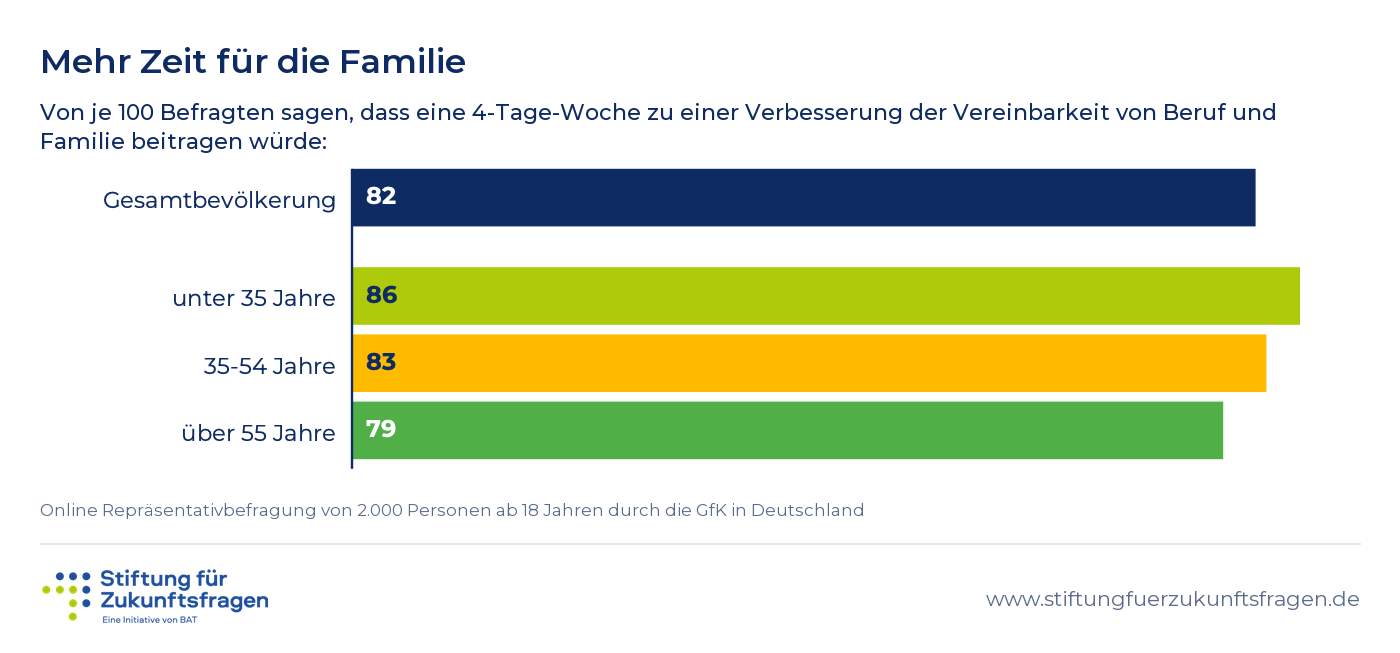
More time for the family
Out of every 100 respondents, a 4-day week would contribute to an improvement in the compatibility of work and family life:
Data as table
| Total population | 82 |
| under 35 years | 86 |
| 35-54 years | 83 |
| over 55 years | 79 |
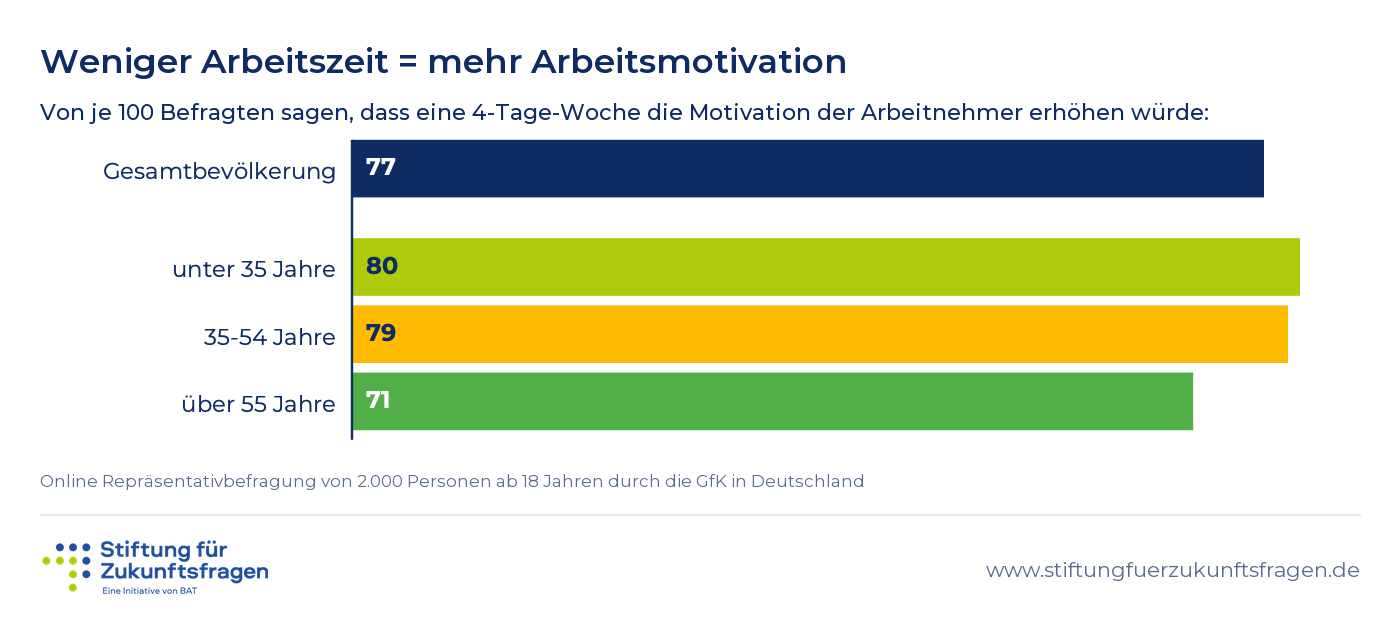
Less working time = more work motivation
Out of every 100 respondents, a 4-day work week would increase employee motivation:
Data as table
| Total population | 77 |
| under 35 years | 80 |
| 35-54 years | 79 |
| over 55 years | 71 |
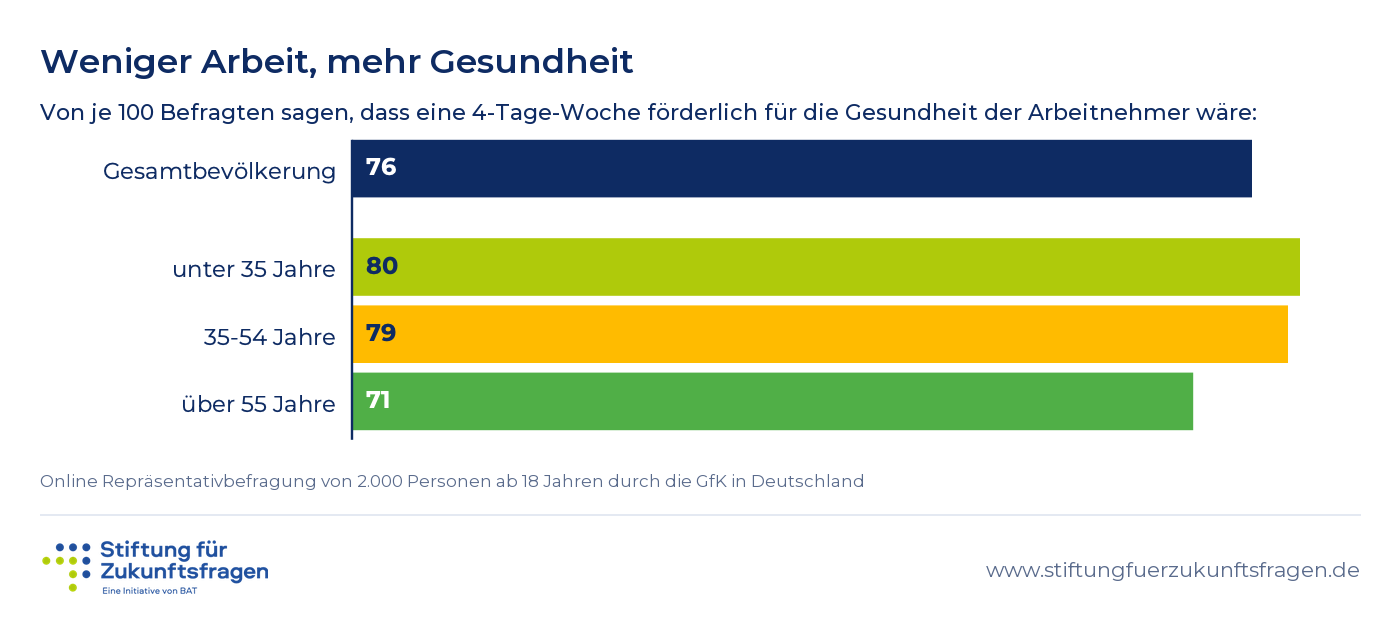
Less work, more health
Out of every 100 respondents, a 4-day work week would be beneficial for the health of employees:
Data as table
| Total population | 76 |
| under 35 years | 80 |
| 35-54 years | 79 |
| over 55 years | 71 |
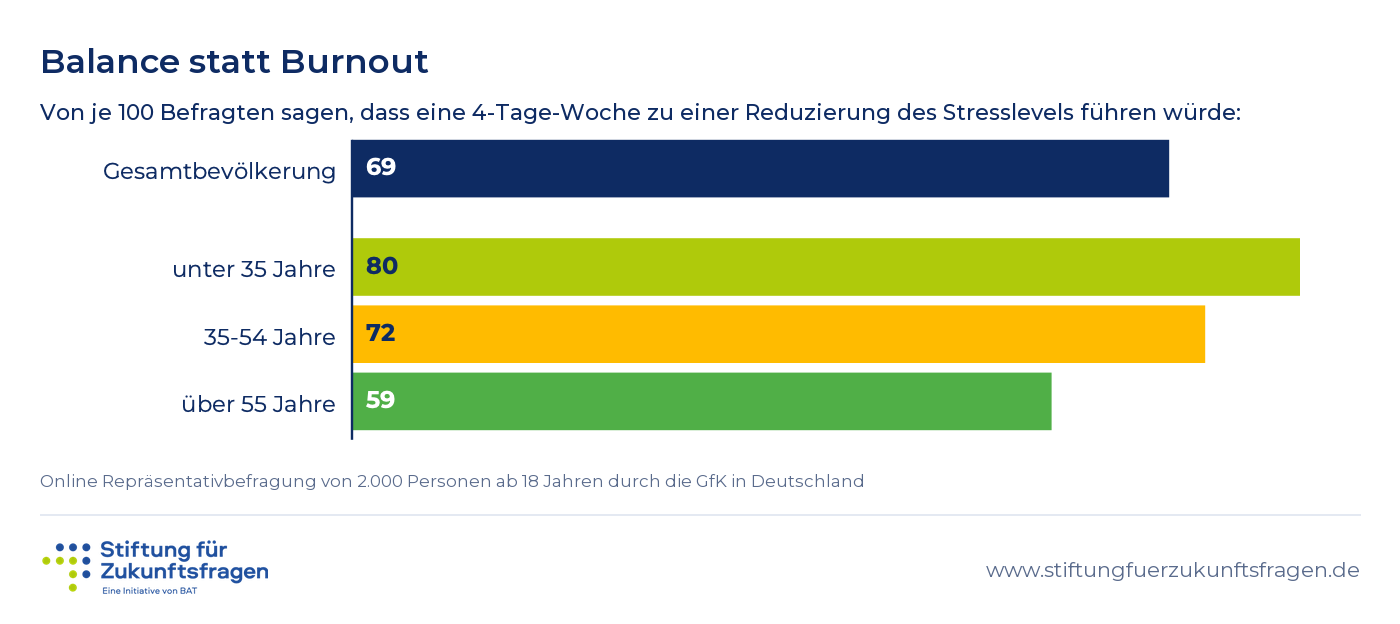
Balance instead of burnout
Out of every 100 respondents, a 4-day work week would lead to a reduction in stress levels:
Data as table
| Total population | 69 |
| under 35 years | 80 |
| 35-54 years | 72 |
| over 55 years | 59 |
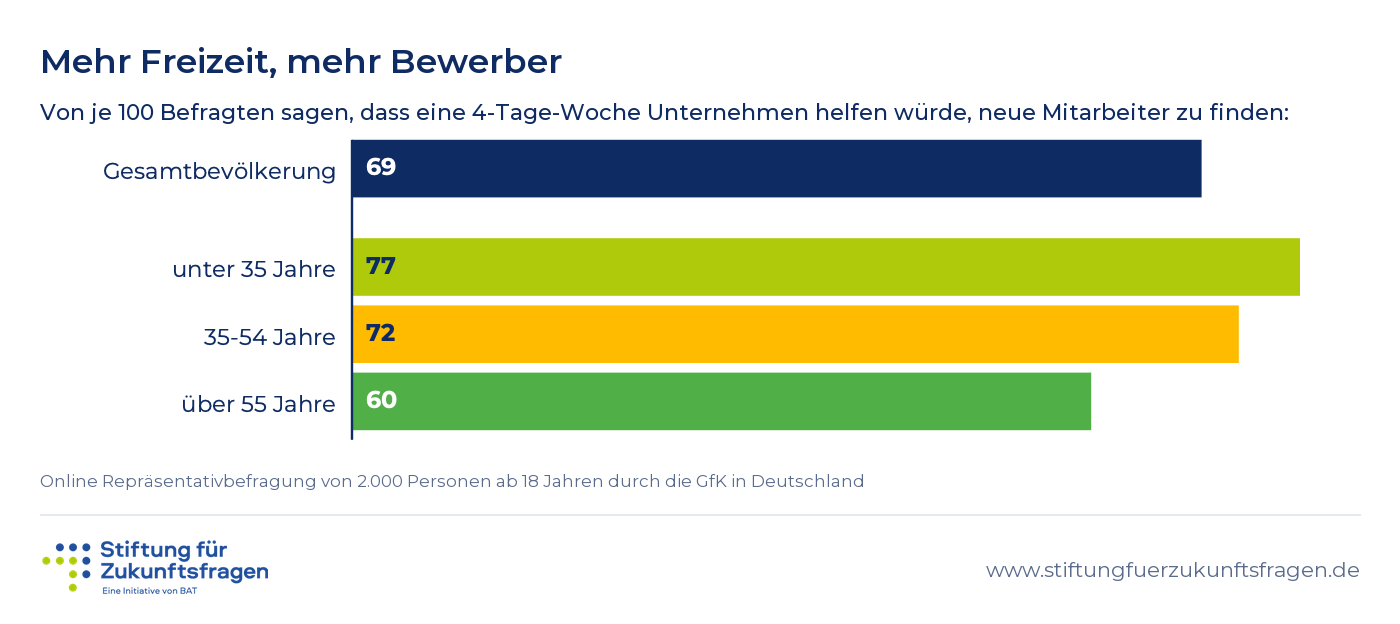
More free time, more applicants
Out of every 100 respondents, a 4-day work week would help companies find new employees:
Data as table
| Total population | 69 |
| under 35 years | 77 |
| 35-54 years | 72 |
| over 55 years | 60 |
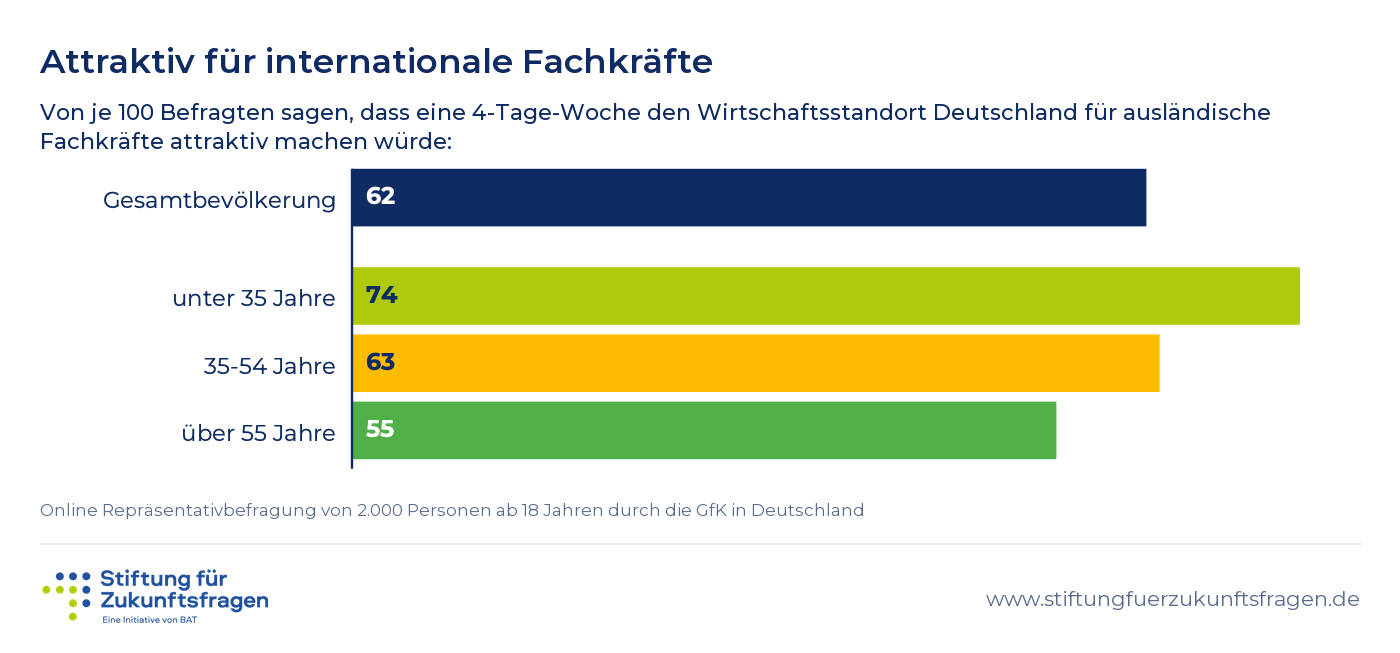
Attractive to international professionals
Out of every 100 respondents, a 4-day work week would make Germany an attractive business location for foreign skilled workers:
Data as table
| Total population | 62 |
| under 35 years | 74 |
| 35-54 years | 63 |
| over 55 years | 55 |
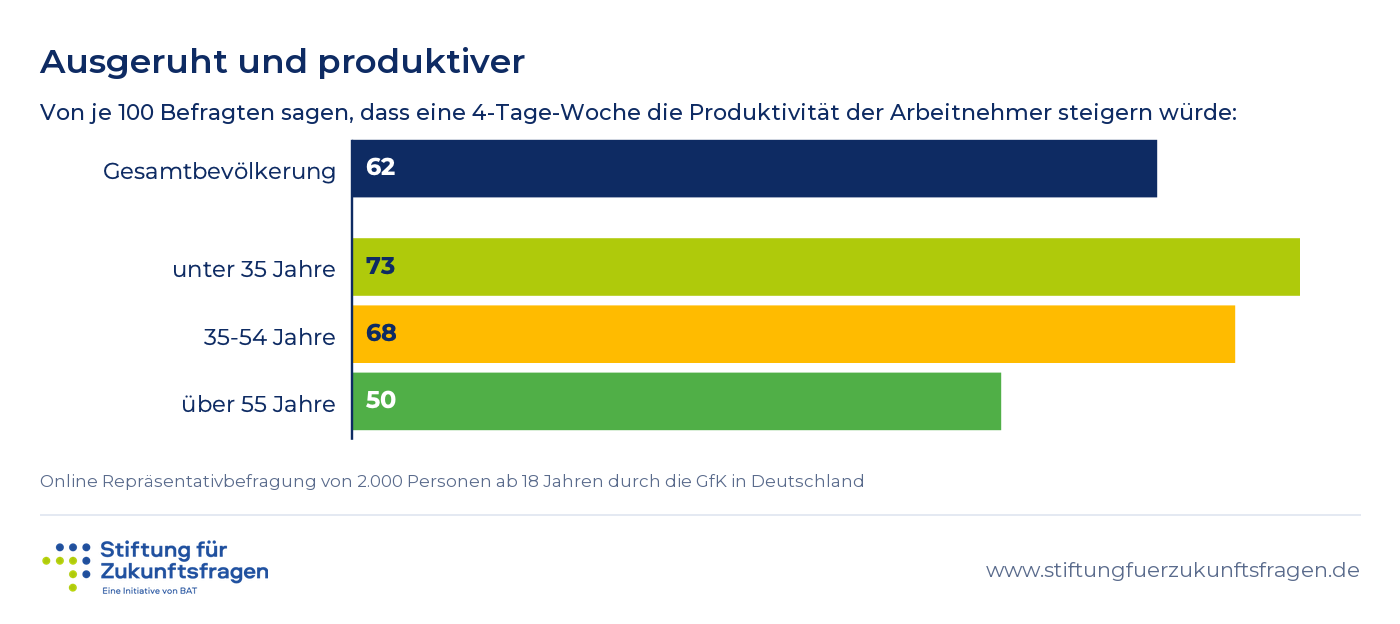
Rested and more productive
Out of every 100 respondents, a 4-day work week would increase employee productivity:
Data as table
| Total population | 62 |
| under 35 years | 73 |
| 35-54 years | 68 |
| over 55 years | 50 |
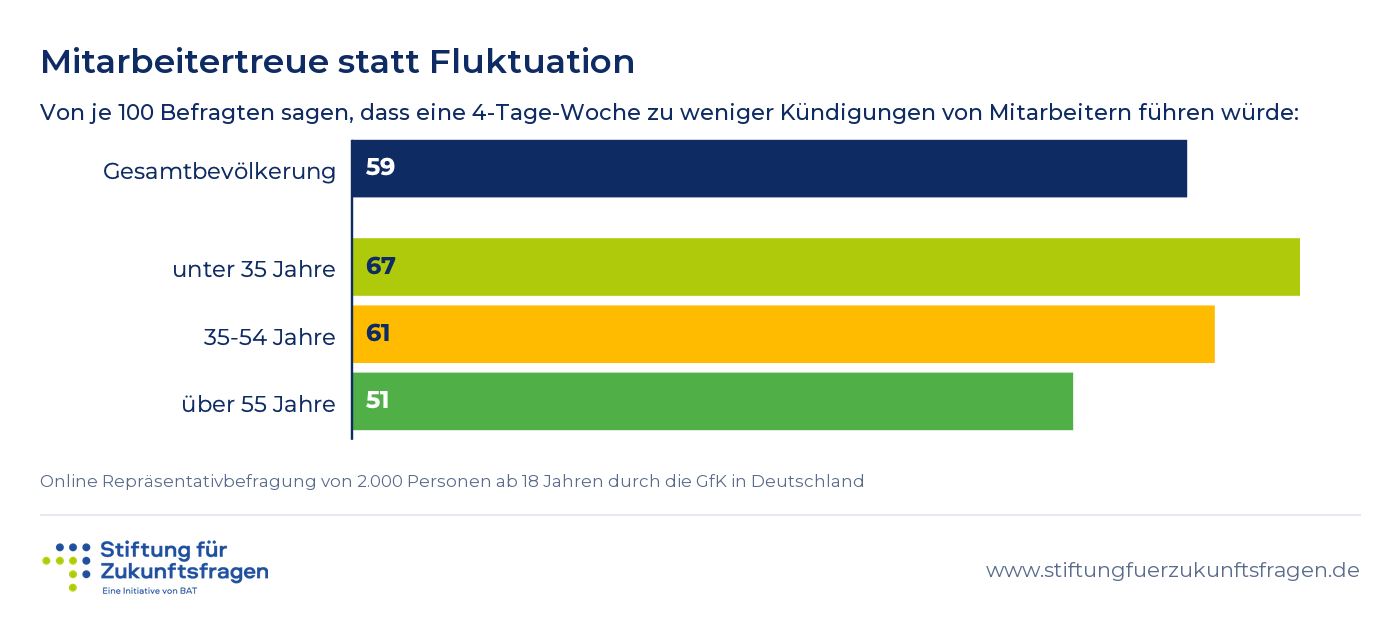
Employee loyalty instead of turnover
Out of every 100 respondents, a 4-day work week would lead to fewer employee resignations:
Data as table
| Total population | 59 |
| under 35 years | 67 |
| 35-54 years | 61 |
| over 55 years | 51 |
Method:
Survey institute GfK | field time December 2023 | 2,000 respondents aged 18-74 years | online
Additional information
HISTORICAL CLASSIFICATION
For a long time throughout history, the amount of work was based on the time of day and season, as well as the time required to complete a task. It was not until industrialisation that work was divided into hours. The saying "work is half the battle" dates back to this time and emphasised the high time commitment of workers. In 1825, the weekly working time of a full-time employee was actually almost half a lifetime and totalled 82 hours. Over the course of the 20th century, there was a slow but steady trend towards a reduction in working hours. At the beginning of the century, the average working time was already 64 hours, which was reduced to 48 hours with the introduction of the 8-hour working day in 1918. At the end of the 1950s, the trade union slogan "Daddy's Saturday is mine" led to the gradual introduction of the 5-day week, which led to a further reduction in the working week to 40 hours. Since then, however, the working week has not changed any further and is currently - still - at 40 hours.
INTERNATIONAL
In a European comparison, Germany's average weekly working hours for full-time employees are in the middle of the field. While countries such as Greece, Sweden and Austria tend to have longer working hours, Finland, Denmark, France and the Netherlands have shorter working weeks. However, the debate about the introduction of a 4-day week is not only topical in this country. Belgium is a pioneer in Europe, as it was the first country to introduce a legal entitlement to a 4-day week. Belgian employees have the flexibility to choose between four or five working days, with the same workload and salary.
Iceland went a step further a few years ago and reduced working hours to four days with full pay for one per cent of the working population. The aim was to maintain productivity, which proved successful after a test phase: no drop in productivity was observed, but rather an improved balance between work and leisure time. In the meantime, 86% of Icelanders have reduced their working hours.
A highly acclaimed study by the Universities of Cambridge and Oxford in the UK examined the effects of reduced working hours with full pay in 61 companies over six months. The results were significant: 71% less burnout and 39% less stress among employees, a 65% reduction in sick days and 57% fewer redundancies. No company recorded a decline in turnover, but on average a slight increase of 1.4%. As a result, 56 of the 61 companies decided to stay with the 4-day week.
The 4-day week is also gaining ground outside Europe. In the USA, many companies reduced working hours and wages to 80 per cent during the COVID-19 pandemic. After the end of the pandemic, many employees rejected the offer to return to full working hours with full pay and stuck with a shorter week. In Japan, a government study on the declining birth rate identified the link between working hours and lack of time for relationships, starting a family and childcare. To tackle this problem, the Japanese government is supporting companies that voluntarily switch to a 4-day week.