

New job: Ideas manager
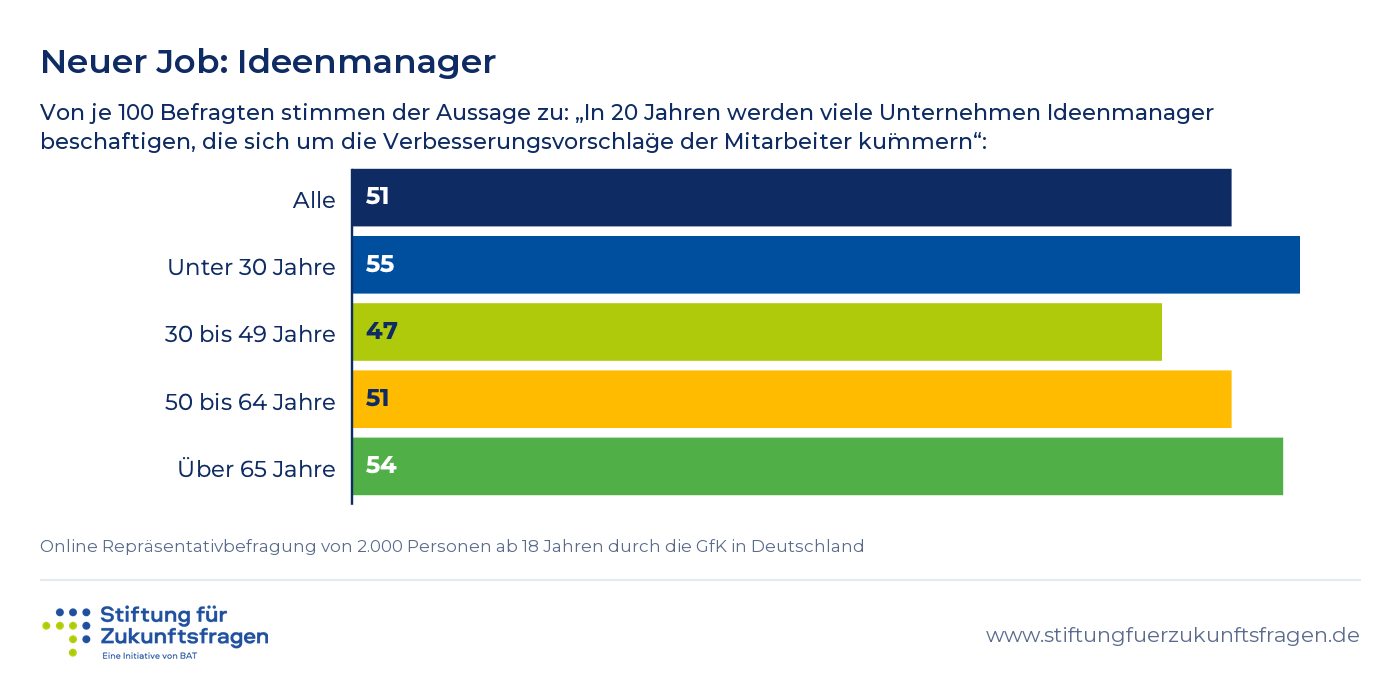
Out of 100 respondents, the following statement was agreed with: "In 20 years, many companies will employ idea managers who will take care of employees' suggestions for improvement":
Data as table
| All | 51 |
| Under 30 years | 55 |
| 30 to 49 years | 47 |
| 50 to 64 years | 51 |
| Over 65 years | 54 |
Results
In times of increasing globalisation and a growing shortage of skilled workers, the innovative strength and creative contributions of employees within companies are gaining in importance. The immense creative potential that lies in the minds of employees in German companies will be indispensable in the future. More than one in two people even see a new occupational field of "ideas managers" in companies in the future. In addition to collecting ideas, their tasks will also include developing suggestions for increasing labour productivity, improving work processes and implementing a good balance between work and non-work.
Reasons
In the immediate working environment, there is no better expert for innovation than the employees themselves. Consequently, a sustainable company needs systematic idea management in order to promote employees' creative ideas and initiatives for the further development of the company. The willingness to contribute innovative suggestions depends largely on an appreciative, trusting and participative corporate culture. A culture of fear and control, on the other hand, only promotes service by the book. Putting people at the centre creates a working environment in which significant ideas can be generated. Not every idea requires a financial reward - recognition within the company is often at least as important as monetary incentives. A balanced relationship between remuneration and recognition is therefore ideal. Even the introduction of a four-day week, which at first glance does not fit into the current system, could be realised through employee ideas for maintaining productivity and at the same time meet the needs of many employees.
Forecast
Even inconspicuous ideas can have far-reaching consequences. A historical example of this is the Austrian doctor Ignaz Philipp Semmelweis (1818-1865), who saved countless lives by encouraging his colleagues to practise hand hygiene before coming into contact with patients. This simple but revolutionary innovation was initially met with derision and was largely ignored in medical practice at the time. Today, social science research on innovation refers to the resistance to new ideas as the "Semmelweis effect". In many companies today, a suggestion for improvement often does not lead to the idea provider being recognised, but rather to a mild smile or even social exclusion. This should, must and will change in the future.