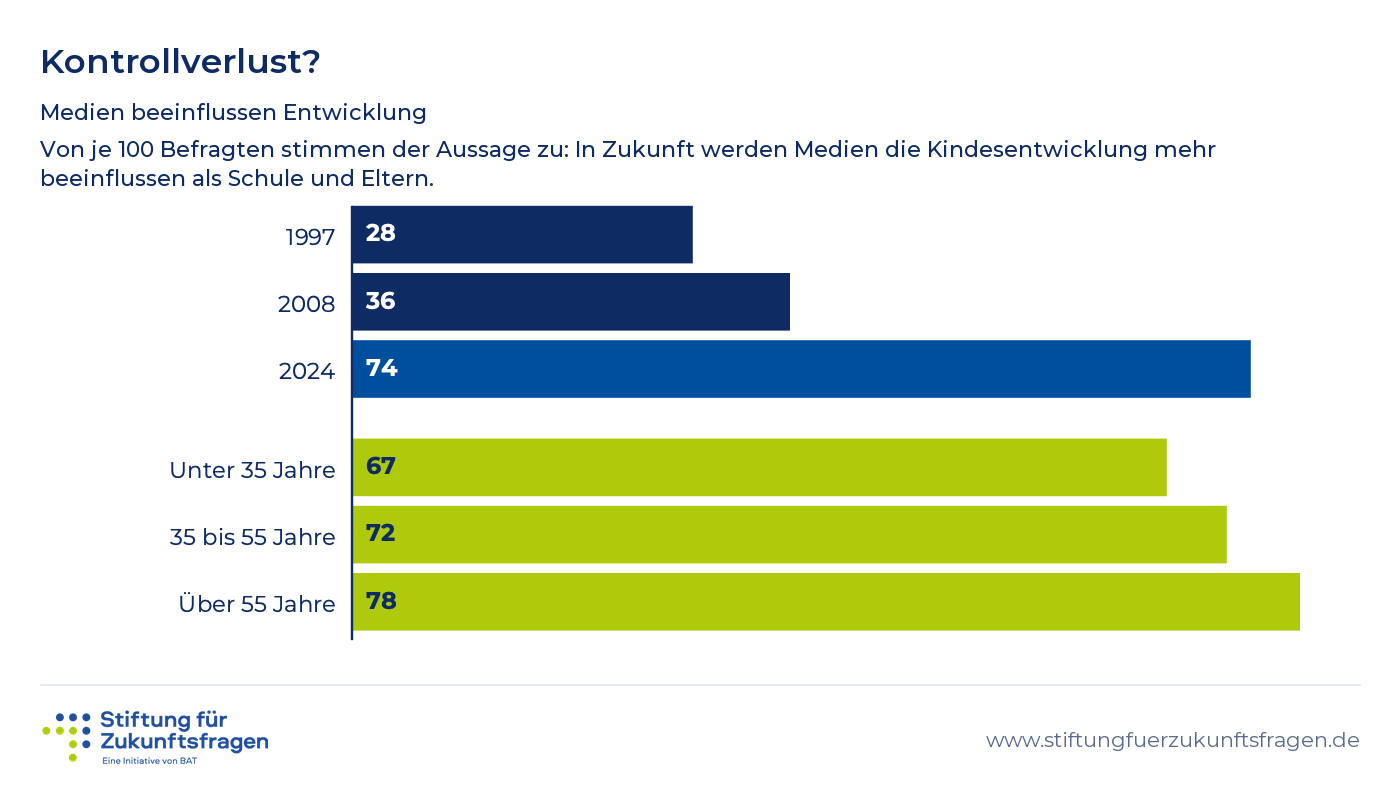


Loss of control?
Media influence development
Out of every 100 respondents, the following statement holds true: In the future, media will influence child development more than schools and parents.
Data as table
| 1997 | 28 |
| 2008 | 36 |
| 2024 | 74 |
| Under 35 years | 67 |
| 35 to 55 years | 72 |
| Over 55 years | 78 |
Result
Today's generation of children and teenagers is surrounded by a multitude of digital content – from social media and streaming services to online learning platforms. These media offer a wealth of information, entertainment, and opportunities for social interaction. Increasingly, however, they are also influencing the development of young people. Three out of four Germans now see the future influence of media as more formative than traditional influences such as school and family. This expectation increases with age, with two-thirds of those under 34 also anticipating this development. Compared to 2008, this level of agreement has doubled, and compared to 1997, it has almost tripled.
Reasons
A key reason is undoubtedly technological development. In recent years, the media landscape has changed, becoming significantly more differentiated, influential, and virtually ubiquitous. It is possible to be online anytime and almost anywhere, and smartphones are a constant companion, whether at school, at home, or during leisure time.
Furthermore, societal trends also play a role. Today's society is faster-paced and more global than ever before. Adolescents are influenced by a multitude of offerings and impressions from around the world, making it more difficult for schools and parents to impart and shape values and exert influence.
Media outlets and companies are increasingly using algorithms and personalized content to influence children and entice them to consume media. Many children and young people lack sufficient media literacy to critically examine content or recognize misinformation and manipulation.
Forecast
Media will continue to influence and shape child development in the future. The range of options is too attractive, virtual contact with others too commonplace, and the demand on schools to integrate media more strongly into their lessons too great.
However, it is not the media itself, but rather the content that determines whether it is used responsibly or harmfully. In light of this development, it is therefore essential to closely monitor the content of the media consumed and, if necessary, regulate it. In this context, parents are just as responsible as educators, politicians, media companies, and society as a whole. This begins with the example set by adult role models and extends to legal guidelines from policymakers. Maintaining non-media-based leisure activities, whether in sports and clubs or in the cultural and natural spheres, will also be crucial in the future. Only in this way will it be possible to give children the best possible opportunities to develop into well-rounded and responsible adults.