

Current research, 288
17 September 2020
Leisure Monitor 2020
The BAT Foundation for Future Studies presented its "Leisure Time Monitor 2020" on 17 September 2020. For the study, which has been conducted regularly since 1986, over 2,000 people aged between 18 and 74 were surveyed on a representative basis about their leisure behaviour and the special topics of "Leisure in times of coronavirus" and "Leisure wishes".
Core results:
- THE MOST FREQUENT LEISURE ACTIVITIES OF FEDERAL CITIZENS: Internet ahead of television for the first time
- 5-YEAR COMPARISON OF LEISURE ACTIVITIES: More lonely than together
- TEN DIFFERENT LEISURE ACTIVITIES PER DAY: do more in the same amount of time
- LEISURE IN CORONA TIMES: Private. Pragmatic. Productive
- WHAT WE WOULD LIKE TO DO MORE OF: Active. Regenerative. Communicative.
The most frequent leisure activities of German citizens: Internet ahead of television for the first time
For a good 30 years, television was the leading medium for German citizens. No other leisure activity was used as frequently and regularly as the programmes of public and private broadcasters. This year, the Internet has taken the top spot for the first time, leaving television well behind.
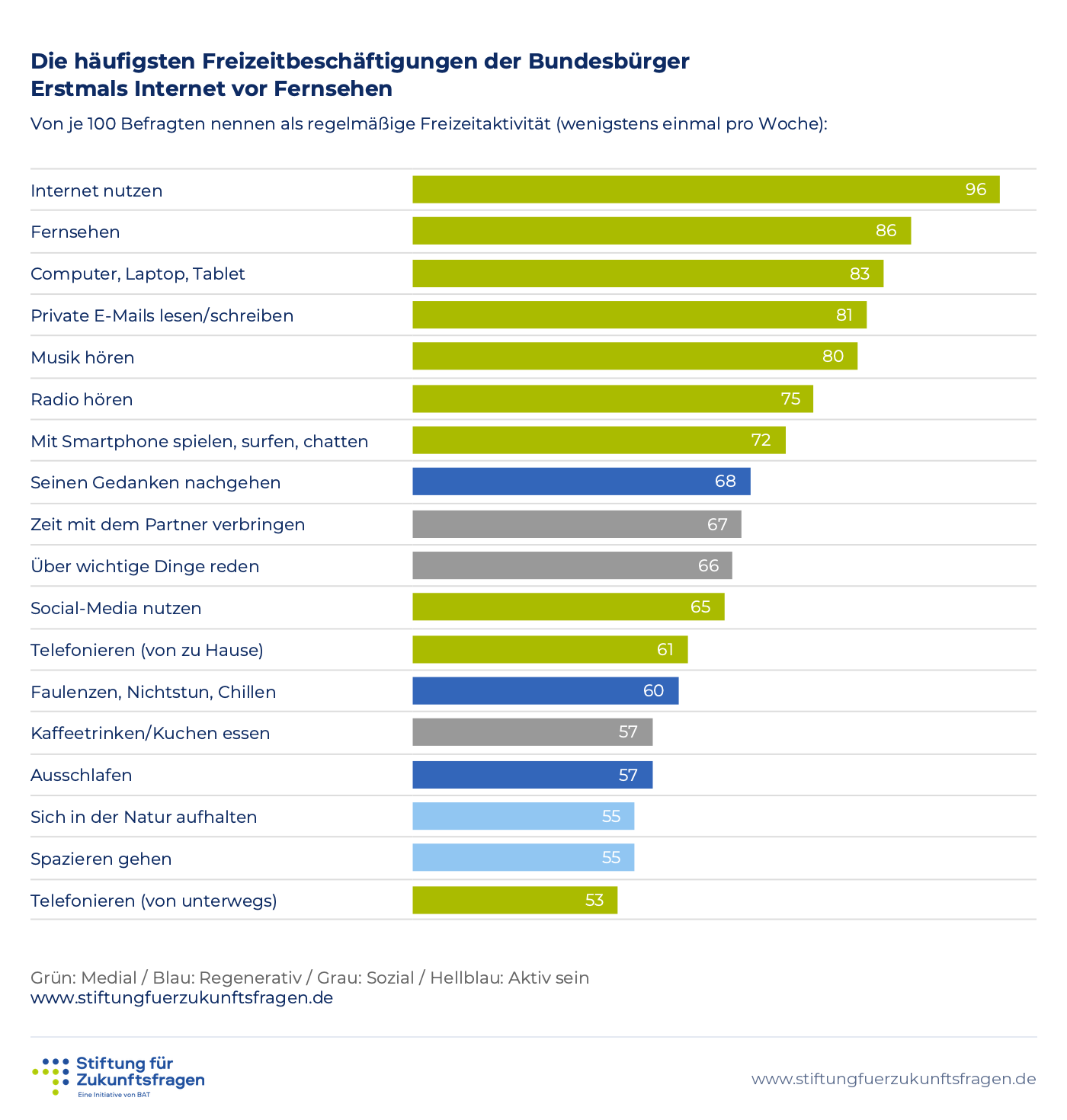
96 per cent of Germans regularly (at least once a week) use the limitless online offerings of the World Wide Web as a source of information, contact bridge, games or entertainment platform. Television (86%) follows some way behind in second place, just ahead of computer/laptop or tablet use (83%).
The dominance of media in leisure activities is also evident in the other places: private e-mail correspondence, listening to music and radio and playing, surfing and chatting on the smartphone. The top 10 leisure activities are rounded off with one regenerative activity ("Pursuing one's thoughts") and two social activities: "Spending time together with a partner" and "Talking about important things".
Data as table
| Using the internet | 96 |
| Television | 86 |
| Computer, laptop, tablet | 83 |
| Reading/writing private emails | 81 |
| Listen to music | 80 |
| Listen to the radio | 75 |
| Playing games, surfing the web, chatting on your smartphone | 72 |
| to follow his thoughts | 68 |
| Spending time with your partner | 67 |
| Talk about important things | 66 |
| Using social media | 65 |
| Making phone calls (from home) | 61 |
| Loitering, doing nothing, chilling | 60 |
| Drinking coffee/eating cake | 57 |
| Sleep in | 57 |
| Spending time in nature | 55 |
| Go for a stroll | 55 |
| Making phone calls (while traveling) | 53 |
Leisure activities in a 5-year comparison: more lonely than together
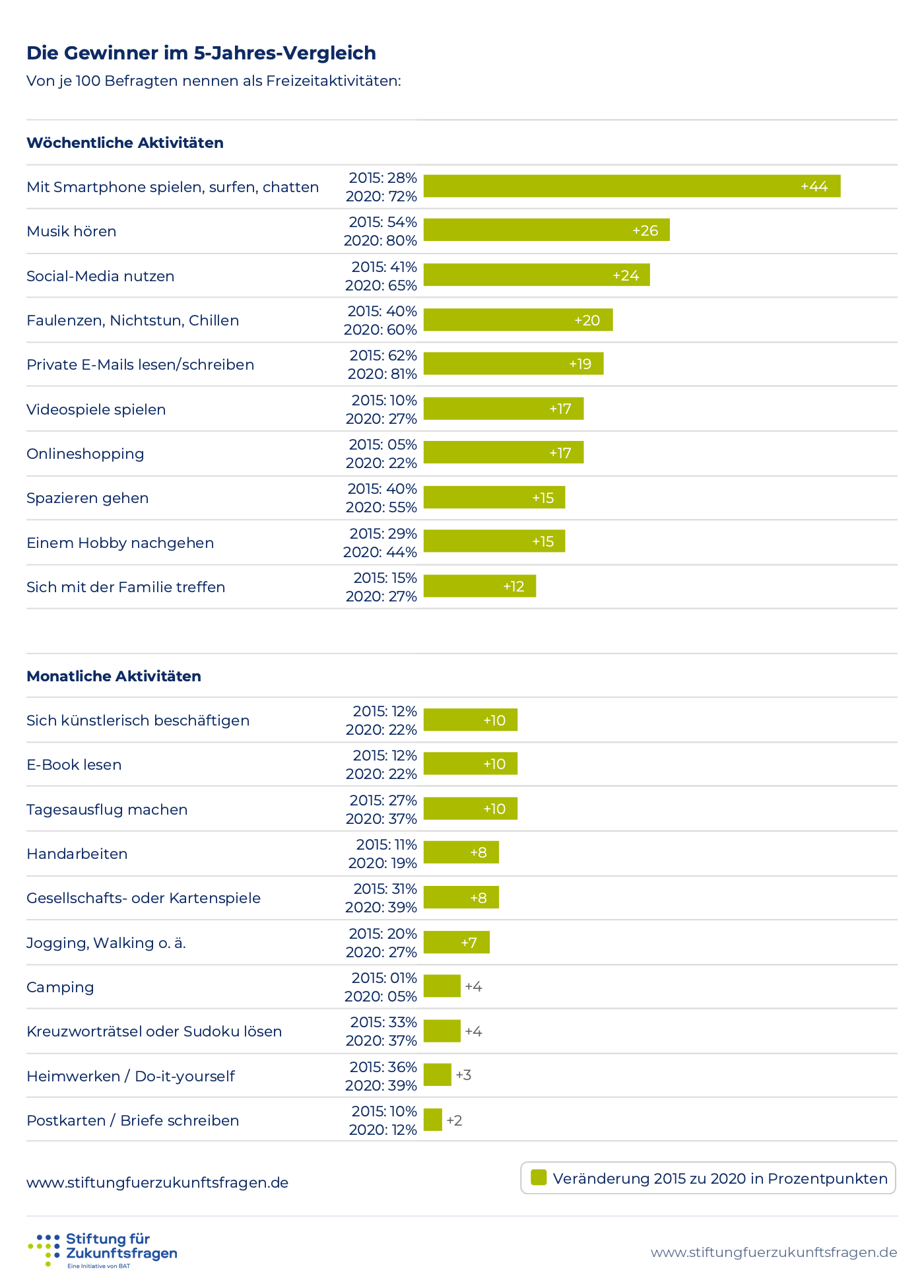
A year-on-year comparison between 2015 and 2020 shows at first glance the increasing dominance of new media. Significantly more people are playing, chatting and surfing on their smartphones than in the past. Social media services, video games and online shopping are also being used more frequently.
At the same time, the pandemic is also changing social interaction and family activities are intensifying. People are taking more day trips, going camping more often and spending more time playing cards and board games.
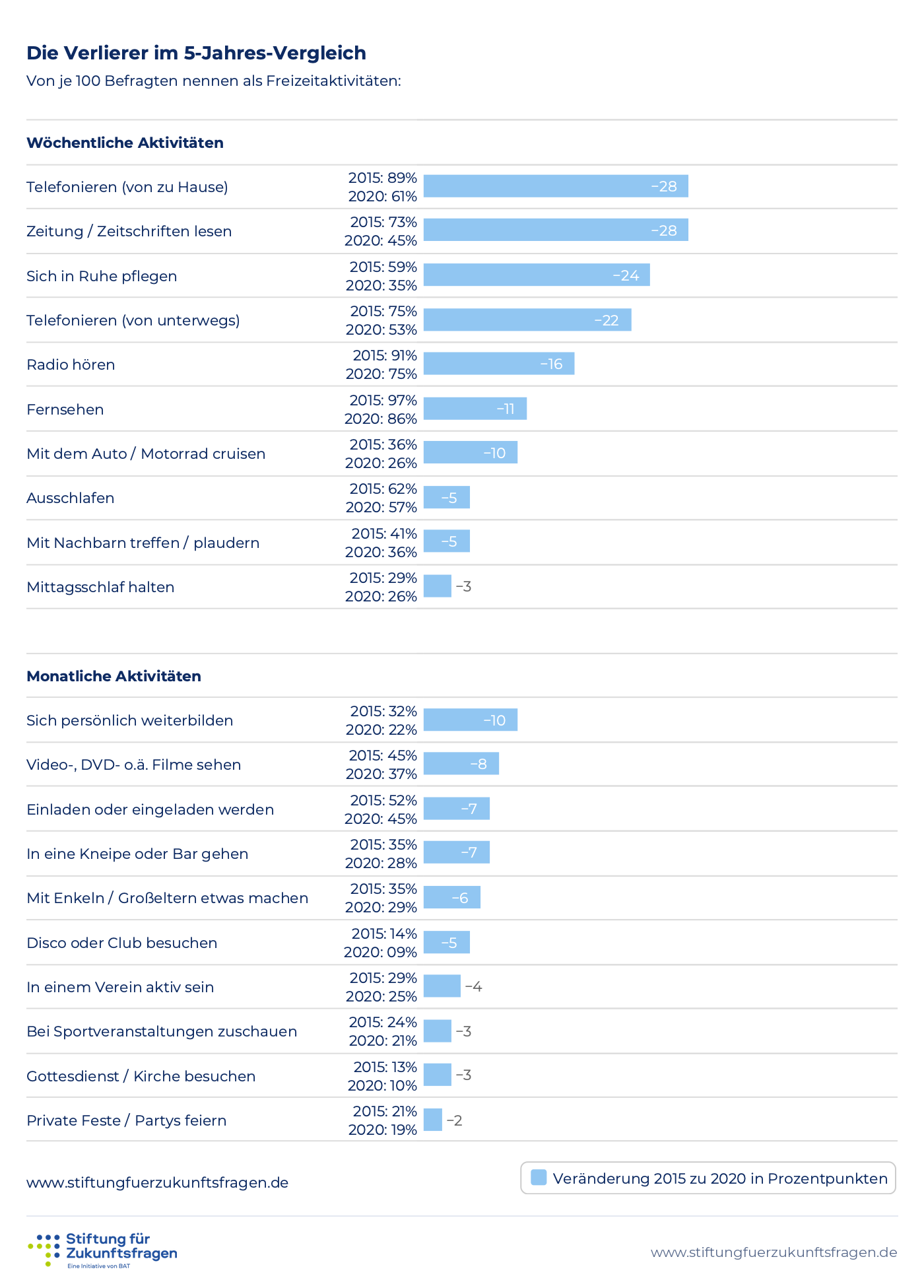
In contrast, Germans are taking less time for relaxing activities. Whether it's taking an afternoon nap, sleeping in or taking care of yourself in peace and quiet, watching TV or listening to the radio on the sofa - all of these activities are currently performed less frequently than five years ago.
For the first time in years, people are also making fewer phone calls - both mobile and landline. This can be explained by the increasing range of alternative forms of communication, from text messages and emails to video calls.
As expected, the majority of out-of-home activities are also less popular than five years ago: From going to pubs or discos to spectator or club sports to church services and private parties.
"2020 was and is a difficult year for the leisure industry as a whole: bans and uncertainty on the one hand, ongoing costs and responsibility towards employees on the other. This poses major challenges for many companies. But there are also positive developments in the form of new, innovative concepts as well as solidarity and support from customers"says the Scientific Director of the BAT Foundation, Professor Dr Ulrich Reinhardt.
Data as table
| 2015 | 2020 | Change from 2015 to 2020 in percentage points | |
|---|---|---|---|
| Weekly activities | |||
| Playing games, surfing the web, chatting on your smartphone | 28 | 72 | +44 |
| Listen to music | 54 | 80 | +26 |
| Using social media | 41 | 65 | +24 |
| Loitering, doing nothing, chilling | 40 | 60 | +20 |
| Reading/writing private emails | 62 | 81 | +19 |
| playing video games | 10 | 27 | +17 |
| online shopping | 5 | 22 | +17 |
| Go for a stroll | 40 | 55 | +15 |
| Pursuing a hobby | 29 | 44 | +15 |
| Meeting with family | 15 | 27 | +12 |
| Monthly activities | |||
| Engage in artistic pursuits | 12 | 22 | +10 |
| Read e-book | 12 | 22 | +10 |
| Make a day trip | 27 | 37 | +10 |
| Handicrafts | 11 | 19 | +8 |
| board games or card games | 31 | 39 | +8 |
| Jogging, walking, etc. | 20 | 27 | +7 |
| camping | 1 | 5 | +4 |
| Solve crossword puzzles or Sudoku | 33 | 37 | +4 |
| DIY / Do-it-yourself | 36 | 39 | +3 |
| Writing postcards / letters | 10 | 12 | +2 |
Data as table
| 2015 | 2020 | Change from 2015 to 2020 in percentage points | |
|---|---|---|---|
| Weekly activities | |||
| Making phone calls (from home) | 89 | 61 | -28 |
| Reading newspapers/magazines | 73 | 45 | -28 |
| Take time to pamper yourself | 59 | 35 | -24 |
| Making phone calls (while traveling) | 75 | 53 | -22 |
| Listen to the radio | 91 | 75 | -16 |
| Television | 97 | 86 | -11 |
| Cruising by car / motorcycle | 36 | 26 | -10 |
| Sleep in | 62 | 57 | -5 |
| Meeting/chatting with neighbors | 41 | 36 | -5 |
| Taking a nap | 29 | 26 | -3 |
| Monthly activities | |||
| Personal development | 32 | 22 | -10 |
| Watching videos, DVDs, or similar films | 45 | 37 | -8 |
| To invite or to be invited | 52 | 45 | -7 |
| Go to a pub or bar | 35 | 28 | -7 |
| Doing something with grandchildren / grandparents | 35 | 29 | -6 |
| Visit a disco or club | 14 | 9 | -5 |
| Being active in a club | 29 | 25 | -4 |
| watching sporting events | 24 | 21 | -3 |
| Visiting a church service / attending church | 13 | 10 | -3 |
| Celebrating private parties | 21 | 19 | -2 |
Leisure time in Corona times: Private. Pragmatic. Productive
Distancing rules and entry controls in supermarkets, fewer tables and meals in restaurants, plus uncertainty and convenience - all this has led to many Germans ordering their food online (37%) and ordering their groceries online (18%). However, the effects of the coronavirus pandemic are not only evident in terms of food, but also in people's individual leisure activities:
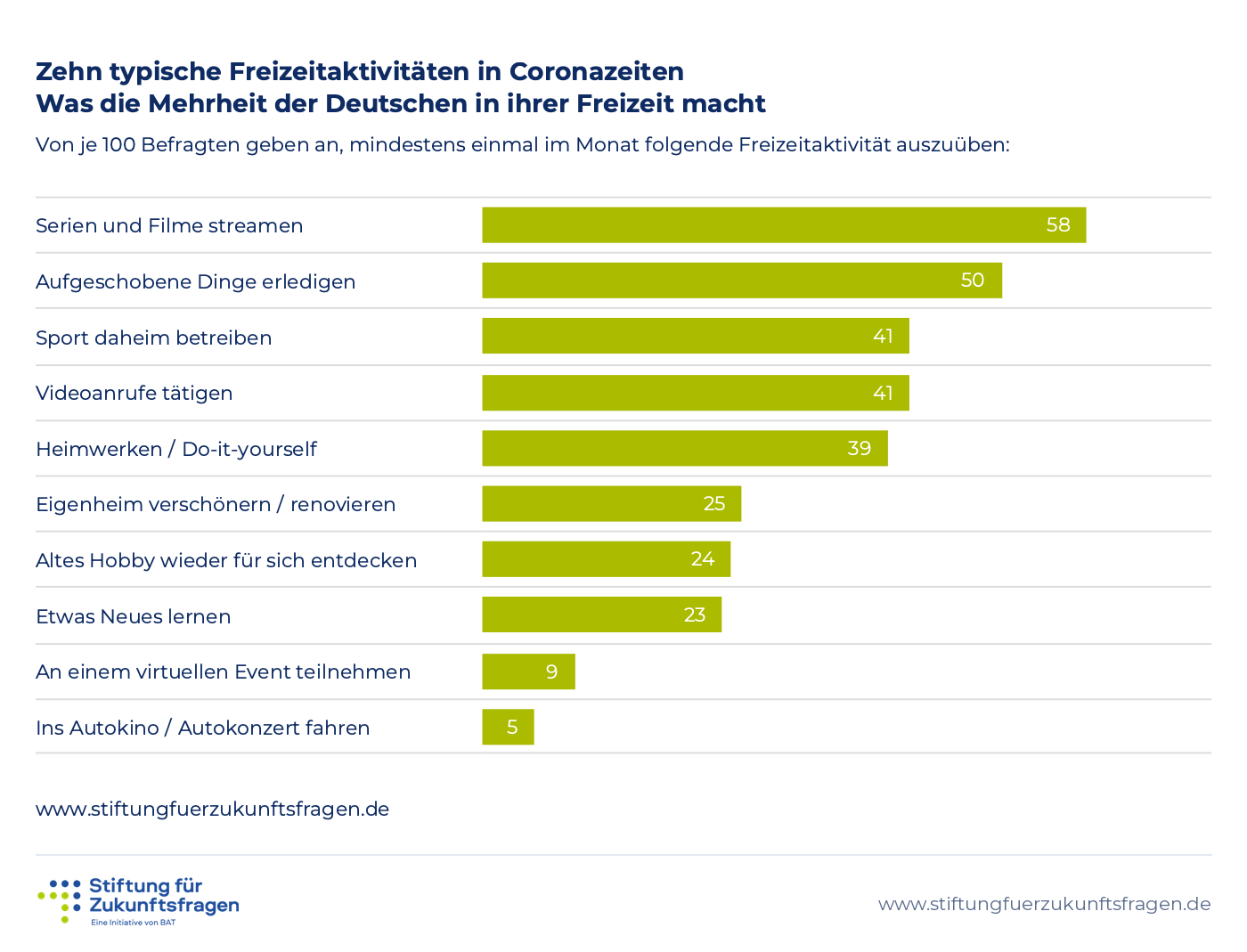
- Drive-in cinemas For many years, films were only something for nostalgics and cineastes, but thanks to corona, this leisure activity is enjoying a new popularity - especially in summer (5%). Market squares, parks and sports stadiums are being converted to show both classic and new films.
- Finally see the Mona Lisa in the Louvre, stroll through the Guggenheim Museum in New York, listen to a concert in the Elbphilharmonie or watch the Rolling Stones play from the front row. All of this is possible - at least virtually. Almost one in ten German citizens (9%) can currently register to "visit" virtual events inspire.
- Whether it's a new language, a sport or a manual skill - almost one in four Germans (23%) has learnt a new language in the past few months. New ability.
- Many citizens have used the time to rediscover an old hobby (24%), the to beautify your own home or renovate it straight away (25%) or new Do-it-yourself projects (39%). The DIY market is booming accordingly.
- Those who can't or don't want to meet in person are turning to digital options. Whether Zoom, Teams, Skype or another programme: Video telephony has become a viable alternative (41%). Not only are many companies moving their meetings and sessions to the virtual space, but family exchanges and contact with friends also often take place in this way.
- Whether it's a visit to the gym, team sports or indoor sports - Germans have had to do without many sporting activities in recent months. In order to stay fit and prevent coronavirus-related kilos from getting out of hand, two out of five people (41%) sporty at home active. This could be a workout in front of the TV, a virtual yoga class or the treadmill in the office.
- Around one in two German citizens (50%) devoted a long time postponed (unpleasant) tasks - From tax returns and personal filing to reviewing insurance policies. Many Germans are also using the restrictions to finally clear out or thoroughly tidy up. Accordingly, eBay classifieds, Kleiderkreisel and similar providers are recording double-digit growth rates in some cases.
- Less and less traditional, more and more on demand - This sums up the television viewing behaviour of German citizens. What was already largely taken for granted by the younger generation before the pandemic has now also reached large sections of the rest of the population. Almost three in five people (58%) regularly use Netflix, Sky, Amazon Prime or similar providers.
Ten different activities per day: do more in the same amount of time
Every German citizen engages in an average of ten different leisure activities per day. In a 5-year comparison, this is an increase of two activities (2015: 8). If the average leisure time per day were taken as a basis, there would be less than half an hour for each activity. However, German citizens engage in many activities in parallel rather than one after the other.
For example, people eat dinner, surf the internet, make phone calls, iron or chat while watching TV. Despite this parallel use, hardly any activity lasts longer than two hours - at the latest then most people want to do something else.
Reinhardt: "The ever-growing number of leisure activities is increasingly reaching its time limits. There are two possible solutions: Either people will work less in future - thanks to digitalisation - and have more free time available, or they will reduce the number of their activities. If neither happens, stress will continue to increase. As a result, leisure time will not only lose its fascination but also its function of regeneration from and for work, a contrast to everyday routine or simply fun."
Data as table
| Stream TV series and movies | 58 |
| Get things done that have been postponed | 50 |
| Doing sports at home | 41 |
| Make video calls | 41 |
| DIY / Do-it-yourself | 39 |
| Home improvement / renovation | 25 |
| Rediscovering an old hobby | 24 |
| Learn something new | 23 |
| Participate in a virtual event | 9 |
| Go to the drive-in cinema / drive-in concert | 5 |
What we would like to do more often: Active. Regenerative. Communicative.
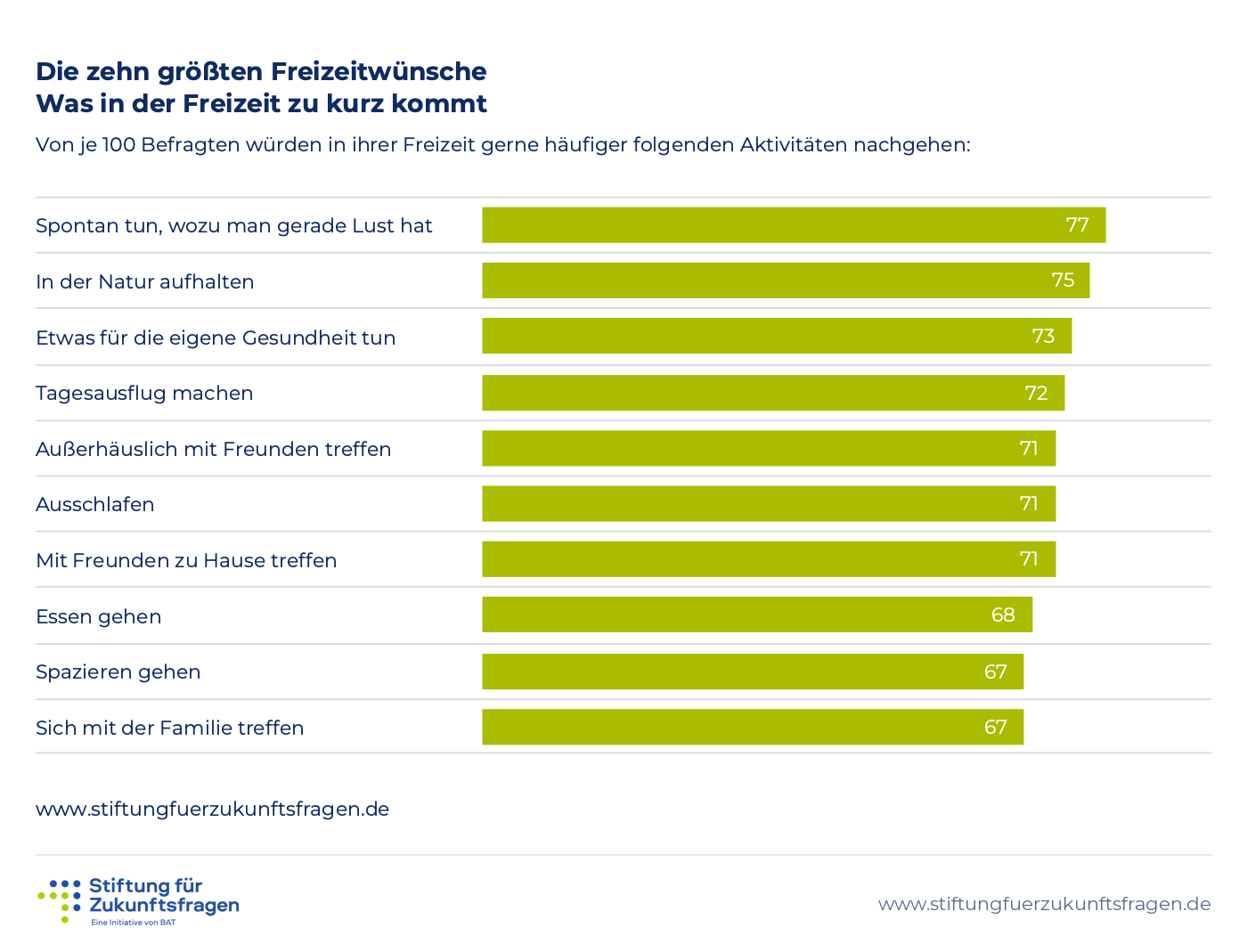
Many leisure activities are currently only available to a limited extent or not at all. The wishes for the time after Corona are correspondingly extensive. The need for spontaneous activities and appointments is particularly high. More than three out of four German citizens hope to be able to make short-term decisions again in the long term in order to fulfil their own leisure wishes.
Activities outside the home as well as social and regenerative activities play the biggest role here. Three quarters want to spend more time in nature and almost as many want to do something for their own health, go on a day trip, meet friends, go out to eat, spend time with their family or partner. Sleeping in, doing nothing or simply lying in the bathtub are also neglected by the majority at the moment. There is also evidence of a need to catch up on sport and culture, entertainment and experiences.
Compared to the 2015 survey, it is noticeable that significantly more wishes were expressed. Whereas just 12 activities were mentioned by the majority five years ago, the current figure is 32.
"Many people are currently missing the routine and everyday life of 2019. They are longing for the familiarity, security and choice that leisure time has always offered them. It is important to critically scrutinise what they really miss and what they might be able to do without in the future"Professor Reinhardt, head of the study, states.
"Leisure time is always defined by its voluntary nature, i.e. it is an activity that takes place without pressure, expectations, stress or obligations. In this respect, the current situation could also be a starting signal for a change in leisure activities. Ultimately, every citizen has to ask themselves what leisure activities they really enjoy, what is good for them and what makes them happy"says Reinhardt.
Data as table
| Spontaneously do whatever you feel like doing. | 77 |
| Spending time in nature | 75 |
| Do something for your own health | 73 |
| Make a day trip | 72 |
| Meeting friends outside the home | 71 |
| Sleep in | 71 |
| Meeting up with friends at home | 71 |
| to eat out | 68 |
| Go for a stroll | 67 |
| Meeting with family | 67 |
Technical data of the investigation
Number and representation: Over 2,000 people aged 18 to 74 in Germany
Period of the survey: August 2020
Method: CAWI
Survey institute: Gesellschaft für Konsumforschung (GfK), Nuremberg