

Chart of the week, 2023-KW47
23 November 2023
Between scepticism, progress and necessity: Our economy on the road to sustainability?
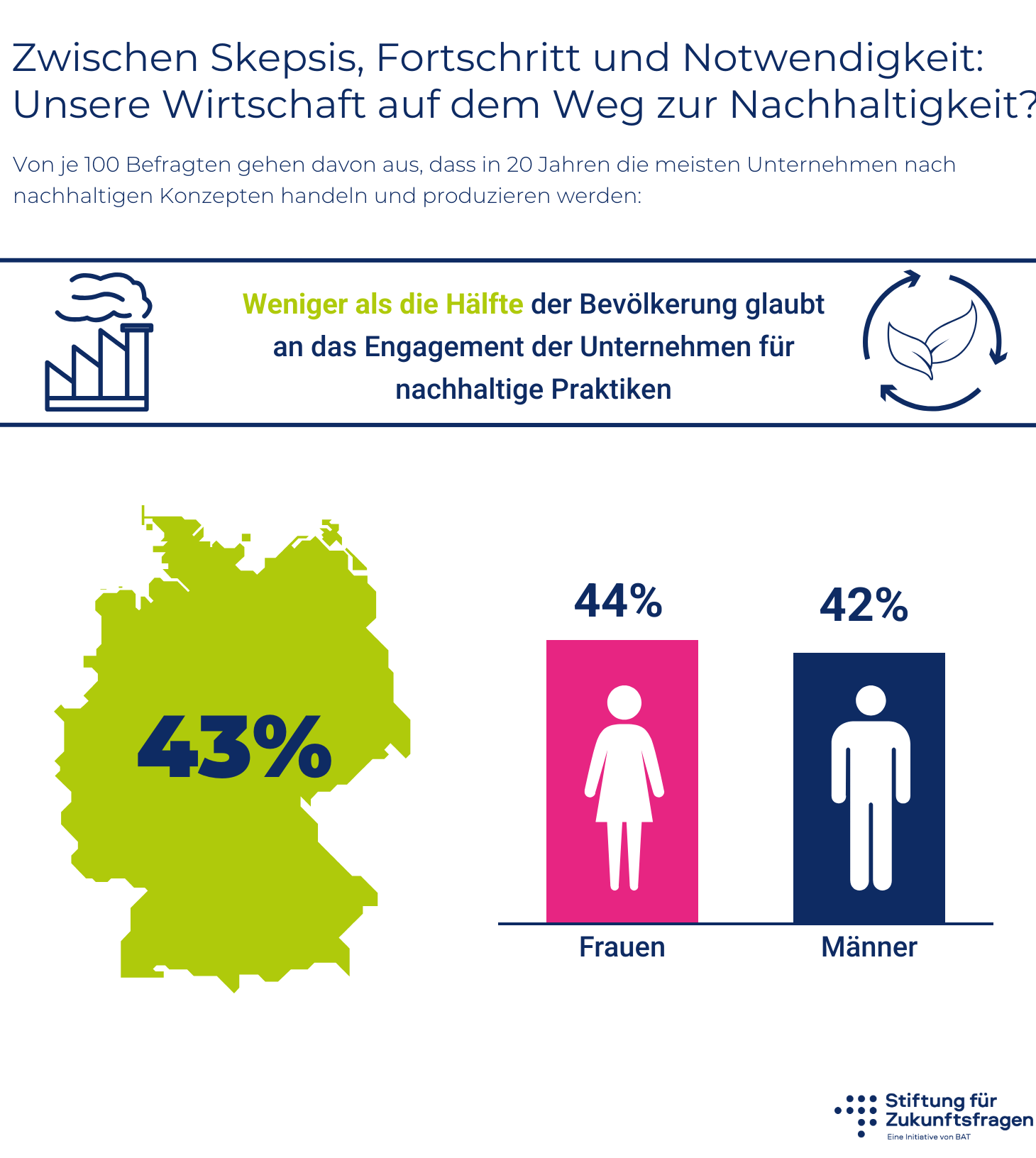
Of every 100 respondents, one assumes that in 20 years most companies will operate and produce according to sustainable concepts:
Less than half of the population believes in companies' commitment to sustainable practices.
Data as table
| Women | 44 |
| Men | 42 |
Result
In light of the challenges posed by climate change, societal adaptation and the implementation of preventative sustainability concepts are essential. The economy plays a key role in this, as it is among the main sources of emissions. However, less than half of the population believes that companies will make sufficient future commitments to sustainable practices. There are hardly any differences in this regard based on gender, age, education, or income.
Reasons
The Federal Republic of Germany has committed itself to anchoring the 17 Sustainable Development Goals of the United Nations as guiding principles in its policies. The business sector plays a key role in implementing these goals. Sustainable concepts include, for example, controlled energy, water, and material consumption; a reduction in waste and increased recycling; a reduction in emissions; the use of renewable energy sources; sustainable supply chains; and alternative product development. Furthermore, socially fair trade, fair working conditions, and the implementation of environmental management systems (to measure, monitor, and reduce environmental impacts) should be integrated into corporate concepts and strategies.
The public's skepticism towards the willingness of businesses to act sustainably has numerous causes – from a lack of transparency and environmental scandals to a lack of laws and controls, as well as the prioritization of profit and a lack of financial incentives.
Another reason is the lack of data and/or insufficient communication and reporting. Numerous companies are pursuing ambitious goals: whether VW or Siemens, Bosch or Allianz, Delta or Deutsche Post, Apple or Amazon – they all aim to be climate-neutral within two decades at the latest. And many other economic players are also working on increasing their energy efficiency, using sustainable materials and technologies, and modernizing their facilities. Currently, two out of five medium-sized companies already have a sustainability strategy.
Forecast
The future development of corporate sustainability will depend significantly on how consistently companies implement their sustainability strategies. The general public is increasingly aware of environmental issues and expects greater ecological commitment from businesses. Trust in companies will be determined not only by the implementation of their plans, but also by the transparency and traceability of their measures.
The introduction of the EU's Corporate Sustainability Reporting Directive (CSRD), which requires larger companies to publish detailed sustainability reports, has already taken an important step towards transparency and accountability. This directive could serve as a driver for broader acceptance and implementation of sustainability practices across the economy. Furthermore, the growing importance of ESG (Environmental, Social, Governance) criteria in investors' decisions will put additional pressure on companies to adopt sustainable practices.
Digitalization will also help sustainability efforts. to make processes more efficient. Innovative technologies such as blockchain could, for example, provide greater transparency in supply chains. Furthermore, the growing environmental awareness of consumers will play a crucial role. A stronger demand for sustainable products and services will prompt companies to adapt their business models in order to remain competitive in the market.
Overall, the future of corporate sustainability will be shaped by a combination of regulatory requirements, market mechanisms, technological innovation, and societal pressure. Companies that recognize and respond to these trends will not only strengthen public trust but also achieve long-term economic success.