


Current research, 172b
31 March 2003
Working like your parents – permanently employed and with regular working hours
""Working like your parents" – with a permanent position and regular working hours.
The job nomads are a legend.
The "Brave New World of Work," touted for years by business and politics, appears to be a myth, much like the promises of the "New Economy." Nearly three-quarters (71%) of all working people want to "work like their parents" in the 21st century – with permanent employment and regular working hours. This is according to a representative survey conducted by the BAT Leisure Research Institute, the results of which were presented by Institute Director Prof. Dr. Horst W. Opaschowski at the 11th Congress of the German Society for Human Resource Management (DGFP) in Wiesbaden. In his presentation, Opaschowski challenged a number of widely discussed myths. His key points are summarized below:
The reality of today's working world is more like a multifaceted society: sometimes cutthroat, sometimes responsible; sometimes throwaway, sometimes performance-driven. At times, one even gets the impression that teamwork is preached in professional life, but assertiveness is expected; collegiality is desired, but ruthlessness is tolerated. Flat hierarchies are promoted and work-life balance concepts are invoked, which prove to be myths in the real world of business.
Myth 1: "Job nomads""
A phantom is haunting the world of work – the job nomad, a new type of employee who doesn't pay enough into the pension system and lacks adequate protection against life's risks such as illness, disability, and old age. The job nomad puts social security last. They are supposed to be highly motivated experts with a highly flexible work schedule and a high degree of autonomy. In their pursuit of success, their career path is marked by countless breaks: yesterday an insurance salesman, today an investment advisor, tomorrow a stockbroker. The job nomad no longer has a permanent home. They constantly have to rethink their approach and move around. From Hamburg to Dresden, from Dresden to Munich, and from Munich to Berlin. Always chasing after jobs. Their life partner is joined by their life-phase job. This is what it might be like if the job nomad weren't a myth, but reality.
The reality of the modern working world paints a very different picture. Around-the-clock flexibility – here today, gone tomorrow – is hardly part of employees' work and life planning. Job nomads, caught between permanent employment, unemployment, and bogus self-employment, who can operate a "mobile office" with a cell phone, laptop, and shared desk from anywhere, deciding when, where, and how they work – these job nomads largely belong to the realm of modern myths – just like the "paperless office." Employees' desire for security and stability is simply too strong.
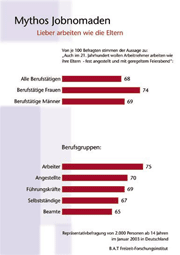
What employees really want are stable working conditions, meaning permanent positions rather than temporary or freelance contracts. Almost three-quarters (71%) of all working people readily admit: Even in the 21st century, they want to "work like their parents – with a permanent contract and a regular end to the workday." Of course, this is also a generational issue. Understandably, the desire for irregular working hours and contracts diminishes with age. Those aged 40 to 49 are the most vocal in their desire for a regular end to the workday (75%). But young people aged 18 to 34 also prefer to work conventionally like their parents (63%) and are significantly less enthusiastic about flexibility and mobility in their professional lives (33%), even in the 21st century.
Job nomads, who are flexible, mobile, and constantly on the move from one employer to another, and who are supposed to replace the traditional employee, encounter their psychological limits in the reality of the workplace. Most employees prefer to work conventionally and traditionally, with fixed rules and time constraints. The model of the itinerant worker with highly flexible rolling containers finds few supporters because even job nomads ultimately want to settle down.
Myth 2: Time Pioneers
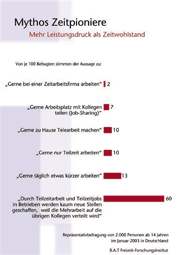
Time pioneers are considered role models of a new meritocracy because they value time affluence as much as material wealth. They consciously work less to have more time for themselves and their families. They perform their work with the same motivation and commitment as full-time employees. However, two-thirds of working people (60%) experience the following in their daily work: "Part-time work and part-time jobs in companies hardly create any new positions because the extra work is distributed among the remaining colleagues" (working women: 60% – working men: 62%).
Only a slim majority of the younger generation up to the age of 24 actually still believes in the myth of "more and new jobs" through part-time work (51%). Everyone else views part-time jobs soberly as another form of rationalization and productivity increase: More part-time work makes better use of people and machines, allows for more flexible responses to seasonal market fluctuations, and reduces absences due to illness, workplace accidents, and time off for errands. The main winners in any case are the companies. Employees, on the other hand, bear a double burden: Full-time employees have to do even more, and part-time employees have to live with the perception of being underemployed or even inferior because they produce less.
Accordingly, today's working people are critical of new working time models:
Only seven percent of working people are interested in job sharing, the sharing of a workplace with a colleague.
And working professionals want almost nothing to do with temporary work or employment through a temporary staffing agency. Temporary work is only conceivable for a mere two percent of employees. Even among the unemployed, only five percent of those surveyed would opt for temporary work. The hopes of politicians to tap into temporary jobs as a virtually "nationwide" employment reserve through personnel service agencies (PSAs) will not be fulfilled anytime soon.
Myth 3: Flat hierarchies
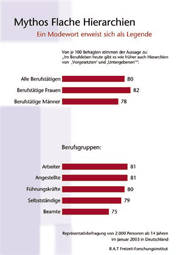
From the employees' perspective, almost nothing has changed: "In today's professional life, just like in the past, there are hierarchies of 'superiors' and 'subordinates,'" say 80 percent of the surveyed professionals (women: 821,000 – men: 781,000). Only the self-employed, who are responsible for themselves, have a somewhat more positive opinion (751,000). Otherwise, the vast majority of employees consider so-called "flat hierarchies" a myth or an overused buzzword. Just as fifty or a hundred years ago, the hierarchy of superiors and subordinates dominates in companies, clearly defining not only who reports to whom but also giving clear instructions on what is to be done and how. Clearly, most employees in the 21st century still expect clear task assignments and binding job descriptions: tasks defined by specifications.
It is noteworthy in this context that hierarchy and teamwork are not seen as opposites by employees. Employees want a clearly defined framework for action "from above," but one that still allows them sufficient leeway and freedom of choice regarding individual and/or team performance. This is the only way to explain why employees still value group success more highly than individual performance. When asked which of the following descriptions best describes the current situation in professional life, the answers are relatively moderate and balanced:
""In today's professional life, group work and team spirit are of paramount importance" (52%).
""In today's professional life, individual performance still counts more than group success" (44%).
In professional life, both independence and teamwork skills are clearly required. Depending on the task, one skill is needed more often than the other – and ideally, both at the same time.
The modern employee is an entrepreneur in the workplace, completing or delegating clearly defined tasks, either independently or collaboratively. Effectiveness and productivity arise from the intersection of both areas of expertise. Teamwork is necessary, but not a panacea. Ultimately, individual performance within the team is what counts: this is a new dual competency that prevents both individualistic behavior and simply disappearing into the background. The days when the concept of teamwork was touted as something like, "Team is short for: Great, someone else will do it," are definitively over. Hierarchy is no longer obsolete, yet the team concept lives on.
Myth 4: Work-Life Balance
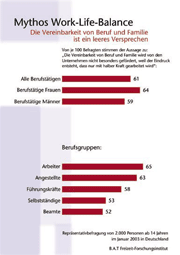
The rapid increase in stress levels and psychosomatic complaints has led to the spread of the American work-life balance movement to Germany in recent years. The goal is to finally take the reconciliation of work and family life seriously and to blur the boundaries between work and leisure. The focus should once again be on the "whole person," rather than work without beginning or end. However, reality paints a different picture: The working world of 2003 cannot (or will not) fulfill the promise of a work-life balance. The divide between professional and private life, or rather the widespread incompatibility of work and family, largely persists. Employees offer a realistic explanation: "Companies don't particularly promote work-life balance because it creates the impression that people are only working half-heartedly," say almost two-thirds (62%) of working people. The impression is that, from a business perspective, the ideal is actually: Half pay + half working hours = full performance. Individual "work-à-la-carte" still suffers under the public ideal of full employment: Those who value family life as much as professional life are exposed to suspicions ranging from lack of work motivation and reluctance to laziness.
The downside of a harmonious work-life balance often means jeopardizing one's career. Those who take time off for family during economically challenging times give the impression of not working with the expected full commitment. Sabbaticals, part-time work, or half-day jobs that truly address the need for "work-life balance" are paid less, receive less support, and are quickly overlooked for promotions, while full-time employees easily advance.
The modern world of work thrives on unrealistic myths that glorify situations, events, or ideas. These modern myths exert a powerful suggestive force and fascination. As a result, truths and realities, such as unresolved social conflicts, can temporarily fade from view. Demythologizing, on the other hand, is tantamount to disillusionment and profound disillusionment. It fundamentally shakes the belief in unlimited progress in the economic and professional world.
On the other hand, new work myths offer support in the search for meaning in a world dominated by economic and technological constraints: They respond to the crisis of work with the fascination of new work qualities such as New Work, New Economy, New Self-Employment, New Entrepreneurship, New Service Mentality, New Jobs, etc. Such myths are also developing in other areas of life (e.g., New Age, New Religions). Clearly, there is a primal human need for such myths.