

Chart of the Week, 2025-Week 45
November 6, 2025

How important is a sense of responsibility?
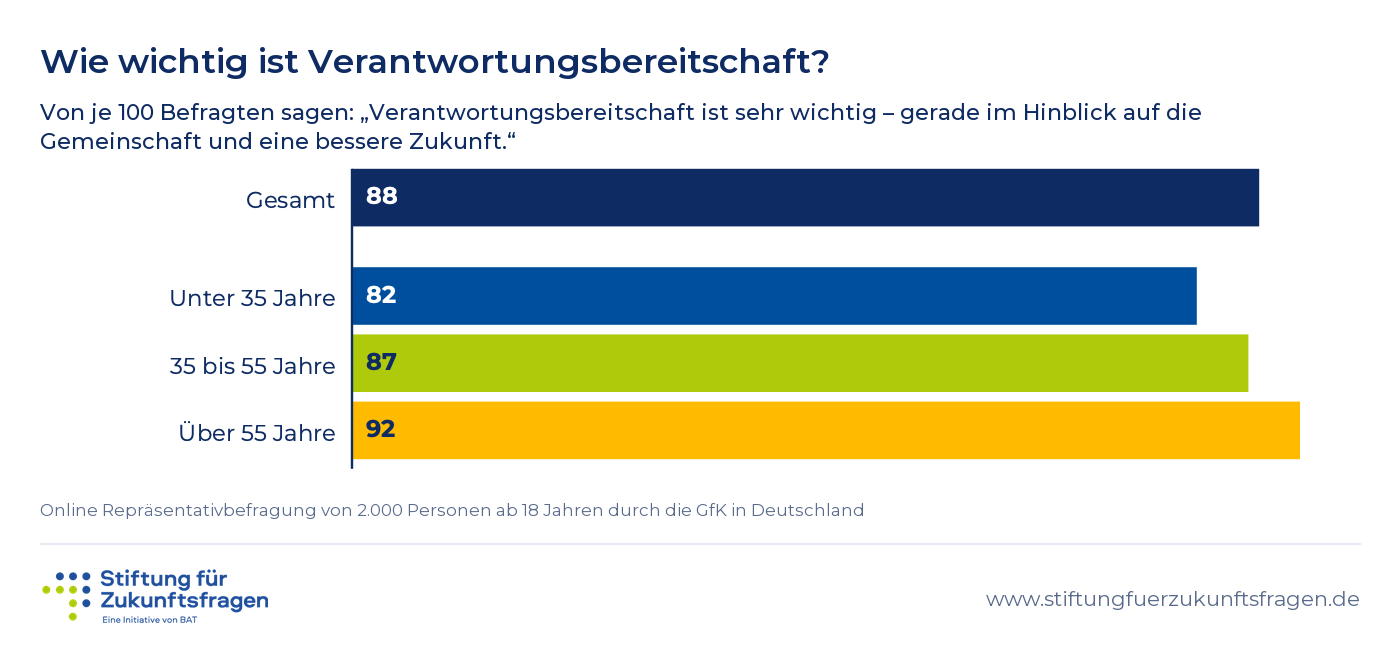
Of every 100 respondents, one said: "Taking responsibility is very important – especially with regard to the community and a better future."„
Data as table
| Total | 88 |
| Under 35 years | 82 |
| 35 to 55 years | 87 |
| Over 55 years | 92 |
Result
Responsibility is seen by the vast majority of the population as an essential foundation for a functioning society. 88 percent of German citizens consider a willingness to take responsibility particularly important – especially with regard to harmonious coexistence and a fairer future. This attitude is consistent across all generations, although there are differences in its expression: 92 percent of those over 55, 87 percent of those aged 35 to 54, and 82 percent of those under 35 emphasize the importance of responsibility.
Reasons
Responsibility arises from an interplay of inner conviction and societal expectations. Older citizens, in particular, have learned throughout their lives that responsible action is worthwhile – for example, in family life, at work, or through volunteering. Younger people, on the other hand, more often perceive responsibility as a burden or restriction, especially when it is accompanied by a lack of self-efficacy or feeling overwhelmed. Societal changes also play a role: traditional values such as a sense of duty were more strongly emphasized in the past, while today's generations place more emphasis on self-realization. Nevertheless, it is clear that when responsibility is linked to opportunities for shaping one's life and a sense of purpose, the willingness to assume it also increases.
Forecast
Responsibility will have to be conceived of both individually and collectively in the future. In an increasingly complex world—shaped by climate crisis, digitalization, and social upheaval—we need both: people who take responsibility for their actions and structures that enable collective engagement. Education, transparent communication, and a culture of trust can foster responsibility without overwhelming individuals. Crucially, we must understand responsibility as an opportunity for participation—not just as an obligation. Because: those who take responsibility strengthen not only their own self-confidence but also social cohesion.