

Chart of the week, 2025-KW36
4 September 2025
Consumer typologies
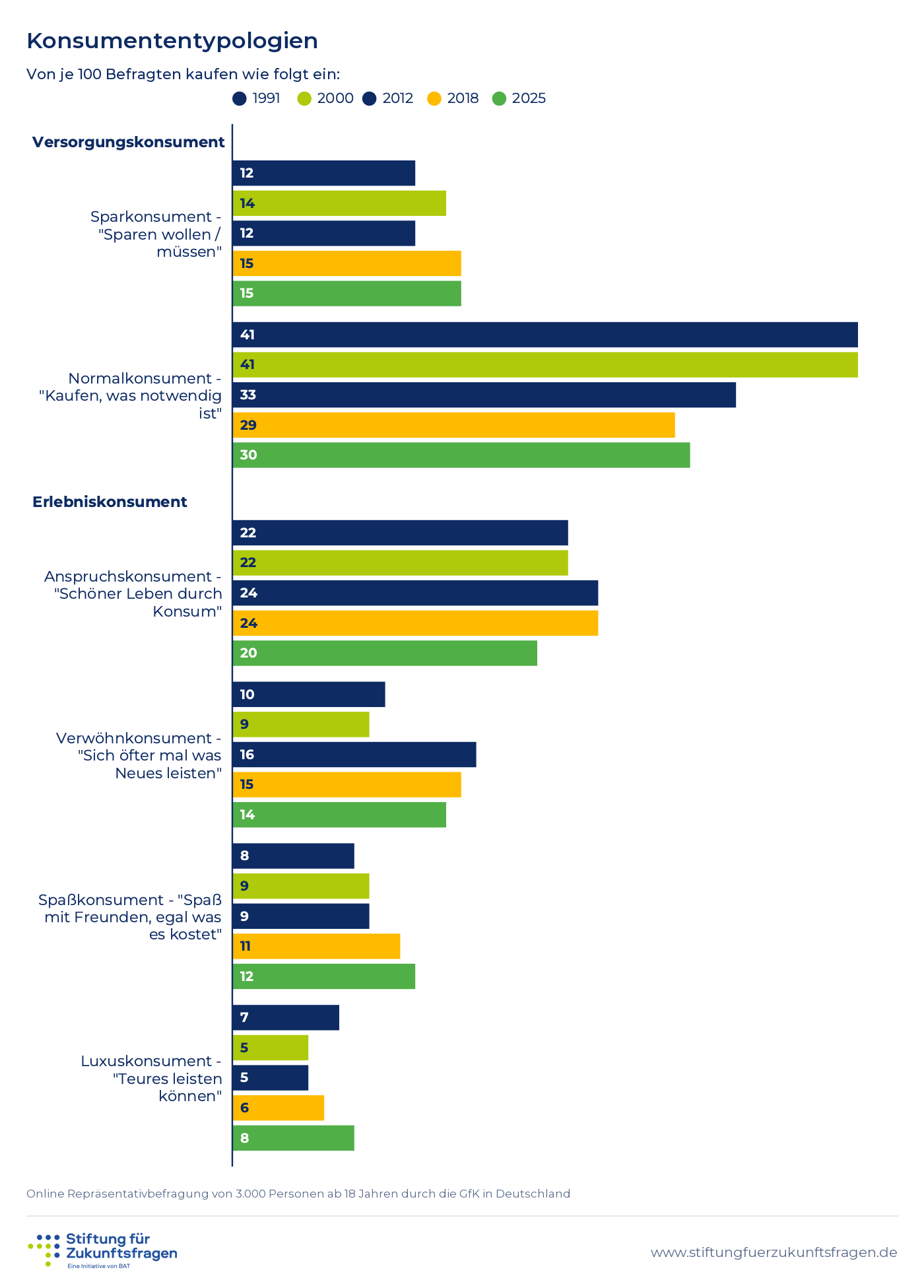
Out of every 100 respondents, the following are the shopping habits:
Data as table
| 1991 | 2000 | 2012 | 2018 | 2025 | |
|---|---|---|---|---|---|
| Consumer who saves money - "want / need to save"" | 12 | 14 | 12 | 15 | 15 |
| Average consumer - "Buy what is necessary"" | 41 | 41 | 33 | 29 | 30 |
| Discerning consumer - "A better life through consumption"" | 22 | 22 | 24 | 24 | 20 |
| Indulgent consumer - "Treating yourself to something new every now and then"" | 10 | 9 | 16 | 15 | 14 |
| Fun consumer - "Fun with friends, no matter the cost"" | 8 | 9 | 9 | 11 | 12 |
| Luxury consumer - "Being able to afford expensive things"" | 7 | 5 | 5 | 6 | 8 |
Result
German citizens can be categorised into five different consumer types, with the majority falling into the realm of experiential consumption. At 30 %, the normal consumer is the largest single group that buys the necessities. However, if all experience consumers are added together - aspirational consumers (buy something that enriches their lives), indulgence consumers (treat themselves to something special), fun consumers and luxury consumers - they now account for almost 60 %. This is a significant change, as the distribution was exactly the opposite a generation ago.
Reasons
The development from purely utilitarian consumption to experiential consumption has evolved historically. While consumption 200 years ago was almost exclusively for survival, industrialisation and the emergence of department stores, advertising (such as the first advertising pillar in 1855) and later the introduction of household appliances and cars made consumption possible for broader sections of the population. Since the 1980s and 90s, more leisure time and higher incomes have increasingly emotionalised shopping and turned it into a leisure activity. Nowadays, consumption not only serves the purpose of self-expression, but also the question of meaningfulness and renunciation. The increasing number of luxury consumers who value quality, design and sustainability reflects the growing gap between rich and poor. In addition, for many fun consumers, consumption is a social experience that they share with friends or family.
Forecast
The future of consumption will be characterised by even greater differentiation and individualisation. Traditional opposites such as „mass and class“ or „cheap and expensive“ will continue to exist side by side. For retailers, this means repositioning themselves and focussing on added value beyond the pure product. The ambience, personalised advice and quality of experience will be decisive. Consumption will become increasingly conscious and selective, with the question „Why am I buying this?“ playing a greater role than in the past. Bold retailers who dare to utilise new technologies and focus on a specific target group will have the chance to survive in this changing market.