

The BAT Foundation for Future Studies will present the "Leisure Time Monitor 2024" at an online press conference on 27 August 2024. For the survey, which has been conducted regularly since 1982, over 3,000 representatively selected citizens aged 18 and over were asked about over 100 different leisure activities in July and August 2024.
Core results
- INTERNET: THE DIGITAL GATEWAY TO OUR LEISURE WORLD
- RECREATION: CHILLING INSTEAD OF NURSING
- OUTDOOR ACTIVITIES: EXPERIENCE INSTEAD OF TRADITION
- INTERPERSONAL CONTACTS: DIGITAL INSTEAD OF REAL
- SPORT: A NEW URGE TO MOVE
- BLACKLIST: WHAT TO AVOID IN 2024 AND WHY
- LEISURE WISHES: RELAX, MEET, EXERCISE
INTERNET: THE DIGITAL GATEWAY TO OUR LEISURE WORLD
In a world increasingly dominated by digital possibilities, the internet has established itself as the central gateway to the world of leisure. Whether for information, entertainment, social networking or to prevent boredom - the internet is omnipresent and plays an increasingly important role in daily life. Currently, 97 per cent of Germans state that they use the internet at least once a week, making it the undisputed number one leisure activity.
"The internet is omnipresent - whether on the couch, in bed or on the move - and is with us at all times. Accordingly, it has become an indispensable companion in our free time, allowing us to organise it according to our individual needs," says Professor Dr Ulrich Reinhardt, Scientific Director of the BAT Foundation for Future Studies.
In addition to the World Wide Web, other media offerings characterise the top 10 most common leisure activities. From playing with smartphones and watching TV to listening to music, leisure time flies by with all these activities.
Despite the dominance of the media, many people value their periods of relaxation within their own four walls. Regenerative activities such as sleeping in, chilling out or thinking are an integral part of everyday life for many, as they make a significant contribution to slowing down. Social activities also take place predominantly in the home environment. Conversations with partners and meetings with friends or neighbours continue to be important components of social life, even if encounters have become rarer overall.
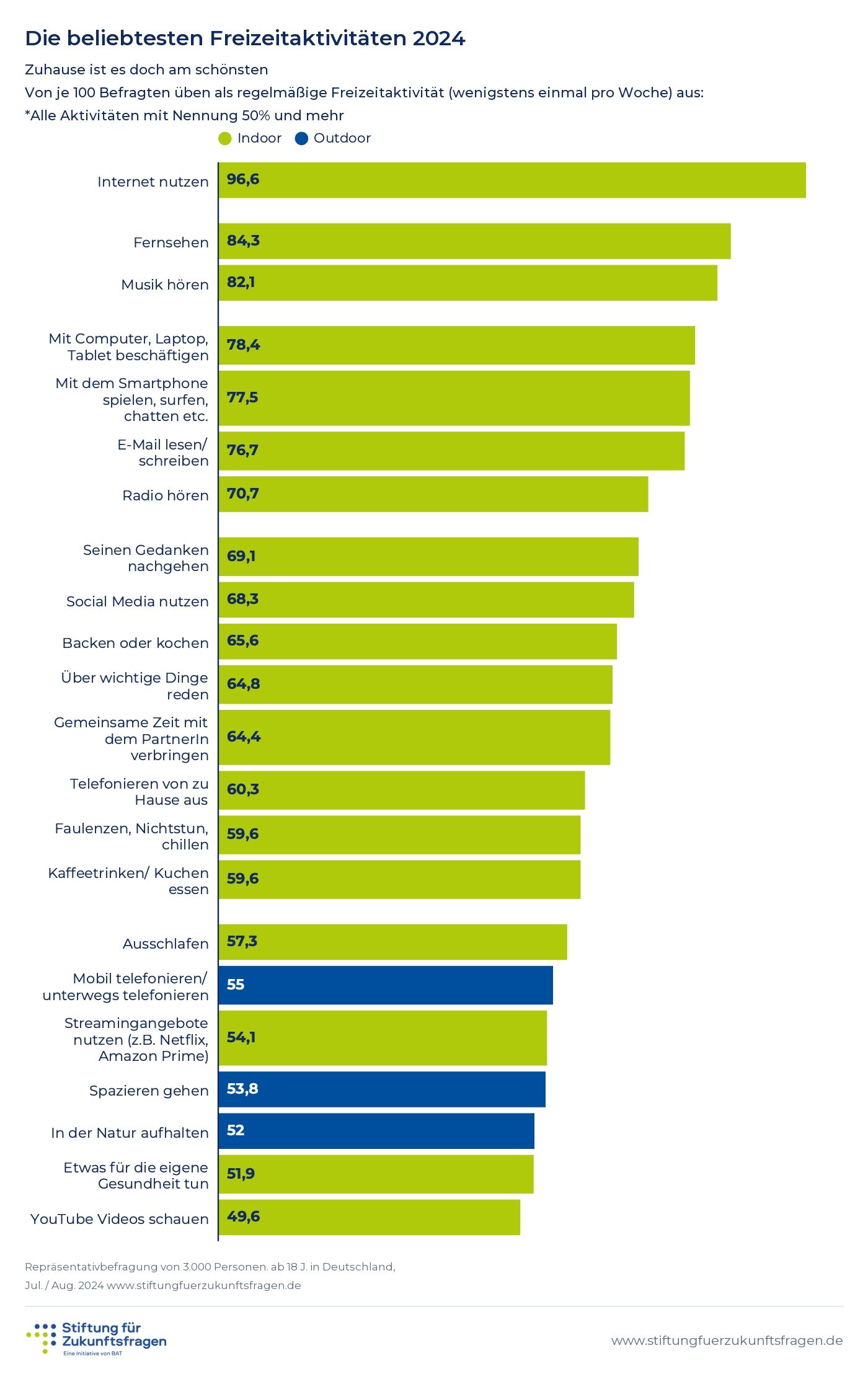
The most popular leisure activities in 2024
There's no place like home.
Out of every 100 respondents, the following are practiced as regular leisure activities (at least once a week):
*All activities with reference 50% and more
Data as table
| Using the internet | 96,6 |
| Television | 84,3 |
| Listen to music | 82,1 |
| Using a computer, laptop, or tablet | 78,4 |
| Playing games, surfing the web, chatting, etc. on your smartphone. | 77,5 |
| Read/write email | 76,7 |
| Listen to the radio | 70,7 |
| to follow his thoughts | 69,1 |
| Use social media | 68,3 |
| baking or cooking | 65,6 |
| Talk about important things | 64,8 |
| Spending time together with your partner | 64,4 |
| Making phone calls from home | 60,3 |
| Loitering, doing nothing, chilling | 59,6 |
| Coffee/cake | 59,6 |
| Sleep in | 57,3 |
| Mobile phone calls / making calls on the go | 55 |
| Use streaming services (e.g. Netflix, Amazon Prime) | 54,1 |
| Go for a stroll | 53,8 |
| Spending time in nature | 52 |
| Do something for your own health | 51,9 |
| Watch YouTube videos | 49,6 |
RECREATION: CHILLING INSTEAD OF NURSING
At a time when daily life is characterised by stress and a fast pace, regenerative leisure activities are also changing. While taking care of oneself or sleeping in used to play a major role, many people are now consciously slowing down by doing nothing - they want to switch off and let themselves be sprinkled with as much light as possible. Despite the benefits that this activity offers, the desire for even more relaxation remains unfulfilled, as many feel inhibited by FOMO and social pressure and do not really take time for themselves. Active and conscious inactivity without a guilty conscience would be important for relaxation.
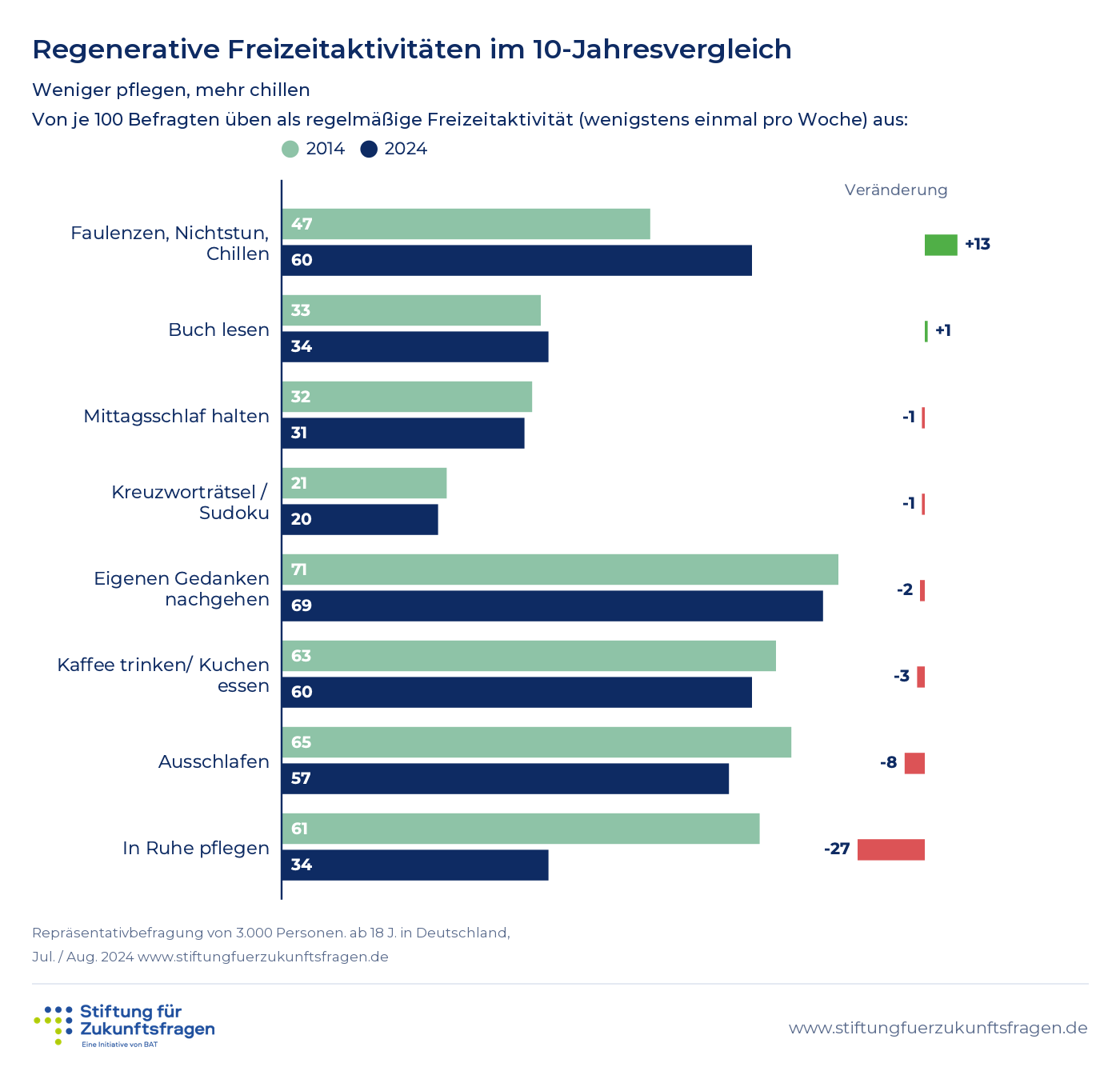
Regenerative leisure activities in a 10-year comparison
Less grooming, more chilling
Out of every 100 respondents, the following are practiced as regular leisure activities (at least once a week):
Data as table
| 2014 | 2024 | change | |
|---|---|---|---|
| Loitering, doing nothing, chilling | 47 | 60 | +13 |
| Read a book | 33 | 34 | +1 |
| Taking a nap | 32 | 31 | -1 |
| Crossword puzzle / Sudoku | 21 | 20 | -1 |
| to follow one's own thoughts | 71 | 69 | -2 |
| Drink coffee/eat cake | 63 | 60 | -3 |
| Sleep in | 65 | 57 | -8 |
| Maintain in peace | 61 | 34 | -27 |
OUTDOOR ACTIVITIES: EXPERIENCE INSTEAD OF TRADITION
A 10-year comparison shows an increase in some out-of-home activities. Day trips and weekend excursions in particular are enjoying growing popularity and show an increased need for experience-orientated activities. Visits to restaurants and flea markets as well as voluntary work have also increased. They illustrate the increasing importance of social interaction in leisure time.
On the other hand, leisure activities such as cruising by car/motorbike, club activities or regular visits to church services, pubs or shopping centres are in slight decline. What these activities have in common is that they tend to be perceived as traditional, familiar and ordinary and are not associated with being new, unusual or exciting.
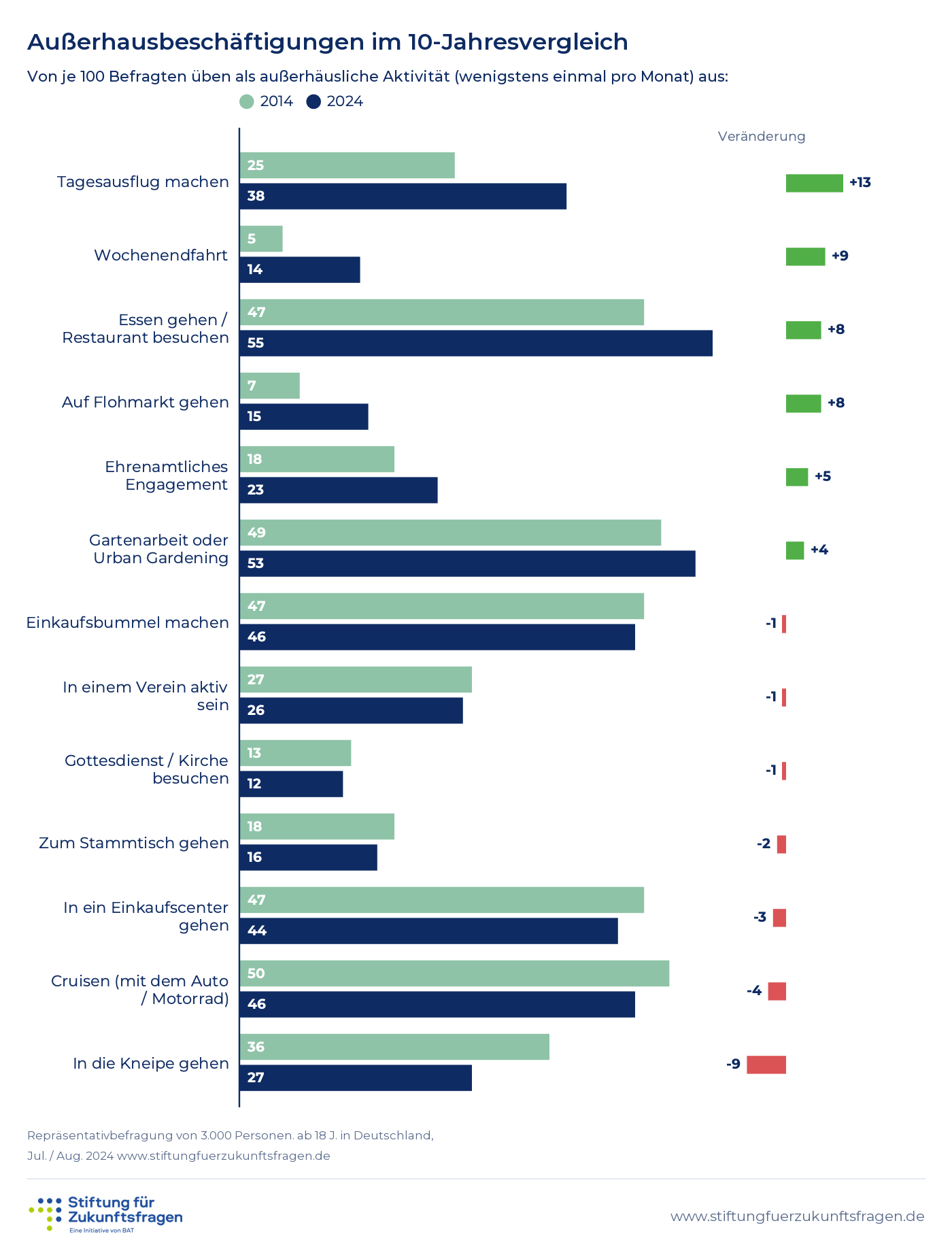
Out-of-home employment: a 10-year comparison
Out of every 100 respondents, the following activities are performed outside the home (at least once a month):
Representative survey of 3,000 people aged 18 and over in Germany.,July / August 2024 www.stiftungfuerzukunftsfragen.de Data as table
Out-of-home employment in a 10-year comparison — Out of every 100 respondents, the following activities are performed (at least once a month):
2014 2024 change Make a day trip 25 38 +13 weekend trip 5 14 +9 Going out to eat / Visiting a restaurant 47 55 +8 Go to the flea market 7 15 +8 Voluntary engagement 18 23 +5 Gardening or urban gardening 49 53 +4 Go on a shopping spree 47 46 -1 Being active in a club 27 26 -1 Visiting a church service / attending church 13 12 -1 Go to the regulars' table 18 16 -2 Go to a shopping center 47 44 -3 Cruising (by car / motorcycle) 50 46 -4 Go to the pub 36 27 -9
Download chart:PNG
Out-of-home employment: a 10-year comparison
Out of every 100 respondents, the following activities are performed outside the home (at least once a month):
Data as table
| 2014 | 2024 | change | |
|---|---|---|---|
| Make a day trip | 25 | 38 | +13 |
| weekend trip | 5 | 14 | +9 |
| Going out to eat / Visiting a restaurant | 47 | 55 | +8 |
| Go to the flea market | 7 | 15 | +8 |
| Voluntary engagement | 18 | 23 | +5 |
| Gardening or urban gardening | 49 | 53 | +4 |
| Go on a shopping spree | 47 | 46 | -1 |
| Being active in a club | 27 | 26 | -1 |
| Visiting a church service / attending church | 13 | 12 | -1 |
| Go to the regulars' table | 18 | 16 | -2 |
| Go to a shopping center | 47 | 44 | -3 |
| Cruising (by car / motorcycle) | 50 | 46 | -4 |
| Go to the pub | 36 | 27 | -9 |
INTERPERSONAL CONTACTS: DIGITAL INSTEAD OF REAL
Interpersonal contacts are tending to decrease. While the technological possibilities for networking are becoming ever more comprehensive, personal encounters and joint activities in real life are on the decline. Meeting up with friends and neighbours or spending time with your partner has become rarer. This not only reflects the growing demands and increasingly hectic pace of contemporary life, but also a shift towards more individualised and often digitalised forms of social interaction. In an age of constant accessibility and a focus on efficiency, personal closeness is paradoxically losing its value.
At the same time, this development reveals a fundamental change in the importance of leisure time and interpersonal relationships. Social rituals that were once so important, such as chatting with neighbours or spending time with friends, are becoming less relevant. The challenge for the future is to find a balance between digital networking and real human contact in order to overcome the growing distance and strengthen social ties in an increasingly fast-paced world.
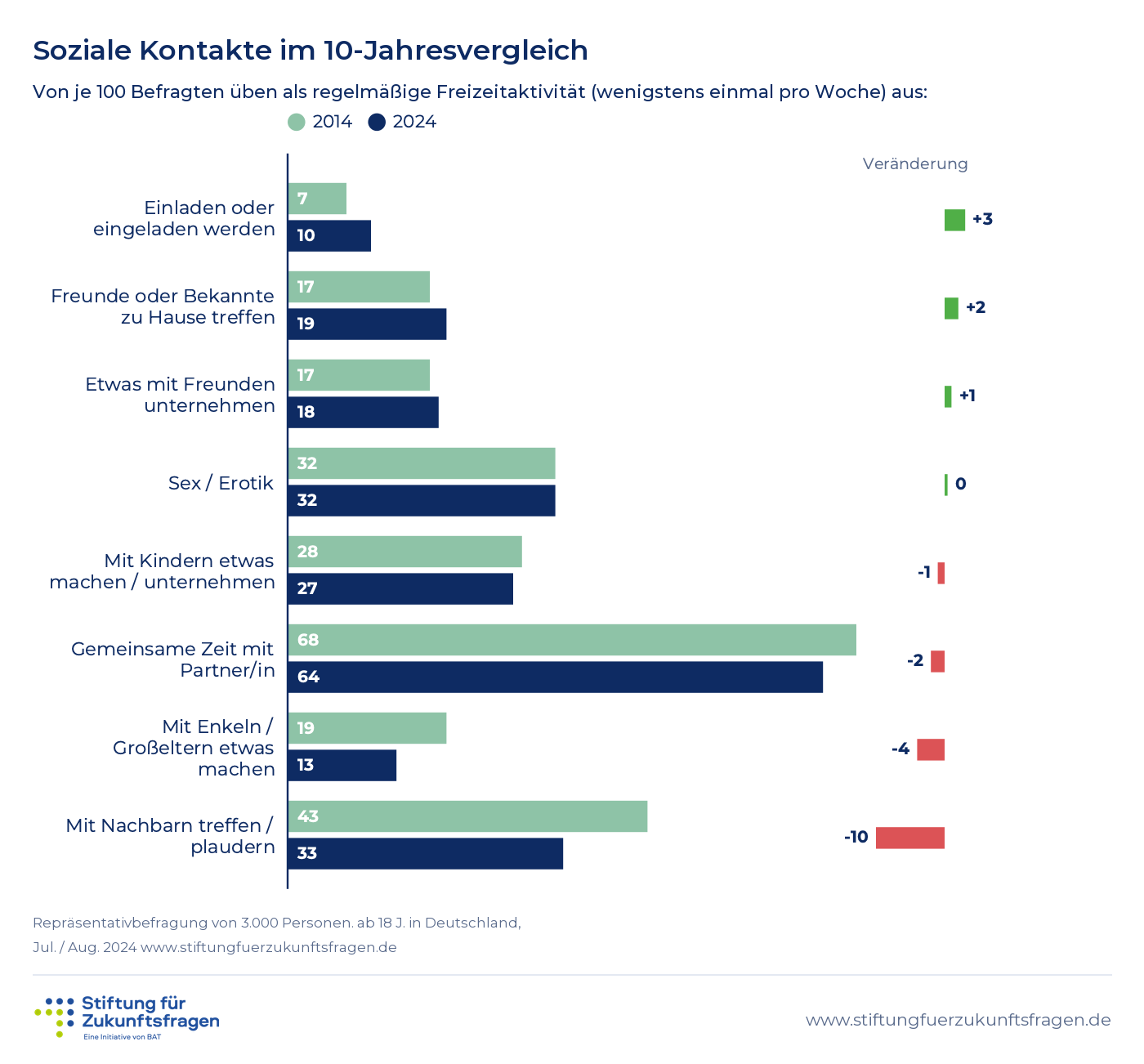
Social contacts in a 10-year comparison
Out of every 100 respondents, the following are practiced as regular leisure activities (at least once a week):
Representative survey of 3,000 people aged 18 and over in Germany.,July / August 2024 www.stiftungfuerzukunftsfragen.de Data as table
Social contacts in a 10-year comparison — Out of every 100 respondents, the following are practiced as regular leisure activities (at least once a week):
2014 2024 change To invite or to be invited 7 10 +3 Meeting friends or acquaintances at home 17 19 +2 Doing something with friends 17 18 +1 Sex / Erotica 32 32 0 Doing something with children / doing something with children 28 27 -1 Spending time together with your partner 68 64 -2 Doing something with grandchildren / grandparents 19 13 -4 Meeting/chatting with neighbors 43 33 -10
Download chart:PNG
Social contacts in a 10-year comparison
Out of every 100 respondents, the following are practiced as regular leisure activities (at least once a week):
Data as table
| 2014 | 2024 | change | |
|---|---|---|---|
| To invite or to be invited | 7 | 10 | +3 |
| Meeting friends or acquaintances at home | 17 | 19 | +2 |
| Doing something with friends | 17 | 18 | +1 |
| Sex / Erotica | 32 | 32 | 0 |
| Doing something with children / doing something with children | 28 | 27 | -1 |
| Spending time together with your partner | 68 | 64 | -2 |
| Doing something with grandchildren / grandparents | 19 | 13 | -4 |
| Meeting/chatting with neighbors | 43 | 33 | -10 |
SPORT: A NEW URGE TO MOVE
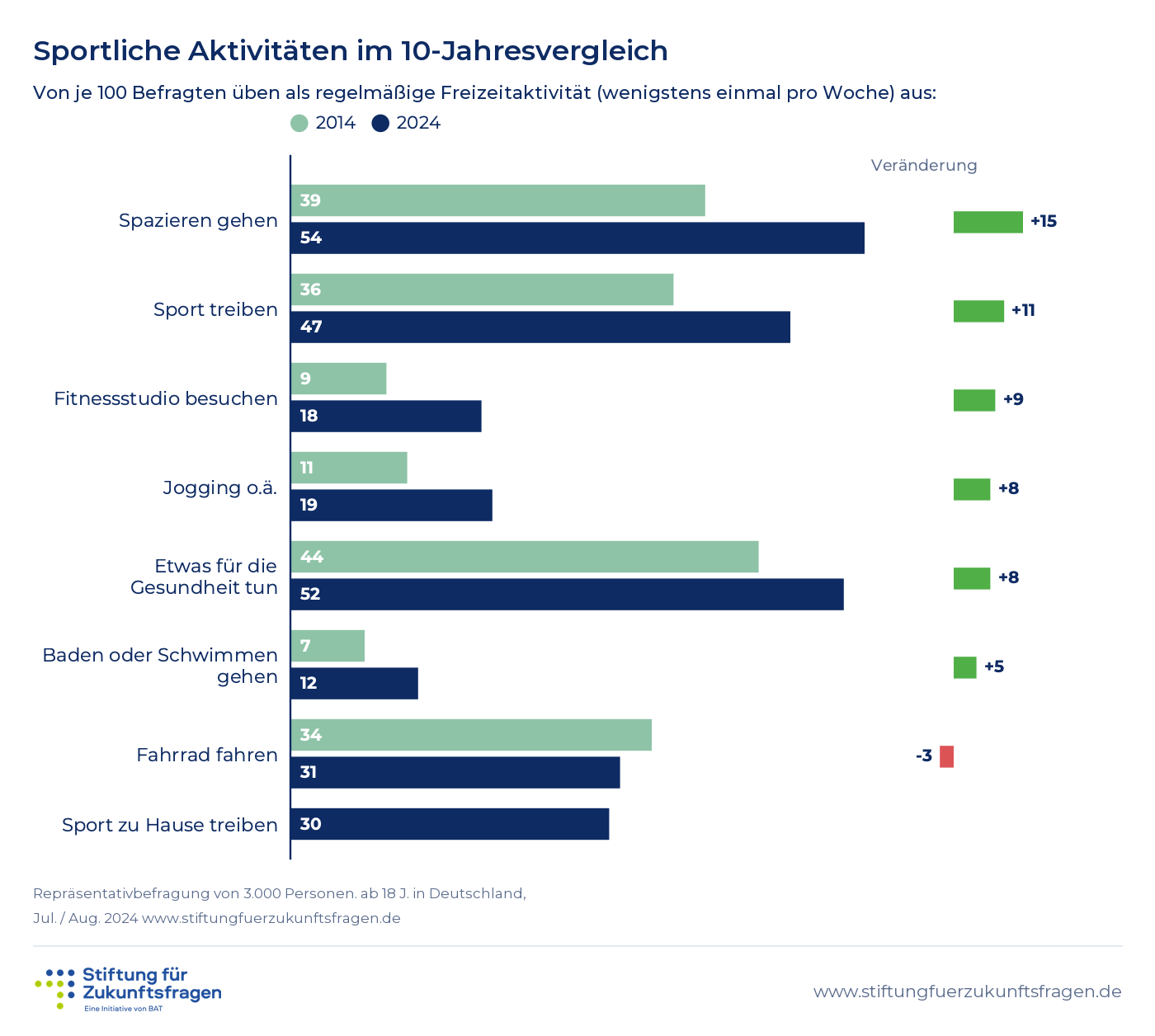
A comparison of the last ten years shows a clear trend towards a more active and health-conscious lifestyle. Walking and other sporting activities have become an integral part of leisure time for many people. This clearly shows how the need for exercise is constantly growing, especially against the backdrop of increasing digitalisation and the associated long periods of sitting in front of screens, a contrasting programme in leisure time is essential. The growing popularity of gyms, jogging and swimming is striking. These activities are now practised almost twice as often as they were ten years ago. This shows the shift towards a society in which physical fitness and maintaining one's own health are becoming increasingly important. There is also a growing desire for flexibility and independence, as almost one in three people now also do sport at home.
Sporting activities over the past 10 years
Out of every 100 respondents, the following are practiced as regular leisure activities (at least once a week):
Data as table
| 2014 | 2024 | change | |
|---|---|---|---|
| Go for a stroll | 39 | 54 | +15 |
| to do sports | 36 | 47 | +11 |
| Visit the gym | 9 | 18 | +9 |
| Jogging or similar. | 11 | 19 | +8 |
| Do something for your health | 44 | 52 | +8 |
| Going for a bath or a swim | 7 | 12 | +5 |
| ride a bike | 34 | 31 | -3 |
| Doing sports at home | nB. | 30 |
BLACKLIST: WHAT TO AVOID AND WHY
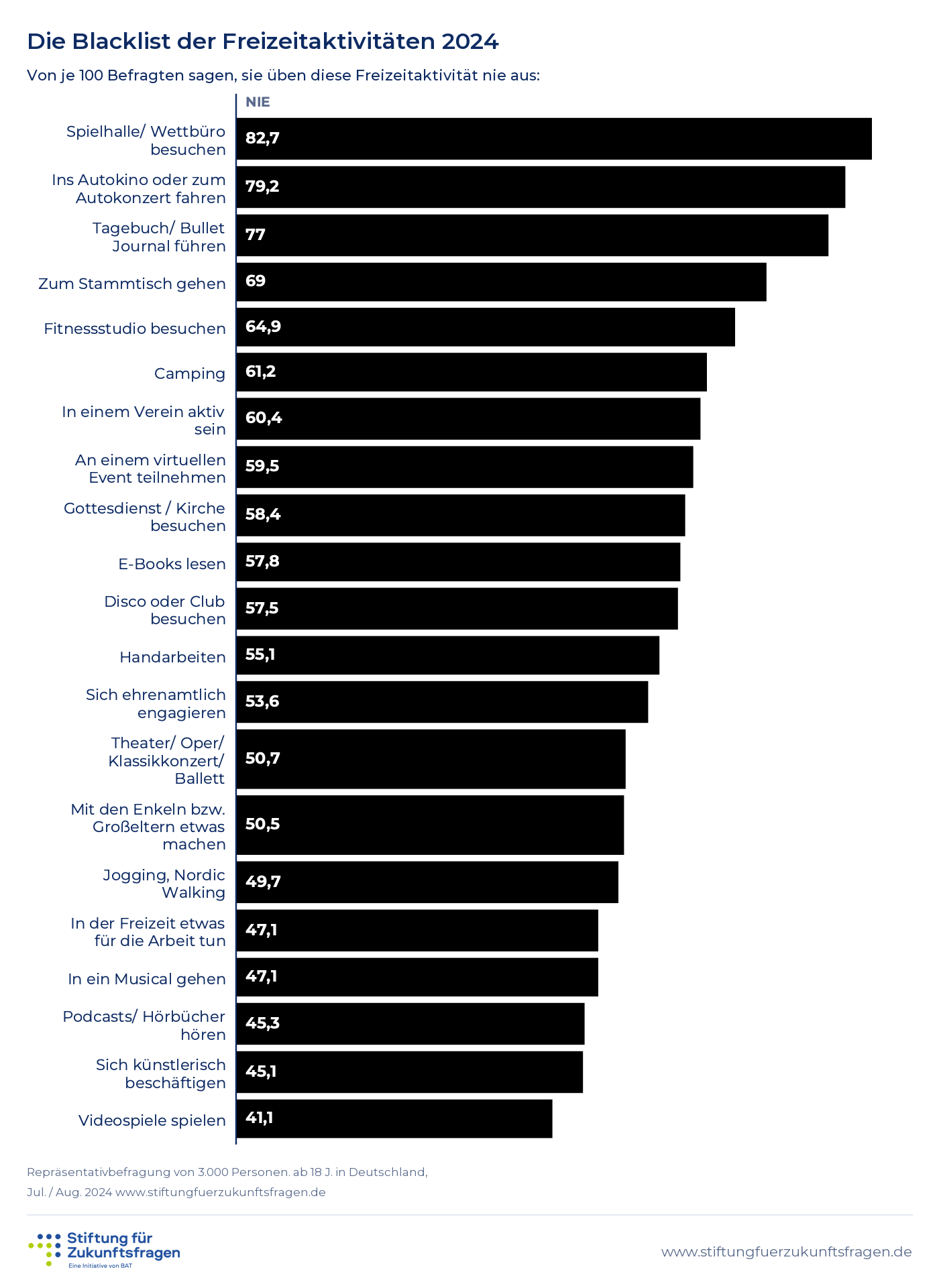
With the increase in leisure activities and opportunities, the pressure on many traditional activities is growing. For example, going to amusement arcades and regulars' tables, going to the gym or discos, or getting involved in clubs or churches is no longer attractive for the majority of German citizens. Reinhardt: "There is a changing understanding of leisure time: away from traditional forms of employment towards more individualised, often digitally influenced experiences. Many citizens are avoiding activities that are either associated with fixed obligations or social norms".
The Blacklist of Leisure Activities 2024
Out of every 100 respondents, they say they never engage in this leisure activity:
Data as table
| NEVER | |
|---|---|
| Visit an arcade/betting shop | 82,7 |
| Go to the drive-in cinema or a drive-in concert | 79,2 |
| Keep a diary/Bullet journal | 77 |
| Go to the regulars' table | 69 |
| Visit the gym | 64,9 |
| camping | 61,2 |
| Being active in a club | 60,4 |
| Participate in a virtual event | 59,5 |
| Visiting a church service / attending church | 58,4 |
| Reading e-books | 57,8 |
| Visit a disco or club | 57,5 |
| Handicrafts | 55,1 |
| Volunteering | 53,6 |
| Theatre/ Opera/ Classical Concert/ Ballet | 50,7 |
| Doing something with the grandchildren or grandparents | 50,5 |
| Jogging, Nordic Walking | 49,7 |
| Doing something for work in your free time | 47,1 |
| Go to a musical | 47,1 |
| Listen to podcasts/audiobooks | 45,3 |
| Engage in artistic pursuits | 45,1 |
| playing video games | 41,1 |
LEISURE WISHES: RELAX, MEET, EXERCISE
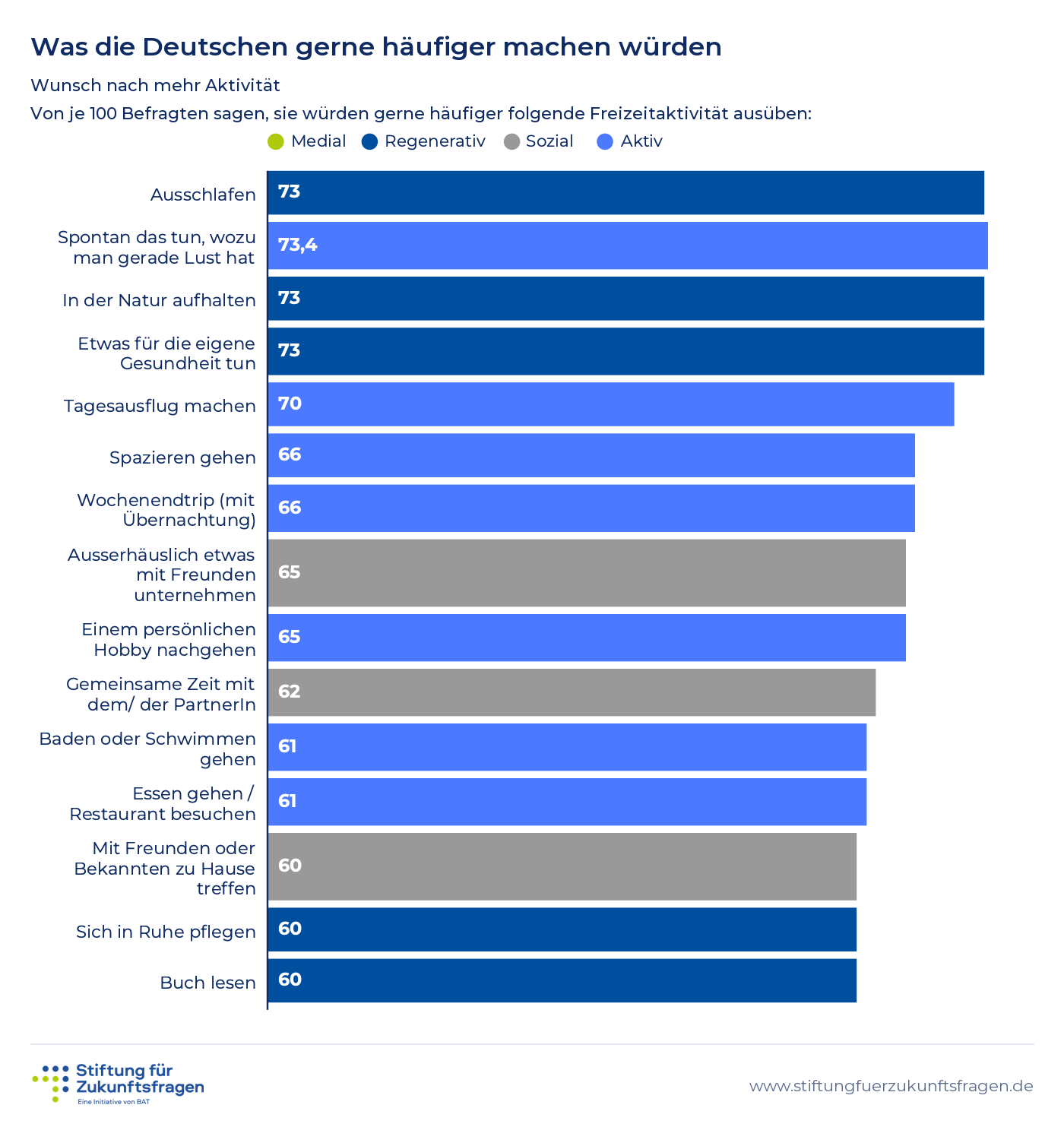
When asked which activities German citizens would like to do more often, active activities are mentioned alongside regenerative and social activities. Hardly anyone wants more time for media activities. Many people express the wish to have more time for relaxing activities. These include sleeping in, relaxing activities such as reading a book or taking care of oneself in peace. The desire for leisure time reflects the need for personal regeneration and a balance between the demands of work and other leisure activities.
On the other hand, there is also the need for more social relationships, for example through shared experiences with friends and partners, whether at home or away from home, as these are often neglected in times of working from home and increasing individualisation. Many people are looking for more closeness and time together to laugh, experience something or talk in peace.
However, the greatest desire among citizens is for more active leisure activities. Whether it's walks, day trips, weekend breaks or sporting activities - many people want to make their leisure time more active and more active. Nature not only offers a balance to the often sedentary everyday life, but also an opportunity to escape the daily grind and recharge your batteries.
Conclusion from Reinhardt: "People are increasingly looking for relaxation, social closeness and active experiences. These desires stand in contrast to the often digital and hectic reality and emphasise the desire for balance and well-being in a fast-paced world. It is now important to implement these leisure wishes more often and to change leisure behaviour ourselves."
What Germans would like to do more often
Desire for more activity
Out of every 100 respondents, they said they would like to do the following leisure activity more often:
Data as table
| Sleep in | 73 |
| Spontaneously do whatever you feel like doing. | 73,4 |
| Spending time in nature | 73 |
| Do something for your own health | 73 |
| Make a day trip | 70 |
| Go for a stroll | 66 |
| Weekend trip (with overnight stay) | 66 |
| Doing something outside the home with friends | 65 |
| Pursuing a personal hobby | 65 |
| Spending time together with your partner | 62 |
| Going for a bath or a swim | 61 |
| Going out to eat / Visiting a restaurant | 61 |
| Meeting with friends or acquaintances at home | 60 |
| Take time to pamper yourself | 60 |
| Read a book | 60 |