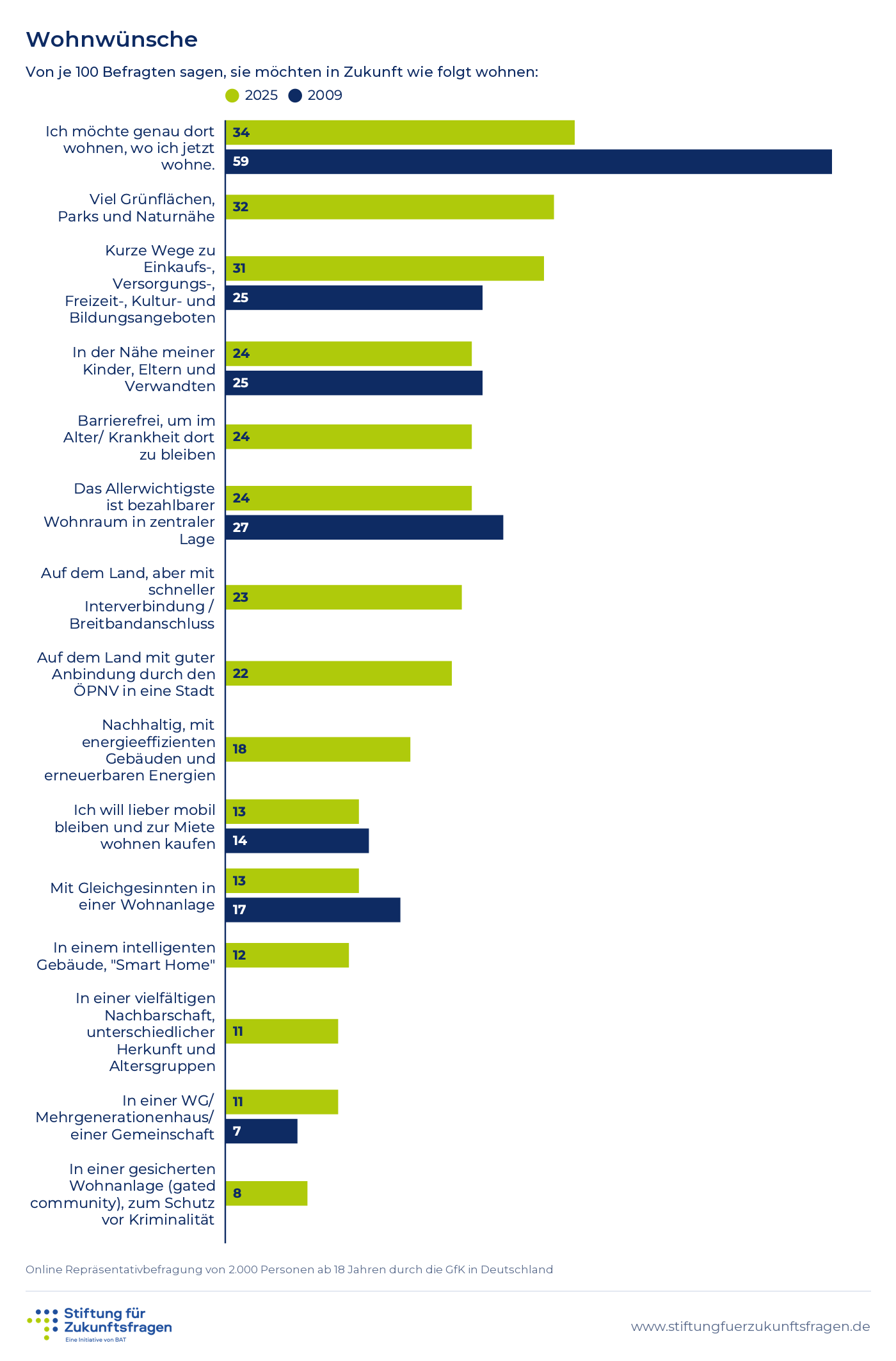



Housing wishes
Out of every 100 respondents, they say they would like to live as follows in the future:
Data as table
| 2025 | 2009 | |
|---|---|---|
| I want to live exactly where I live now. | 34 | 59 |
| Plenty of green spaces, parks and proximity to nature | 32 | |
| Short distances to shopping, supply, leisure, cultural and educational facilities | 31 | 25 |
| Near my children, parents and relatives | 24 | 25 |
| Barrier-free, so that people can remain there in old age/illness | 24 | |
| The most important thing is affordable housing in a central location. | 24 | 27 |
| In the countryside, but with fast internet/broadband access | 23 | |
| In the countryside with good public transport connections to a city | 22 | |
| Sustainable, with energy-efficient buildings and renewable energies | 18 | |
| I prefer to remain mobile and rent rather than buy. | 13 | 14 |
| Living with like-minded people in a residential complex | 13 | 17 |
| In an intelligent building, "Smart Home"" | 12 | |
| In a diverse neighborhood, with different origins and age groups | 11 | |
| In a shared apartment/multi-generational house/community | 11 | 7 |
| In a gated community, for protection against crime | 8 |
Result
For 31% of German citizens, a place to live with short distances is currently the most important housing criterion. This means a home from which everyday needs – shopping, school, doctor, or cultural events – can be reached on foot or by bicycle. This aspect will therefore be the top priority for housing preferences in 2025.
Compared to 2009, a significant increase is evident: Back then, this figure was 26 %. At the same time, the classic ideal of a central location is losing some importance – currently, 24 % cite affordable housing in a good inner-city location as important.
Furthermore, changing attitudes towards life in the countryside are evident: Almost half of the respondents would, in principle, move there – provided that digital infrastructure and mobility are guaranteed.
Reasons
The demands placed on housing have changed. Today, places of residence are increasingly chosen based on their suitability for everyday life. Shorter distances make it easier to organize life and reduce time expenditure, dependence on cars, and daily stress.
At the same time, the desire for closeness is not at odds with autonomy. Many people long for connection without feeling trapped in rigid structures. This is also evident in the topic of communal living: only 13 out of 3 can imagine living with like-minded individuals in housing projects, and only 11 out of 3 can envision multigenerational living. The majority prefers what they know – 34 out of 3 want to live as they have been.
Quality of living is therefore not defined solely by floor plan or square meters, but increasingly by accessibility, usability and reliability in everyday life.
Forecast
In the coming years, the importance of accessibility and functional proximity will become even more pronounced. Places of residence that effectively support daily life will become increasingly attractive – not only in cities, but also in rural areas, provided that infrastructure and digital connectivity develop accordingly.
Even communal forms of housing could evolve further – but in a restrained way that preserves individual private spaces. New models will be successful where they respond to existing needs rather than imposing new concepts.
Housing remains a central element of social participation. Those who plan or design living spaces today will have to focus even more strongly in the future on how people live – not just where they live.