

Chart of the week, 2025-KW28
10 July 2025

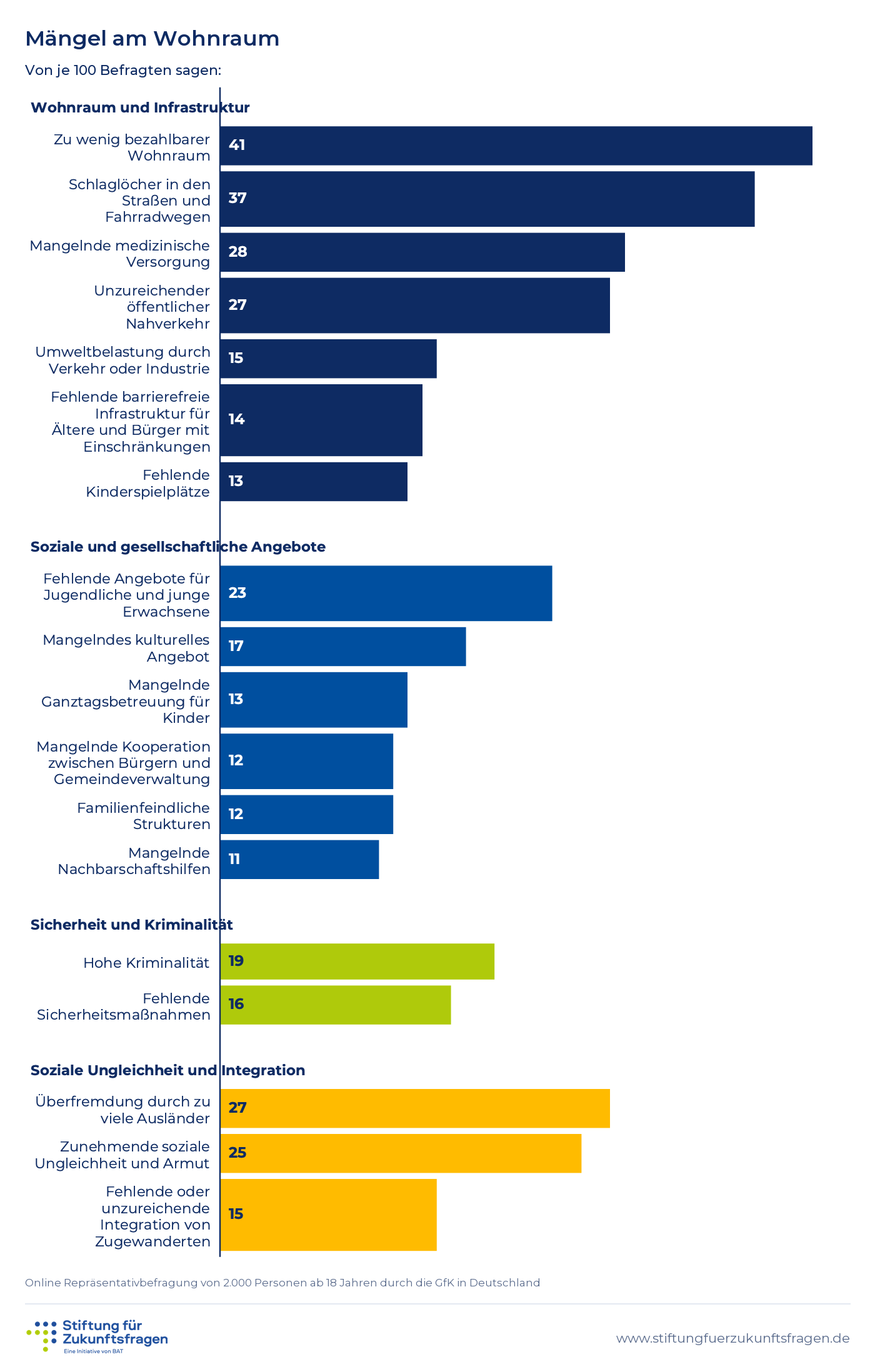
Defects in the living space
Out of every 100 respondents, the following say:
Data as table
| Housing and infrastructure | |
|---|---|
| Too little affordable housing | 41 |
| Potholes in the roads and cycle paths | 37 |
| Lack of medical care | 28 |
| Inadequate public transport | 27 |
| Environmental pollution caused by traffic or industry | 15 |
| Lack of accessible infrastructure for the elderly and citizens with disabilities | 14 |
| Lack of children's playgrounds | 13 |
| Social and community services | |
| Lack of services for teenagers and young adults | 23 |
| Lack of cultural offerings | 17 |
| Lack of full-day childcare | 13 |
| Lack of cooperation between citizens and local government | 12 |
| Anti-family structures | 12 |
| Lack of neighborly assistance | 11 |
| Security and crime | |
| High crime rate | 19 |
| Lack of safety measures | 16 |
| Social inequality and integration | |
| Overcrowding due to too many foreigners | 27 |
| Increasing social inequality and poverty | 25 |
| Lack of or insufficient integration of immigrants | 15 |
Result
Structural deficits characterise the attitude to life of many citizens in their place of residence. The lack of affordable housing and infrastructural weaknesses such as potholes in the roads or inadequate medical care are mentioned most frequently. Social issues such as a lack of leisure activities for young people or a perceived lack of cultural life were also mentioned. Safety concerns and worries about social division - for example due to foreign infiltration or social inequality - also illustrate the extent to which socio-economic conflicts influence the neighbourhood.
Reasons
The dominance of the issue of housing shortages reflects the ongoing urbanisation and the associated demand pressure in metropolitan areas. Rising rents, limited land resources and insufficient new construction activity are fuelling this development. Infrastructural deficiencies are the result of investment backlogs and an allocation of public funds that is not always transparent. Criticism of medical care, on the other hand, can be attributed to demographic change, among other things, while deficits in local public transport are often attributed to poor connections and inadequate frequency.
The perceived precarious social situation - especially the lack of youth programmes - points to a neglect of municipal services of general interest, particularly in rural regions. Security concerns, on the other hand, do not only arise from actual crime data, but also from subjective feelings of insecurity, which are reinforced by media coverage. The mention of foreign infiltration and social inequality is linked to social change processes that are exacerbated by inadequate integration measures and economic polarisation.
Forecast
The challenges identified also offer starting points for improvements. Initial successes are already being seen in the area of housing, for example through the promotion of innovative construction projects and the conversion of commercial space. In the social sector, citizen participation is becoming increasingly important. Participatory urban development projects and the involvement of young citizens in the design of living, working and leisure facilities strengthen the community and minimise the potential for conflict.
Security concerns can be defused on the one hand by preventative measures such as more surveillance and on the other hand by expanding social work. At the same time, more transparent crime statistics and greater involvement of the population in security issues will help to build confidence and increase the feeling of security. In the long term, there are signs of positive developments overall, but it will remain crucial in the future to include the needs of all population groups - from young people to newcomers to senior citizens - in the organisation of the immediate living environment.