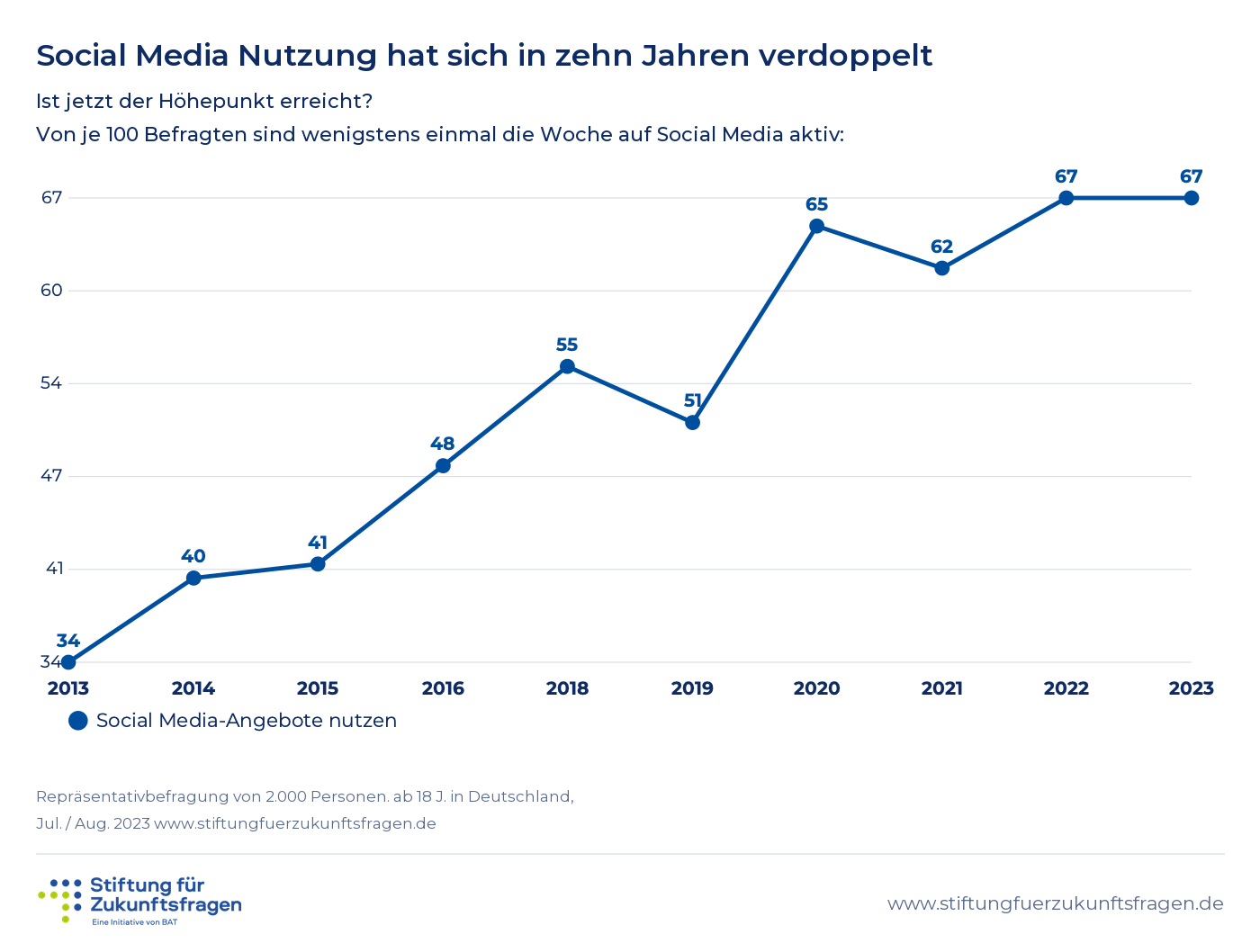


Social media usage has doubled in ten years
Has the peak been reached now.
Out of every 100 respondents, at least one is active on social media once a week:
Data as table
| Using social media services | |
|---|---|
| 2013 | 34 |
| 2014 | 40 |
| 2015 | 41 |
| 2016 | 48 |
| 2018 | 55 |
| 2019 | 51 |
| 2020 | 65 |
| 2021 | 62 |
| 2022 | 67 |
| 2023 | 67 |
A review and outlook for Twitter, Instagram, Facebook and co.
The data is an extract from our new Leisure Monitor 2023 study. You can find the full results on our Special page Freizeitmonitor.de.
Result
Over the last decade, the proportion of citizens active on social media has almost doubled from 34% to 67%. However, growth has slowed noticeably in the last three years. In 2020, there were almost as many users active on Instagram, Facebook and the like as there are now. On the one hand, this shows the firm establishment of social media offerings in leisure time, but on the other hand also a possible saturation of the market.
Reasons
The initial fascination with social media is largely due to the emergence of large companies. LinkedIn (2003), Facebook (2004), Twitter (2006), Instagram (2010) and Snapchat (2011) left their footprint in the digital space early on and triggered or utilised the social media boom. Their innovations and networking opportunities captivated many citizens. The slowdown in growth in recent years can be attributed to various developments and reasons:
- TimeSocial media use is time-consuming and many people want to use their free time for other activities.
- MainstreamThe use of social media has become a matter of course and has lost its innovative character.
- Social pressureThe pressure to post content regularly and to be present online is increasing, but is also being viewed more and more critically at the same time.
- ClutterThe multitude of platforms makes it difficult to maintain an overview and find the right platform for you.
- Lack of innovation: Innovations in the platforms have declined in recent years.
- Data protection concernsConcerns about privacy and data handling are increasing.
- CommercialisationCompanies and advertising content are increasingly dominating social portals and transforming "social media" into "social commerce" platforms.
Forecast
The social media sector will have to evolve in the future if it wants to remain attractive to the majority of citizens. Partly due to today's short attention spans on the part of users, platforms such as TikTok and Instagram are currently benefiting more and more from user-generated video content, while traditional posts are increasingly losing their appeal. Instead of the large platforms dominating, smaller platforms that serve more specific needs, interests and communities could also gain in importance.
In addition, the integration of augmented reality (AR) and virtual reality (VR) could change the way social media is experienced, making it more immersive and interactive. Authenticity will also be a key issue, as many users crave genuine, unadulterated experiences. In addition, there will be discussions about usage rights and data protection, which will also determine the use and non-use of certain platforms.