

Current Research, 318
June 4, 2026

Currently, 100 women in Germany have 135 children; ten years ago, the figure was 159. The increasing childlessness in Germany is primarily an expression of growing insecurity – not a lack of desire for a family. Those who choose not to have children usually cite not just one reason, but a whole range of mutually reinforcing concerns. For example, two-thirds cite the high financial burden as a reason against having children. However, a majority also mentions worries about their children's future security, the desire for freedom and independence, and a lack of supportive government services.
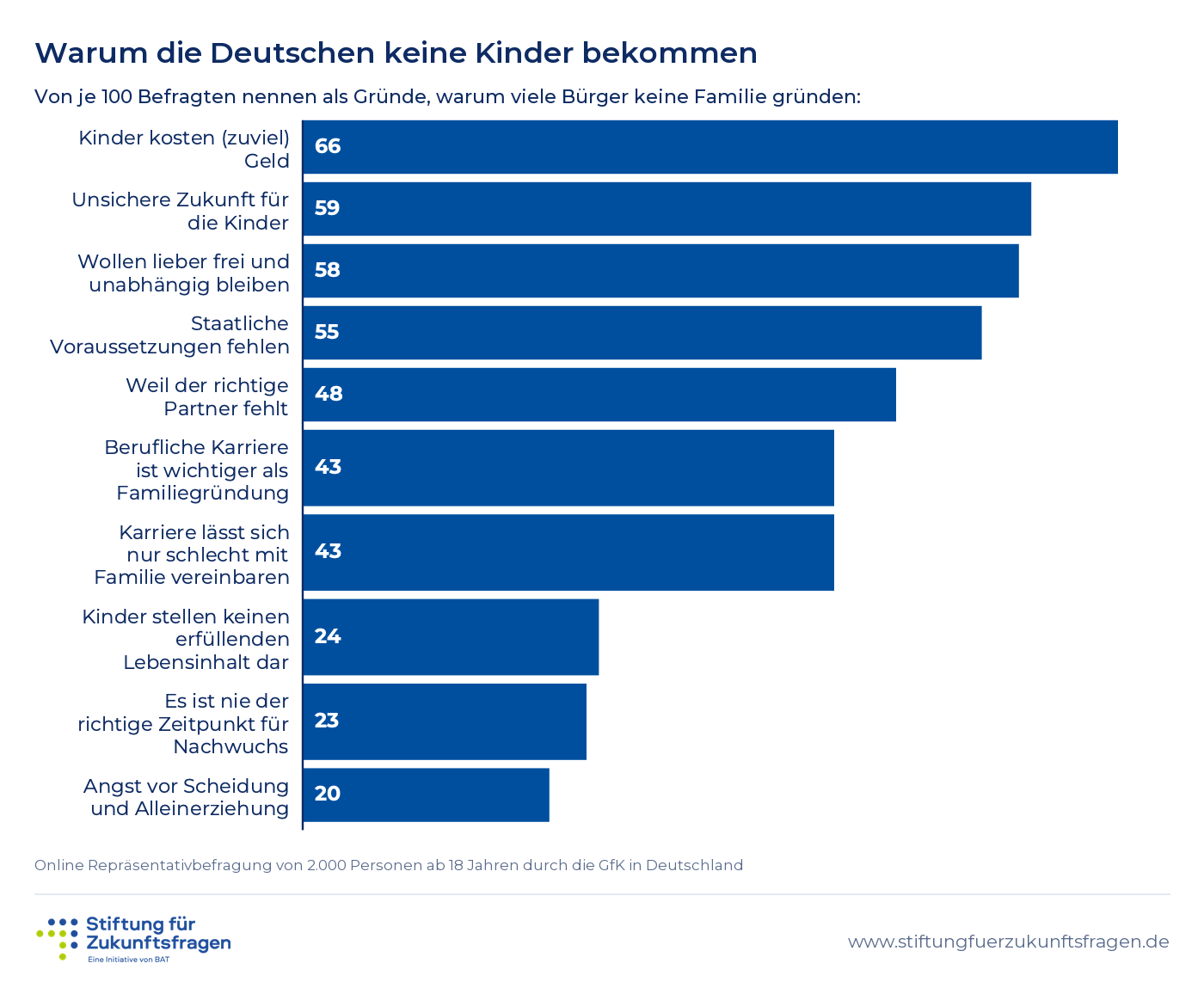
Why Germans aren't having children
Out of every 100 respondents, the following reasons are given as to why many citizens do not start a family:
Data as table
| Children cost (too much) money | 66 |
| An uncertain future for the children | 59 |
| They prefer to remain free and independent | 58 |
| State prerequisites are lacking | 55 |
| Because the right partner is missing | 48 |
| Professional career is more important than starting a family | 43 |
| It is difficult to reconcile a career with family life. | 43 |
| Children do not represent a fulfilling purpose in life. | 24 |
| It's never the right time to have children | 23 |
| Fear of divorce and single parenthood | 20 |
Time comparison: Uncertainty displaces professional arguments
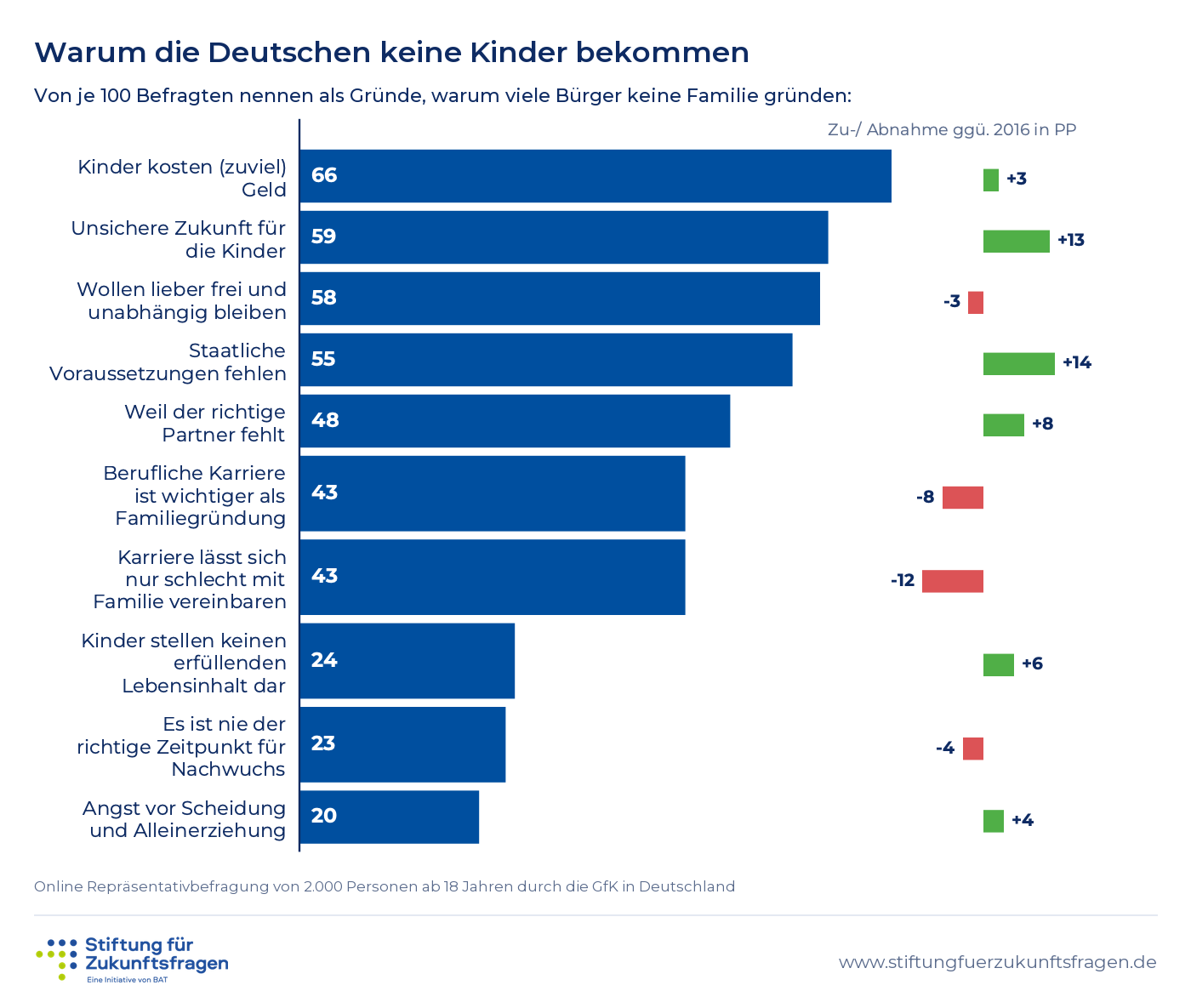
In a ten-year comparison, three shifts are particularly noticeable: Concern for a good future for children has gained significantly in importance (+13 %), as has the reference to a lack of state support (+14 %). At the same time, professional arguments are mentioned much less frequently: The notion that a career is difficult to reconcile with family life is losing importance (-8 %), as is the statement that professional success is more important than starting a family (-12 %).
Professor Dr. Ulrich Reinhardt, scientific director of the foundation, says:
„"Today, the focus is not on professional conflicts with family life, but on a lack of suitable conditions. In a time of perceived uncertainty, many citizens worry whether their children will still live safely and prosperously."“
Why Germans aren't having children
Out of every 100 respondents, the following reasons are given as to why many citizens do not start a family:
Data as table
| Increase/decrease compared to 2016 in PP | ||
|---|---|---|
| Children cost (too much) money | 66 | +3 |
| An uncertain future for the children | 59 | +13 |
| They prefer to remain free and independent | 58 | -3 |
| State prerequisites are lacking | 55 | +14 |
| Because the right partner is missing | 48 | +8 |
| Professional career is more important than starting a family | 43 | -8 |
| It is difficult to reconcile a career with family life. | 43 | -12 |
| Children do not represent a fulfilling purpose in life. | 24 | +6 |
| It's never the right time to have children | 23 | -4 |
| Fear of divorce and single parenthood | 20 | +4 |
Women wait for reliability, men for a career break.
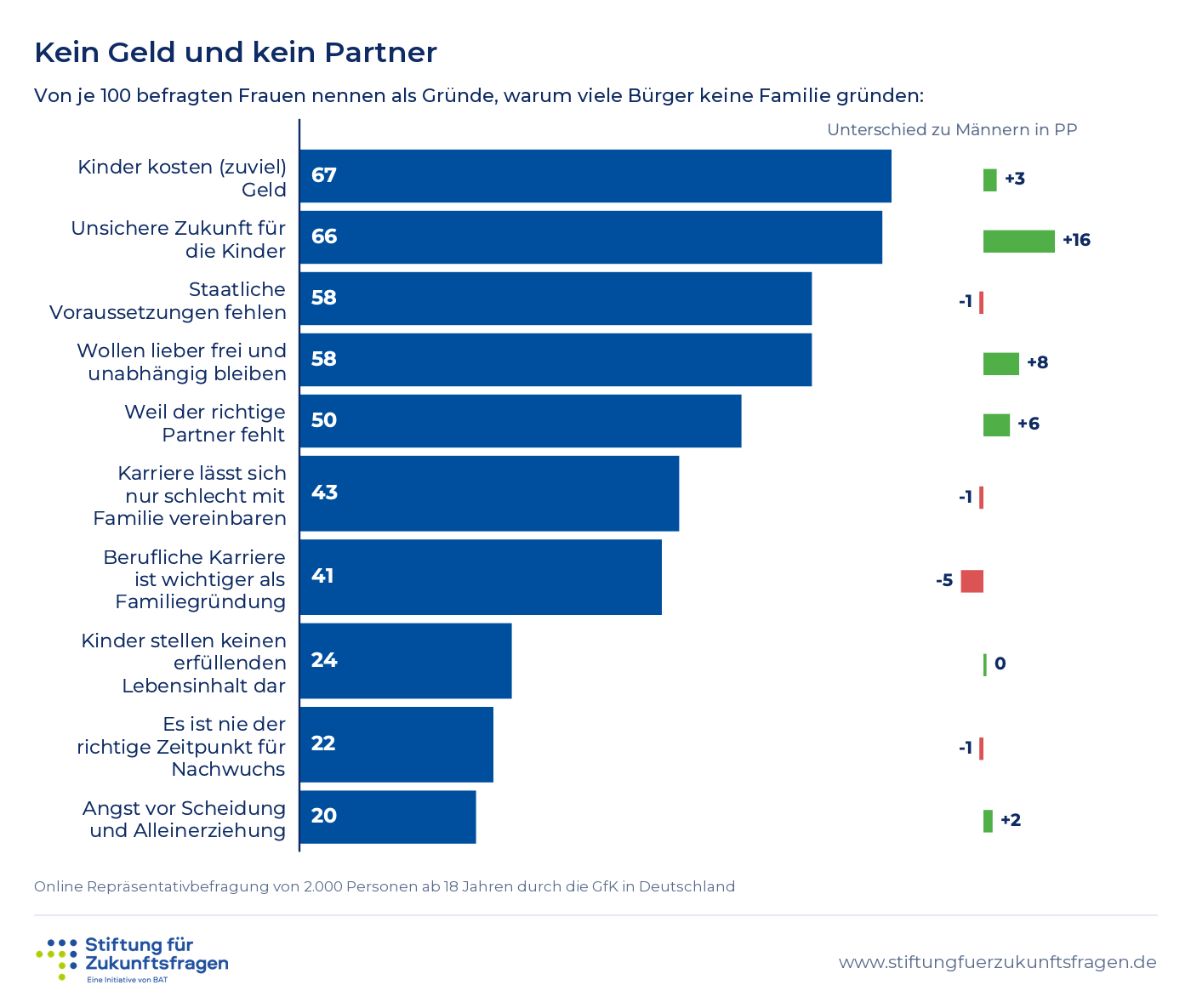
The gender differences also reveal clear trends: Women more frequently cite the lack of a partner, in addition to external factors, which points to changing partnership and educational trajectories. Men, on the other hand, more often state that they prioritize their professional career. For many women, starting a family thus depends more heavily on reliable external conditions and a suitable, equal partnership.
No money and no partner
Of every 100 women surveyed, the following reasons were given as to why many citizens do not start a family:
Data as table
| Difference to men in PP | ||
|---|---|---|
| Children cost (too much) money | 67 | +3 |
| An uncertain future for the children | 66 | +16 |
| State prerequisites are lacking | 58 | -1 |
| They prefer to remain free and independent | 58 | +8 |
| Because the right partner is missing | 50 | +6 |
| It is difficult to reconcile a career with family life. | 43 | -1 |
| Professional career is more important than starting a family | 41 | -5 |
| Children do not represent a fulfilling purpose in life. | 24 | 0 |
| It's never the right time to have children | 22 | -1 |
| Fear of divorce and single parenthood | 20 | +2 |
Childless: Self-determined instead of family-bound
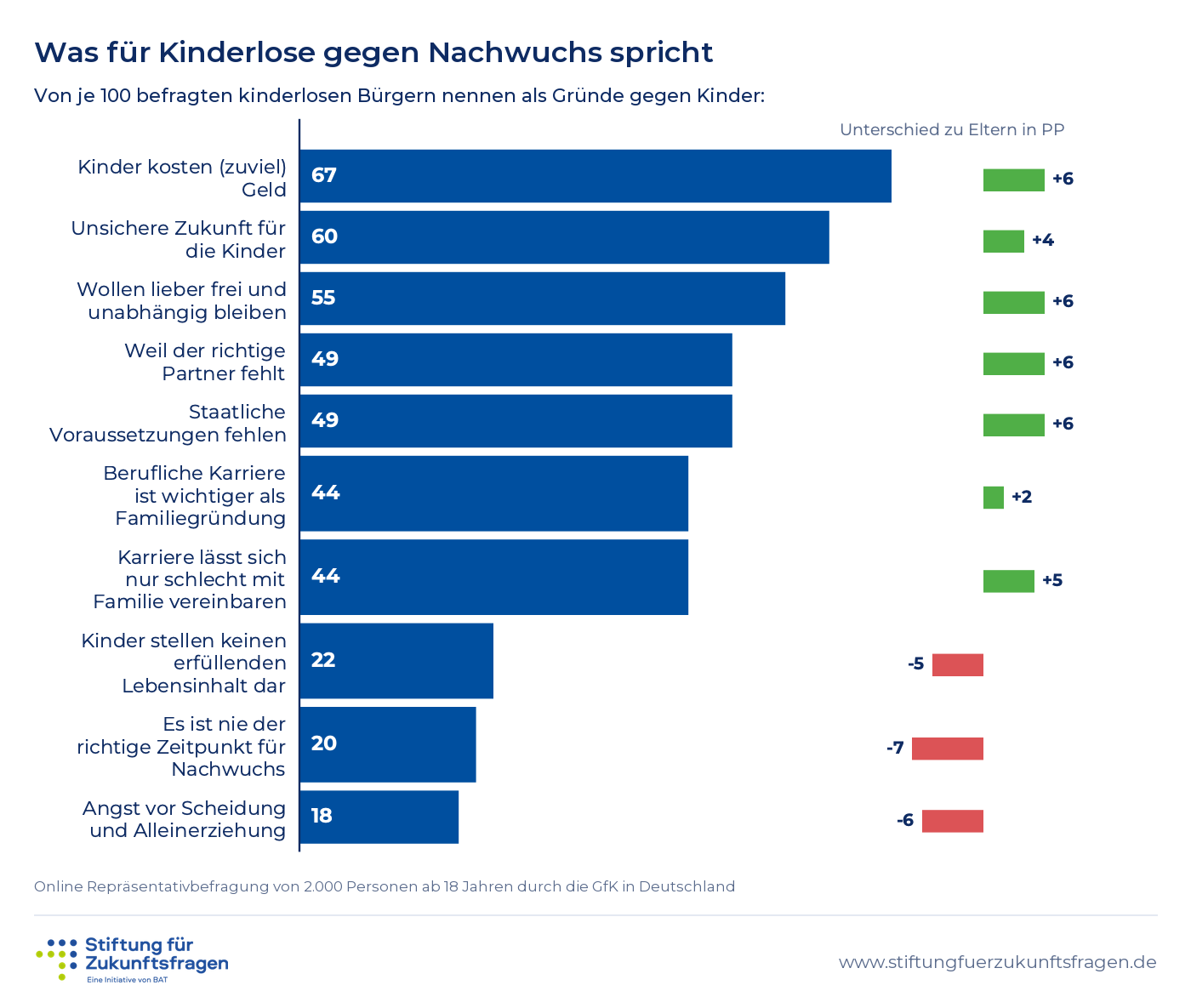
For childless individuals, the reasons for not having children primarily focus on their own life plans and the conditions under which starting a family even seems conceivable to them. The desire to remain free and independent is cited particularly frequently. For them, childlessness is not merely a sacrifice, but often a conscious decision in favor of self-determination and more open biographical options.
Furthermore, the question of partnership is of great importance. For many childless people, the lack of a suitable partner is one of the main obstacles on the path to starting a family. Reinhardt:
„"From the perspective of many childless people, starting a family requires not only the desire for children, but also a stable relationship that offers reliability, shared perspectives and a viable everyday basis. Where this prerequisite is lacking, parenthood is postponed or completely rejected."“
Thirdly, the financial burden remains a key factor. Children are considered expensive, and from the perspective of those without children, this idea is linked to the worry of having to restrict their own freedom, consumption opportunities, and future plans.
What speaks against having children for childless people
Of every 100 childless citizens surveyed, the following reasons were given against having children:
Data as table
| Difference to parents in PP | ||
|---|---|---|
| Children cost (too much) money | 67 | +6 |
| An uncertain future for the children | 60 | +4 |
| They prefer to remain free and independent | 55 | +6 |
| Because the right partner is missing | 49 | +6 |
| State prerequisites are lacking | 49 | +6 |
| Professional career is more important than starting a family | 44 | +2 |
| It is difficult to reconcile a career with family life. | 44 | +5 |
| Children do not represent a fulfilling purpose in life. | 22 | -5 |
| It's never the right time to have children | 20 | -7 |
| Fear of divorce and single parenthood | 18 | -6 |
Conclusion: Families need good conditions – and the courage to use them.
Ultimately, the results paint a clear picture: childlessness today is less an expression of a lack of desire for a family than a consequence of growing uncertainty and high expectations regarding the conditions for starting a family. It is not a single obstacle that is decisive, but rather the interplay of financial concerns, anxieties about the future, desires for freedom, and biographical uncertainties.
At the same time, the differences between genders, as well as between childless individuals and parents, highlight the diverse perspectives on having children. Therefore, policymakers and businesses are called upon to create reliable and supportive framework conditions – but so too are citizens themselves, who must summon the courage to start a family. For when societal conditions become more reliable, partnerships are experienced as more stable and equal, and the future seems more predictable, the willingness to not only desire a family, but to actually start one, is likely to increase.