
Start-up into life
Self-employment under scrutiny: Research institute of British American Tobacco publishes comprehensive representative study „Start-up into life: How self-employed are Germans?“
For the first time since German reunification, the number of new business start-ups is negative. More companies are being dissolved than newly registered. Insolvency figures are reaching a new peak. In the 1960s, more than one in five employees (221,000,300) was self-employed; today, only one in ten employed people (10.11,000,300) in Germany is self-employed (3.6 million) – a relatively low proportion compared to the EU average (141,000,300). Outside of agriculture, only about one in eleven employed people in Germany (West Germans: 9.51,000,300 – East Germans: 8.21,000,300) is self-employed. The politically targeted increase in the self-employment rate to 15 percent is still a long way off.
The subjective assessment: One's own opinion is more important than one's own company.
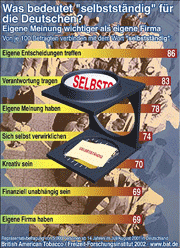
Job losses and high unemployment are on one side, while growing hopes for new entrepreneurial ideas and business start-ups are on the other. Self-employment could be a way out of the employment crisis. However, when Germans think of self-employment, they think more of a personality trait than of starting a business. Having one's own opinion (78%) is more important to Germans than owning one's own company (69%). Self-reliance in life is demonstrated by the ability to make one's own decisions (83%). This is according to a new research study by the Leisure Research Institute of British American Tobacco, in which 5,000 people aged 14 and over in Germany were surveyed about their attitudes toward self-employment in life and work.
„From the public’s perspective, self-employment is a positively connoted term that describes desirable achievement and life goals,“ says Prof. Dr. Horst W. Opaschowski, head of the institute. „Unlike the general population, the self-employed and freelancers particularly emphasize the aspect of responsibility. Self-employed individuals are characterized by their willingness to take responsibility – for themselves and for others, both professionally and privately.“
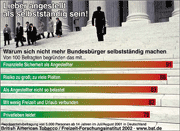
Can self-employment be a way out of the employment crisis? Experience shows that every new business creates four new jobs. However, the great hope of the 21st century for the creation of new companies is not being fulfilled in Germany. While more than three-quarters of German citizens (78%) believe that "we need more self-employed people," only one in ten employees is actually willing to take the plunge. 89 percent of Germans "feel more comfortable when they are guided." The risk is simply too great for them: "There are too many bankruptcies," say 88 percent of the population.
„In business, society, and politics, the praises of self-employment have been sung almost unquestioned. In reality, for most entrepreneurs, self-employment is more of a test of endurance than a path to self-realization,“ says Professor Opaschowski. „Many entrepreneurs feel forced into self-employment out of necessity (e.g., 600,000 unemployed since 1995). They have involuntarily forced experiences with self-employment, which is why many start-up ventures fail.“
The vast majority of young people aged 18 to 34 give up prematurely and accept the fact that "self-employment is not attainable for everyone" (83%). The groundwork for a new generation of entrepreneurs has not yet been laid in Germany. A culture of risk-taking remains largely foreign to young people. Ninety percent of 18- to 34-year-olds do not want to "take the risks of being an entrepreneur" and prefer to enjoy the "financial security" and regular income of being an employee. "Being self-reliant rather than an employee: This entrepreneurial mindset is underdeveloped in Germany," says Professor Opaschowski. "The prevailing model is still that of the industrial age – the dependent employee, for whom a welfare mentality is more attractive than entrepreneurial risk."„
Between perspective and profit:
The self-employment profile of women
There are worlds of difference between women and men in their understanding of the qualities an independent personality must possess:
- Women place significantly more value on honesty (53% – m: 46%), politeness (49% – m: 42%) and proper behavior (43% – m: 39%) and also expect more tolerance (44% – m: 38%) and sense of justice (41% – m: 35%), respect (36% – m: 32%) and self-control (49% – m: 46%).
- Men, on the other hand, demand more will to succeed and win from an independent personality (53% – w: 50%) and also emphasize assertiveness somewhat more (65% – w: 63%).
Here, seemingly irreconcilable professional aspirations clash, contrasting gentle and strict ones. However, a closer look reveals that women place just as much value on self-confidence and strength of character as men (781 TP3T and 511 TP3T respectively), but also demand adherence to convention, decency, and social skills. This confirms the findings of a BAT representative survey from the 1980s, which stated: 1. Women are more socially engaged and 2. Women are more considerate (BAT Study: Women's Leisure Activities, 1989, p. 39) – not only in their private lives but also in their professional lives.
The requirements profile:
Competent. Resilient. Motivated.
What the general public assumes many self-employed people to do – „They want to get rich,“ at least according to 56 percent of Germans – is viewed much more realistically by the self-employed themselves (43%). The first negative professional experiences during the start-up phase have sharpened the sense of reality for many young people: Every second entrepreneur under 34 (51%) has lost faith in getting rich quick and advises anyone planning the same to abandon unrealistic expectations early on. Otherwise, serious misjudgments of market developments can occur. Opaschowski: „Start-ups often fail due to insufficient business knowledge and a lack of expert advice.“ For most entrepreneurs, self-employment is simply another word for self-realization; that is, they follow their own creative impulses more than mere commercial interests. Specifically: They want to utilize the full range of their skills in their work (82%). They want to seize the opportunities to be creative and entrepreneurial themselves (82%). And: They have an entrepreneurial idea (77%) and want to realize this idea themselves from beginning to end (70%). For them, being entrepreneurial means being creative. A high, almost idealistic standard for both idea generators and idea implementers.
What self-employed people demand of themselves is almost synonymous with being overwhelmed and resembles living 'close to the limit'. The answers to the question "What personal qualities and skills should one possess to be successful as a self-employed person?" reveal a profile of requirements that can be described as "Competent. Resilient. Motivated." Enjoyment of work (95%), professional competence (94%), and resilience (94%) describe the specific requirements of today's self-employed. Part of a self-employed person's professional attitude is taking care of their own health. According to the self-employed, good health (91%) is more important than extensive life experience (71%) or diverse professional experience (78%).
When 85 percent of self-employed individuals consider a 60- to 70-hour work week a given, it becomes clear how important their private social environment is to them—an environment that must understand their excessive workload. Otherwise, they wouldn't be able to cope. Understanding partners (85%) and reliable friends (52%) are therefore indispensable. Almost one in three young entrepreneurs under the age of 34 necessarily prioritizes career success over starting a family, making the very personal decision: to have as few children as possible (31%). This is a consequential decision and also explains why there are such serious succession problems, particularly in small and medium-sized enterprises (SMEs).
Starting a business must always involve life planning, which includes starting a family as well as arranging for business succession. Otherwise, professional success can quickly lead to family disaster. Almost three-quarters of the self-employed (73%) have to admit, with self-criticism: "Private life suffers or is even sacrificed. Family always gets neglected."„
The divided citizens:
To lead or to be led?
Should self-employment become a new educational ideal for the 21st century? To answer this question, German citizens were confronted with a series of contradictory statements. The survey results are not surprising at first glance. The population remains divided: some want to lead, others prefer to be led. Those who choose self-employment in life must largely abandon lethargy, inertia, and complacency.
Both the general population and the self-employed make two momentous statements based on their personal experience in dealing with people:
- „Many feel more comfortable when they are guided“ (89%)
- „"Self-employment is not attainable for everyone (86%).".
The educational principle of "challenge rather than indulge" remains an indispensable educational goal. Realistically, even young people today recognize (79% – rest of the population: 78%): "In our performance-oriented society, we need more independent individuals who take responsibility." This is an educational and socio-political imperative.
Starting a business:
Too many rules as an obstacle
Business, politics, and society hope for a new culture of risk-taking, a new era of entrepreneurship, and a wave of new business start-ups in the future. The socio-political objective is clear. However, personal experiences fluctuate between entrepreneurial zeal, overconfidence, and seemingly insurmountable obstacles. Too much risk and too many regulations: this sums up the reasons why more people in Germany aren't becoming self-employed today.
According to the general public, most people shy away from the "risk of entrepreneurship" (92%). As an employee, one can enjoy much greater financial security and the regularity of work (and income). One doesn't need to "burden oneself so much" (83%); after all, the risk is ultimately borne by "the boss." As a self-employed person, on the other hand, "one is subject to too many rules, regulations, and requirements imposed by the state": Self-employed individuals (80%) and the rest of the population (78%) agree that the state places more obstacles in one's path than it builds bridges.
According to the self-employed individuals surveyed, anyone in Germany who seriously wants to promote business start-ups and self-employment should primarily focus on three measures:
- Offering start-up capital at a low price (85%)
- Provide favorable tax rules for start-ups (74%)
- Reduce bureaucracy (61%).
Politics and business are called upon to act here, otherwise the demand for a new culture of risk-taking in economic life risks becoming a mere empty formula.
When asked whether self-employment is a matter of predisposition or a consequence of upbringing or social influences, almost two-thirds of self-employed individuals (63%) responded that "education towards self-employment from early childhood" is the most likely factor contributing to professional independence. The importance of parental upbringing is seen as pivotal for one's entire life. Young entrepreneurs under 34 years of age, in particular, emphasized the importance of upbringing (69%).
Young entrepreneurs rate the example set by their parents or grandparents as equally important motivation for their own self-employment (69% – overall self-employed: 61%), as it encourages them to emulate and try things themselves. Other significant influencing factors cited by the self-employed group include: role models among their friends (43%), strong interpersonal skills (i.e., a genuine desire to interact with others, 43%), and early encouragement of diverse interests (50%).
Even deeply personal negative experiences within the family, at school, or at work can become a driving force for self-employment. Almost one in four young entrepreneurs under the age of 34 (23%) wants to "prove it to their parents." Escape from their parents' home environment also occasionally plays a role for these young business founders. Some describe their career choice as a "conscious escape from family constraints" (5%), an "escape from an authoritarian school" (9%), or a "reaction to their parents' negative experiences in the workplace" (14%).
A future culture and pedagogy of self-reliance must always keep two educational goals in mind: personal independence and professional independence. The proposals of the self-employed themselves also point in this direction. They call for schools to offer "more projects with a serious focus for learning responsibility" (41%). According to the self-employed, this must also be accompanied by a new role for teachers. Teachers should take on more advisory and pedagogical tasks than before (36%). In doing so, they should be supported in their work by "people actually employed (e.g., tradespeople)" (32%).
In this context, a demand from the self-employed is particularly thought-provoking: They call for not less, but rather more instruction in music, art, theater, sports, religion, and philosophy (27%) in schools. This demand is almost counter-cyclical, given that budget cuts are currently being implemented, especially in the arts and culture sector. Yet these subjects are of great practical importance for learning independence. They serve as a foundation for gaining experience in independent work in a wide variety of forms: play with a work component, work with a play component, and also work with a serious component. This can include extracurricular activities and interest groups, as well as learning to be proactive in student initiatives, self-help groups, and community projects.
Self-employment in Germany has two faces:
- The trend towards individualizing life is directly linked to the growing importance of the ideal of the self-employed individual. In childhood, adolescence, family formation, and retirement, the "business of self-employment" becomes a lifelong challenge for every individual.
- And in their professional lives, young entrepreneurs in particular dream of finally being their own boss and no longer everyone's slave. Professional reality is like walking a tightrope: sometimes the captain of their own boat and sometimes the jack-of-all-trades, sometimes the hunter and sometimes the prey, sometimes the boss and sometimes the puppet. Starting a business can also mean independently pulling strings that are being pulled by others.
Self-employment, the great hope of the 21st century, has so far failed to materialize. Many self-employed individuals suffer from the overwhelming burden of government bureaucracy and tax disadvantages, including inadequate social security in old age. Some negative experiences lead to the conclusion: "You're walking with one foot in a mental institution and the other in the welfare office."„
While the willingness to assume entrepreneurial risks has remained limited among the population so far, the desire for greater independence in life and as an entrepreneur in the workplace is increasing. The 21st century can certainly give rise to a new culture of self-reliance if it is experienced and practiced early on through example in the home and practice in schools. According to a clear majority of the population, self-reliance in life and at work has not been "exactly encouraged" to date (68%). Educational policy is therefore particularly challenged to ensure that fostering self-reliance becomes "the" educational goal of the 21st century. A lifestyle characterized by dependence and the shirking of responsibility has no future.
The book „Start-up ins Leben. Wie selbständig sind die Deutschen?“ by Horst W. Opaschowski is now available in bookstores (Germa Press Verlag Hamburg, ISBN 3-924 865-37-X) or online at www.bat.de for EUR 17.80.
See also directory of all publications