
1979-2009: 30 years of futurology. Foundation for Future Studies publishes study „Vision Germany. New paths into the world of tomorrow“
Out of the crisis with innovations: „Wind energy, healthcare and childcare.“
Germans demand priorities in shaping the future
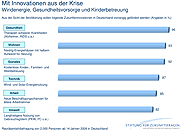
Household robots? Cyber glasses, 3D television and smart fridges? None of this is set to become a reality in the future, according to the wishes and demands of Germans. Germans answer the question „What comes after the crisis?“ by emphasising the need to maintain and improve the quality of life and the environment in Germany. At the top of the list are the wishes for free child, family and elderly care (92%), for treatments for serious illnesses from Alzheimer's to Aids (96%) and for prioritising the use of wind and solar energy (87%). These are the findings of the new „Vision Deutschland“ study by the BAT Foundation for Future Studies, in which a representative sample of 2,000 people aged 14 and over were asked about their ideas for the future.
„Across all phases of life, Germans want to live more in a state of social well-being in the future. They are hoping for support from the state, business and science,“ says Prof Dr Horst W. Opaschowski, Scientific Director of the Foundation and author of the new future study: „Germans think little of inventions for the moment. In their opinion, only sustainable innovations can guarantee lasting prosperity and personal well-being in the long term.“
Germans have very specific ideas about how their visions of today can become the technological and social innovations of tomorrow. For them, these innovations do not simply fall from the sky: their realisation depends on current decisions in economic and research policy. The population's priorities, which should lead Germany out of the crisis and into a future worth living, include the environment, quality of work and quality of life in equal measure.
Green electricity. The lead energy of the future
In the fight against climate change, Germans are focussing entirely on energy efficiency and renewable energies. Alternative energy markets are the new growth markets for them. 87 per cent of the population are therefore calling for priority to be given to promoting the use of wind and solar energy. They want the production of green electricity to become the leading energy source of the future. Foundation Director Opaschowski: „This is a vision for the world of tomorrow, the realisation of which is worthwhile and pays off from the point of view of the population. The wasteful use of energy should be stopped and the development of new energy sources should be prioritised. The Germans are pinning all their hopes on alternative energies. They see it as a panacea for the unresolved problems of climate change.“
Healthcare. The megamarket of the future
Health is the greatest good in life, but it is not an end in itself. Behind this is a massive fear of serious illness. It therefore comes as no surprise that almost all German citizens (96%) see therapies ranging from Alzheimer's to AIDS as „the“ number one innovation of the future. According to the population, these services will become the most important future task in the medical field. Professor Opaschowski: „Health is becoming the megamarket of the future. Biotechnology, genetic engineering, cell therapy and regenerative medicine are among the future beacons of hope. Medical advances should primarily be used to combat the threats to life. The existential should take precedence over wellness, lifestyle or good looks.“ Accordingly, possible innovations in medical research, such as the use of genetic engineering findings to simply increase life expectancy by up to a hundred years (31%) or drugs to increase intelligence (20%), are considered to be of secondary importance. Most German citizens don't just want to live long. They also want to know whether it is worth living that long.
From childcare to basic pensions. The social prosperity of the future
The basic security of large sections of the population will be jeopardised if it is not possible in future to guarantee people's social quality of life as well as maintaining their material standard of living. Security is becoming as important as freedom - from childhood to old age. In times of crisis, more and more people are dependent on provision and care, on welfare and support. This sounds like a cry for help from the population to local authorities, church communities and welfare organisations, parents' associations, businesses and private providers. The childcare requests range from childminder support to day care.
92 per cent of the population across all ages consider such social care services to be „personally important“. The overwhelming majority of the population has now recognised that poverty and social welfare are a threat in old age if no social policy provision is made at an early stage. To prevent poverty in old age, 87 per cent of the population therefore consider the introduction of a basic pension for all to be essential.
„The expansion of these facilities and services cannot happen quickly or well enough for the citizens of Germany. They are not only pinning their hopes for the future on the need to invest in childcare places. Proof of qualification and the reliable guarantee of standardised quality seals are just as important to them.“ The population would like to see more provision from a sustainable policy, especially activating support for charitable activities and social commitment from citizens themselves. Over two thirds of the population (70%) call for special priorities in local politics. Specifically: the priority promotion of voluntary neighbourhood help through helper exchanges in residential areas. Citizens want to help each other more - if only they are allowed to do so and given infrastructural support.
Women and older workers. The new target groups in the labour market of the future
Demographic change will soon be reflected in the world of work: 85 per cent of Germans are already calling for new employment opportunities for older workers. This is the only way to overcome staff shortages in the future. The consequences are inevitable: Companies retain their expertise and their „long-term memory“. And older workers can secure their standard of living by earning additional income. Older people are becoming more important again.
A clear majority of the population (66%) also sees the creation and promotion of more management positions for women as another essential task for the future. Opaschowski: „Because women's qualifications are demonstrably growing and in some cases surpassing those of men, it is only logical that women should be given more management positions. Management levels must become more female.“
Efficiency and intergenerational homes. The housing of the future
Comfortable living should remain affordable. In difficult economic times, Germans are pinning their hopes on future technologies such as „low-energy houses with half the heating costs“. 93 per cent of Germans want this vision of the future to become reality. Tenants and landlords alike want to utilise the energy-saving potential of their houses and flats more effectively and achieve energy efficiency.
The demand of two thirds of the population (65%) to develop interconnected household security systems with burglary protection functions in the future must also be seen in this context. This is a social challenge for future housing construction. From the population's perspective, intergenerational housing is also forward-looking: two thirds of Germans (64%) consider intergenerational building, house and flat communities to be particularly important. Professor Opaschowski: „However, there is still a lack of pilot projects and best-practice examples that encourage people to live in a society of longevity without being alone or feeling abandoned.“
Use instead of consume. The ecological requirements of the future
Pragmatism instead of panic is the population's recommendation for solving the environmental issue. At the top of the list is the realisation that natural resources should be used more carefully and that wasteful consumption should be replaced by more economical use. They consider three ecological visions of the future to be realistic:
- The long-term use of consumer durables such as cars, PCs, etc. (82%).
- More electricity generation through waste incineration (80%).
- Vehicle tax exemption for environmentally friendly cars such as electric cars and cars with fuel cells (78%).
These are to be the environmental technology innovations of the future from the population's perspective. Opaschowski: „This type of environmental and climate protection doesn't hurt and is still effective. And there is no need to threaten people with abandonment or bans.“
Protecting privacy. The media challenge of the future
Whether it's CeBit or the Consumer Electronics Fair, information about new media developments and products is coming thick and fast. Book fairs are dominated by discussions about newly developed e-books that are supposed to overshadow traditional print media. But the impression is deceptive: the makers have done the maths without the takers. In these increasingly uncertain times, the public's expectations of the media industry of the future are completely different. Surveillance cameras for personal security (31%) are seen as more important than electronic newspapers and books (20%).
The media will continue to be indispensable for information and entertainment in the future. However, new media technology products obviously contribute little to solving the unresolved social issues of everyday life. The invention of the e-book will do little to change this. 80 per cent of Germans are happy to do without this digital revolution for the time being.
Model Germany. Land of hope and progress
Heinrich Heine's famous saying „If I think of Germany at night, I am deprived of sleep’ is given a positive twist. When Germans think of the future, they think of hope (41%) and progress (39%), followed by work (37%), technology (34%) and education (23%). Living in a land of hope and progress - this is primarily how the young generation up to the age of 34 envisages the future. Young people are much more enthusiastic about Germany's future prospects than the rest of the population: Based on the three foundations of work (46%), technology (42%) and education (32%), they have high hopes (45%), even and especially in difficult economic times, and are committed to progress (48%): they think little of standing still - they want to move and not stand still. For them, moving forward means Getting ahead.
They trust in their own achievements and - more than the other population groups - expect this to bring growth and prosperity to Germany. Professor Opaschowski: „For the young generation, hope for the future and belief in progress are not mutually exclusive. Young people are most likely to see their hopes for the future realised in a country of ideas and achievement. For them, the future means progress - ecological, technological and social.“
However, young people's belief in the future viability of reforms is extremely low (16%). This is hardly surprising, as „reforms“ have been part of everyday social and educational policy in Germany for over thirty years and have lost their innovative character for the younger generation. For this generation, reform policy has become a permanent topic („Generation Reform“).
Vision Germany. What moves us forward together
From the population's point of view, the course for tomorrow's world must be set today: Politics and business should act now, especially as they have the young people on their side. Compared to the rest of the population, the young generation of 14 to 34-year-olds favours more work (+9 percentage points), more education (+9), more innovation (+6) and more performance (+4) when thinking about the future. Today's hopefuls can become tomorrow's high achievers. Germany - one generation ahead: Compared to the rest of the population, self-confidence is replacing trust in God (-5) and fewer feelings of insecurity (-7) are replacing fear of the future. The next generation wants little to do with pessimism about the future. They see themselves as actors of the future and do not want to rely solely on the state and politics. They want to make a difference themselves and do everything in their own interest to move „us“ forward together. Opaschowski: „The solitary becomes the solidary: the society of egos becomes a community of mutuality.“
Germany is at the beginning of a period of renewal - with the consequence that the future is being rediscovered. Visions of the future are no longer confused with product visions. And more with entrepreneurial courage than with faith in the state, German citizens want to tread paths into the future and not shy away from detours.
The study comes to the hopeful conclusion that what the pioneers and American settlers once achieved was the historic reconstruction work of the post-war generation in Germany. Now, in times of global economic crisis, a second reconstruction effort is beginning, in which citizens want to leave their mark and not just dust. When, if not now? Roll up our sleeves and renew Germany: have visions, dare to innovate - and get started! Entrepreneurial spirit and a willingness to innovate, initiative and reliability can become the new „Made in Germany“. The society in Germany will be different after the crisis - a more self-confident and solidary society with strong citizens.
Research information
To mark the anniversary of British American Tobacco's „30 years of scientific commitment“ (1979-2009), the Foundation for Future Studies (formerly the BAT Leisure Research Institute) is publishing the study „Vision Deutschland. New paths into the world of tomorrow“. The author is Prof Dr Horst W. Opaschowski, Scientific Director of the Foundation.
Number and representation of respondents: 2,000 people aged 14 and over
Survey period: January to March 2009
Survey institute: GfK Marktforschung/Nuremberg
FOUNDATION FOR FUTURE ISSUES
An initiative of British American Tobacco
Alsterufer 4
20354 Hamburg