

Chart of the week, 2025-KW32
7 August 2025
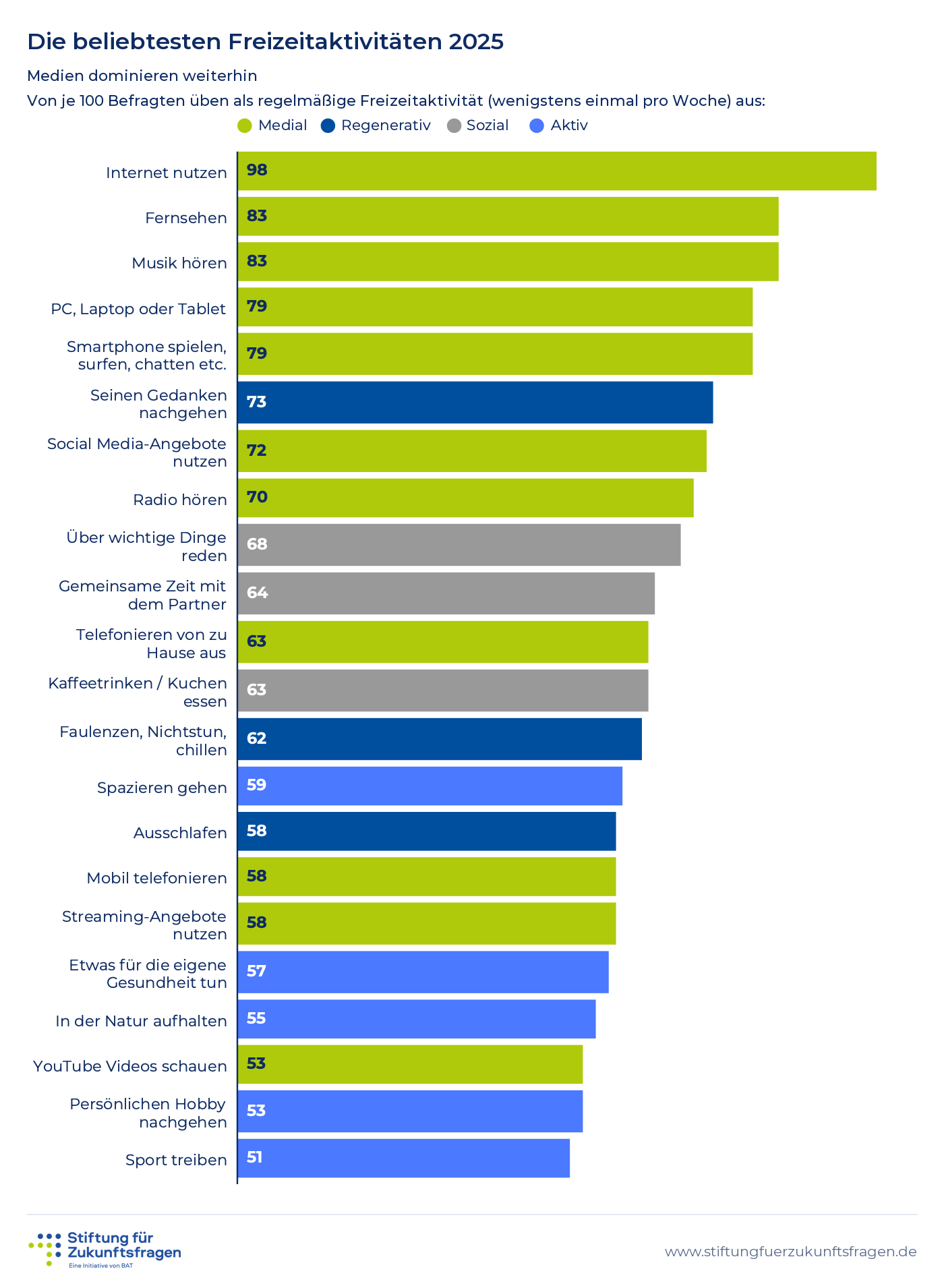
The most popular leisure activities in 2025
Media continue to dominate
Out of every 100 respondents, the following are practiced as regular leisure activities (at least once a week):
Data as table
| Using the internet | 98 |
| Television | 83 |
| Listen to music | 83 |
| PC, laptop or tablet | 79 |
| Playing games on your smartphone, surfing the web, chatting, etc. | 79 |
| to follow his thoughts | 73 |
| Using social media services | 72 |
| Listen to the radio | 70 |
| Talk about important things | 68 |
| Spending time together with your partner | 64 |
| Making phone calls from home | 63 |
| Coffee / Cake | 63 |
| Loitering, doing nothing, chilling | 62 |
| Go for a stroll | 59 |
| Sleep in | 58 |
| Mobile phone calls | 58 |
| Use streaming services | 58 |
| Do something for your own health | 57 |
| Spending time in nature | 55 |
| Watch YouTube videos | 53 |
| Pursue a personal hobby | 53 |
| to do sports | 51 |
Result
Internet use is by far the most common leisure activity among Germans: 98 % of respondents are online at least once a week. Watching TV (83 %), listening to music (83 %) and using a PC, laptop or smartphone (79 % each) are also part of the weekly routine for many.
But media is not the only thing that dominates everyday life. 73 % state that they regularly think about things, 62 % deliberately laze around and 59 % go for a walk. A total of 51 % even do sport - an all-time high. What is striking here is the broad mix: between digital entertainment, simple relaxation, socialising and physical exercise, a varied leisure profile unfolds.
Reasons
Leisure activities are increasingly based on the principle of individual availability. Many offers can be called up at any time, regardless of location and are easily accessible. Digital media in particular fulfils the need for distraction, information and connection - without much effort.
At the same time, the desire for balance is growing: walks, sporting activities or consciously doing nothing reflect the need for deceleration and self-care. What's more, people who spend a lot of time in front of screens are increasingly looking for physical or mental counterbalances. This reprioritisation is also reflected in the fact that traditional social contacts are still maintained - but less frequently than a few years ago.
Forecast
Leisure time in the future will be strongly characterised by two poles: On the one hand, convenient, always-available media use. On the other hand, the desire for exercise, mindfulness and real experiences.
Digital offerings will continue to increase - for example through personalised content or AI-supported recommendations. At the same time, activities with a regenerative or active character are expected to continue to gain in importance, especially in an increasingly digitalised everyday life.
The decisive factor will be whether we succeed in finding a new balance between availability and commitment, between consumption and encounters. After all, real relaxation is not only achieved by switching off - but by consciously experiencing it.