

Tourism analysis 2025
11 February 2025
German Tourism Analysis 2025
Crisis mood - but not when travelling
Core results
-
- Travel frequency continues to rise
- Travel time like 20 years ago
- Holiday spending at record high
- Daily costs have fallen
- Germany remains the most popular holiday destination
- Spain in 1st place among European holiday destinations
- Far and Southeast Asia in first place for long-haul holidays
- New rather than familiar destinations
- Travelling intentions on the rise
- Destinations 2025: Between love of home and wanderlust
- Early booking is in
The current figures on the travel behaviour of German citizens are in remarkable contrast to the general mood in the country. Despite economic uncertainties, social tensions and an overall pessimistic attitude, the frequency of travelling continues to rise. These are the findings of the 41st German Tourism Analysis conducted by the non-profit BAT Foundation for Future Studies. For the representative survey, over 3,000 German citizens aged 18 and over were asked about their travel behaviour and travel intentions.
41st German Tourism Analysis 2025
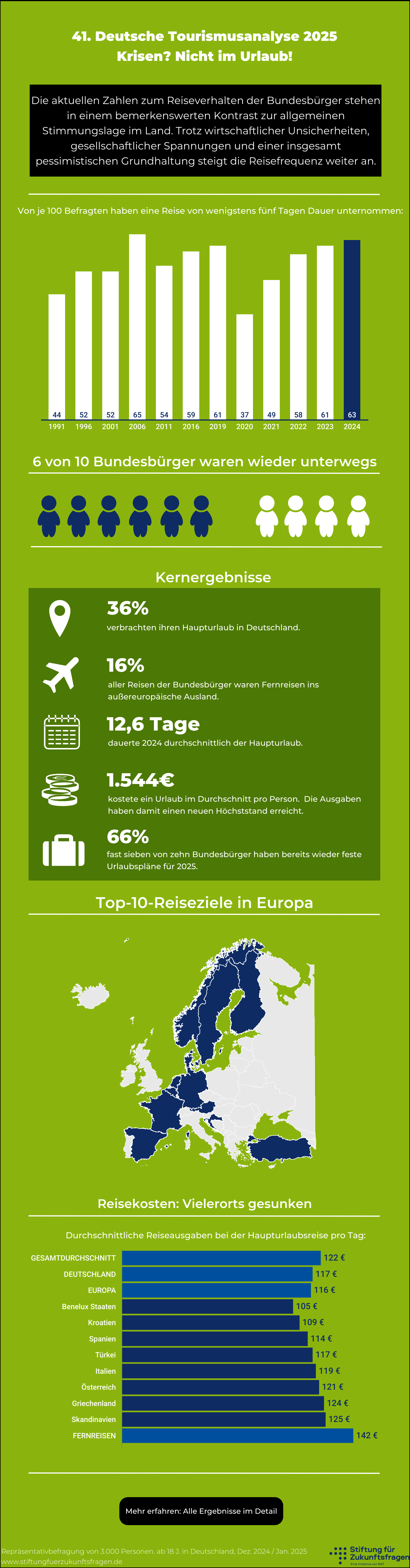
Crises? Not on vacation!
The latest figures on the travel behavior of German citizens stand in remarkable contrast to the general mood in the country. Despite economic uncertainties, social tensions, and an overall pessimistic outlook, the frequency of travel continues to rise.
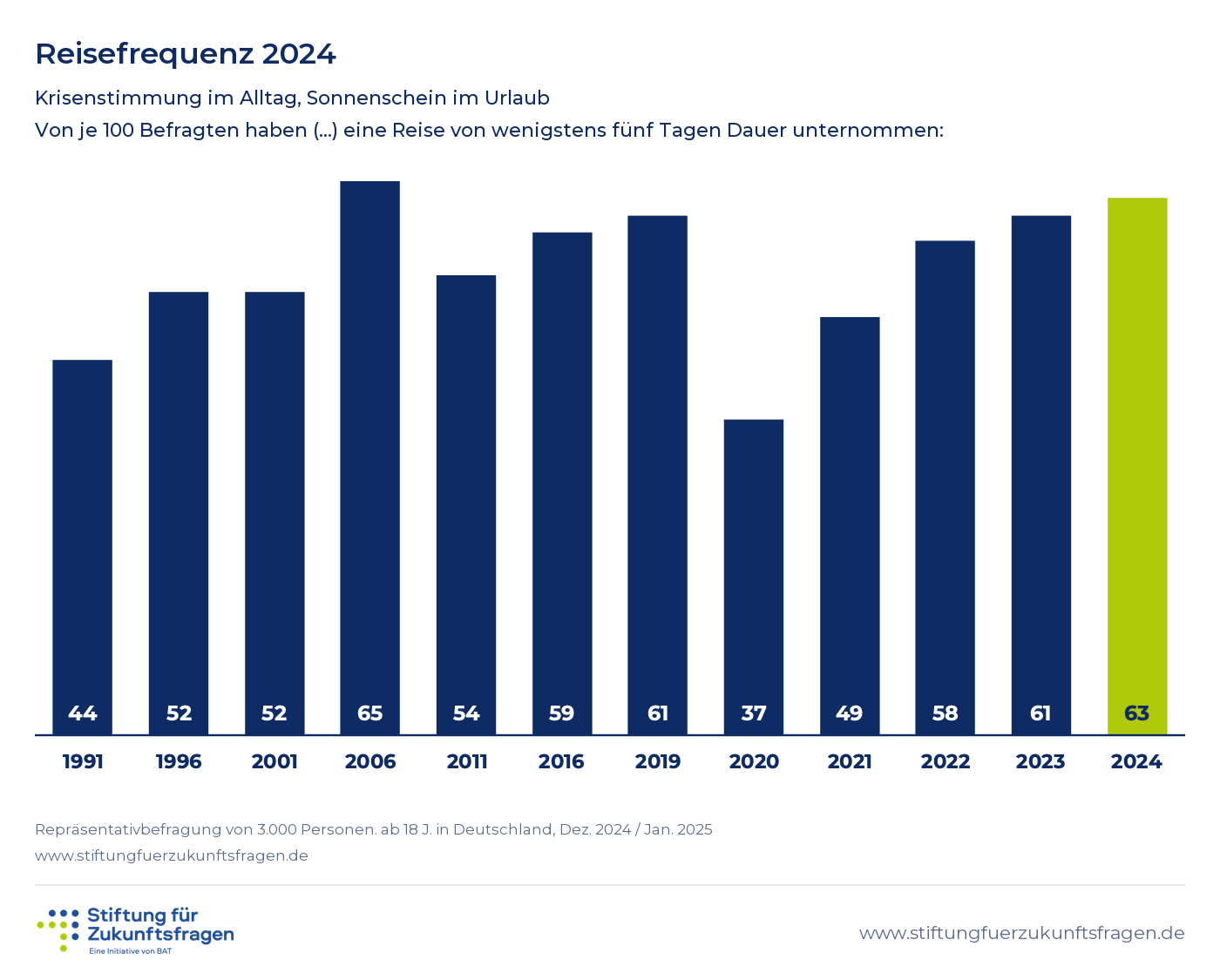
Out of every 100 respondents, one undertook a trip lasting at least five days:
6 out of 10 German citizens were traveling again
Core results
36% — spent their main vacation in Germany.
16% — of all trips taken by German citizens were long-distance trips to countries outside Europe.
12.6 days
The average length of the main holiday in 2024 was...
€1,544 — that's the average cost of a holiday per person. Spending has thus reached a new record high.
66% — almost seven out of ten German citizens already have firm holiday plans for 2025.
Top 10 travel destinations in Europe
Travel costs: Lowered in many places
Average daily travel expenses for the main holiday trip:
Learn more: All results in detail
Data as table
| OVERALL AVERAGE | 122 € |
| GERMANY | 117 € |
| EUROPE | 116 € |
| Benelux countries | 105 € |
| Croatia | 109 € |
| Spain | 114 € |
| Turkey | 117 € |
| Italy | 119 € |
| Austria | 121 € |
| Greece | 124 € |
| Scandinavia | 125 € |
| LONG-DISTANCE TRAVEL | 142 € |
| Year | Portion | |
|---|---|---|
| Total | 1991 | 44 |
| Total | 1996 | 52 |
| Total | 2001 | 52 |
| Total | 2006 | 65 |
| Total | 2011 | 54 |
| Total | 2016 | 59 |
| Total | 2019 | 61 |
| Total | 2020 | 37 |
| Total | 2021 | 49 |
| Total | 2022 | 58 |
| Total | 2023 | 61 |
| Total | 2024 | 63 |
Travelling frequency
In 2024, 63 per cent took a trip lasting at least five days, almost reaching the historic high of 65 per cent in 2006. Compared to the previous year 2023, this corresponds to an increase of two percentage points.
Travel frequency 2024
Crisis atmosphere in everyday life, sunshine on vacation
Of every 100 respondents, (...) undertook a trip lasting at least five days:
Data as table
| 1991 | 44 |
| 1996 | 52 |
| 2001 | 52 |
| 2006 | 65 |
| 2011 | 54 |
| 2016 | 59 |
| 2019 | 61 |
| 2020 | 37 |
| 2021 | 49 |
| 2022 | 58 |
| 2023 | 61 |
| 2024 | 63 |
Trip duration
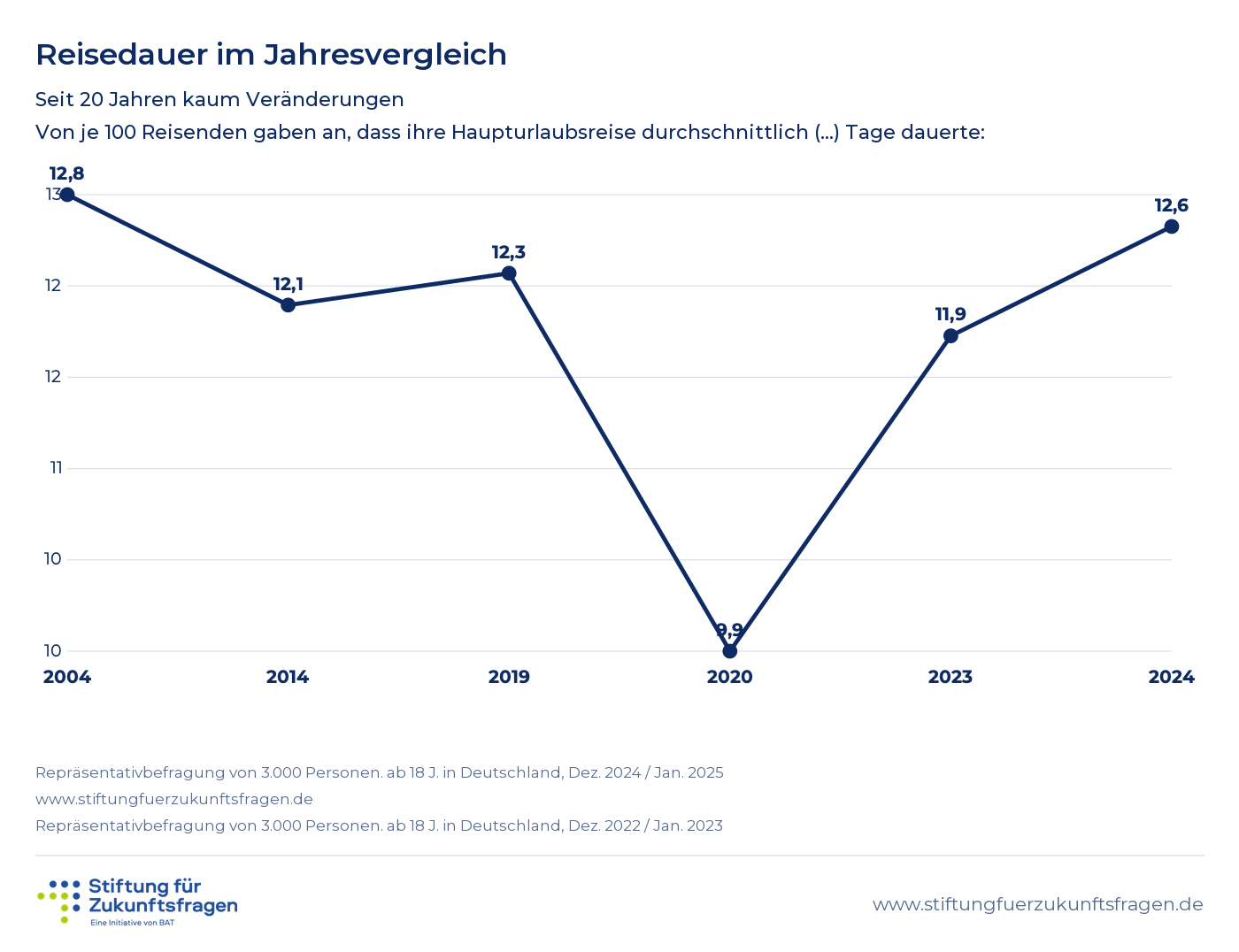
The average length of holiday in 2024 was just under 13 days, slightly exceeding the previous year's figure. However, a look at the long-term trend over the past 20 years reveals a remarkable consistency. Apart from the pandemic-related restrictions in the first year of coronavirus, the duration of holidays has remained largely stable over the years.
Travel duration compared to previous years
Hardly any changes in 20 years
Of every 100 travelers, one indicated that their main holiday trip lasted an average of (...) days:
Data as table
| 2004 | 12,8 |
| 2014 | 12,1 |
| 2019 | 12,3 |
| 2020 | 9,9 |
| 2023 | 11,9 |
| 2024 | 12,6 |
"The differences can mainly be explained by the distance and the effort involved in travelling"according to the Scientific Director of the Foundation, Professor Dr Ulrich Reinhardt. "Destinations in Germany or neighbouring countries allow for shorter main holidays, as they can be reached quickly and still offer relaxation. Croatia and Italy benefit from their easy accessibility by car, which favours slightly longer stays. Typical air travel destinations such as Spain or Greece, on the other hand, are chosen for longer holidays, as travellers want to compensate for the more expensive journey by staying longer. Finally, long-haul holidays stand for a special experience that justifies a correspondingly longer stay due to the long journey time and higher costs.
Travelling expenses
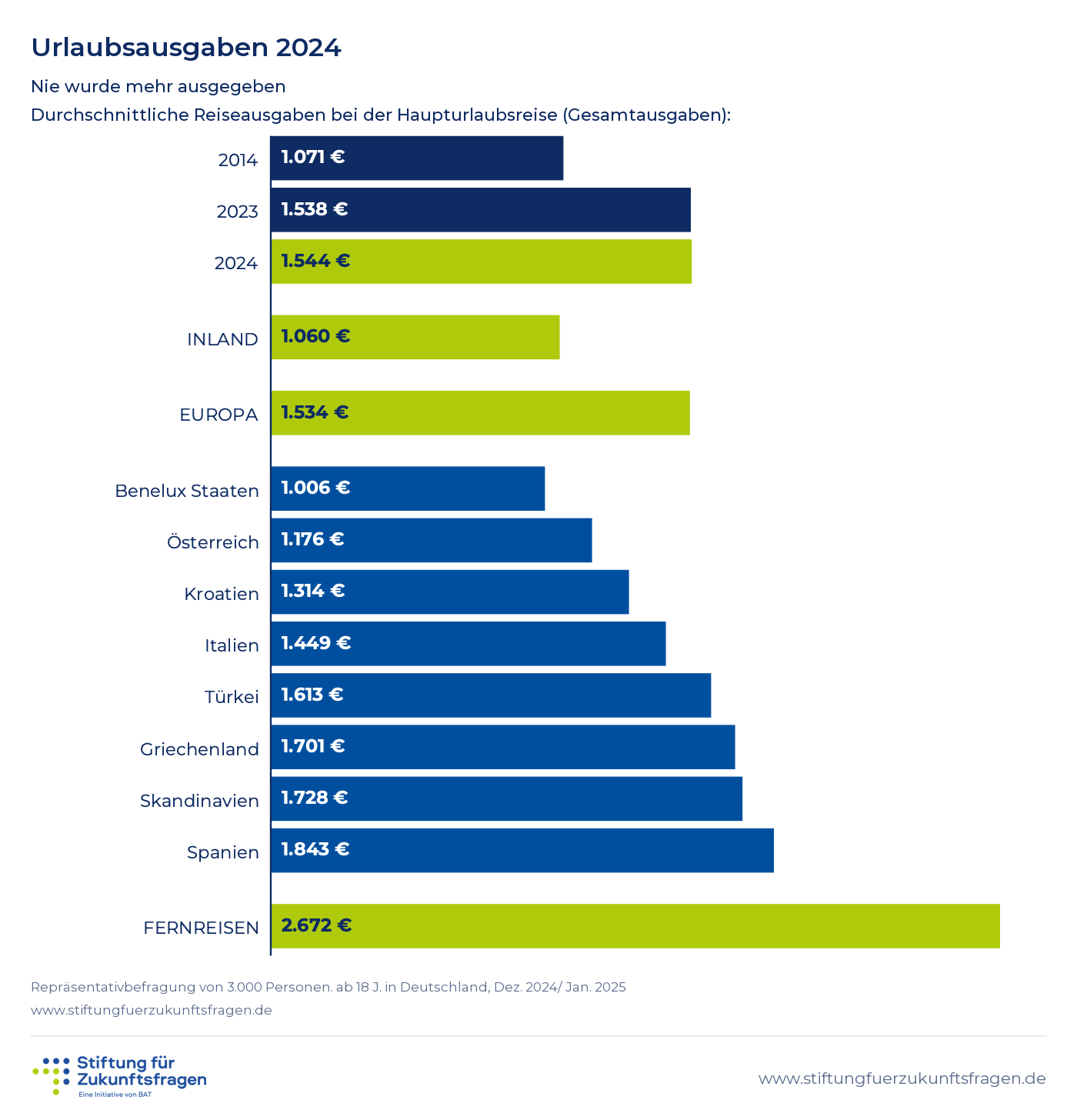
The average holiday costs amounted to EUR 1,544 per person in 2024, remaining almost at the previous year's level but almost 50 per cent above the long-term average.
Within Europe however, there are considerable price differences: While travelling to the Benelux countries or Austria remains comparatively affordable, classic air travel destinations such as Spain, Turkey or Greece are much more expensive.
Particularly high expenses are incurred for Long-distance travelwhich are characterised not only by longer stays, but also by higher flight prices and often more expensive accommodation.
Holiday expenses 2024
Never was more spent
Average travel expenses for the main holiday trip (total expenses):
Data as table
| 2014 | 1.071 € |
| 2023 | 1.538 € |
| 2024 | 1.544 € |
| INLAND | 1.060 € |
| EUROPE | 1.534 € |
| Benelux countries | 1.006 € |
| Austria | 1.176 € |
| Croatia | 1.314 € |
| Italy | 1.449 € |
| Turkey | 1.613 € |
| Greece | 1.701 € |
| Scandinavia | 1.728 € |
| Spain | 1.843 € |
| LONG-DISTANCE TRAVEL | 2.672 € |
Domestic destinations
Also in the year 2024 Germany the most popular destination of German citizens, accounting for 36 per cent of all holiday trips.
Domestic travel destinations 2024
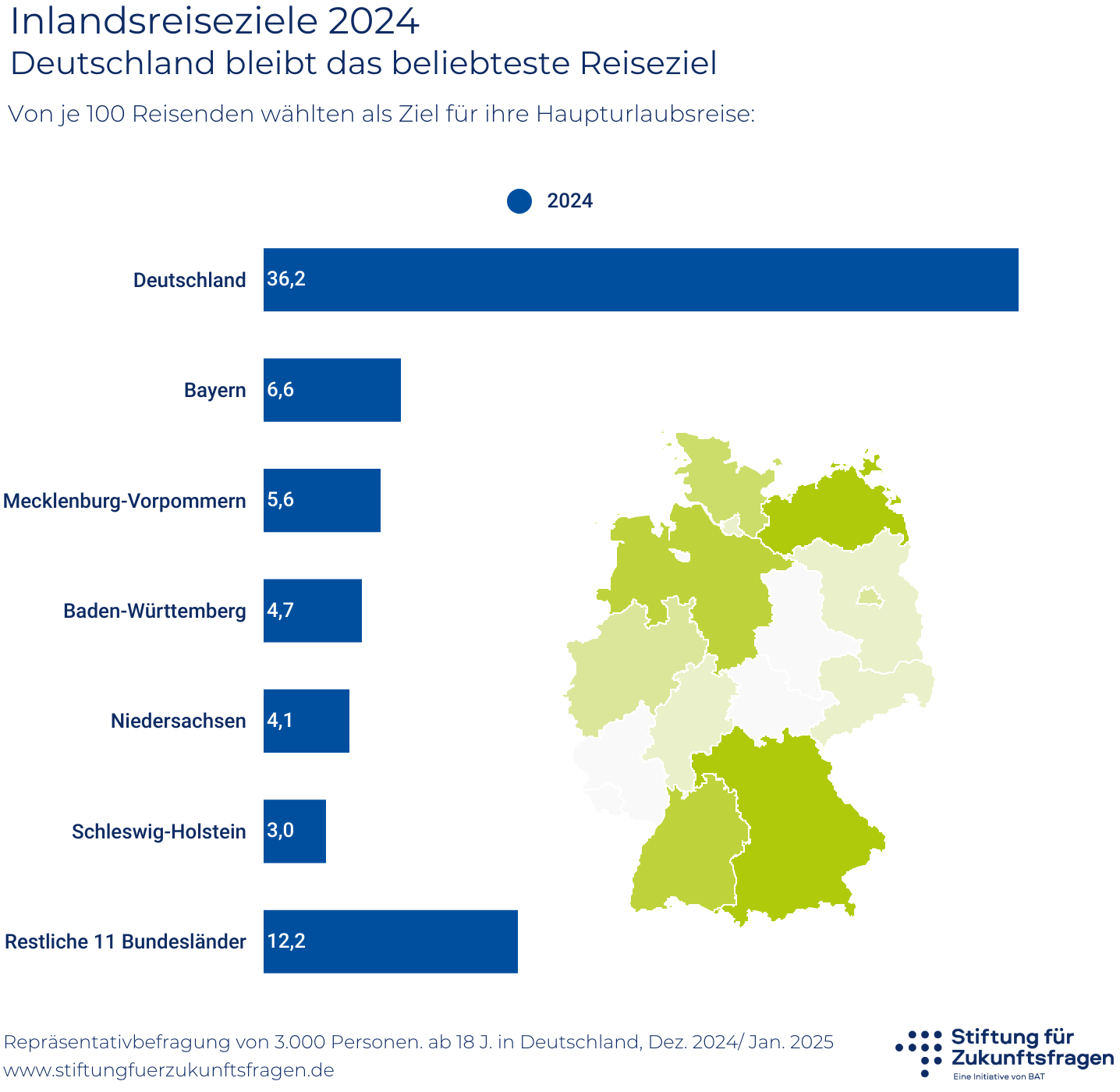
Germany remains the most popular holiday destination
Out of every 100 travelers, the following destinations were chosen for their main holiday trip:
Data as table
| 2024 | |
|---|---|
| Germany | 36,2 |
| Bavaria | 6,6 |
| Mecklenburg-Western Pomerania | 5,6 |
| Baden-Württemberg | 4,7 |
| Lower Saxony | 4,1 |
| Schleswig-Holstein | 3,0 |
| Remaining 11 federal states | 12,2 |
Bavaria was once again particularly popular, coming out on top among the federal states.
Baden-Württemberg was the only one of the five most-visited federal states to significantly increase its share in a ten-year comparison. At the same time, the other eleven federal states also recorded more guests, which indicates an increasing diversification of destinations within Germany.
Professor Reinhardt: "Classic holiday destinations such as the North Sea and Baltic coasts or the Alpine region remain popular, but lesser-known destinations are becoming increasingly important. More and more people are consciously choosing new places away from the heavily frequented holiday areas and are opting for more individual travel experiences."
European destinations
The results for European travel destinations in 2024 show a clear shift in preferences compared to 2014 and, in part, to 2023. Spain Still the most popular holiday destination Although Germany remains the most popular country, its current value is noticeably below the 2014 level, whereas Italy has hardly changed and is maintaining its stable position.
Top 10 European travel destinations: Türkiye again ahead of Scandinavia
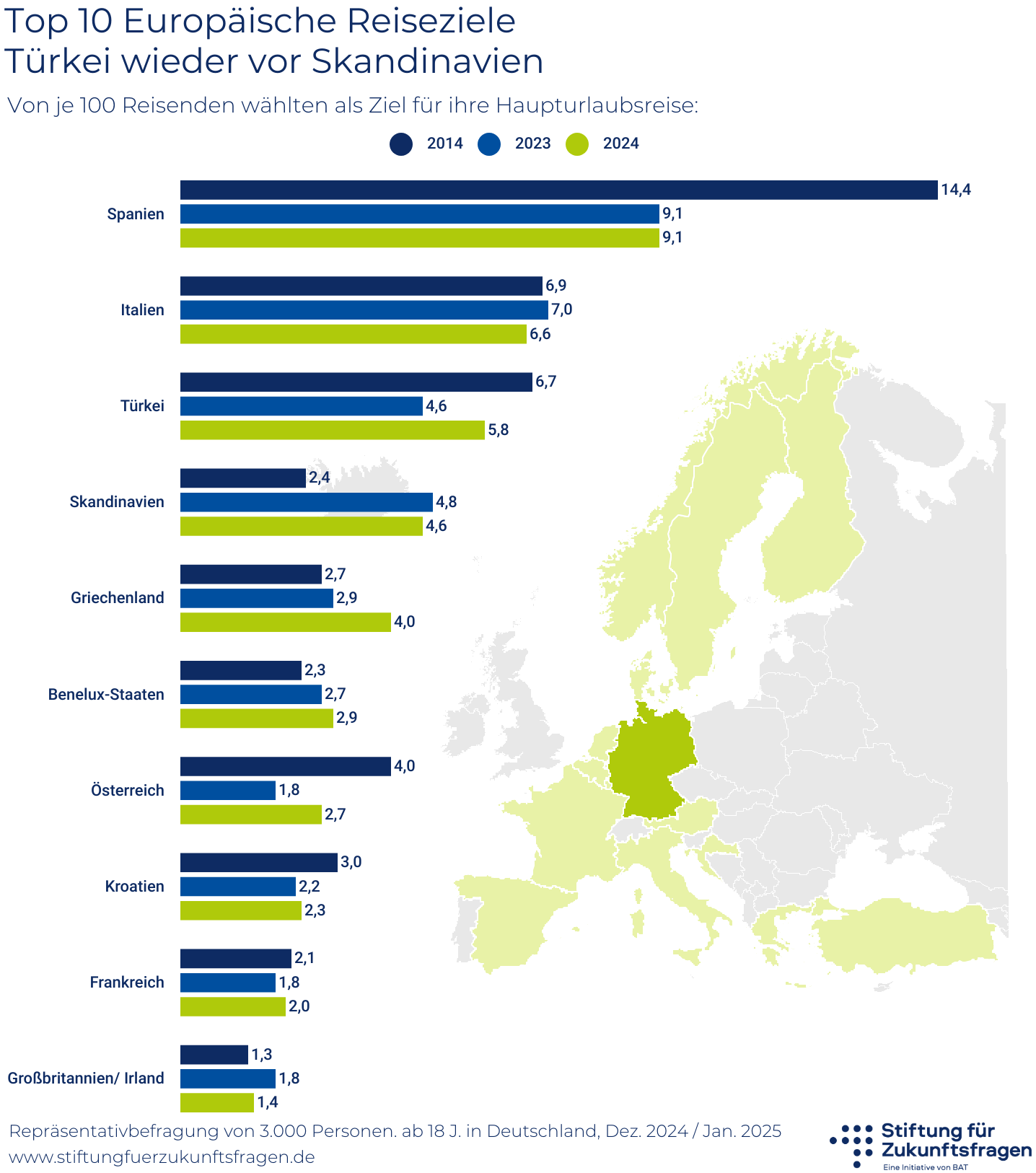
Out of every 100 travelers, the following destinations were chosen for their main holiday trip:
Data as table
| 2014 | 2023 | 2024 | |
|---|---|---|---|
| Spain | 14,4 | 9,1 | 9,1 |
| Italy | 6,9 | 7,0 | 6,6 |
| Turkey | 6,7 | 4,6 | 5,8 |
| Scandinavia | 2,4 | 4,8 | 4,6 |
| Greece | 2,7 | 2,9 | 4,0 |
| Benelux countries | 2,3 | 2,7 | 2,9 |
| Austria | 4,0 | 1,8 | 2,7 |
| Croatia | 3,0 | 2,2 | 2,3 |
| France | 2,1 | 1,8 | 2,0 |
| Great Britain/Ireland | 1,3 | 1,8 | 1,4 |
The picture is particularly dynamic in Turkey, where tourism demand is like a rollercoaster ride - albeit with a clear upward trend of late. Scandinavia was able to almost maintain the high level of the previous year and Greece recorded clear growth thanks to significantly lower daily costs, as did Austria.
These developments illustrate how strongly travel decisions are influenced by temporary factors such as price trends, geopolitical headlines, weather conditions and economic conditions.
Long-distance destinations
The popularity of long-haul destinations remained at a high level in 2024, with preferences shifting slightly within the regions.
Long-haul travel destinations year-on-year: Southeast Asia is booming
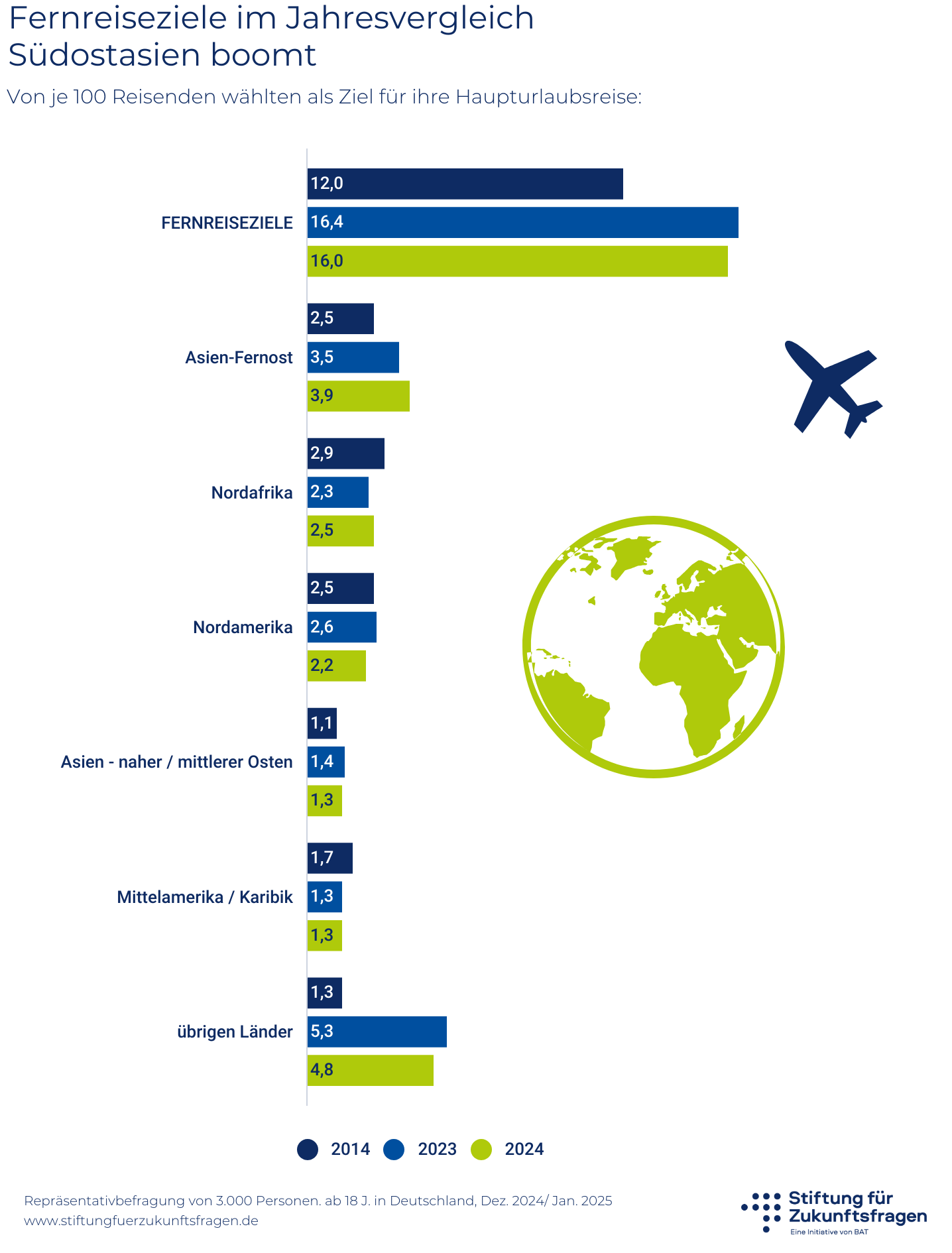
Out of every 100 travelers, the following destinations were chosen for their main holiday trip:
Data as table
| 2014 | 2023 | 2024 | |
|---|---|---|---|
| DISTANCE-FREE DESTINATIONS | 12,0 | 16,4 | 16,0 |
| Asia-Far East | 2,5 | 3,5 | 3,9 |
| North Africa | 2,9 | 2,3 | 2,5 |
| North America | 2,5 | 2,6 | 2,2 |
| Asia - Near/Middle East | 1,1 | 1,4 | 1,3 |
| Central America / Caribbean | 1,7 | 1,3 | 1,3 |
| other countries | 1,3 | 5,3 | 4,8 |
Travelling intentions
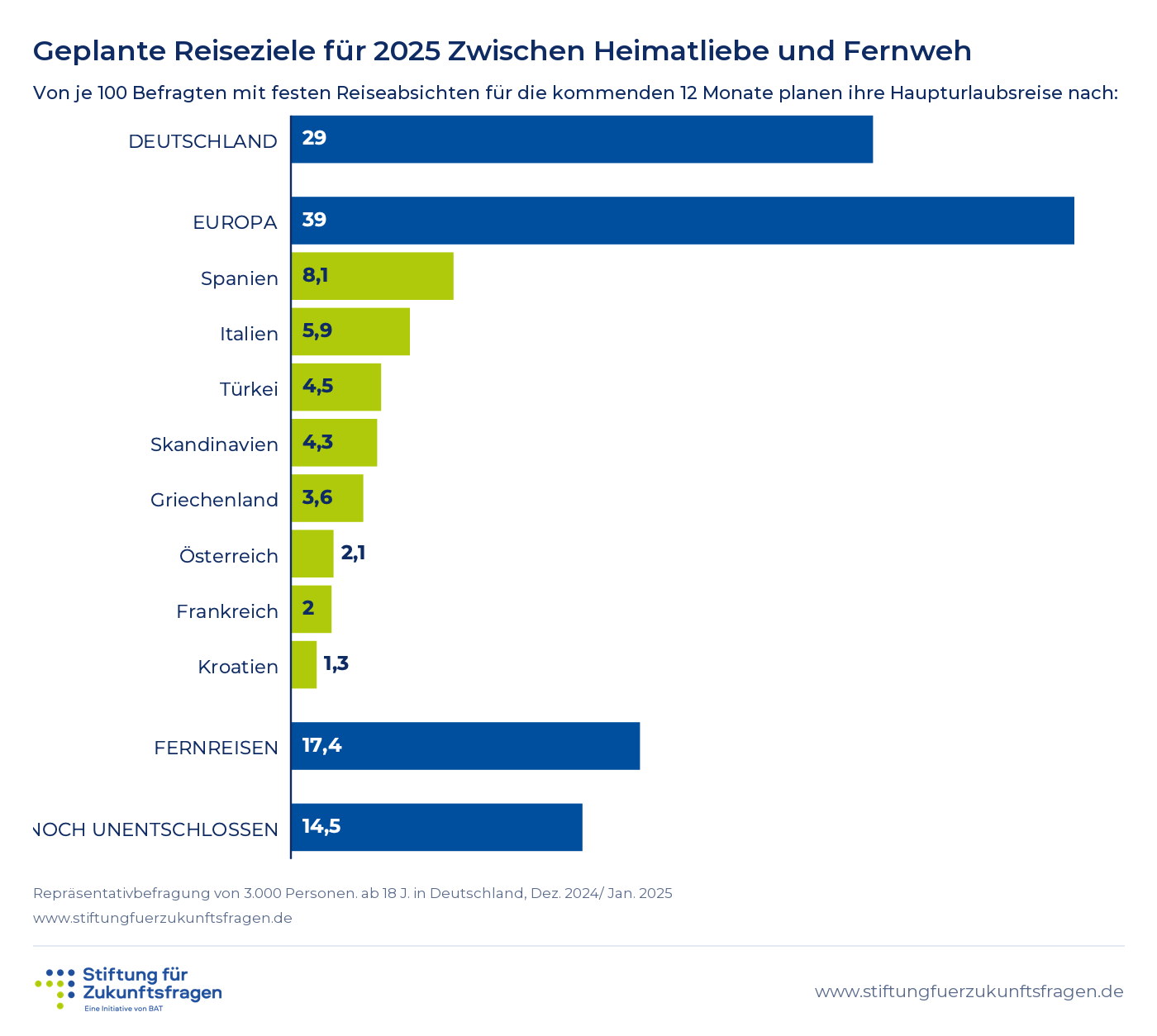
Despite global crises and uncertainties, the desire to travel among German citizens remains unbroken and Retains its fixed status in 2025 in everyday life. Two thirds of the population are already planning to take at least one trip this year. This corresponds to an increase of 20 per cent compared to 20 years ago. While the number of undecided travellers remains constant year-on-year, there is a clear decline in the long term, which indicates an increasing determination and prioritisation of travel.
Professor Reinhardt: "In 2025, travelling will still be seen by most Germans as an essential part of life. For them, holidays are not just about relaxation, but also a conscious break from stressful everyday life - an outlet in a time characterised by pessimism and negative headlines, as well as an expression of resilience and the need for normality."
Planned travel destinations for 2025: Between love of home and wanderlust
Of every 100 respondents with firm travel plans for the next 12 months, their main holiday trip is planned to:
Data as table
| GERMANY | 29,0 |
| EUROPE | 39,0 |
| Spain | 8,1 |
| Italy | 5,9 |
| Turkey | 4,5 |
| Scandinavia | 4,3 |
| Greece | 3,6 |
| Austria | 2,1 |
| France | 2,0 |
| Croatia | 1,3 |
| LONG-DISTANCE TRAVEL | 17,4 |
| STILL UNDECIDED | 14,5 |
Booking behaviour
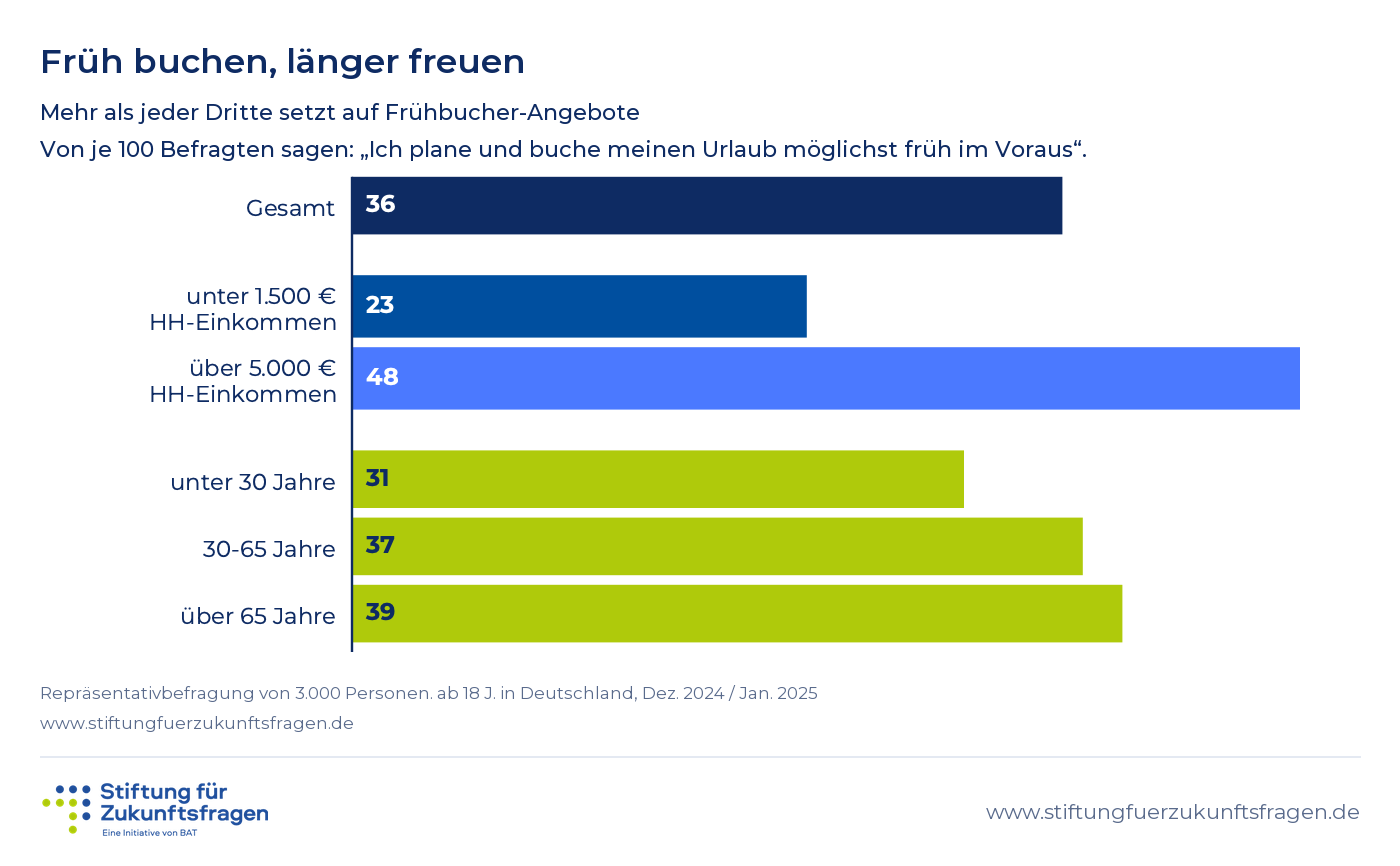
More than one in three people plan and book their holiday as early as possible. Reinhardt explains: "Early organisation not only allows better control over the travel arrangements, but also extends the period of anticipation. For many, planning is part of the holiday experience, as it raises expectations and makes it possible to experience the trip in your mind. In this way, relaxation doesn't just begin on site, but well in advance as a source of positive emotions."
Book early, enjoy longer
More than one in three people rely on early booking offers.
Out of every 100 respondents, one in 100 said: "I plan and book my vacation as far in advance as possible.".
Data as table
| 2025 | |
|---|---|
| Total | 36 |
| household income below €1,500 | 23 |
| household income over €5,000 | 48 |
| under 30 years | 31 |
| 30-65 years | 37 |
| over 65 years | 39 |
Method:
GfK survey institute | field time December 2024 / January 2025 | 3,000 respondents aged 18-74 years | online