
Global crises and conflicts, inflation and economic challenges, as well as climate change and rapidly advancing digitalisation - all of this is leading to growing uncertainty among the majority of citizens and is causing them to look to the coming twelve months with fear. These are the findings of a recent study by the BAT Foundation for Future Studies, which surveyed a representative sample of over 2,000 people aged 18 and over.
Scepticism towards tomorrow doubles in 10-year comparison
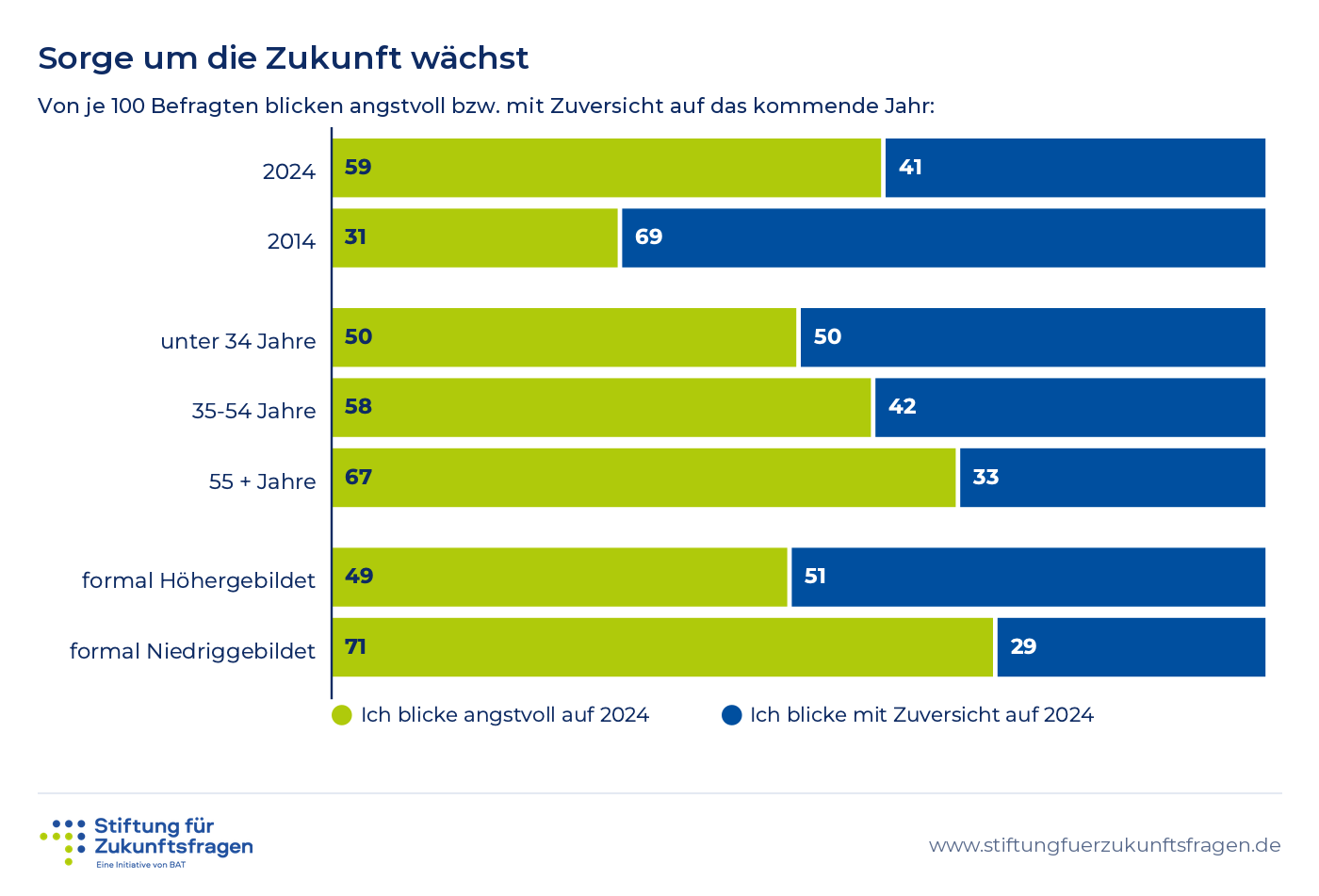
Within the population, worries increase with age. For example, every second person under the age of 34 is anxious about the year 2024, while more than two thirds of those over 55 are already worried. There are also major differences in the level of education. A slight majority of those with a higher level of formal education are hopeful about the future, compared to just 29 per cent of those with a lower level of formal education.
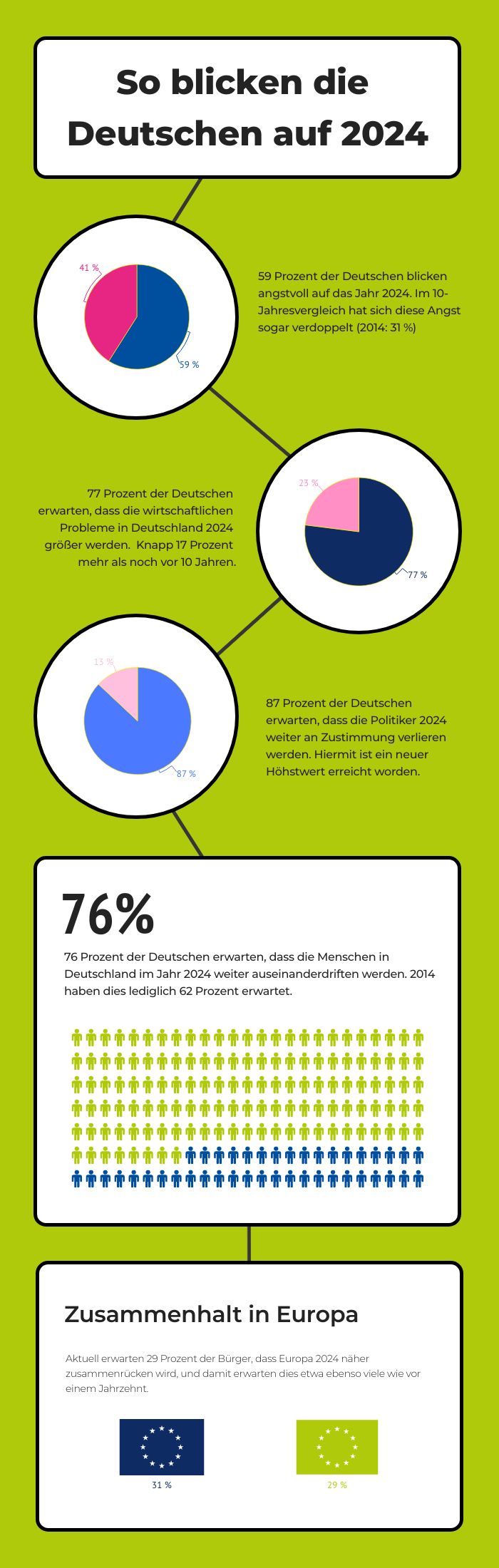
Growing concern about the future
Out of every 100 respondents, one looks to the coming year with fear and the other with confidence:
Data as table
| I look forward to 2024 with trepidation. | I look forward to 2024 with confidence. | |
|---|---|---|
| 2024 | 59 | 41 |
| 2014 | 31 | 69 |
| under 34 years | 50 | 50 |
| 35-54 years | 58 | 42 |
| 55+ years | 67 | 33 |
| formally highly educated | 49 | 51 |
| formally low-educated | 71 | 29 |
Fear of the economic downturn is great
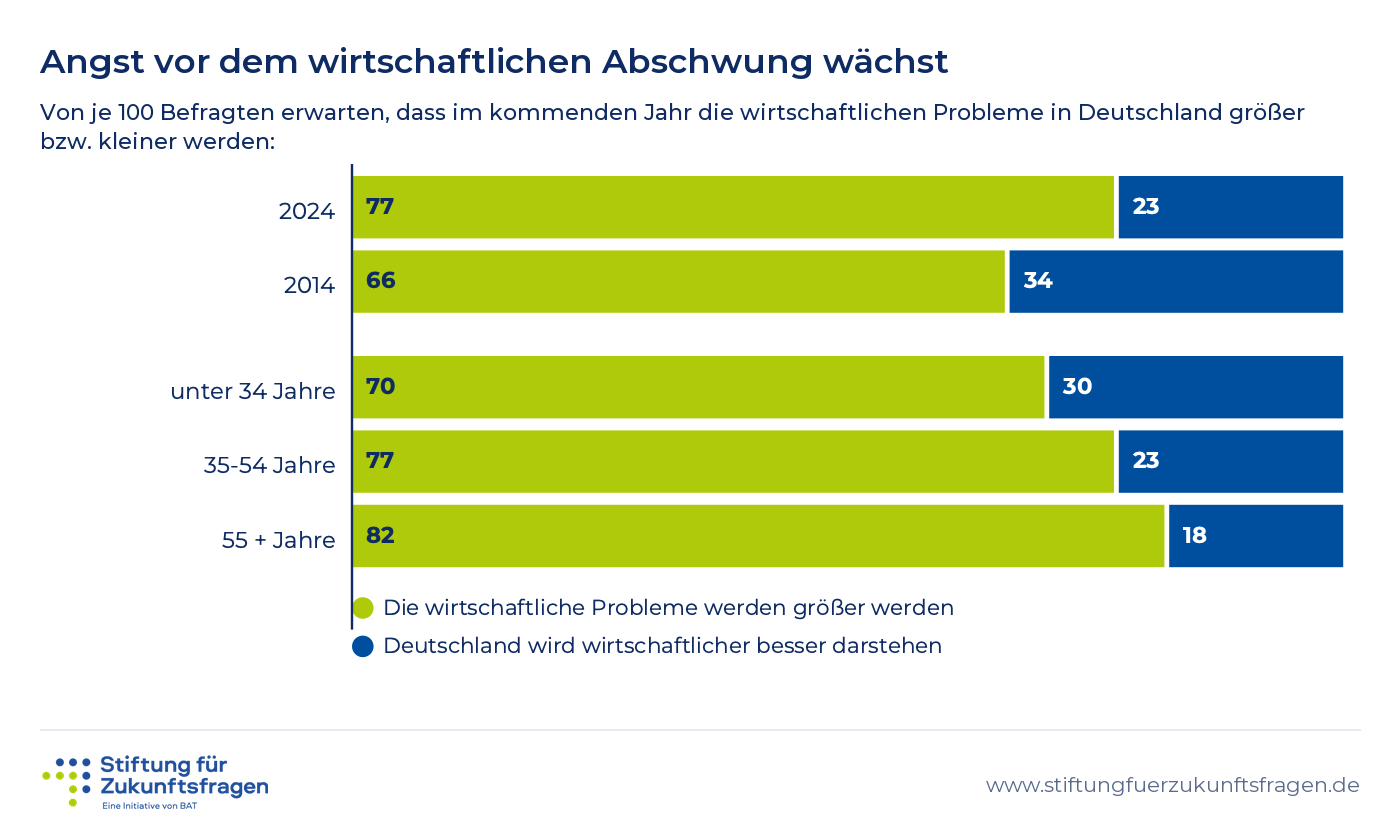
The vast majority also have a negative view of the development of economic output in Germany. Whereas in 2014, one in three still expected the economy to grow, this figure has now fallen to one in four.
For Professor Dr Ulrich Reinhardt, the Foundation's Scientific Director, the reasons for this are complex: "Rising energy costs are not only putting a strain on household budgets, but are also increasing the pressure on companies. Added to this is a shortage of skilled labour that affects almost every industry. Unresolved trade conflicts and the increasing focus of many countries on national issues are also putting pressure on the export-orientated German economy. The reports on all these challenges are shaping people's views and making them look to the economy of tomorrow with concern.
Fears of an economic downturn are growing.
Of every 100 respondents, one expects the economic problems in Germany to worsen or decrease in the coming year:
Data as table
| The economic problems will worsen. | Germany will be in a better economic position. | |
|---|---|---|
| 2024 | 77 | 23 |
| 2014 | 66 | 34 |
| under 34 years | 70 | 30 |
| 35-54 years | 77 | 23 |
| 55+ years | 82 | 18 |
Disenchantment with politics reaches historic high
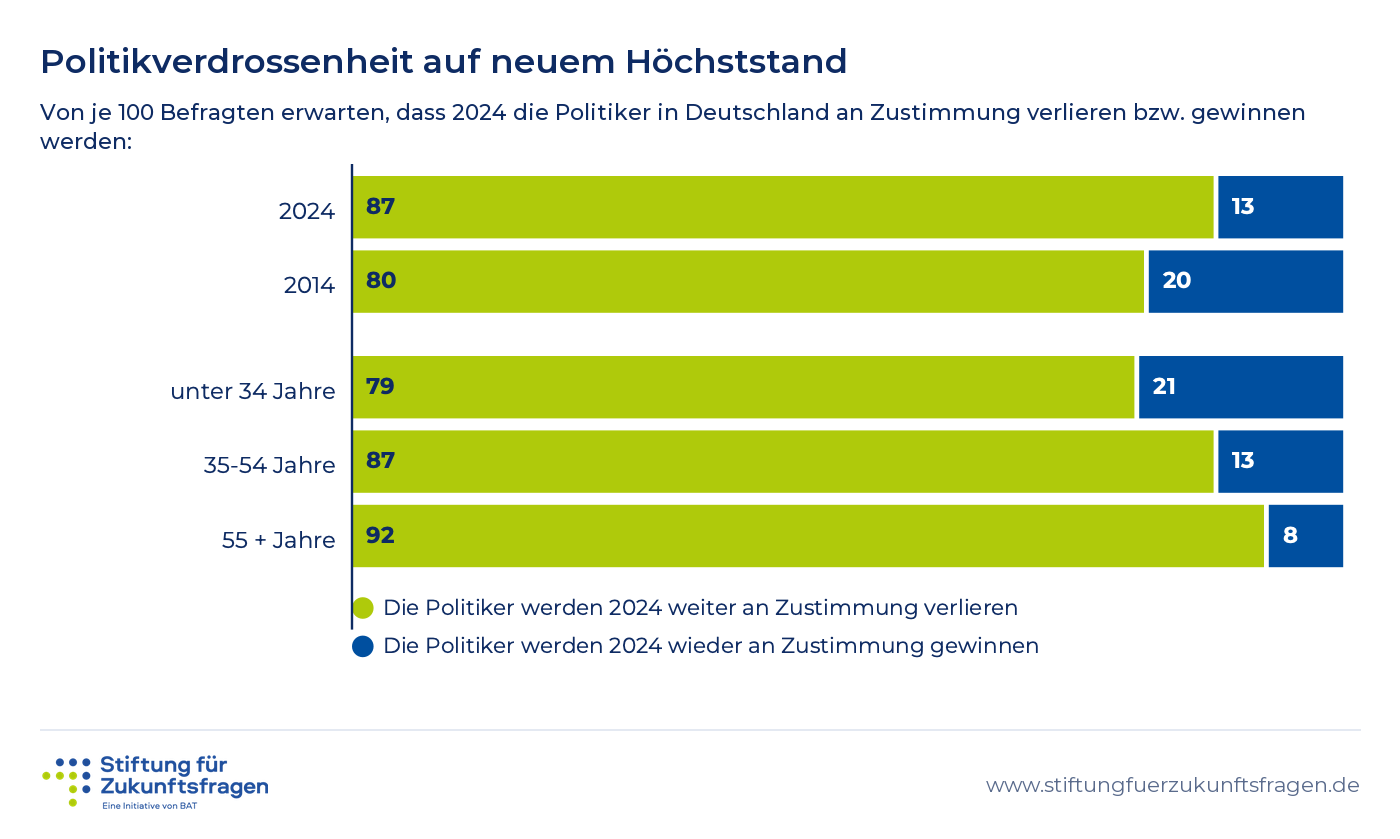
Almost nine out of ten German citizens perceive a profound alienation of the population from political representatives. They expect that politicians will receive hardly any support and that more and more citizens will turn away in disillusionment. Older voters in particular hardly believe that they will gain approval.
Political disillusionment at a new high
Of every 100 respondents, one expects politicians in Germany to lose or gain approval in 2024:
Data as table
| Politicians will continue to lose approval ratings in 2024. | Politicians will regain popularity in 2024. | |
|---|---|---|
| 2024 | 87 | 13 |
| 2014 | 80 | 20 |
| under 34 years | 79 | 21 |
| 35-54 years | 87 | 13 |
| 55+ years | 92 | 8 |
There are many reasons for the loss of trust
Many politicians are accused of lacking competence and transparency and are said to lack effective solutions to pressing problems. Another important factor is the increasing polarisation in the political debate, which is eroding trust in the political system. The conviction that political decision-makers serve party political interests rather than the common good increases the alienation of many citizens from politics. Reinhardt: "The persistent scepticism towards the political class is a key challenge for the future that must be overcome in order to restore citizens' trust in political institutions and find common solutions to the existing challenges. If this does not happen, there is a risk of further radicalisation, which will ultimately endanger democracy.
More cohesion expected in Europe than in Germany
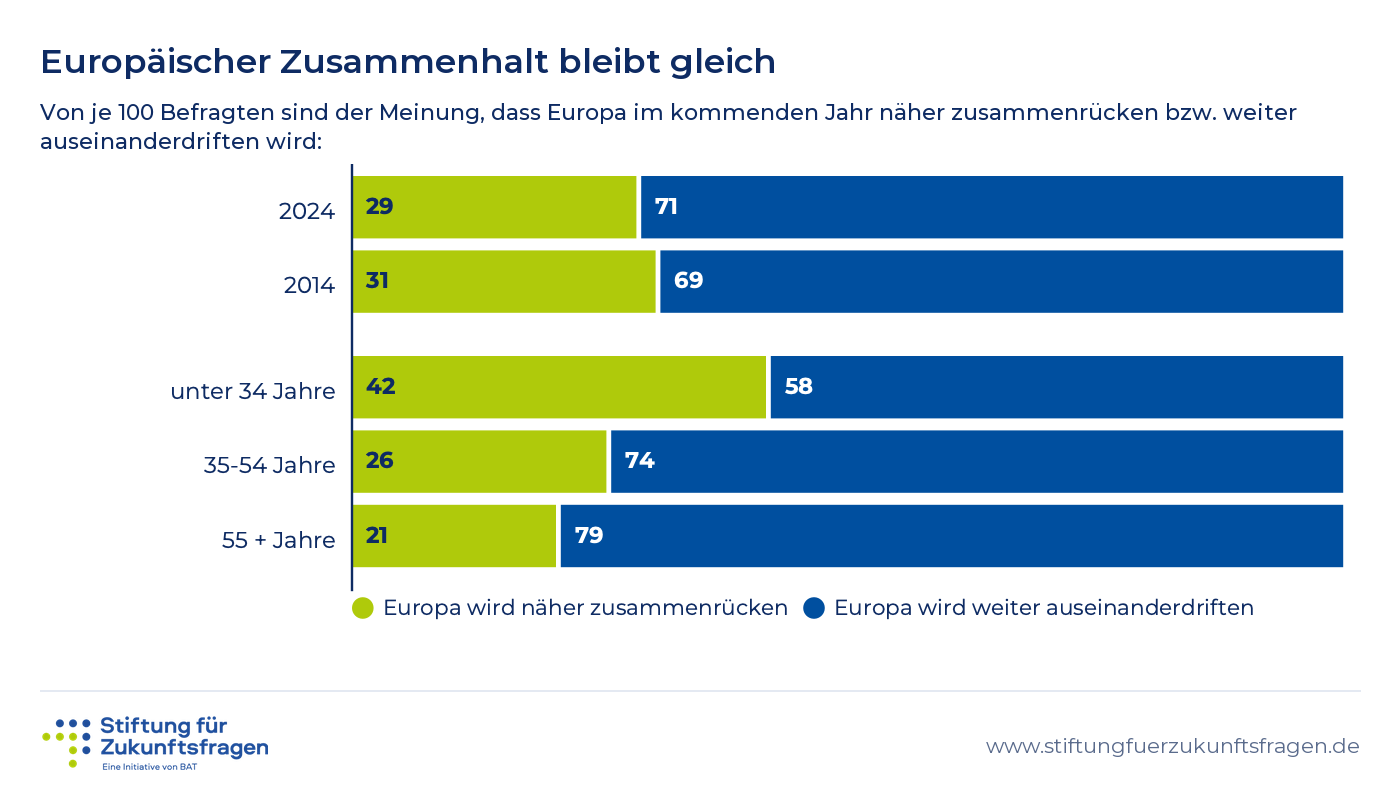
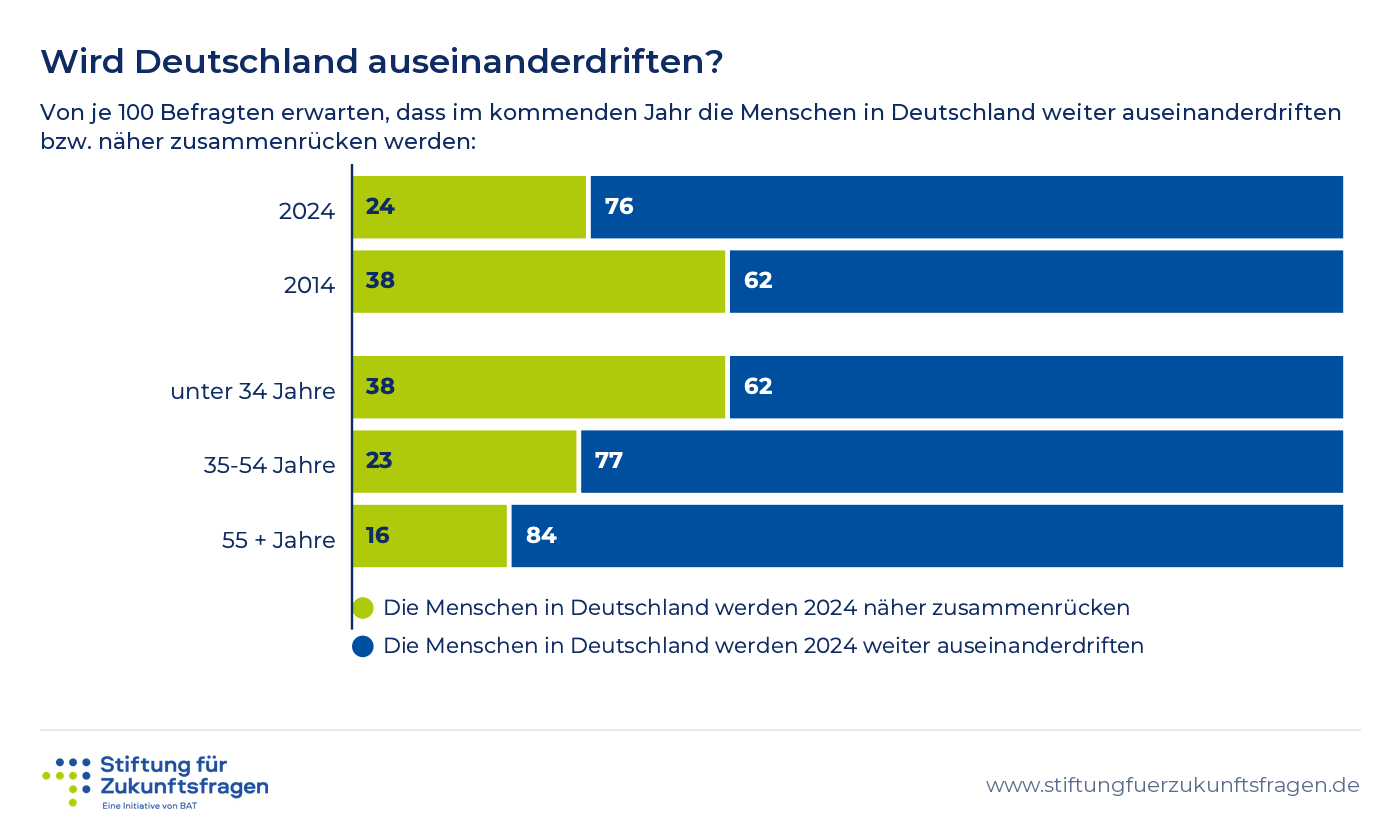
Currently, 29 per cent of citizens expect Europe to move closer together, the same proportion as a decade ago. In contrast, more than three quarters of the population believe that Germany will drift further apart, which is significantly more than ten years ago.
Between the different age groups, the positive expectation of closer co-operation is roughly twice as high among the younger generation as among the over 55s. The generally more confident attitude of the under-34s shows that some of them have a very different view of social development in Germany and Europe.
For Reinhardt, this goes hand in hand with questions about the values, priorities and expectations of the various age groups, as the answers clearly show how multi-layered society's perspective on the coming years is. "It remains to be seen how these different views will affect political decisions in the coming years, and thus the shaping of the future."
European unity remains unchanged
Of the 100 respondents surveyed, one believes that Europe will either grow closer together or drift further apart in the coming year:
Data as table
| Europe will grow closer together | Europe will continue to drift apart. | |
|---|---|---|
| 2024 | 29 | 71 |
| 2014 | 31 | 69 |
| under 34 years | 42 | 58 |
| 35-54 years | 26 | 74 |
| 55+ years | 21 | 79 |
Will Germany drift apart?
Of every 100 respondents, one expects that people in Germany will drift further apart or move closer together in the coming year:
Data as table
| People in Germany will grow closer together in 2024. | The people in Germany will drift further apart in 2024. | |
|---|---|---|
| 2024 | 24 | 76 |
| 2014 | 38 | 62 |
| under 34 years | 38 | 62 |
| 35-54 years | 23 | 77 |
| 55+ years | 16 | 84 |