
The coronavirus pandemic still has Germany firmly in its grip. And even for 2021, few Germans expect a noticeable improvement. More than anything else, Germans miss personal contact with family, friends and neighbours.
This is the conclusion of the latest study by the non-profit BAT Foundation for Future Studies, for which a representative sample of 3,000 German citizens were asked about their assessments and behaviour in times of coronavirus.
Restrictions also expected in 2021
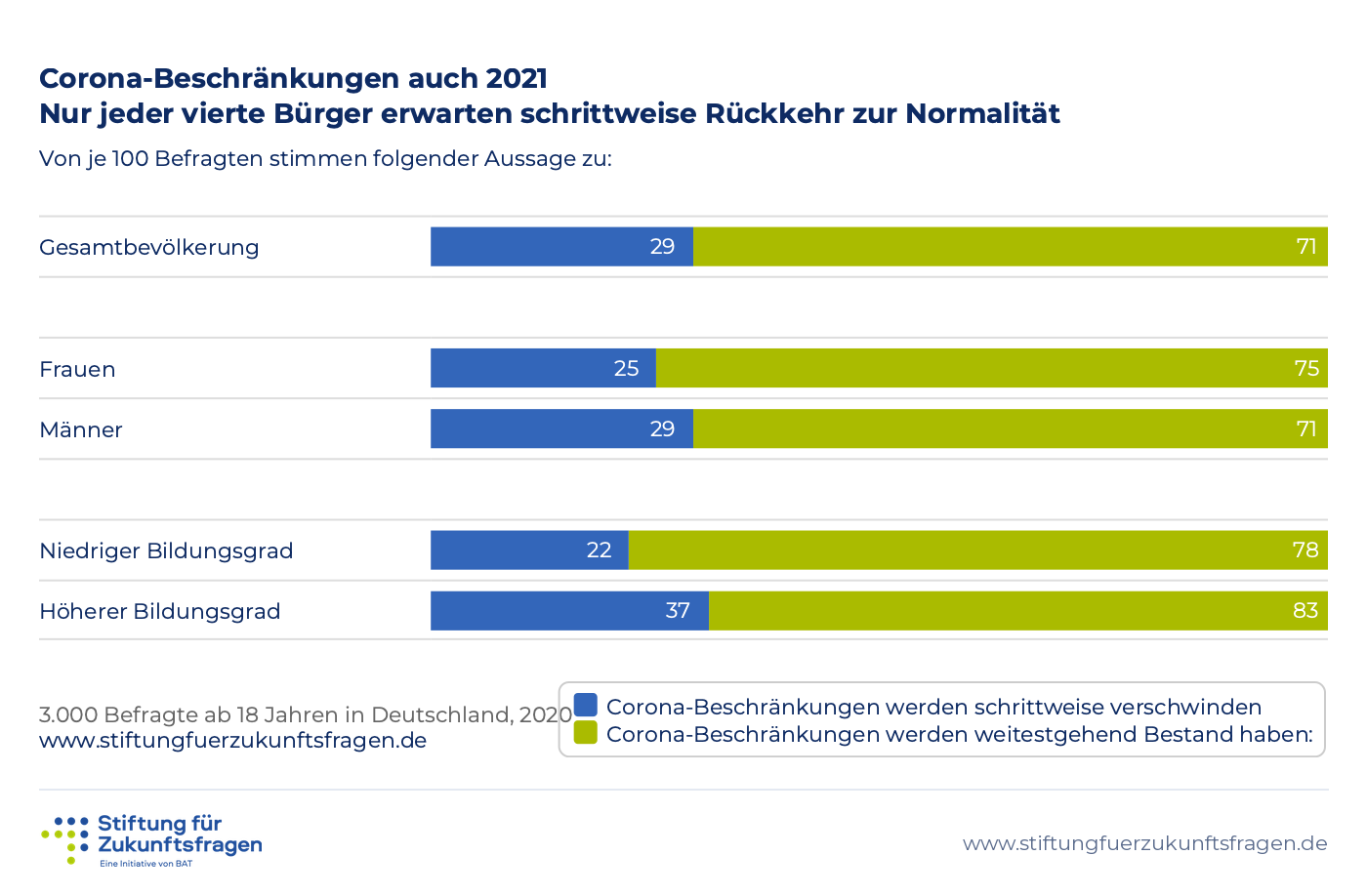
Numerous companies around the world are researching a vaccine against the virus. Despite promising reports, the vast majority of Germans do not believe that the current containment measures will end any time soon. On the contrary, 71 per cent expect restrictions similar to those currently in place next year.
Within the population, only those with a higher formal education are somewhat more optimistic and expect a gradual abolition, e.g. of the mask requirement and contact restrictions.
Data as table
| Corona restrictions will gradually disappear | Corona restrictions will largely remain in place: | |
|---|---|---|
| Total population | 29 | 71 |
| Women | 25 | 75 |
| Men | 29 | 71 |
| Low level of education | 22 | 78 |
| Higher level of education | 37 | 63 |
Longing for meetings and appointments
People in Germany currently miss socialising with family and friends the most. For around half of the population, contact restrictions are the greatest deprivation in recent months.
The Scientific Director of the Foundation, Professor Dr Ulrich Reinhardt, summarises the results as follows:
„Most people recognise the necessity of the restrictions and are sticking to the rules. At the same time, there is a great longing to see relatives and friends again. In this double emergency situation, many citizens are acting pragmatically and switching to digital forms of communication.“
And it made Zoom - digital instead of real contact
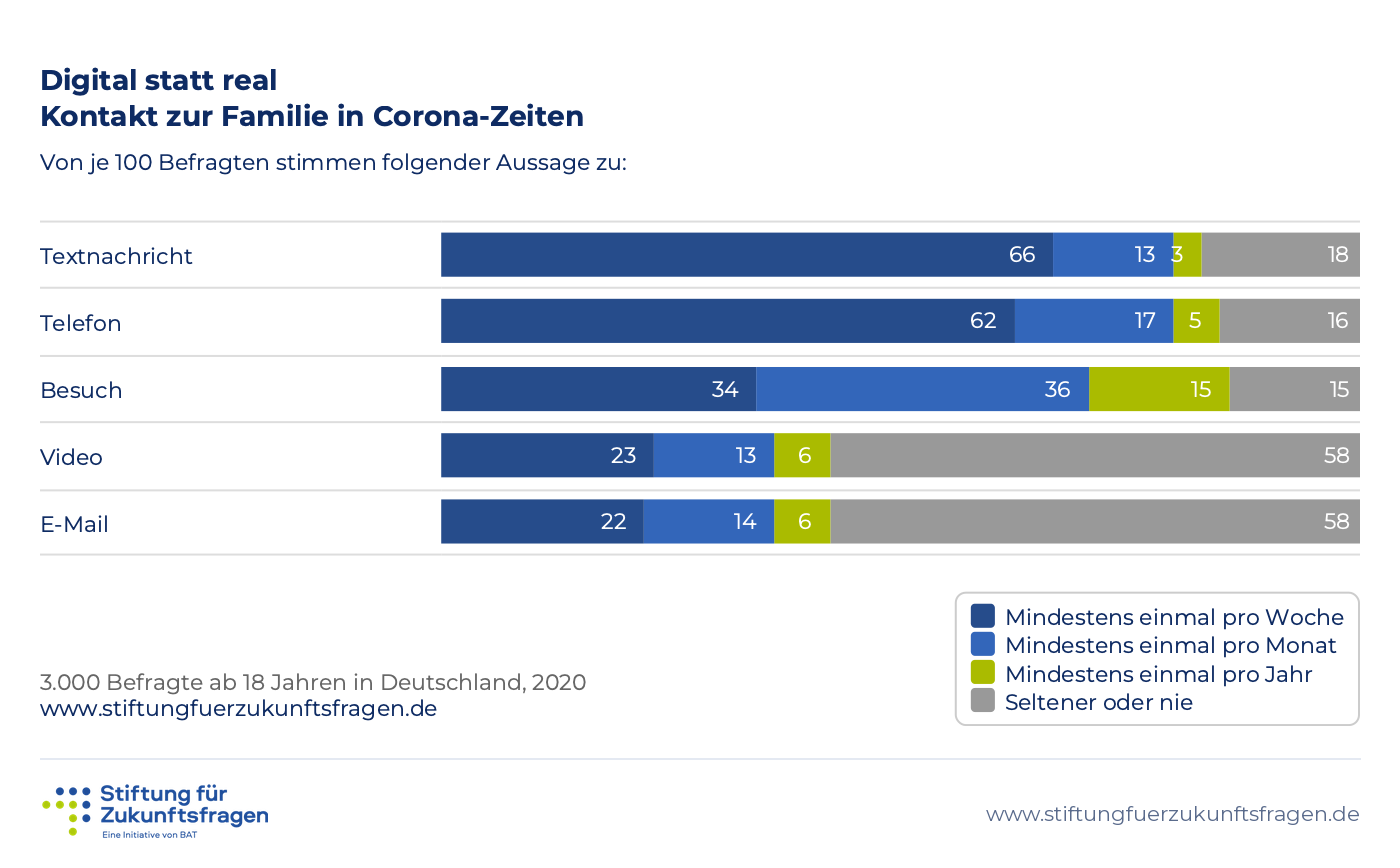
Text messages via WhatsApp, Facebook, Signal or another messaging service are currently the most common form of communication between family members. Two thirds of the population use this form of communication at least once a week. The telephone is similarly popular, although it is mainly used by older Germans. Despite limited opportunities, one in three people still meet in person. Communication via video telephony is also becoming increasingly popular. Almost one in four people now use it at least once a week.
„Video telephony is increasingly becoming a common exchange platform. While younger people particularly emphasise the simplicity of it, older people appreciate suddenly having even more contact with their children and grandchildren than before the outbreak of the pandemic thanks to Zoom, Skype and the like. However, it remains to be seen whether this type of communication will develop into a permanent alternative or remain more of a supplement“says Reinhardt.
Data as table
| At least once a week | At least once a month | At least once a year | Rarely or never | |
|---|---|---|---|---|
| Text message | 66 | 13 | 3 | 18 |
| phone | 62 | 17 | 5 | 16 |
| Visit | 34 | 36 | 15 | 15 |
| video | 23 | 13 | 6 | 58 |
| 22 | 14 | 6 | 58 |
Family is and remains the most important thing
Family is and remains the most important thing - the vast majority of Germans agree with this statement. As a result of the first and now second lockdown and the resulting closeness to family, more and more Germans actually feel more connected to their family. One in two Germans even say that they have only (re)discovered the value of family as a result of the coronavirus pandemic.
Contrary to popular opinion, the family is not a model that is on its way out. On the contrary, a renaissance of the family is clearly on the horizon. Especially in uncertain times, the family is proving to be a reliable anchor point and the most important thing in the lives of many people.